Categories
Career Can D0

The Trailblazer Woman Effect with Elle Ballard

What does it really mean to be a trailblazer? Elle Ballard, founder of Women of the World Network, joins Mary Ann Faremouth on this episode of Career Can Do to share how women from across the globe are coming together to support, uplift, and grow – together.

Elle is hosting a special event on October 18th in Houston called Trailblazer Woman, designed to celebrate women who pursue their passions with courage and resilience. She explains how the WOW community has created a space for women to gain visibility, build lasting relationships, and share lessons from their journeys in life and business. “We can grow together faster,” Elle says, “if we have that circle that we can come to, that we can share, that we can just be in.”

Mary Ann shares her own experience with WOW, including how contributing to the group’s collaborative books helped her land new opportunities and expand her reach. From speaking engagements and podcast features to powerful new friendships, WOW has helped her – and many others – step into their full potential.

The upcoming event will feature speakers from diverse backgrounds, dancing, networking, and time for reflection as we begin to look toward the year ahead. Elle encourages women to come ready to connect, learn, and be inspired.

Two things you’ll walk away with? New relationships that can grow into something meaningful—and fresh ideas to carry you into 2025 with clarity and confidence.

Resources

Trailblazer Woman Event in Houston – 18th of October

Elle Ballard on LinkedIn

Mary Ann Faremouth on the Web | X (Twitter)

Categories
Data Driven Compliance

Data Driven Compliance – Understanding the ECCTA and Its Impact on Fraud Prevention with Vince Walden

Welcome to Season 2 of the award-winning Data Driven Compliance. In this new season, we will look at the new Failure to Prevent Fraud offense. Join host Tom Fox as we explore this new law and how to comply with it through the lens of data driven compliance. This podcast is sponsored by konaAI. In this episode of Season 2, Tom Fox is joined by Vince Walden, CEO of konaAI.

In this episode, they take a deep dive into the details of the UK Economic Corporate Crime Transparency Act, specifically the ‘Failure to Prevent Fraud’ offense. Walden, bringing the perspective of a fraud examiner and CPA, discusses the types of fraud covered under the new law and its broad scope, affecting not just UK companies but also US subsidiaries of UK companies. Walden emphasizes the importance of fraud prevention compliance programs and outlines how effective data analytics and risk assessments can help companies prevent fraud. He also explores the integration of advanced technologies like AI in building robust fraud detection mechanisms. The conversation highlights that effective compliance leads to better business processes and profitability.

Key highlights:

  • Understanding Fraud Offenses Under the Act
  • The Broad Scope of the Act
  • Importance of Compliance Programs
  • Data Analytics in Fraud Risk Management
  • Future of Fraud Detection with AI

Resources:

Vince Walden on LinkedIn

konaAI, a Covasant company

Click here for konaAI White Paper Rethinking Compliance: Practical Steps for Adapting to the UK’s New Fraud Legislation

Connect with Tom Fox on LinkedIn

Categories
From the Editor's Desk

From the Editor’s Desk – Compliance Week’s Insights and Reflections from July to August 2025

In this episode of From the Editor’s Desk, co-hosts Tom Fox and Ian Sherr dive into key compliance stories from July, including differences in AI regulation between the U.S., EU, and UK, and shifts in regulatory approaches globally. They discuss notable cases, such as the DOJ’s $14 billion healthcare fraud prosecution tied to transnational crime, and T-Mobile’s acquisition of US Cellular amidst DEI program cuts. Upcoming initiatives in Compliance Week are also highlighted, including in-depth industry coverage and data-driven stories to aid compliance professionals in their roles. The episode concludes with insights into the recent acquisition of ECI by Compliance Week’s parent company, Verdian Insights, which aims to enhance resources available to the compliance community.

Highlights include:

  • Highlighting Key Stories from Compliance Week in July
  • Emerging Patterns in Compliance
  • Tariffs and Their Impact
  • SEC Whistleblower Claims Analysis
  • Upcoming Features and Data Stories
  • ECI Acquisition by Verdian Insights and Its Impact

Resources:

Ian Sherr on LinkedIn

Compliance Week

Categories
Fox on Podcasting

Fox on Podcasting – Podpage and Beyond: Elevating Listener Experience with Dave Jackson

Join Tom Fox as he explores the world of podcasting, and get ready to be inspired to start your own podcast. In this episode, Tom welcomes Dave Jackson, a podcasting veteran and educator. Dave Jackson is the head of podcasting at Podpage and the founder of the School of Podcasting. He is also an author and a member of the Podcast Hall of Fame.

Join Tom Fox as he welcomes Dave Jackson, a podcasting pioneer, to discuss the evolution of podcasting from its early days to the present. Dave shares his journey from chiseling podcasts out of stone to becoming a key figure at Podpage, a platform that enhances the listener experience. With insights into monetization, community building, and maintaining integrity, this episode is a must-listen for aspiring podcasters.

Key highlights:

  • The Evolution of Podcasting
  • Monetizing Podcasts
  • Building a Podcast Community
  • Ethics and Integrity in Podcasting
  • Overcoming Fear in Podcasting
  • Garth Brooks and Self-Doubt
  • Podcasting Insights and Recommendations

We’d love to hear your thoughts on this episode! Leave a comment, share your feedback, and don’t forget to like and follow for more insightful discussions.

Resources:

Dave Jackson on LinkedIn

Podpage

Artwork

Elaine Capers

Art by Elaine

Tom

Instagram

Facebook

YouTube

Twitter

LinkedIn

Categories
Compliance Tip of the Day

Compliance Tip of the Day – AI, Whistleblowing and a Culture of Speak Up

Welcome to “Compliance Tip of the Day,” the podcast where we bring you daily insights and practical advice on navigating the ever-evolving landscape of compliance and regulatory requirements. Whether you’re a seasoned compliance professional or just starting your journey, we aim to provide you with bite-sized, actionable tips to help you stay on top of your compliance game. Join us as we explore the latest industry trends, share best practices, and demystify complex compliance issues to keep your organization on the right side of the law. Tune in daily for your dose of compliance wisdom, and let’s make compliance a little less daunting, one tip at a time.

How can AI enhance your whistleblower program, improve your culture of Speak Up, and crowdsource intelligence from your employees?

For more on this topic, check out The Compliance Handbook, a Guide to Operationalizing Your Compliance Program, 6th edition, which LexisNexis recently released. It is available here.

Categories
Daily Compliance News

Daily Compliance News: August 1, 2025, The All AI Edition

Welcome to the Daily Compliance News. Each day, Tom Fox, the Voice of Compliance, brings you compliance-related stories to start your day. Sit back, enjoy a cup of morning coffee, and listen in to the Daily Compliance News. All, from the Compliance Podcast Network. Each day, we consider four stories from the business world, compliance, ethics, risk management, leadership, or general interest for the compliance professional.

Top stories include:

  • Big tech is revising AI claims on its products. (WSJ)
  • Meta and Microsoft soar on AI spending. (NYT)
  • China looks at Nvidia AI chip security. (WSJ)
  • The AI governance divide is splitting the world. (AI Business)

You can donate to flood relief for victims of the Kerr County flooding by going to the Hill Country Flood Relief here.

Categories
Trekking Through Compliance

Trekking Through Compliance: Episode 61 – Unity on the Final Frontier: Cross-Cultural Compliance Insights from ‘Day of the Dove’

Modern compliance officers grapple with complexities arising from international business relationships, mergers, acquisitions, and partnerships, navigating disparate cultural expectations and norms. Star Trek TOS, especially the episode “Day of the Dove,” provides a surprisingly rich source of compliance insights into these challenges. In a globalized business environment, compliance professionals frequently encounter situations analogous to the manipulated hostilities between the Federation and Klingons. Misunderstandings, mistrust, and cross-cultural miscommunication can escalate tensions, threaten corporate integrity, and hinder operations. Let’s distill five critical compliance lessons from “Day of the Dove,” offering practical guidance to the compliance professional for cross-cultural scenarios.

Lesson 1: Recognize and Neutralize Bias and Stereotyping

Illustrated By: Early in the episode, the Enterprise crew and the Klingons instantly regard each other with suspicion and prejudice.

Compliance Lesson: For compliance officers, understanding and addressing implicit biases is crucial. Like the Enterprise crew, professionals often enter new markets or partnerships with preconceived ideas about cultural expectations, risk tolerance, or ethical behaviors. Such biases may cloud objective judgment and inadvertently fuel tension or compliance failures.

Lesson 2: Question Motives and Uncover Root Causes

Illustrated By: When Kirk realizes the ongoing conflict is unnatural, he questions its cause, eventually uncovering the entity exploiting their anger.

In compliance, cross-cultural misunderstandings often have deeper root causes than the surface-level tension suggests. Misaligned incentives, conflicting internal controls, and divergent perceptions of risk can escalate minor disagreements into full-blown compliance crises.

Lesson 3: Collaboration and Common Goals Overcome Conflict

Illustrated By: Ultimately, Kirk and Commander Kang set aside their rivalry, jointly recognizing their mutual enemy as the manipulative entity.

Compliance Lesson: Cross-cultural compliance similarly requires organizations to align clearly defined common objectives, shared values, and mutual benefit. Whether responding to anti-corruption regulations like the FCPA, managing third-party due diligence, or harmonizing diverse internal standards, clear communication and shared goals serve as the foundation for collaboration.

Lesson 4: Communication and Transparency are Critical

Illustrated By: Misunderstandings abound initially due to poor communication between the Klingons and the Federation.

Compliance Lesson: Compliance challenges arising from cross-cultural scenarios frequently result from misunderstandings or assumptions due to poor transparency or communication. Language barriers, culturally distinct reporting methods, and differing standards of directness or openness can lead to confusion and non-compliance.

Lesson 5: Leadership Sets the Tone and Culture

Illustrated By: Both Kirk and Kang exhibit strong leadership by openly demonstrating the willingness to reconsider their positions and lead their crews in jointly rejecting the entity’s divisive influence.

Compliance Lesson: Compliance leadership must similarly set the tone and demonstrate cultural competence. Leaders who visibly prioritize integrity, open dialogue, and mutual respect set a powerful compliance culture example. Cross-cultural scenarios particularly require compliance leaders to demonstrate humility, openness, and willingness to learn and adjust behaviors.

Final ComplianceLog Reflections

The global nature of today’s business operations makes cross-cultural competency not merely a nice-to-have, but an essential compliance skill set. “Day of the Dove,” through its compelling narrative and insightful conflict resolution, mirrors real-world compliance scenarios faced by international organizations.

By integrating these timeless lessons from “Day of the Dove,” compliance professionals are better equipped to navigate complex cross-cultural challenges, transforming potential conflicts into opportunities for collaboration, understanding, and compliance excellence.

Resources:

⁠⁠Excruciatingly Detailed Plot Summary by Eric W. Weisstein⁠⁠

⁠⁠MissionLogPodcast.com⁠⁠

⁠⁠Memory Alpha

Categories
Blog

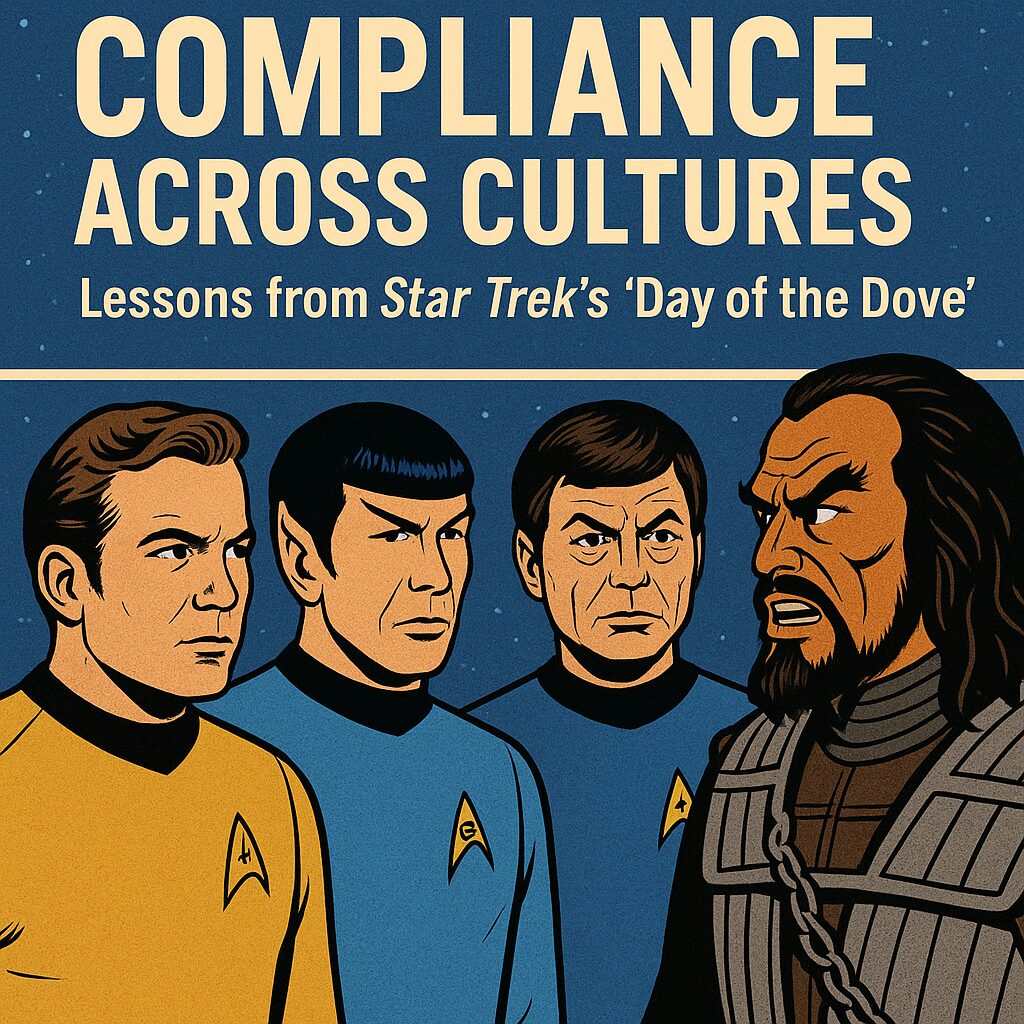
Compliance Across Cultures: Lessons from Star Trek’s “Day of the Dove”

In the dynamic and continually evolving landscape of corporate compliance, one recurring theme is the necessity of cross-cultural understanding and collaboration. Modern compliance officers grapple with complexities arising from international business relationships, mergers, acquisitions, and partnerships, navigating disparate cultural expectations and norms. Star Trek TOS, especially the episode “Day of the Dove,” provides a surprisingly rich source of compliance insights into these challenges. As we revisit this classic, let’s examine what Captain Kirk and his crew can teach today’s compliance professional about managing cross-cultural compliance risks effectively.

The episode sees the USS Enterprise encountering a mysterious entity that thrives on conflict and hatred. After coming across Klingon survivors led by Commander Kang, Kirk’s crew and the Klingons are manipulated into perpetual conflict aboard the Enterprise. Both sides soon realize that the entity is using their hatred to feed and grow stronger. Ultimately, they unite to reject the divisiveness that feeds the entity, ending the conflict and regaining control of the Enterprise.

In a globalized business environment, compliance professionals frequently encounter situations analogous to the manipulated hostilities between the Federation and Klingons. Misunderstandings, mistrust, and cross-cultural miscommunication can escalate tensions, threaten corporate integrity, and hinder operations. Let’s distill five critical compliance lessons from “Day of the Dove,” offering practical guidance to the compliance professional for cross-cultural scenarios.

Lesson 1: Recognize and Neutralize Bias and Stereotyping

Illustrated By: Early in the episode, the Enterprise crew and the Klingons instantly regard each other with suspicion and prejudice. Their preconceived notions drive initial hostility, fueled by longstanding animosity and stereotypes.

Compliance Lesson: For compliance officers, understanding and addressing implicit biases is crucial. Like the Enterprise crew, professionals often enter new markets or partnerships with preconceived ideas about cultural expectations, risk tolerance, or ethical behaviors. Such biases may cloud objective judgment and inadvertently fuel tension or compliance failures.

To prevent this, organizations must implement targeted compliance training that explicitly addresses biases and promotes empathy and cultural intelligence. Awareness and sensitivity training programs can assist staff in challenging assumptions, mitigating prejudices, and fostering constructive dialogues, much like Kirk’s eventual acknowledgment of shared misunderstandings.

Lesson 2: Question Motives and Uncover Root Causes

Illustrated By: When Kirk realizes the ongoing conflict is unnatural, he questions its cause, eventually uncovering the entity exploiting their anger. This epiphany sets the stage for collaboration and resolution.

In compliance, cross-cultural misunderstandings often have deeper root causes than the surface-level tension suggests. Misaligned incentives, conflicting internal controls, and divergent perceptions of risk can escalate minor disagreements into full-blown compliance crises.

Conducting effective root-cause analyses, guided by robust investigative frameworks as recommended by regulatory bodies like the DOJ and the 2024 ECCP, can uncover the underlying issues fueling compliance challenges. This diagnostic approach not only mitigates immediate issues but also promotes long-term resilience and cultural cohesion.

Lesson 3: Collaboration and Common Goals Overcome Conflict

Illustrated By: Ultimately, Kirk and Commander Kang set aside their rivalry, jointly recognizing their mutual enemy as the manipulative entity. By focusing on a shared goal, they regain their agency and restore harmony aboard the Enterprise.

Compliance Lesson: Cross-cultural compliance similarly requires organizations to align clearly defined common objectives, shared values, and mutual benefit. Whether responding to anti-corruption regulations like the FCPA, managing third-party due diligence, or harmonizing diverse internal standards, clear communication and shared goals serve as the foundation for collaboration.

Compliance leaders must foster environments where culturally diverse teams understand and internalize collective compliance objectives. Creating alignment workshops, compliance vision statements, and shared metrics are effective strategies to build unity and proactive cooperation among global stakeholders.

Lesson 4: Communication and Transparency are Critical

Illustrated By: Misunderstandings abound initially due to poor communication between the Klingons and the Federation. Once both parties openly discuss their suspicions, their improved communication proves essential in ending the conflict.

Compliance Lesson: Compliance challenges arising from cross-cultural scenarios frequently result from misunderstandings or assumptions due to poor transparency or communication. Language barriers, culturally distinct reporting methods, and differing standards of directness or openness can lead to confusion and non-compliance.

Organizations must proactively address these communication gaps by implementing multilingual training programs, culturally sensitive reporting hotlines, and comprehensive policies written clearly and accessible across cultures. Additionally, transparency must be embedded in compliance systems, ensuring stakeholders across different geographies have clear, consistent, and accessible information.

Lesson 5: Leadership Sets the Tone and Culture

Illustrated By: Both Kirk and Kang exhibit strong leadership by openly demonstrating the willingness to reconsider their positions and lead their crews in jointly rejecting the entity’s divisive influence.

Compliance Lesson: Compliance leadership must similarly set the tone and demonstrate cultural competence. Leaders who visibly prioritize integrity, open dialogue, and mutual respect set a powerful compliance culture example. Cross-cultural scenarios particularly require compliance leaders to demonstrate humility, openness, and willingness to learn and adjust behaviors.

The DOJ’s 2024 Evaluation of Corporate Compliance Programs (ECCP), reinforced recently by Nicole Argentieri’s commentary, specifically highlights culture as critical to compliance effectiveness. Leaders who exemplify integrity and communicate clear, respectful expectations foster a compliance-positive environment. Such leadership inspires global employees, encouraging them to embrace company values and compliance standards.

Final ComplianceLog Reflections

The global nature of today’s business operations makes cross-cultural competency not merely a nice-to-have, but an essential compliance skill set. “Day of the Dove,” through its compelling narrative and insightful conflict resolution, mirrors real-world compliance scenarios faced by international organizations.

Just as Kirk’s crew and the Klingons successfully rejected divisiveness. They overcame manipulated hostilities. Compliance professionals must recognize and neutralize biases, uncover root causes of tension, prioritize common goals, enhance transparent communication, and demonstrate culturally sensitive leadership.

As we forge ahead in a global compliance landscape, these insights from classic Star Trek remain relevant. The universe Kirk explored may be fictional, but the lessons learned aboard the Enterprise are profoundly real and applicable for every compliance professional operating in the interconnected global business environment.

By integrating these timeless lessons from “Day of the Dove,” compliance professionals are better equipped to navigate complex cross-cultural challenges, transforming potential conflicts into opportunities for collaboration, understanding, and compliance excellence.

Resources:

⁠⁠Excruciatingly Detailed Plot Summary by Eric W. Weisstein⁠⁠

⁠⁠MissionLogPodcast.com⁠⁠

⁠⁠Memory Alpha

Categories
12 O’Clock High-a podcast on business leadership

12 O’Clock High, A Podcast on Business Leadership – Building Trust and Relationships: The Power of Compliance and Ethics with Jacqui Pruet

12 O’Clock High, an award-winning podcast on business leadership, brings together stories from history, the arts, sports, movies, research, and current events to consider leadership lessons. In this episode, Tom Fox interviews Jacqui Pruet, founder of A. C. E. Austin Compliance & Ethics Professional.

Pruet shares her journey of creating ACE to address the lack of local networking opportunities for compliance professionals in Austin, Texas. She discusses her passion for ethics and compliance, stemming from her background as a state regulator and strategist, as well as her innovative approach to building high-trust leadership communities. Pruet emphasizes the importance of relationships and trust in compliance, sharing insights on how effective compliance can drive business efficiency and profitability. She also explores the evolving alignment between innovation, governance, and compliance, and discusses how her regulatory background gives her a unique perspective in the compliance field.

Key highlights:

  • Jacqui Pruet’s Journey to Founding ACE
  • The Importance of Compliance and Ethics
  • Executing the Vision of ACE
  • High-Trust Leadership Communities
  • Confidentiality and Trust in Leadership
  • Building Relationships and Trust
  • Revenue and Ethics: A Strategic Advantage
  • Regulatory Background and Compliance Strategy

Resources:

Jacqui Pruet on LinkedIn

Tom Fox

Instagram

Facebook

YouTube

Twitter

LinkedIn

Categories
Blog

Key Compliance Issues from America’s AI Action Plan

The release of “America’s AI Action Plan” by the White House represents a monumental stride in positioning the United States as the global leader in artificial intelligence (AI). This detailed document not only sets forth America’s strategic path but also underscores essential compliance considerations that every corporate compliance professional should keenly understand. In today’s post, we will summarize the central compliance themes of this document and outline 5 key lessons for corporate compliance professionals.

Key Compliance Issues from America’s AI Action Plan

America’s AI Action Plan, structured around three key pillars—Innovation, Infrastructure, and International Diplomacy and Security—presents significant compliance considerations:

Regulatory Streamlining and Innovation. A clear mandate emerges to reduce bureaucratic hurdles. Actions include revoking overly restrictive AI regulations imposed previously and promoting open-source AI to ensure accessibility and innovation. Regulatory streamlining will involve actively reviewing and revising current rules to foster a more conducive environment for technological advancement and competitiveness. This process will require compliance professionals to stay informed and adaptable, ensuring their organizations are aligned with new regulatory expectations swiftly. Furthermore, compliance teams must support a culture of innovation within the company, fostering practices that not only comply with the regulatory framework but also capitalize on opportunities presented by reduced bureaucracy.

Bias and Ideological Neutrality. AI systems should uphold free speech and objectivity, steering clear of ideological biases. Compliance teams must monitor AI implementations to ensure alignment with these principles. Organizations must establish clear policies and procedures to prevent ideological bias in AI systems, ensuring fairness and neutrality in automated decision-making. Continuous training and awareness initiatives should be provided to technical and non-technical staff alike to recognize and mitigate biases proactively. Regular audits and reviews of AI outputs are essential to detect and correct biases early, thus safeguarding against reputational harm and regulatory scrutiny while promoting ethical standards in AI usage.

Infrastructure Security and Cybersecurity. AI demands significant infrastructure investment, notably data centers and energy sources, to operate securely and efficiently. Compliance teams must ensure robust cybersecurity and resilience in these critical infrastructures. This involves implementing comprehensive security frameworks, ensuring adherence to national and international cybersecurity standards, and fostering organizational preparedness against cyber threats. Compliance professionals must coordinate closely with cybersecurity experts to assess vulnerabilities, implement robust security measures, and conduct regular testing and training to maintain resilience. Proactive engagement with cybersecurity communities and participation in intelligence-sharing forums are also vital strategies to preempt emerging threats effectively.

AI Adoption Governance. The slow adoption of AI by critical sectors due to complex regulatory environments necessitates transparent governance and risk management frameworks. Compliance professionals must facilitate understanding and proper usage of these technologies. It is crucial to establish governance frameworks that define clear roles, responsibilities, and processes for AI adoption. Compliance professionals should collaborate with various stakeholders to develop risk assessment methodologies, regulatory sandboxes, and Centers of Excellence, which enable controlled experimentation and rapid deployment of AI technologies. Continuous education and clear communication strategies must be employed to enhance organizational understanding of AI benefits, risks, and regulatory expectations, fostering broader acceptance and responsible adoption.

International Collaboration and Export Controls. Strong emphasis is placed on international alliances and strict export controls to manage the proliferation of sensitive AI technologies. Compliance must rigorously adhere to export control regulations and manage international data-sharing practices effectively. Navigating international compliance requirements involves a comprehensive understanding and adherence to varied jurisdictional rules and agreements. Compliance teams must establish robust internal controls, monitoring mechanisms, and training programs to ensure regulatory compliance in international transactions. Active engagement in international compliance forums and collaboration with regulatory authorities enhance an organization’s ability to adapt swiftly to changing international regulatory landscapes. This ensures that organizations can effectively manage compliance risks while promoting international partnerships and market opportunities.

Five Key Lessons for Compliance Professionals

1. Proactively Engage in Regulatory Adaptation and Innovation Enablement.

Corporate compliance teams must actively engage in the regulatory review and revision process. With the federal government prioritizing the reduction of bureaucratic hurdles, compliance professionals should regularly audit existing organizational practices against evolving regulations. They should implement agile compliance frameworks that allow quick adaptation to regulatory changes. Compliance teams should also foster and support internal innovation by creating clear compliance guidelines that allow creative experimentation within safe boundaries. Promoting a proactive rather than reactive approach enables the organization to capitalize on emerging opportunities in AI, ensuring competitive advantage while staying compliant with the evolving regulatory landscape.

2. Maintain Vigilance in Preventing Bias and Upholding Objectivity.

Compliance professionals must rigorously enforce standards, ensuring AI systems uphold principles of free speech and ideological neutrality. Establishing clear internal policies against bias in automated decision-making is critical. Compliance teams should implement ongoing educational initiatives, ensuring all staff understand the ethical and regulatory implications of bias in AI. Additionally, routine audits and bias-detection protocols should be embedded into AI systems development processes. Through vigilant monitoring and continuous training, compliance officers play a crucial role in safeguarding their organizations from reputational harm, regulatory infractions, and maintaining public trust in the responsible use of AI technologies.

3. Implement Robust Cybersecurity and Infrastructure Protection Measures.

Given the critical role of secure infrastructure in AI deployment, compliance professionals must ensure that robust cybersecurity measures are in place across data centers, computing resources, and energy systems. They must collaborate closely with cybersecurity experts to develop comprehensive security frameworks that align with national and international cybersecurity standards. Continuous risk assessment, vulnerability scanning, and regular training exercises should be implemented to maintain readiness against cyber threats. Furthermore, compliance officers should engage proactively with cybersecurity communities and industry-specific intelligence-sharing platforms to stay ahead of emerging threats, effectively safeguard critical infrastructure, and ensure regulatory compliance.

4. Foster Effective AI Governance and Accelerate Adoption.

The compliance team plays a pivotal role in facilitating and accelerating the adoption of AI within their organizations. This requires the establishment of clear governance frameworks, specifying roles, responsibilities, and structured processes for the safe and responsible deployment of AI technologies. Compliance professionals should actively collaborate with various organizational stakeholders, including legal, IT, operations, and executive teams, to develop comprehensive risk management frameworks and regulatory sandboxes, which allow controlled experimentation and implementation of AI solutions. Communication and educational initiatives led by compliance teams are essential in bridging knowledge gaps, addressing regulatory concerns, and enhancing organizational confidence in adopting innovative AI technologies.

5. Strengthen Compliance with International Standards and Export Control Regulations.

International collaboration and strict adherence to export control regulations are essential in managing the proliferation risks associated with AI technologies. Compliance teams must develop and enforce rigorous internal control systems, ensuring compliance with varied international jurisdictions and regulatory frameworks. This involves continuous monitoring of international regulatory changes, providing targeted compliance training for relevant employees, and establishing clear data-sharing protocols that align with international data protection standards. Additionally, compliance professionals should actively engage with international compliance forums and regulatory bodies, maintaining open communication channels to swiftly adapt to changing international norms and ensure their organization’s global operations remain compliant and competitive.

America’s AI Action Plan represents not just a technological vision but a compliance roadmap. Corporate compliance professionals are now uniquely positioned to lead their organizations through this transformative period, turning strategic initiatives into actionable compliance practices. By internalizing these five lessons, compliance teams can ensure their organizations thrive within America’s strategic AI trajectory while safeguarding compliance, ethics, and governance standards.