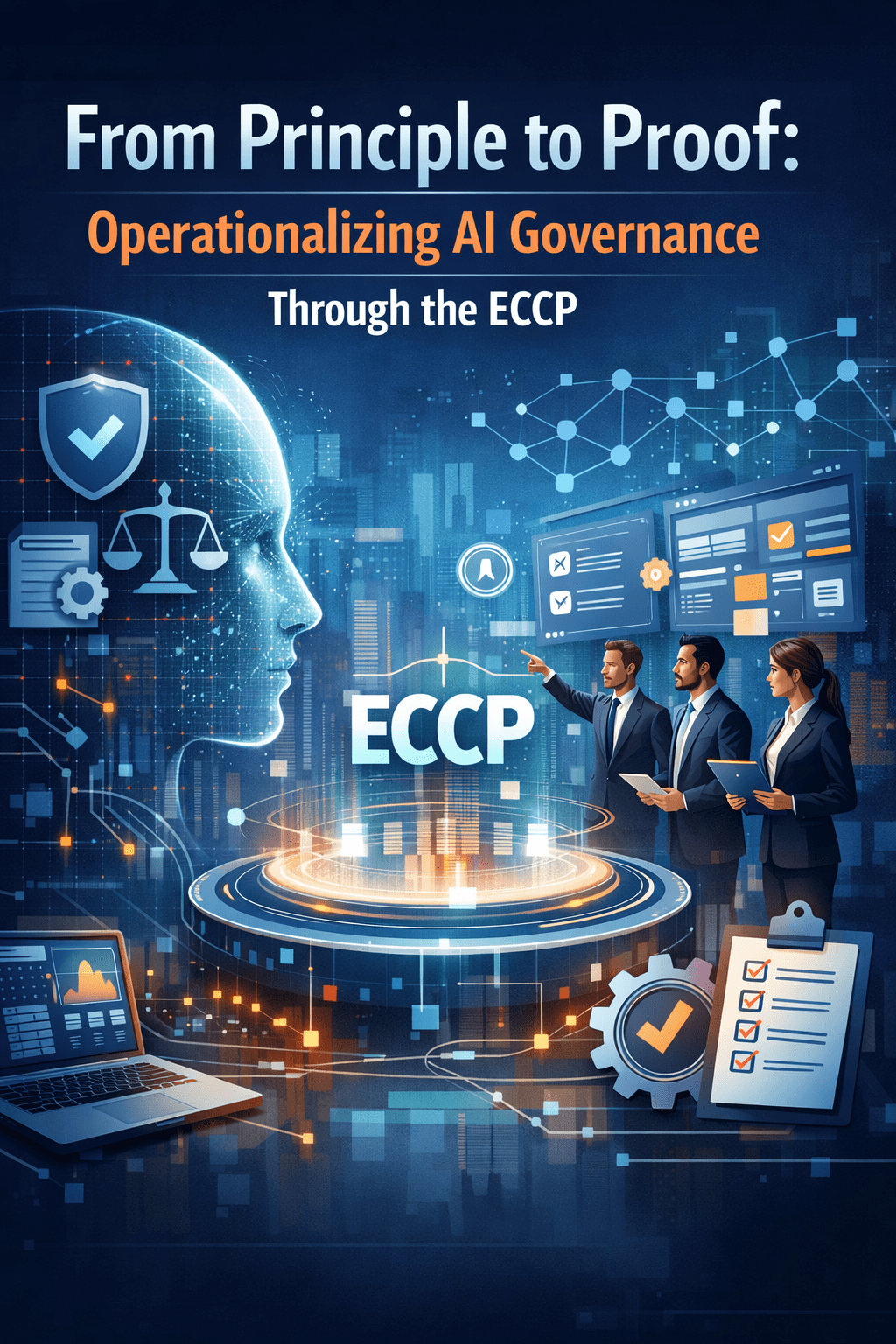
Artificial intelligence governance has officially crossed the threshold from theory to expectation. The Department of Justice has not issued a standalone “AI rulebook,” but it has provided a framework for compliance professionals to consider the issue: the 2024 Evaluation of Corporate Compliance Programs (ECCP). In this version of the ECCP, the DOJ laid out guidance that any technology capable of creating material business risk must be governed, monitored, and improved like any other compliance risk. That includes artificial intelligence.
Too many organizations still treat AI governance as an ethics exercise, a technical problem, or a future concern. That posture is not defensible. The DOJ does not ask whether your program is fashionable or aspirational. It asks three very old-fashioned questions: Is your compliance program well designed? Is it applied in good faith? Does it work in practice? Those questions apply with full force to AI.
In this post, I want to move the discussion from abstract frameworks to operational reality. I will show how compliance professionals can use the ECCP to structure AI governance, select board-grade KPIs, and demonstrate effectiveness in a way regulators understand. I will also show how the NIST AI Risk Management Framework (NIST Framework) fits neatly underneath this structure as an operating model, not a competing philosophy.
AI Governance Is Already an ECCP Issue
The DOJ has repeatedly emphasized that compliance programs must evolve as business risks evolve. Artificial intelligence is not a future risk. It is already embedded in pricing, hiring, credit decisions, customer interactions, fraud detection, and third-party screening. If an AI model can influence revenue, customer outcomes, or regulatory exposure, it is a compliance risk. Period.
The ECCP does not require companies to eliminate risk. It requires them to identify, assess, manage, and learn from it. AI governance, therefore, belongs squarely inside the compliance program, not off to the side in an innovation lab or technology committee.
The ECCP as an AI Governance Blueprint
The power of the ECCP is its simplicity. Every enforcement action ultimately traces back to the same three questions. Let us apply them directly to AI.
Is the Program Well Designed?
Design begins with risk assessment. If your organization cannot answer a basic question such as “What AI systems do we have, who owns them, and what decisions they influence,” you do not have a program. You have hope. A well-designed AI compliance program starts with an AI asset inventory that identifies models, tools, vendors, and use cases. Each asset must be risk-classified based on business impact, regulatory exposure, and potential harm.
Board-level KPIs here are coverage metrics. How many AI assets have been identified? What percentage has been risk-classified? How many high-impact models have completed an impact assessment before deployment? If your dashboard does not show near-full coverage, the design is incomplete.
Policies and procedures come next. The DOJ does not care how many policies you have. It cares whether they provide clear guidance for real decisions. AI policies should cover the full lifecycle, from design and data sourcing through deployment, monitoring, and retirement. A practical KPI is policy coverage. What percentage of AI assets operate under current, approved procedures? How often are those procedures refreshed? Annual updates are a reasonable baseline in a rapidly changing risk environment.
Is the Program Applied Earnestly and in Good Faith?
Good faith is demonstrated through action, not intent. Training is a central indicator. The DOJ expects role-based training tailored to actual risk. A generic AI awareness course does not meet this standard. Developers, model owners, compliance reviewers, and business leaders all require different training. Completion rates matter, but so does comprehension. Measuring post-training proficiency improvement is one of the clearest signals that training is more than a box-checking exercise.
Third-party risk management is another critical area. Many organizations rely on external models, data providers, or AI-enabled vendors. If you do not understand how those tools are built, governed, and updated, you are importing risk without controls. Strong programs use standardized AI diligence questionnaires, assign assurance scores, and require contractual safeguards for high-risk vendors. A board-ready KPI here is the percentage of high-risk AI vendors subject to enhanced diligence and contractual controls.
Mergers and acquisitions deserve special attention. AI risk does not wait for post-close integration. The DOJ has been explicit that pre-acquisition diligence matters. A defensible KPI is simple and unforgiving. 100% of acquisition targets with material AI usage must undergo AI due diligence before closing. Anything less invites inherited risk.
Does the Program Work in Practice?
This is where many programs fail. Paper controls do not impress regulators. Outcomes do. Incident reporting is a critical signal. A low number of reported AI issues may indicate fear, confusion, or a lack of safety rather than safety concerns. What matters is whether issues are identified, investigated, and resolved promptly. Mean time to investigate is a powerful metric. If AI-related concerns take months to resolve, the program is not working. Clear escalation paths, defined investigation playbooks, and documented root cause analysis are essential.
Continuous monitoring is equally important. High-risk AI systems must be monitored for performance drift, data changes, and unintended outcomes. The DOJ expects companies to use data analytics to test whether controls are functioning. KPIs here include validation pass rates before deployment, drift-detection coverage for critical models, and corrective action closure rates. These are not technical vanity metrics. They are evidence of effectiveness.
Where NIST Fits and Why It Matters
The NIST AI Risk Management Framework does not compete with the ECCP. It operationalizes it. The ECCP tells you what regulators expect. NIST helps you implement those expectations across governance, mapping, measurement, and management. For example, ECCP risk assessment aligns with NIST’s mapping function. ECCP’s continuous improvement aligns with NIST’s measurement and management functions. Using NIST terminology creates a shared language across compliance, legal, security, and data science teams. That shared language is governance in action.
Reporting AI Risk to the Board
Boards do not want technical detail. They want assurance. The most effective AI governance dashboards focus on a small set of indicators that answer the DOJ’s three questions: coverage, quality, responsiveness, and learning. Examples include the percentage of AI assets risk-classified, validation pass rates, investigation cycle times, and corrective action closure rates. When these metrics move in the right direction, they tell a credible story of control. More importantly, they show that compliance is not reacting to AI. It is governing it.
Five Key Takeaways for Compliance Professionals
- AI as Risk. Artificial intelligence is already within the scope of the ECCP. If AI can influence business outcomes, it must be governed like any other compliance risk.
- Risk Management Program. A well-designed AI compliance program begins with complete asset identification and risk classification. Coverage metrics are the first signal regulators will examine.
- Implementation. Good faith implementation is demonstrated through role-based training, disciplined third-party oversight, and pre-acquisition AI diligence. Intent without execution does not count.
- Outcomes, not Inputs. Effectiveness is proven through outcomes. Investigation speed, monitoring coverage, and corrective action closure rates matter more than policy volume.
- Complementary. The NIST Framework complements the ECCP by providing an operating model that compliance, legal, and technical teams can share. Together, they turn principles into proof.
Final Thoughts
AI governance is not about predicting the future. It is about demonstrating discipline in the present. The DOJ is not asking compliance professionals to become data scientists. It is asking us to do what they have always done well: identify risk, establish controls, test effectiveness, and improve continuously. The ECCP already gives you the framework. The only question is applying it.