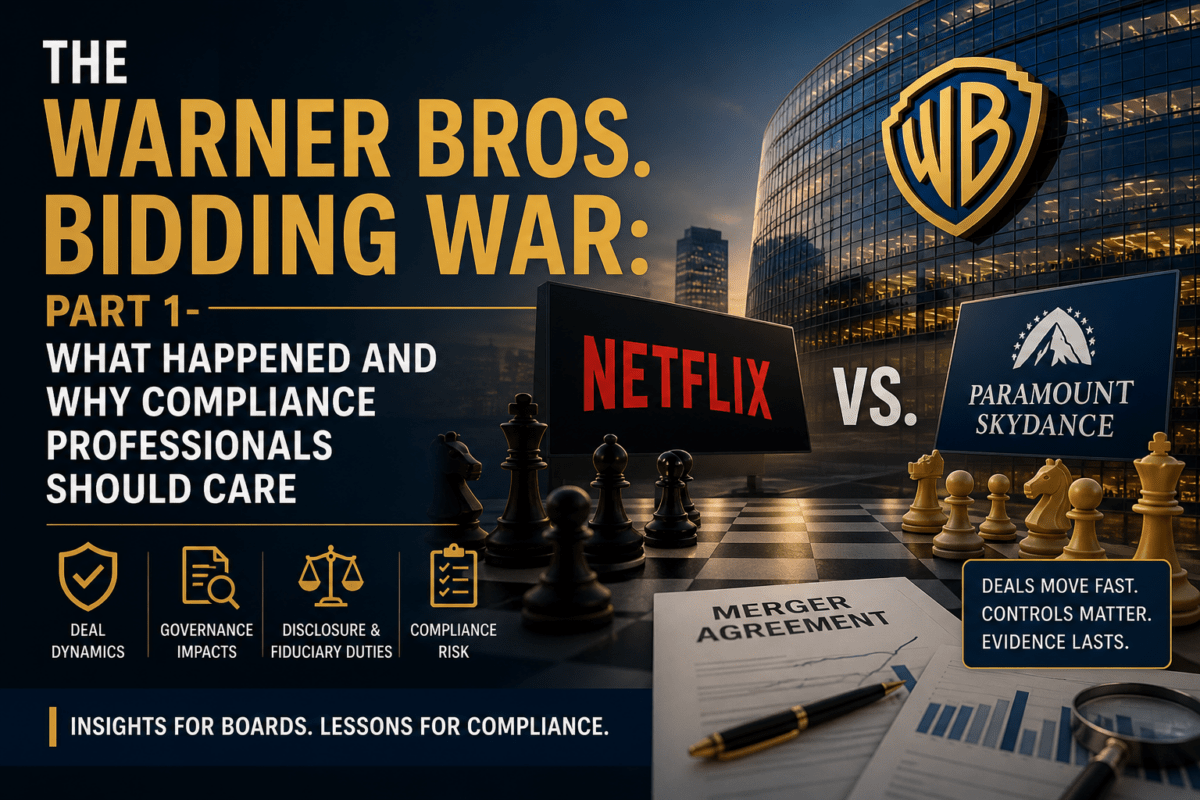
A fast-moving corporate auction shows how deal terms, fiduciary duties, disclosure controls, regulatory risk, and evidence discipline can determine the outcome of a major transaction. Over the rest of this week, I will be exploring the Warner Bros./Netflix/Paramount bidding war, which
The Deal That Changed Direction
The Warner Bros./Netflix/Paramount bidding war is one of those corporate stories that looks like Hollywood drama on the surface but is really a governance story underneath. At first, Warner Bros. (WBD) had an agreed transaction with Netflix. That deal carried a $2.8 billion company termination fee payable by WBD under specified circumstances, including termination to enter into a superior proposal. The proxy materials also disclosed a $5.8 billion regulatory termination fee payable by Netflix if the deal failed for certain regulatory reasons. (SEC)
Then Paramount Skydance (Paramount) came back with a revised proposal. It raised the bid to $31 per WBD share in cash, added a ticking fee, offered a $7 billion regulatory termination fee, and agreed to fund the $2.8 billion termination fee owed to Netflix. (SEC) Reuters reported that WBD said the revised Paramount proposal could be considered superior, which set the process in motion. (Reuters)
By February 27, 2026, WBD terminated the Netflix agreement and entered into a merger agreement with Paramount Skydance. WBD later disclosed that Paramount Skydance paid the $2.8 billion Netflix termination fee on WBD’s behalf. (SEC)
That is the transaction story. The compliance story is deeper.
This Was Not Merely a Higher Price
In M&A, price matters. But price is rarely the only issue. Boards also look at certainty of closing, regulatory risk, financing, timing, shareholder value, legal exposure, and execution risk. Paramount did not merely increase the cash price. It addressed several deal objections at once. It offered to cover the Netflix break fee. It added a ticking fee if closing was delayed. It increased regulatory risk protection. It positioned its offer as cleaner, faster, and more certain than the existing transaction. (SEC)
That matters because boards do not evaluate superior proposals in a vacuum. They evaluate the entire package. The better governance question is not simply, “Which offer is higher? ”It is, “Which offer delivers the best risk-adjusted value to shareholders, and can the Board prove how it reached that conclusion? ”
The Termination Fee Became a Governance Issue
The $2.8 billion termination fee is an important part of the story. In ordinary conversation, that number sounds like a barrier. In this transaction, it became part of the competitive bidding structure. Paramount agreed to fund the termination fee, which changed the economics for WBD shareholders. WBD’s own annual report language later stated that, after the Board determined it had received a Company Superior Proposal and Netflix waived its right to propose revisions, WBD terminated the Netflix agreement and Paramount paid Netflix the $2.8 billion fee on WBD’s behalf. (SEC)
For compliance and governance professionals, this is the control point: when a large termination fee can be assumed, reimbursed, funded, or otherwise neutralized by a rival bidder, the company needs clear documentation showing who approved that structure, how it was analyzed, how it was disclosed, and how conflicts were managed.
Disclosure Was Not a Back-Office Exercise
In a contested transaction, disclosure is part of the control environment. The company must update shareholders, respond to rival communications, track proxy statements, preserve drafts, document board deliberations, and avoid selective disclosure. The Netflix proxy materials laid out the termination fee structure and the circumstances under which the fee could become payable. (SEC) Paramount’s revised proposal was also publicly communicated through SEC filings, including the increased $31-per-share cash price and the regulatory termination fee. (SEC)
This is where compliance should pay attention. A transaction can move faster than the company’s document discipline. Emails, banker calls, board materials, draft press releases, proxy supplements, and negotiation notes can become evidence. If the company doesn’t have a real-time evidence protocol, the record will build itself, which isn’t ideal.
Why Compliance Professionals Should Care
Some believe this is a board-and-banker story. That is too narrow. It is also a compliance story because compliance is about governance, controls, documentation, accountability, escalation, and evidence. A high-stakes transaction tests whether the company’s control environment holds up under the highest pressure. It tests whether the Board receives complete information. It tests whether management understands escalation obligations. It tests whether legal, finance, communications, investor relations, and compliance can coordinate without losing the record.
This is exactly the kind of moment when the DOJ’s Evaluation of Corporate Compliance Programs is relevant, even outside an enforcement action. The central question is familiar: is the program well-designed, adequately resourced, empowered to function, and working in practice? In M&A, that means the compliance function should understand how deal governance intersects with disclosure controls, third-party risk, regulatory commitments, document preservation, and post-closing integration.
The Larger Lesson
The WBD bidding war shows that corporate governance is not theoretical. It is operational. A superior proposal clause is not just legal drafting. A termination fee is not just a financial number. A proxy supplement is not just a filing. Each is a control point. The companies that manage these moments well do three things. They make decisions through disciplined processes. They document the basis for those decisions in real time. They align governance, legal, finance, disclosure, and compliance before the crisis point arrives.
Practical Takeaways for Compliance Professionals
- Major transactions require evidence discipline from day one.
- Disclosure controls must be ready before a rival bidder appears.
- Termination fees and regulatory commitments should be treated as governance issues, not simply deal terms.
- Board minutes and waiver records must tell the fiduciary story.
- Compliance should have a seat at the broader transaction control table, especially when regulatory, third-party, data access, communications, and post-closing integration risks are implicated.
That is the lesson for every CCO. You may not be running the auction, but your program should help the company prove that it made decisions with integrity, evidence, and accountability.