Employees trust that leadership will tell them the truth. Investors trust that disclosures are accurate. Customers trust that representations are reliable. Boards trust that management reporting is complete. Compliance officers trust that records, interviews, hotline reports, emails, chats, invoices, certifications, and audit findings reflect reality.
Artificial intelligence now challenges that foundation. AI can generate text, audio, images, video, records, summaries, identities, and narratives at speed and scale. It can help a compliance function become more effective. It can also make falsehood more convincing, fraud more sophisticated, and manipulation harder to detect.
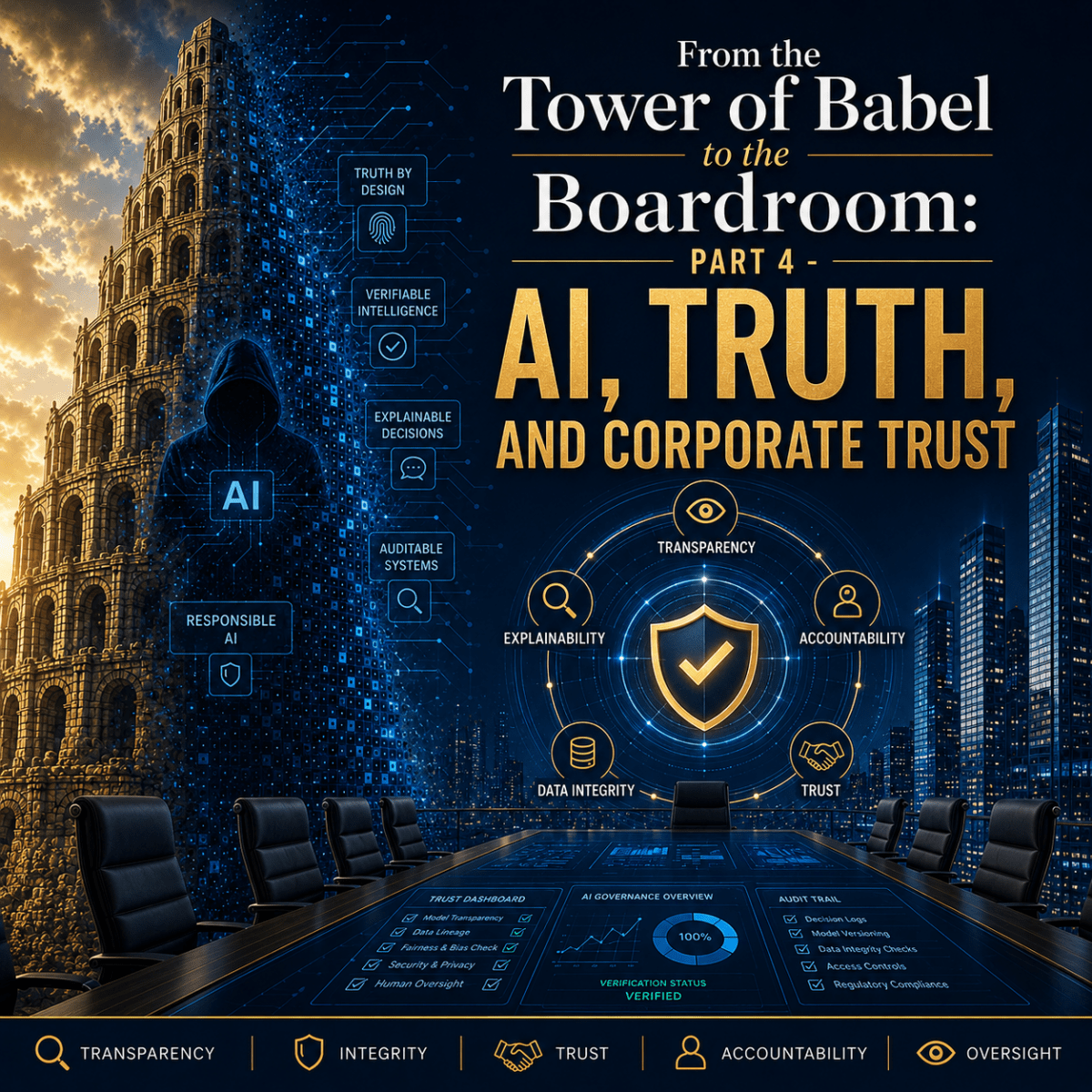
In the first three posts in this series, we used Magnifica Humanitas to move from governance principle to compliance program design and then to internal controls for shadow AI. In this fourth post, we turn to one of the most important themes in the Encyclical Letter: truth. Pope Leo XIV says the digital transformation requires us to rediscover truth as a common good, protect the dignity of work, and safeguard freedom against dependence and commercialization (Magnifica Humanitas, ¶131). For boards and compliance leaders, that is a powerful governance lesson. Without truth, there is no trust. Without trust, there is no culture. Without culture, no compliance program can be effective.
Truth as a Common Good
Magnifica Humanitas warns that digital platforms and AI systems are transforming public and institutional communication. The Encyclical identifies a core risk: AI can construct distorted narratives, blur the boundary between truth and falsehood, mix facts with opinions, and manipulate content, images, and video (Magnifica Humanitas, ¶132). It also reminds us that truthful information requires verification, cross-checking of sources, responsible argument, and shared practices of trust (Magnifica Humanitas, ¶132).
For the compliance professional, this is not abstract philosophy. It is an operational reality. A corporation is built on records and representations. A company’s compliance program depends on accurate policies, reliable data, trustworthy reporting, credible investigations, authentic communications, and truthful escalation to leadership and the board. If AI weakens the company’s ability to know what is real, AI becomes a compliance risk.
The issue is not only misinformation in public discourse. It is misinformation inside the enterprise. AI-generated falsehood can appear in emails, invoices, employee complaints, due diligence materials, contracts, investigation files, synthetic images, training materials, board reports, and financial documentation. Truth is no longer only an ethical value. It is a control objective.
From Encyclical Principle to Corporate Trust Requirement
The corporate translation is direct. If truth is a common good, information integrity is a governance requirement. If AI can distort narratives and manipulate content, companies need verification controls. If truthful information depends on cross-checking and responsible argument, compliance cannot treat AI outputs as self-authenticating. If communication creates culture, as Magnifica Humanitas teaches, then AI-generated communications must be governed because they shape how employees, customers, investors, and directors understand the company (Magnifica Humanitas, ¶135).
The Encyclical also calls for an ecology of communication grounded in transparency, personal data protection, rigorous verification, and the proper use of digital tools (Magnifica Humanitas, ¶137). In corporate terms, that means controls over high-risk communications, rules for AI-generated content, validation of AI-assisted summaries, protection of the integrity of investigations, and reporting systems that enable the board to trust what it receives.
Synthetic Reality and Corporate Risk
We are entering the age of synthetic reality. Companies must assume that audio may be cloned, video may be fabricated, documents may be AI-generated, and digital identities may be false. This does not mean every communication is suspect. It means the company must build verification protocols for high-risk decisions.
The Arup deepfake fraud demonstrates the corporate risk. The Guardian reported that in 2024, public reporting stated that engineering firm Arup was victimized in a deepfake scam involving its Hong Kong office, where fraudsters reportedly used AI-generated video impersonations in a call that led to the transfer of approximately $25 million. That incident should be understood as more than a cyber story. It is a governance story, a finance controls story, a human factors story, and a compliance story.
A traditional approval process may fail when a trusted executive appears to be present on a video call. A fraud-prevention control may fail when an employee believes their identity has already been verified. A payment control may fail when urgency, authority, secrecy, and synthetic trust converge. The compliance lesson is clear: in an AI-enabled environment, trust must be verified when the risk is high.
AI and the Integrity of Corporate Information
Boards and CCOs should treat the integrity of corporate information as part of AI governance. This includes information created by AI, information summarized by AI, and information used to make AI-supported decisions.
Consider internal investigations. AI can help summarize documents, cluster communications, identify patterns, and organize timelines. But Magnifica Humanitas reminds us that AI lacks moral conscience, does not understand what it produces, and does not bear responsibility for its consequences (Magnifica Humanitas, ¶99). A compliance investigator cannot delegate credibility findings to a machine. AI can support the investigation record. It cannot become the investigation record.
Consider hotline reporting. AI may help triage allegations, identify themes, translate complaints, and route issues. But if the system misclassifies a serious allegation as low risk, strips away nuance, or fails to identify indicators of retaliation, the company may miss a critical signal. Consider board reporting. A polished AI-generated report may look authoritative while masking weak data, incomplete controls, or unsupported conclusions. In compliance, elegance is not evidence.
The DOJ ECCP and Trustworthy AI
The DOJ’s Evaluation of Corporate Compliance Programs (ECCP) now asks how companies identify and manage emerging technology risks, including AI. It asks how companies govern AI in commercial operations and in their compliance programs; whether controls monitor trustworthiness and reliability; whether AI is limited to intended uses; what human decision-making baseline is used; how accountability is enforced; and how employees are trained.
This is where the Encyclical’s moral mandate and the DOJ’s compliance test meet. Magnifica Humanitas says responsibility must be clearly defined at every stage and that accountability requires identifying who must account for decisions, justify them, monitor them, challenge them, and remedy harm (Magnifica Humanitas, ¶105). The ECCP asks whether a company has converted that accountability into governance, controls, training, monitoring, and evidence. For CCOs, the question is not whether AI can help compliance. It can. The question is whether compliance can explain how AI-supported information is validated, reviewed, escalated, corrected, and documented.
NIST, COSO, and the Control Language of Trust
NIST provides a practical vocabulary for this discussion. The NIST AI Risk Management Framework identifies trustworthy AI characteristics, including validity and reliability; safety, security, and resilience; accountability and transparency; explainability and interpretability; privacy enhancement; and fairness, with harmful bias managed. For this post, reliability and transparency matter most. Reliability asks whether an output can be trusted for the intended purpose. Transparency asks whether the company can understand, explain, and govern the system.
COSO also matters here. COSO’s internal control framework is designed to help organizations achieve operations, reporting, and compliance objectives, and COSO’s GenAI guidance translates that internal-control discipline into AI governance. In the AI context, companies need controls over the creation, use, review, approval, and communication of AI-generated or AI-assisted information. This is where CCOs, internal audit, finance, legal, and IT must work together. The company should identify where authenticity matters most and design controls accordingly.
Practical Controls for AI, Truth, and Trust
A practical compliance program should include controls for AI-enabled truth risk.
First, companies should adopt verification protocols for high-risk communications. Payment instructions, executive requests, wire transfers, confidential transactions, changes to vendor banking information, M&A activity, crisis communications, and sensitive employment decisions should require independent verification outside the original communication channel.
Second, companies should require labeling or disclosure where AI-generated content is used in official corporate communications and authenticity matters. Third, companies should protect investigations from unverified AI outputs. AI-generated summaries should be treated as work aids, not evidence. Investigators should validate source documents, preserve original records, and document human review.
Fourth, companies should train employees on synthetic fraud. Magnifica Humanitas warns that AI-enabled manipulation of images and videos can make exploitation and deception more insidious (Magnifica Humanitas, ¶141). Employees should learn the red flags: urgency, secrecy, unusual payment instructions, refusal to use normal channels, unexpected video calls, requests to bypass controls, and pressure from apparent senior leaders.
Fifth, companies should create an incident response process for AI-enabled deception. A deepfake attempt, a synthetic invoice, a cloned executive voice, a fake employee profile, or an AI-generated document should be reportable, investigated, tracked, and remediated.
Board Oversight and Corporate Trust
For boards, AI and truth raise a serious oversight issue. Directors rely on management reporting to fulfill their duties. If AI affects the integrity of that reporting, boards need to understand the control environment.
The Caremark lesson is not that directors must become forensic AI experts. Directors must make a good-faith effort to ensure that reasonable information and reporting systems are in place for central compliance risks. In Marchand v. Barnhill (Bluebell Ice Cream), the Delaware Supreme Court emphasized the importance of board-level monitoring and reporting systems for mission-critical compliance risks.
Magnifica Humanitas gives this oversight obligation a deeper accountability mandate. It says AI governance requires defined responsibility, justification of decisions, monitoring, challenge, and remediation (Magnifica Humanitas, ¶105). The board’s obligation is not technical mastery. It is a reporting and monitoring system that shows management can authenticate what matters, identify AI-enabled truth risks, escalate concerns, and remediate failures.
5 Lessons for the CCO
- Treat truth as a compliance control. Accurate records, authentic communications, validated reports, and reliable investigation files are essential to the effectiveness of compliance programs. Truth must be designed into the control environment.
- Build verification into high-risk processes. Payment approvals, executive instructions, vendor bank changes, crisis communications, and sensitive decisions should require independent verification.
- Govern AI-assisted evidence. AI can support investigations and reporting, but human review, source validation, preservation of original records, and documentation must remain mandatory.
- Train employees to challenge synthetic reality. Deepfakes, cloned voices, fake identities, and AI-generated documents should be part of fraud, cyber, finance, and compliance training.
- Report information integrity risk to the board. Boards need evidence that management has identified AI-enabled truth risks and designed controls to prevent, detect, respond to, and remediate them.
Conclusion: Corporate Trust Must Be Protected
Magnifica Humanitas reminds us that truth is a common good. That is a moral principle, but it is also a compliance principle. A company cannot govern itself if it cannot trust its information. A board cannot oversee what management cannot verify. A CCO cannot certify program effectiveness if the underlying records, reports, and communications are unreliable.
Compliance professionals should embrace AI. It can improve risk detection, strengthen monitoring, support investigations, and expand analytical capacity. But AI also requires vigilance, responsibility, transparency, governance, and human primacy. In the age of synthetic reality, compliance must help the company protect truth as part of the control environment.
In the next and final post in this five-part series, we will broaden the lens again. We will examine the Human Supply Chain of AI: Workforce Transformation, Third-Party Risk, and Modern Slavery. That post will tie together the human impact of AI, the dignity of work, vendor risk, data governance, and the compliance responsibility to look beyond the visible interface to the people, suppliers, and systems that make AI possible.