Categories
Innovation in Compliance

Innovation in Compliance: Compliance Evangelists Fighting Modern Slavery Together with Matt Friedman

Innovation comes in many areas, and compliance professionals need to not only be ready for it but also embrace it. Join Tom Fox, the Voice of Compliance, as he visits with top innovative minds, thinkers, and creators in the award-winning Innovation in Compliance podcast. In this episode, host Tom Fox visits with Matt Friedman, who provides a 2026 update to the fight against the international scourge of human trafficking and modern slavery and discusses his latest book, Awakening the Advocate.

Friedman is a leading voice in the fight against human trafficking and modern slavery, known for founding and leading the Mekong Club and for more than 35 years of advocacy, policy work, and corporate engagement. He views modern slavery as a vast, still underaddressed crisis, where tens of millions remain trapped while the number of survivors helped and criminals convicted remains far too small to match the scale of the problem. Friedman believes the biggest barrier is not compassion but awareness and that educating employees inside companies can “wake up” lawyers, bankers, marketers, and other professionals who already have the instincts to help. From his perspective, ESG and compliance efforts can protect the business while also driving meaningful anti-slavery action, making corporate compliance a practical engine for both risk reduction and social change.

Key highlights:

  • Compliance Evangelists Fighting Modern Slavery Together
  • Leadership Briefings and Procurement Risk Assessments
  • Board-Level Awareness Protects Reputation and Brand Value
  • AI sifting data to uncover scam-center patterns
  • Modern Slavery Risks Make ESG’s Future Uncertain

Resources:

Matt Friedman on LinkedIn

The Mekong Club

Awakening the Advocate on Amazon.com

Innovation in Compliance was recently honored as the Number 4 podcast in Risk Management by 1,000,000 Podcasts.

Categories
Daily Compliance News

Daily Compliance News: July 28, 2026, The Chirayu Rana Amps It Up Edition

Welcome to the Daily Compliance News. Each day, Tom Fox, the Voice of Compliance, brings you compliance-related stories to start your day. Sit back, enjoy a cup of morning coffee, and listen in to the Daily Compliance News. All from the Compliance Podcast Network. Each day, we consider four stories from the business world, compliance, ethics, risk management, leadership, or general interest for the compliance professional.

Top stories include:

  • Philippine President to address corruption scandal. (ABC News)
  • The secret deal for Meta’s mega-data center in LA. (NYT)
  • Chirayu Rana amps it up against JPMorgan. (WSJ)
  • Trump learns yet again that only Congress has the power to tax. (Reuters)

To learn about the intersection of Sherlock Holmes and the modern compliance professional, check out Tom’s latest book, The Game is Afoot-What Sherlock Holmes Teaches About Risk, Ethics and Investigations on Amazon.com.

Categories
Trekking Through Compliance

Trekking Through Compliance: Episode 58 – Leadership & Tone from the Top Lessons from “The Paradise Syndrome”

Few Star Trek episodes put Captain Kirk in as vulnerable or as revealing a position as “The Paradise Syndrome.” What begins as a routine mission to deflect an asteroid from a primitive planet spirals down into an exploration of leadership, identity, and the power of influence from the very top. For corporate compliance professionals, this story is a masterclass in how tone from the top and authentic leadership can either protect or imperil an entire organization.

Join me as we step through the wormhole and extract five vital leadership lessons for the modern compliance officer, each illustrated by scenes from this unforgettable episode.

Lesson 1: Leadership Presence Is the First Line of Defense

Illustrated by: As soon as Kirk disappears, Spock and McCoy sense something is amiss. The crew is uneasy, decision-making becomes muddled, and a lack of clear command amplifies the mission’s urgency.

Compliance Lesson: The tone set by leadership isn’t just about lofty statements or annual memos. It’s a daily, lived presence.

Lesson 2: Values Must Be Internalized, Not Just Announced

Illustrated by: Despite not knowing who he is, Kirk’s instincts for fairness, curiosity, and protection shine through. He becomes a leader not by decree, but by action.

Compliance Lesson: True leadership is more than titles and speeches; it’s about internalized values that guide decisions, even under stress or uncertainty. Kirk’s ethical compass survives amnesia because it’s part of who he is.

Lesson 3: Crisis Reveals the True Tone from the Top

Illustrated by: Spock makes tough, sometimes unpopular decisions, including pushing the engines to dangerous limits.

Compliance Lesson: In a crisis, all eyes turn to leadership. How leaders act or fail to act under stress defines the tone from the top far more than any code of conduct. Spock’s resolve and willingness to make hard choices keep the crew focused on their mission, even as doubt and tension rise.

Lesson 4: Empathy and Communication Sustain Compliance

Illustrated by: While among the villagers, Kirk forms relationships based on empathy and service.

Compliance Lesson: Leadership is not just about command; it is about connection. In compliance, the ability to listen, understand, and respond to concerns is just as important as issuing directives. Empathy builds credibility and encourages a culture of speaking up, especially during times of change.

Lesson 5: Sustainable Culture Requires Both Structure and Spirit

Illustrated by: When Kirk finally regains his memory and identity, he is torn between his love for Miramanee and his duty to the Enterprise.

Compliance Lesson: Tone from the top is sustained not just by systems and controls but by the personal commitment of leaders to do what’s right, even when it’s difficult. The spirit of compliance must be aligned with the structure of compliance; one without the other is incomplete.

Final ComplianceLog Reflections

The Paradise Syndrome” is a cautionary tale and an inspiration. When leadership vanishes, even temporarily, an organization’s values, direction, and resilience are put to the test. Kirk’s journey reminds us that leadership is not just about the title on the door but about daily actions, internalized values, and the ability to connect authentically with those you lead.

Resources:

⁠⁠Excruciatingly Detailed Plot Summary by Eric W. Weisstein⁠⁠

⁠⁠MissionLogPodcast.com⁠⁠

⁠⁠Memory Alpha

Fiona is an AI-generated voice

Categories
AI Today in 5

AI Today in 5: July 28, 2026, The Cheaper Way Edition

Welcome to AI Today in 5, the newest addition to the Compliance Podcast Network. Each day, Tom Fox will bring you 5 stories about AI to start your day. Sit back, enjoy a cup of morning coffee, and listen in to AI Today in 5. All from the Compliance Podcast Network. Each day, we consider five stories from the business world, compliance, ethics, risk management, leadership, or general interest about AI.

Top AI stories include:

  1. Microsoft unveils new cybersecurity tools. (NYT)
  2. Using traditional legal frameworks to regulate AI. (Reuters)
  3. AI to help in chronic disease research. (HealthcareITNews)
  4. HSBC opens AI center of excellence. (FinTechGlobal)
  5. A cheaper way to use AI in Main Street banks. (WSJ)

For more information on the use of AI in compliance programs, Tom Fox’s new book, Upping Your Game, is available. You can purchase a copy of the book on ⁠Amazon.com⁠.

To learn about the intersection of Sherlock Holmes and the modern compliance professional, check out Tom’s latest book, The Game is Afoot-What Sherlock Holmes Teaches About Risk, Ethics and Investigations on ⁠Amazon.com⁠.

Categories
Blog

Lost Among the Stars: Leadership & Tone from the Top Lessons from Star Trek’s “The Paradise Syndrome”

Few Star Trek episodes put Captain Kirk in as vulnerable or as revealing a position as “The Paradise Syndrome.” What begins as a routine mission to deflect an asteroid from a primitive planet spirals down into an exploration of leadership, identity, and the power of influence from the very top. For corporate compliance professionals, this story is a masterclass in how tone from the top and authentic leadership can either protect or imperil an entire organization.

In “The Paradise Syndrome,” the Enterprise crew is faced not only with a ticking clock but also with the absence of their leader. As Kirk loses his memory and is separated from his command, Spock, McCoy, and the rest must navigate the crisis without the guiding presence that usually sets the tone. What unfolds is a powerful lesson in why leadership and the values it projects matter more than any written policy or technology.

With Kirk’s leadership removed at the most critical moment, we see the cascading impact on the crew, on the planet, and on Kirk himself. This scenario, while fantastical, is a perfect metaphor for what happens in organizations when the tone from the top is unclear, inconsistent, or simply absent.

Join me as we step through the wormhole and extract five vital leadership lessons for the modern compliance officer, each illustrated by scenes from this unforgettable episode.

Lesson 1: Leadership Presence Is the First Line of Defense

Illustrated by: As soon as Kirk disappears, Spock and McCoy sense something is amiss. The crew is uneasy, decision-making becomes muddled, and a lack of clear command amplifies the mission’s urgency.

Compliance Lesson: The tone set by leadership isn’t just about lofty statements or annual memos. It’s a daily, lived presence. When leadership is visible, engaged, and available, the organization operates with clarity and confidence. When it is absent, even for a short time, uncertainty fills the vacuum, and risk increases.

What should I do? For compliance professionals, this means that leadership must be front and center, not just when things go wrong, but in the rhythms of daily business. Leaders should participate in training, be present in investigations, and visibly support the compliance function. A leader’s consistent presence sends the strongest possible message: compliance matters here.

Lesson 2: Values Must Be Internalized, Not Just Announced

Illustrated by: Stripped of his memory, Kirk (as “Kirok”) is taken in by the planet’s people. Despite not knowing who he is, his instincts for fairness, curiosity, and protection shine through. He becomes a leader not by decree, but by action.

Compliance Lesson: True leadership is more than titles and speeches; it’s about internalized values that guide decisions, even under stress or uncertainty. Kirk’s ethical compass survives amnesia because it’s part of who he is.

What should I do? Corporate values, particularly those related to ethics and compliance, must be deeply ingrained in the organization. Training and messaging must move beyond checklists to foster genuine understanding and belief. When faced with unexpected challenges or moral dilemmas, employees should be able to act based on these internalized values, even if the “playbook” is missing. Compliance professionals should focus on culture-building, rather than just disseminating policies.

Lesson 3: Crisis Reveals the True Tone from the Top

Illustrated by: Spock, now in command, faces a daunting technical challenge with limited time and resources. He makes tough, sometimes unpopular decisions, including pushing the engines to dangerous limits. McCoy protests, but Spock remains steadfast, demonstrating calm under pressure.

Compliance Lesson: In a crisis, all eyes turn to leadership. How leaders act or fail to act under stress defines the tone from the top far more than any code of conduct. Spock’s resolve and willingness to make hard choices keep the crew focused on their mission, even as doubt and tension rise.

What should I do? Compliance leaders should prepare for the inevitable crisis by building trust, communicating transparently, and showing willingness to take responsibility. When employees see leadership confronting difficulties head-on, they are more likely to follow suit. Tabletop exercises and crisis simulations should always include a tone-from-the-top component. How will leadership communicate? How will they reinforce values under pressure?

Lesson 4: Empathy and Communication Sustain Compliance

Illustrated by: While among the villagers, Kirk forms relationships based on empathy and service. He marries Miramanee, helps heal a sick child, and supports his new community. Even without his identity, he inspires trust through the way he listens to and responds to those around him.

Compliance Lesson: Leadership is not just about command; it is about connection. In compliance, the ability to listen, understand, and respond to concerns is just as important as issuing directives. Empathy fosters credibility and promotes a culture of speaking up, particularly during times of change.

What should I do? Compliance officers should foster open-door environments where employees feel comfortable sharing concerns and asking questions. Leaders should model humility and emotional intelligence, admitting when they don’t have all the answers. In the modern workplace, psychological safety is an essential component of tone from the top.

Lesson 5: Sustainable Culture Requires Both Structure and Spirit

Illustrated by: When Kirk finally regains his memory and identity, he is torn between his love for Miramanee and his duty to the Enterprise. The heartbreak of leaving behind his new life underscores that authentic leadership often requires personal sacrifice for the greater good.

Compliance Lesson: Tone from the top is sustained not just by systems and controls but by the personal commitment of leaders to do what’s right, even when it’s difficult. The spirit of compliance must be aligned with the structure of compliance; one without the other is incomplete.

What should I do? Senior leaders and compliance professionals must demonstrate their commitment through both words and deeds. This may involve making tough decisions, investing resources, or prioritizing compliance over short-term gains. By modeling this balance, leadership sets the foundation for a culture that endures, regardless of who is at the helm.

Final ComplianceLog Reflections

“The Paradise Syndrome” is a cautionary tale and an inspiration. When leadership vanishes, even temporarily, an organization’s values, direction, and resilience are put to the test. Kirk’s journey reminds us that leadership is not just about the title on the door but about daily actions, internalized values, and the ability to connect authentically with those you lead. By embracing these lessons, compliance officers and business leaders alike can build organizations that thrive not just in paradise but in any storm the universe throws their way.

Resources:

⁠⁠Excruciatingly Detailed Plot Summary by Eric W. Weisstein⁠⁠

⁠⁠MissionLogPodcast.com⁠⁠

⁠⁠Memory Alpha

Categories
Blog

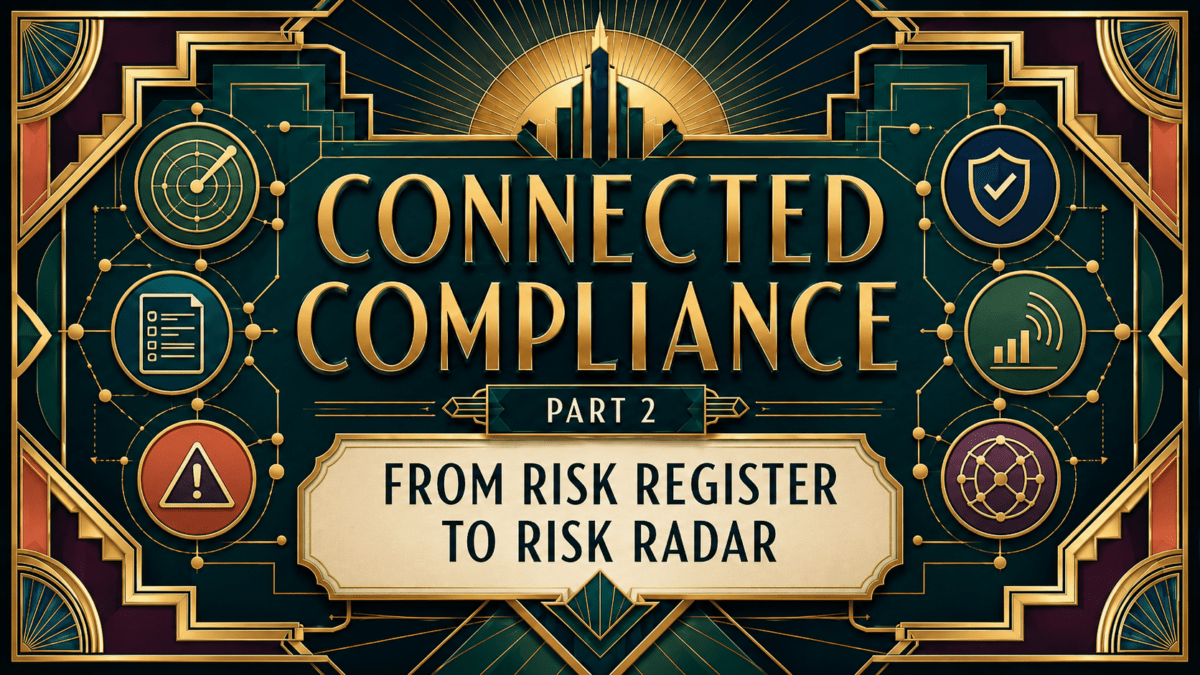
Connected Compliance: Part 2 – From Risk Register to Risk Radar

An effective compliance program is not a collection of disconnected policies, training modules, hotline reports, and investigation files. It is an operating system. Culture determines whether employees will use it. Risk assessment tells the organization where it must adapt. Investigations test whether the system responds credibly. Whistleblower programs reveal whether employees trust it enough to speak. Blog 1 examined communication as the control that connects those elements. In this Part 2, we examine what compliance must do with the intelligence that communication produces.

The traditional risk assessment was built for a world that moved more slowly. Compliance gathered a group of leaders, reviewed enforcement trends, scored familiar risks, produced a heat map, and returned to the exercise the following year. That process still has value, but it is no longer enough.

Today, a new market restriction, customer demand, artificial intelligence deployment, supply-chain disruption, sanctions measure, or data rule can alter the company’s risk profile before the annual plan is approved. The central question is therefore not whether the organization has a risk register. It is whether compliance has a risk radar that can detect change, decide what matters, assign ownership, and translate the signal into action.

Every Compliance Risk Has a Political Dimension

Compliance obligations do not develop in a vacuum. They reflect choices made by governments about national security, trade, technology, labor, privacy, corruption, competition, and corporate accountability. For a multinational company, those choices may conflict, overlap, or change with little notice. Particularly in this political age, the single most-used byword is volatility.

That makes geopolitical awareness a compliance capability. It does not require the CCO to become a foreign-policy analyst. It requires the compliance function to understand how political priorities can become legal obligations, enforcement pressure, customer expectations, or operational constraints. Export controls can reshape product access. Sanctions can alter payment and counterparty risk. Forced-labor requirements can reach deep into a supply chain. AI rules can change how a business collects data, develops products, and makes decisions.

The practical lesson is that legal change is often the last stage in a longer policy development process. Compliance should monitor the earlier signals: legislative proposals, agency speeches, enforcement patterns, trade measures, customer questions, supplier difficulties, and operational workarounds. These indicators do not all demand a program change, but they should enter a disciplined triage process.

What the DOJ Is Really Asking

The Department of Justice has made dynamic risk assessment part of the effectiveness inquiry. The 2024 Evaluation of Corporate Compliance Programs (ECCP) directs prosecutors to consider “emerging risks as internal and external circumstances impacting the company’s risk profile evolve.” This risk profile can change due to factors outside a company’s control or its own business decisions. Moreover, the ECCP language moves risk assessment beyond a scheduled document and into continuous management.

DOJ then asks: “Is the company’s approach to risk management proactive or reactive?” The distinction is critical. A reactive program updates controls after a failure, enforcement action, or audit finding. A proactive program uses operational information across functions to identify change before misconduct occurs. The ECCP also asks whether periodic review is merely a point-in-time exercise or draws on continuing access to operational data, and whether the results lead to updates in policies, procedures, and controls.

The enforcement question is not whether the company predicted every development. No program can. The question is whether the company had a reasonable process for identifying material changes, directing resources to higher-risk areas, documenting its decisions, and revising the program over time.

Build the Risk Radar From Multiple Signals

A dynamic risk process begins with a wider field of vision. Regulatory alerts and outside counsel updates are useful, but they show only part of the environment. Some of the earliest warnings come from inside the business. Sales may see unusual customer demands in a new market. Procurement may find suppliers unable to provide origin information. Finance may identify payment routes that no longer fit the expected transaction. Information security may discover employees using unapproved AI tools. Human resources may raise concerns about retaliation or pressure related to performance targets. Audit may identify recurring exceptions. Hotline reports and investigations may reveal a pattern that a heat map missed.

Compliance should bring these signals together through a repeatable cadence. A quarterly cross-functional review can examine changes in the business model, geography, products, third parties, technology, enforcement, and employee concerns. High-velocity risks may require monthly or event-driven review. The objective is not to create another committee. It is to establish a reliable place where weak signals are compared, challenged, and assigned.

Or simply look at the changes wrought by the Trump Administration in 2026 alone. Venezuela is now open for business. How about the Democratic Republic of Congo? See here and here. Of course there is Iran, but you have to ask what week it is and are we doing business with Iran or are we at war with Iran.

Give One Person the Clock

Emerging risks often fall between organizational boxes. Legal understands the rule. Compliance sees the control issue. Operations owns the process. Procurement controls the supplier relationship. Technology owns the system. To use a well-worn maxim, if everyone is in charge, no one is in charge. In the corporate world, when everyone is generally responsible, no one is specifically accountable. This is both why and where compliance needs to step up its game.

Every material risk needs a named owner with the authority to convene the necessary functions, set deadlines, escalate disagreements, and report on the disposition. That person does not perform every task. The owner keeps the clock, maintains the decision record, and ensures that the issue does not disappear between meetings.

Governance should also define escalation triggers. A credible framework identifies which developments require immediate executive attention, which can be handled through a working group, and which should remain under observation. Without thresholds, organizations either under-escalate material risk or flood leadership with undeveloped issues.

Use a Two-Speed Assessment

Not every signal requires an enterprise-wide risk assessment. Compliance needs two speeds. The first is rapid triage. A small group of subject-matter experts identifies the potential legal obligation, affected operations, time horizon, severity, available data, current controls, and immediate containment needs. This is where AI can play a key role in compliance, essentially superforecasting risks to enable quick, efficient risk management strategies when volatility hits. Additionally, such an approach may lead to a decision to monitor, take interim action, or launch a deeper review.

The second is formal assessment. Complex or high-impact risks may require structured interviews, data analysis, control testing, external counsel, forensic support, or scenario planning. The deeper process should be proportionate to the exposure, not triggered simply because the issue is new. This two-speed model protects agility without sacrificing rigor. It also creates evidence that the company made a reasoned decision. A short written triage record can show what information was considered, who participated, why the company chose its response, and when the issue will be reviewed again.

Convert Assessment Into Real Controls

The most common failure is not the inability to identify risk. It is the failure to convert assessment into a viable risk management strategy and then to implement, monitor, and improve your business operations. A new questionnaire, certification, or policy may create documentation, but documentation alone does not mitigate the underlying exposure.

Consider third-party risk. A supplier questionnaire can identify missing information, but the control lies in what happens next: enhanced diligence, contractual protection, source verification, payment restrictions, audit rights, monitoring, remediation, or a decision not to proceed. The same principle applies to AI. An AI-use policy matters, but effective governance also requires an inventory of use cases, approval gates, data controls, human oversight, testing, monitoring, and accountability.

Each response should identify the control objective, owner, implementation date, evidence, and testing method. Compliance should also ask what existing control can be adapted before building a separate program. Strong governance, escalation, training, data access, and investigation processes are reusable infrastructure across risk domains.

Resource allocation is part of that conversion. If a changing risk profile calls for deeper third-party monitoring, faster export review, or additional AI oversight, the organization must decide what people, technology, and budget will support the response. Compliance cannot claim to be risk-based when yesterday’s priorities continue to dictate today’s resources. The allocation decision, including any accepted constraint, should be visible and documented.

Treat Change Management as a Control

A technically correct response can still fail if employees do not understand it or the business cannot implement it. New requirements frequently collide with established incentives, systems, customer commitments, and local practice. Change management should therefore be part of the control design. Explain why the risk changed. Identify which decisions and workflows are affected. Train the employees and gatekeepers who must act differently. Provide a practical escalation route. Test understanding. Gather feedback. Then revise the process when implementation exposes friction or unintended consequences. For a full discussion of change management as a compliance control, listen to the podcast Ronnie Feldman and I did with Caveni Wong on this episode of Creativity and Compliance.

This is where blog post 1’s communication discipline comes into play. Compliance cannot adapt to risk through broadcast messages alone. It needs a two-way channel that tells employees what changed and tells compliance whether the response works in practice.

Measure Adaptation, Not Activity

The number of risk meetings or completed assessments says little about effectiveness. Better measures test whether the organization moves from signal to decision and from decision to control. Useful indicators include the time required to triage a material development, percentage of actions with named owners and deadlines, overdue remediation, control implementation and testing results, repeat exceptions, unresolved ownership disputes, and lessons incorporated from investigations.

Compliance should also examine whether resources shifted when risk shifted. A program that identifies a higher risk but leaves staffing, monitoring, and controls unchanged has produced analysis without management. The result should be a closed loop: detect, assess, assign, mitigate, test, and learn. That loop turns risk assessment from an annual artifact into a management process.

That transition is where program credibility is tested. Join us tomorrow as we consider how organizations scope investigations, preserve independence, establish consistency, document decisions, and convert findings into remediation. A dynamic risk process helps the company see the signal. A credible investigation determines what happened and what the organization must do next.

Bonus Questions for Compliance Professionals

  1. Which internal and external signals can change the company’s risk profile between formal assessments?
  2. Who has specific ownership for emerging risks that cross legal, compliance, operations, procurement, finance, and technology?
  3. What criteria determine whether an issue is monitored, triaged, escalated, or formally assessed?
  4. Can the company show how a recent risk assessment changed a policy, control, resource allocation, or business decision?
  5. Do substantive mitigation and ongoing monitoring support questionnaires and certifications?
  6. How quickly can the organization move from a weak signal to a documented decision?
  7. What recent investigation finding should change the current risk assessment?