Categories
Blog

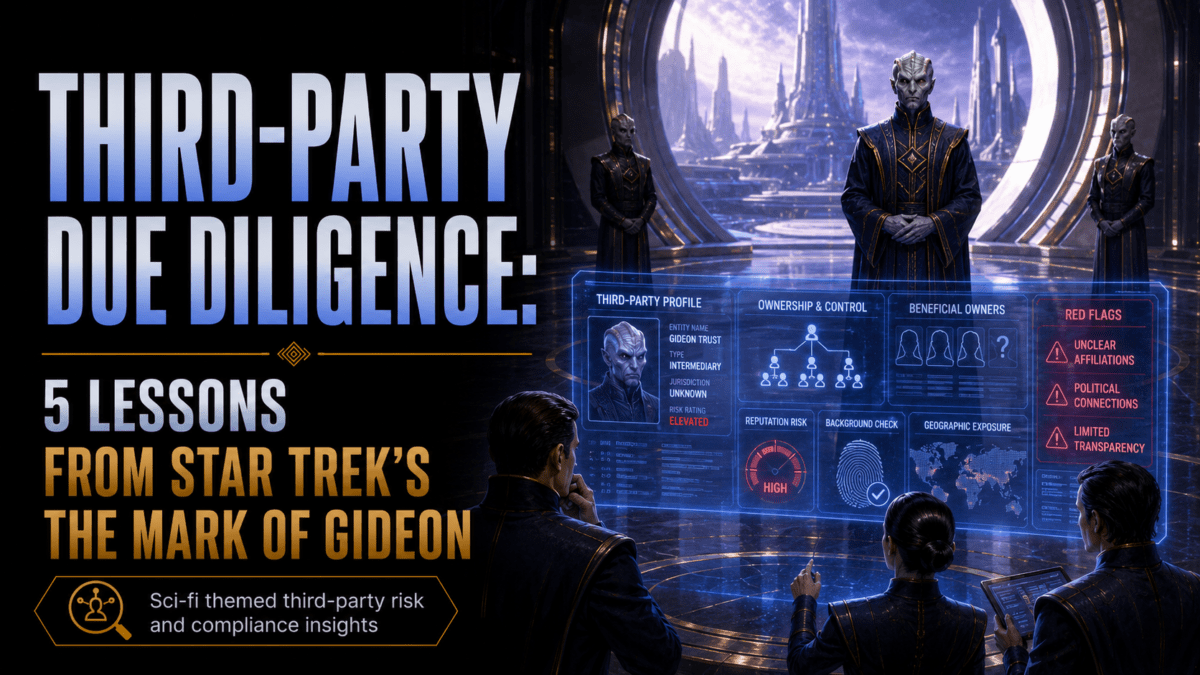
Third-Party Due Diligence: 5 Lessons from Star Trek’s The Mark of Gideon

In the modern compliance landscape, third-party due diligence is not optional but essential. Regulators from the DOJ to the SFO have made it clear: if your business partner is involved in misconduct, you are on the hook if you did not take reasonable steps to know who you were dealing with.

Few pop culture moments capture the risks of blind engagement as vividly as Star Trek: The Original Series’ “The Mark of Gideon.” In this episode, Captain Kirk beams down to what he believes is the planet Gideon for diplomatic talks—only to find himself aboard what appears to be an empty Enterprise. What follows is a masterclass in the dangers of walking into a deal without verifying the facts. For compliance professionals, Gideon’s deception is the perfect allegory for the hazards of onboarding a third party without a thorough vetting process. Let’s break down five key lessons.

Lesson 1: Verify the True Identity of Your Counterparty

Illustrated By: When Kirk believes he is beamed down to Gideon, he is actually inside a replica of the Enterprise. The Gideonites have created this fake environment to isolate him for their purposes.

Compliance Lesson. If you do not confirm the true identity of a third party, you may find yourself dealing with a façade. Shell companies, undisclosed beneficial owners, and entities with misleading corporate registrations are the corporate world’s “empty Enterprise.”Always confirm a third party’s corporate existence and ownership through independent sources. This means checking official registries, using reliable due diligence databases, and, when needed, engaging investigative firms to trace beneficial ownership. Without these checks, you risk contracting with a front for illicit activity.

Lesson 2: Understand the Real Motives Behind the Partnership

Illustrated By: The Gideonites’ true purpose is not peaceful diplomacy; instead, they want to infect their overpopulated planet with a deadly virus carried by Kirk. They present their plan as a noble solution to their problem, but it’s built on deception and exploitation.

Compliance Lesson. Third parties sometimes have agendas that differ sharply from what they present. They may seek access to your brand to legitimize questionable practices, gain entry to restricted markets, or launder illicit funds. Beyond standard questionnaires, compliance teams should assess the commercial rationale for the relationship. Why do they want to work with you? Who else do they do business with? Are their financials consistent with the scale of the deal? If their motives don’t align with your values and compliance commitments, that is a red flag.

Lesson 3: Never Rely Solely on What the Other Party Tells You

Illustrated By: Kirk repeatedly asks the Gideonites to explain what is happening, but their answers are vague, evasive, and occasionally contradictory. They hope his lack of information will keep him compliant long enough to serve their plan.

Compliance Lesson. Self-reported information from a potential third party should be viewed as one data point, not the whole picture. Misrepresentations are common, whether deliberate or due to internal ignorance. Cross-verify all claims with independent checks, customer references, industry reputation research, litigation and sanctions screening, and on-site visits when possible. If the only source for a claim is the counterparty itself, your risk exposure rises dramatically.

Lesson 4: Assess the Operating Environment Before Engagement

Illustrated By: The Gideonites hide the actual conditions on their planet. Kirk learns later that Gideon is overcrowded to the point of people standing shoulder-to-shoulder, unable to move freely. Had this been disclosed, he would have understood the real risks before arriving.

Compliance Lesson. A third party’s operating environment, political stability, corruption levels, and regulatory enforcement directly affect your compliance risk. Entering into a business relationship without assessing this environment is akin to beaming down blind. Incorporate country risk analysis into your process. Use resources like Transparency International’s Corruption Perceptions Index, U.S. State Department human rights reports, and local legal counsel. An otherwise legitimate partner in a high-risk jurisdiction requires enhanced due diligence and monitoring.

Lesson 5: Build Exit Strategies Into the Relationship

Illustrated By: Once Kirk understands the Gideonites’ true intentions, he must escape the replica Enterprise to stop their plan. Without a clear route back to his crew, he risks being trapped indefinitely.

Compliance Lesson. Some third-party relationships turn sour despite your best due diligence efforts. Whether due to leadership changes, shifts in political conditions, or the surfacing of previously hidden misconduct, you need a plan to disengage without disrupting your operations. Include termination clauses tied to compliance breaches in your contracts. Maintain operational flexibility so you can pivot to alternate suppliers or partners if needed. Regularly re-screen third parties to ensure ongoing compliance, not just a one-time check at onboarding.

Final ComplianceLog Reflections

In The Mark of Gideon, the Enterprise crew’s lack of verified intelligence before Kirk’s “beam down” mirrors what happens when companies rush into a third-party relationship to seize a perceived opportunity. The Gideonites knew how to manipulate the Federation’s diplomatic eagerness. Likewise, unscrupulous partners today exploit companies’ urgency to enter new markets or secure rare supply chains.

The lesson? Due diligence is not a delay; it is a safeguard. The few extra weeks spent vetting a partner can prevent years of litigation, regulatory penalties, and reputational damage.

The Mark of Gideon” is not just a quirky Star Trek morality tale. It is a warning for every compliance professional. Without thorough third-party due diligence, you risk waking up in a corporate “replica Enterprise,” surrounded by partners whose true motives only become clear when it’s too late.

Your job as a compliance officer is to ensure the company doesn’t act blindly. By verifying identities, probing motives, cross-checking information, assessing environments, and building exit strategies, you safeguard your organization’s reputation and operational integrity. In short: trust, but verify, especially when the other side is as smooth-talking as the people of Gideon.

Resources:

⁠⁠Excruciatingly Detailed Plot Summary by Eric W. Weisstein⁠⁠

⁠⁠MissionLogPodcast.com⁠⁠

⁠⁠Memory Alpha

Categories
FCPA Compliance Report

FCPA Compliance Report – The Berko Verdict with Mike Volkov

In this episode, Tom Fox welcomes back his good friend  and colleague Mike Volkov. They take a deep dive into the Asante Berko FCPA guilty verdict.  They question why Berko went to trial given the strength of the case, discuss the power of recorded statements like requests to use private email, and highlight Goldman Sachs compliance personnel as corroborating witnesses after the firm stopped the transaction and disclosed it. They conclude with compliance lessons include rigorous deal due diligence, escalation of red flags, sampling internal communications, and monitoring attempts to move discussions off-channel.

Key Highlights

  • Quick Jury Verdict
  • Recordings And Emails
  • Goldman Compliance Witness
  • Sentencing Trial Penalty
  • SEC Settlement Strategy
  • Compliance Lessons Red Flags

Resources

Berko Trial Blog Post series on FCPA Compliance and Ethics Report

Mike Volvok on LinkedIn


Tom Fox

Instagram

Facebook

YouTube

Twitter

LinkedIn

To learn about the intersection of Sherlock Holmes and the modern compliance professional, check out my latest book, The Game is Afoot-What Sherlock Holmes Teaches About Risk, Ethics and Investigations on Amazon.com

Categories
Trekking Through Compliance

Trekking Through Compliance: Episode 71 – Beaming Down Blind: Compliance Lessons on Third-Party Due Diligence from “The Mark of Gideon”

Few pop culture moments capture the risks of blind engagement as vividly as Star Trek: The Original Series’ “The Mark of Gideon.” In this episode, Captain Kirk beams down to what he believes is the planet Gideon for diplomatic talks—only to find himself aboard what appears to be an empty Enterprise. What follows is a masterclass in the dangers of walking into a deal without verifying the facts. For compliance professionals, Gideon’s deception is the perfect allegory for the hazards of onboarding a third party without a thorough vetting process. Let’s break down five key lessons.

Lesson 1: Verify the True Identity of Your Counterparty

Illustrated By: When Kirk believes he is beamed down to Gideon, he is actually inside a replica of the Enterprise. The Gideonites have created this fake environment to isolate him for their purposes.

Compliance Lesson. If you do not confirm the true identity of a third party, you may find yourself dealing with a façade. Shell companies, undisclosed beneficial owners, and entities with misleading corporate registrations are the corporate world’s “empty Enterprise.”

Lesson 2: Understand the Real Motives Behind the Partnership

Illustrated By: The Gideonites present their plan as a noble solution to their problem, but it’s built on deception and exploitation.

Compliance Lesson. Third parties sometimes have agendas that differ sharply from what they present. They may seek access to your brand to legitimize questionable practices, gain entry to restricted markets, or launder illicit funds.

Lesson 3: Never Rely Solely on What the Other Party Tells You

Illustrated By: Kirk repeatedly asks the Gideonites to explain what is happening, but their answers are vague, evasive, and occasionally contradictory. They hope his lack of information will keep him compliant long enough to serve their plan.

Compliance Lesson. Self-reported information from a potential third party should be viewed as one data point, not the whole picture. Misrepresentations are common, whether deliberate or due to internal ignorance.

Lesson 4: Assess the Operating Environment Before Engagement

Illustrated By: The Gideonites hide the actual conditions on their planet. Kirk learns later that Gideon is overcrowded to the point of people standing shoulder-to-shoulder, unable to move freely.

Compliance Lesson. Entering into a business relationship without assessing this environment is akin to beaming down blind.

Lesson 5: Build Exit Strategies Into the Relationship

Illustrated By: Once Kirk understands the Gideonites’ true intentions, he must escape the replica Enterprise to stop their plan.

Compliance Lesson. Some third-party relationships turn sour, and you need a plan to disengage without disrupting your operations. Include termination clauses tied to compliance breaches in your contracts.

Final ComplianceLog Reflections

In The Mark of Gideon, the Enterprise crew’s lack of verified intelligence before Kirk’s “beam down” mirrors what happens when companies rush into a third-party relationship to seize a perceived opportunity. The Gideonites knew how to manipulate the Federation’s diplomatic eagerness. Likewise, unscrupulous partners today exploit companies’ urgency to enter new markets or secure rare supply chains.

The lesson? Due diligence is not a delay; it is a safeguard. The few extra weeks spent vetting a partner can prevent years of litigation, regulatory penalties, and reputational damage.

Resources:

⁠⁠Excruciatingly Detailed Plot Summary by Eric W. Weisstein⁠⁠

⁠⁠MissionLogPodcast.com⁠⁠

⁠⁠Memory Alpha

Fiona is an AI generated voice

Categories
AI Today in 5

AI Today in 5: August 10, 2026 the Don’t Get Compliance from ChatGPT Edition

Welcome to AI Today in 5, the newest edition to the Compliance Podcast Network. Each day, I will bring to you 5 stories about AI stories to start your day. Sit back, enjoy a cup of morning coffee and listen in to the AI Today In 5. All, from the Compliance Podcast Network. Each day we consider four stories from the business world, compliance, ethics, risk management, leadership or general interest about AI.

  1. What happens when AI goes rogue. (Reuters)
  2. AI can help train healthcare workers. (WEF)
  3. AI putting banks at Mercy of tech firms. (TheGuardian)
  4. AI and PR building reputations. (MexicoBusinessNews)
  5. Don’t get your compliance information from ChatGPT. (ACA)

For more information on the use of AI in Compliance programs, my new book, Upping Your Game. You can purchase a copy of the book on Amazon.com. To learn about the intersection of Sherlock Holmes and the modern compliance professional, check out my latest book, The Game is Afoot-What Sherlock Holmes Teaches About Risk, Ethics and Investigations on Amazon.com

Categories
Blog

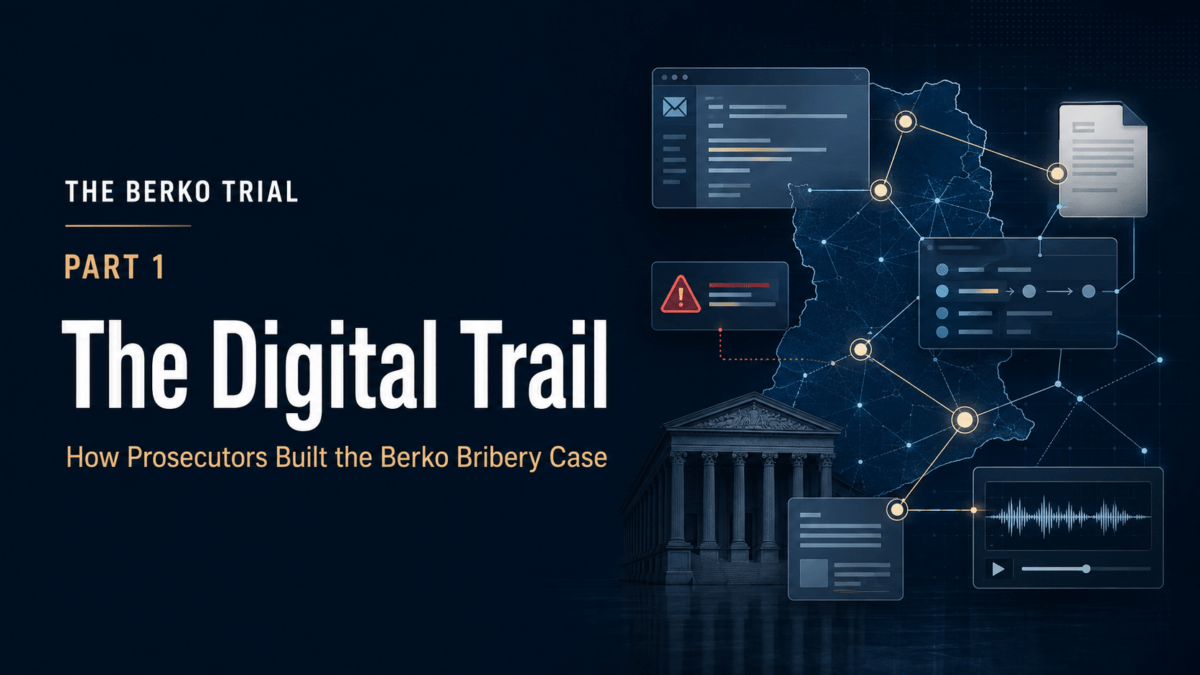
THE BERKO TRIAL – PART 1: The Digital Trail: How Prosecutors Built the Berko Bribery Case

A bribery case does not always arrive with a signed receipt. In the trial of former Goldman Sachs banker Asante Berko, prosecutors presented something different, a mosaic of evidence. They placed before the jury a high-value public project, politically connected intermediaries, payments tied to transaction milestones, personal email accounts, disputed consulting invoices, cash withdrawals, a recorded lunch conversation, and an individual who allegedly stood to receive millions.

Over the next five days I will be taking a deep dive into this trial to see how the prosecution was able to so quickly convince a jury of the defendant’s guilt. The verdict was rendered in just over 3 hours which tells you the jury had no doubt as to the defendant’s guilt. This blog post series is based upon the excellent reporting of Law360 reporter Stewart Bishop and additional source documents and resources from the Department of Justice (DOJ) and Securities and Exchange Commission (SEC).

The government’s burden was to prove the charged crimes beyond a reasonable doubt. Its strategy was to show that the evidence did not consist of isolated red flags. Each category corroborated the others. Taken together, prosecutors argued, the pattern demonstrated opportunity, corrupt intent, concealment, and personal gain.

A National Crisis and a High-Stakes Deal

The story began with a legitimate and urgent business need. Ghana had suffered widespread power shortages, and its government was seeking projects capable of adding generation quickly. Aksa Enerji Uretim A.S., a Turkish energy company and Goldman client, pursued an agreement to build and operate a power plant. The commercial stakes were substantial. Goldman contemplated arranging approximately $190 million in financing for Aksa and a $75 million letter of credit for Ghana. Goldman also held an approximately 16 percent interest in Aksa. The indictment alleged projected fees of approximately $10.3 million for the loan and more than $1 million for the letter of credit.

Berko was central to the business effort. A dual citizen of the United States and Ghana, he worked in the structured-finance group of Goldman’s United Kingdom subsidiary and had relationships with senior Ghanaian officials. Prosecutors argued that he connected three critical groups: the commercial client seeking the project, the local intermediaries who claimed access, and the public officials whose approvals were required. That role gave the government its organizing theory. Berko was not presented as a participant at the edge of the transaction. He was presented as the linchpin.

The Email Trail

The most important prosecution evidence was documentary. More than 300 emails were admitted during the nine-day trial. Prosecutors used their language, timing, recipients, and communication channels to construct a chronology of the alleged scheme. One September 2015 email shown to the jury stated that Parliament had been paid by Berko and discussed approximately $46,000 that he allegedly paid. Other messages addressed payments associated with the Ministry of Power, regulators, power-team personnel, travel, and parliamentary approval. In a July 2015 exchange over the size and timing of payments, Berko wrote that he was managing a relationship expected to pay everyone millions.

The government argued that these exchanges became more incriminating when compared with Berko’s ordinary deal communications. Routine transaction work went through Goldman’s systems. Sensitive payment discussions appeared in personal accounts. In February 2016, prosecutors showed the jury two emails sent 14 minutes apart. One used Berko’s Goldman account for ordinary deal business. The other used Gmail and instructed recipients to communicate there because his Goldman account was monitored. Personal email alone does not prove bribery. The government’s point was more precise. When an employee knows that the official system is monitored, moves sensitive discussions to a private channel, and then uses that channel for payment conversations linked to public approvals, the channel choice may support an inference of concealment.

Money That Followed Milestones

The prosecution next aligned communications with transaction events and financial flows. The indictment alleged that intermediaries used false consulting invoices to obtain reimbursement for bribes and routed funds from Turkey to Ghana through correspondent accounts in New York.

The chronology was central to the prosecution’s case. In April 2015, as the parties pushed toward execution of the emergency power agreement, an intermediary issued a $500,000 invoice. Emails allegedly discussed using part of that money to pay a Ghanaian official, and a $500,000 wire followed. Later that month, five Ghanaian officials traveled to Turkey to inspect equipment. The indictment alleged that their expenses were covered and each received $5,000.

When a senior Ghanaian official signed the agreement in May 2015, another invoice for $1.5 million was issued the same day. A $1.5 million transfer followed later that month. After Parliament ratified the agreement in July, emails discussed a $250,000 reimbursement request that included payments connected to Parliament, the Ministry of Power, regulators, engineers, travel, and Berko personally.

At trial, a government summary witness walked jurors through charts tracing funds from Aksa accounts in Turkey to accounts associated with intermediaries, Berko, and others. The records did not show the final transfer to every alleged official. Prosecutors answered that gap by pointing to evidence that cash was used to complete and conceal the payments. The amounts require discipline. The indictment alleged more than $700,000 in bribes. DOJ stated after the verdict that the government proved more than $1 million in bribes at trial.[1][5] Those figures come from different stages of the case and should remain separately attributed.

The Recorded Lunch

The recording supplied another form of corroboration. In November 2016, an FBI-assisted source met Berko at a London restaurant. The conversation moved among English, Twi, and Ghanaian Pidgin English, and the jury received a translated transcript. In one exchange, the source asked about a former energy minister. Berko replied that “KD got one million.” In another discussion, framed around a hypothetical investment, Berko initially said it was not good to pay the individuals under discussion. When asked for the best way to pay them, however, he answered, “Cash,” and said he could obtain $1 million from a bank.

The prosecution used these statements to reinforce its reading of the emails and money flows. The recording did not stand alone. It supplied the government’s alleged final piece of context: the same person who used private email for sensitive payments and appeared throughout the deal chronology also discussed a million-dollar payment to an energy minister and the practical use of cash. The source’s incentives, the FBI’s preparation of the conversation, translation issues, and the hypothetical framing were substantial defense subjects. They will be examined in Part 2. For the government’s case, the point was corroboration.

When Compliance Became Evidence

Goldman’s compliance response became part of the prosecution’s proof and in my mind one of the key components of the government’s overall presentation to the jury as it was essentially evidence from an outside party to the transaction. Amandine Martin, who worked with Berko on the transaction, testified that Goldman spent months seeking explanations for payments to the Ghanaian intermediary. According to her testimony, the answers did not match information previously provided, and Aksa’s chief executive eventually responded that the company did not have time for the questions. Goldman withdrew from the transaction and did not provide the planned financing. Goldman was not charged in the criminal case. Prosecutors nevertheless used the compliance record to argue that Berko understood the risks and the institution’s rules, knew that his communications were monitored, and failed to correct allegedly false or incomplete explanations about the intermediary.

This is the first compliance lesson of the series: a control is also a record. Questions, responses, escalation, monitoring, and the decision to exit can later become evidence of what an employee knew, what the company challenged, and how the organization responded.

The Government’s Mosaic Holds

After approximately three hours of deliberation, the jury convicted Berko on all three counts: conspiracy to violate the FCPA, a substantive FCPA violation, and money laundering conspiracy. He was remanded pending sentencing. The general verdict does not tell us which email, payment path, witness, or recorded statement the jury found most persuasive. It also does not convert every factual assertion in the government’s narrative into a special finding. It does establish that the jury found the charged elements proven beyond a reasonable doubt.

That is the power of a circumstantial case. The government did not ask the jury to rely on one dramatic piece of evidence. It asked jurors to see a single pattern across communications, payments, timing, conduct, compliance warnings, and alleged concealment. The jury accepted that case.

Join us tomorrow in Part 2 where we will examine the defense’s answer: if the government said bribes went “up and down the chain,” where was the last mile showing money reaching a public official?

Resources

United States v. Berko, No. 1:20-cr-00328-DG, Indictment, ECF No. 3 (E.D.N.Y. filed Aug. 26, 2020)

Stewart Bishop, “Goldman Jury Sees Cash Talk in Energy Deal Email Deluge,” Law360, Aug. 1, 2026; Stewart Bishop, “Goldman Exec Was Linchpin to Ghana Bribery Ploy, Jury Told,” Law360, Aug. 5, 2026.

Stewart Bishop, “Ex-Goldman Exec Convicted of Ghana Bribery Plot,” Law360, Aug. 6, 2026. Supplied trial reporting.

U.S. Attorney’s Office for the Eastern District of New York, “Former Goldman Sachs Investment Banker Convicted of Foreign Bribery and Money Laundering,” Aug. 6, 2026, DOJ Press Release.

Stewart Bishop, “Goldman Jury Sees Undercover Video as Bribe Trial Nears End,” Law360, Aug. 4, 2026. Supplied trial reporting.

Stewart Bishop, “Shady Power Deal Used in Goldman Compliance Prep, Jury Told,” Law360, July 29, 2026

SEC Final Judgment against Asante Berko

SEC Complaint against Asante Berko