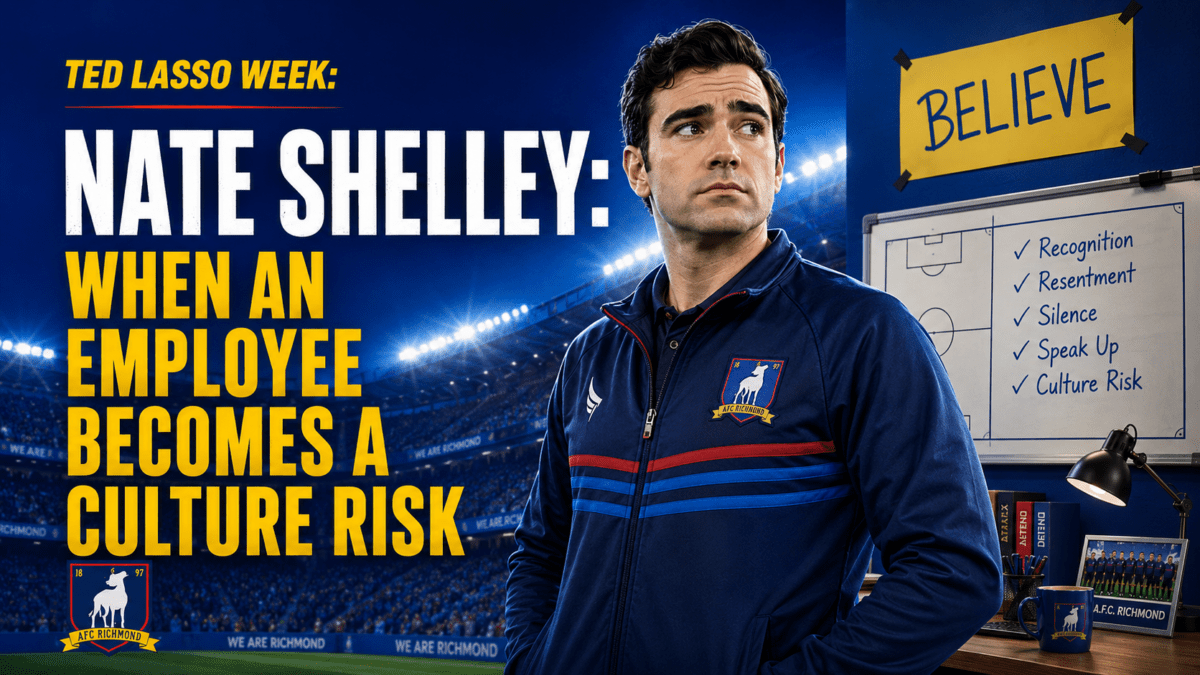
Season 4 of Ted Lasso is out. Matt Kelly reposted a blog he wrote during the original run of the series, and he and I did a deeper dive into the show and its popularity for compliance professionals in an episode of Compliance into the Weeds. I decided to take a deep dive into five characters from the show and use them to explore compliance topics. Over five blog posts, I will consider Manager Ted Lasso, Assistant Manager Nate Shelley, player and later coach Roy Kent, and social media influencer Keeley Jones. Today in Part 3, we consider the professional journey of Nate Shelley, who begins the series as the equipment manager, or in football parlance, the ‘kit man,’ but rises into the managerial ranks.
In Part Two, Rebecca Welton showed how concentrated authority can turn an executive’s private grievance into organizational misconduct. Nate Shelley presents a different risk. His damage begins below the executive level, after AFC Richmond promotes a technically gifted employee without preparing him to exercise power.
Nate is not a villain. He is the overlooked kit man whom players ridicule and leaders barely notice. Ted recognizes his tactical ability, Roy stops the bullying, and Richmond promotes him. Yet the organization mistakes recognition for readiness. Once Nate receives authority, the humiliation he experienced does not disappear. He redirects it toward people with less power.
For compliance professionals, Nate’s story shows that culture risk can emerge when organizations reward expertise, overlook behavioral warning signs, fail to adequately train new managers, and then fail to monitor them.
Promotion Changes the Risk Profile
In “Trent Crimm: The Independent” (Season 1, Episode 3), Jamie Tartt and other players bully Nate until Roy intervenes. Ted also invites Nate to contribute tactical ideas. Those decisions establish dignity and psychological safety for an employee who had neither.
By “The Hope That Kills You” (Season 1, Episode 10), Nate has been promoted to assistant coach. The promotion is understandable. He knows football, sees patterns others miss, and has already helped the team. What Richmond never appears to assess is whether he can supervise people, receive criticism, manage conflict, protect confidential information, or use authority consistently. This is a common corporate failure. The strongest engineer becomes an engineering manager. The top salesperson becomes a regional leader. The best investigator becomes an investigation director. Technical performance is treated as proof of leadership capacity.
Section 8B2.1 of the 2025 U.S. Sentencing Guidelines requires reasonable efforts in selecting personnel with substantial authority, practical training based on role and responsibility, monitoring, and consistent discipline. An effective promotion process should assess conduct, not merely output. It should also include manager training, defined escalation duties, coaching, and a meaningful review period.
Richmond changes Nate’s title. It does not build the controls that should accompany his new power.
The Bullied Employee Becomes the Bullying Manager
Nate’s deterioration becomes unmistakable in “The Signal” and “Headspace” (Season 2, Episodes 6 and 7). Public praise for his tactical decision produces the “Wonder Kid” identity he craves. He also belittles Colin Hughes and directs increasingly harsh treatment at Will, the young employee who replaced him as kit man. Coach Beard witnesses Nate humiliating Colin and tells him to do better. Nate then delivers a public apology. Yet when Will gives him a personalized jersey, Nate responds with private abuse. The apparent correction does not change the conduct. It relocates the harm to a more vulnerable target.
That sequence should concern every compliance officer. A manager confronted about misconduct may learn the wrong lesson: avoid witnesses, control the record, and retaliate where detection is less likely. Closing a matter after an apology, without checking the experience of affected employees or monitoring subsequent conduct, can make the organization less safe.
The DOJ Evaluation of Corporate Compliance Programs asks how managers at all levels demonstrate commitment to compliance, whether employees are comfortable reporting concerns, whether there are “lines of reporting and communications,” and whether discipline is consistent. “Have disciplinary actions and incentives been fairly and consistently applied across the organization? ” Does the compliance function monitor its investigations and resulting discipline to ensure consistency? “And whether the company examines root causes,” “Has the company undertaken a root cause analysis into areas where certain conduct is comparatively over- or under-reported?” Nate’s conduct calls for more than informal coaching. It calls for fact-finding, documentation, protection of Will and Colin, and a plan to determine whether behavior actually changes (i.e., ongoing monitoring).
Warning Signs Are Data
Richmond receives signals throughout Season 2. Nate becomes preoccupied with status, press coverage, social media approval, and perceived slights. He resents Roy’s return to the coaching staff. He spits at his reflection to manufacture confidence. His criticism becomes personal, and his treatment of lower-status employees worsens.
None of these facts alone proves that Nate will betray the team. Together, they form a pattern. Compliance programs fail when each signal remains isolated: Human Resources sees a complaint, a supervisor observes disrespect, colleagues notice resentment, and senior leadership sees performance. No one assembles the complete picture. This is the pattern recognition issue. If no one person or data analytics tool is watching the pattern, it may not be noticed until it is too late.
Under the COSO Internal Control Framework, Richmond’s weakness spans risk assessment (Objective 2), information and communication (Objective 4), and monitoring (Objective 5). The organization has values, but it lacks a reliable process for gathering culture data and testing whether managers operate consistently with those values.
Grievance Becomes Betrayal
Nate’s culture risk becomes an organizational crisis in “Midnight Train to Royston” (Season 2, Episode 11). Trent Crimm informs Ted that an article will reveal Ted’s panic attack and that Nate is the source. In “Inverting the Pyramid of Success” (Season 2, Episode 12), Nate accuses Ted of abandoning him, rejects Ted’s apology, acts out by tearing the “BELIEVE” sign in half, and leaves for West Ham.
Nate has legitimate feelings about recognition, communication, and his relationship with Ted. Those feelings do not justify leaking a colleague’s sensitive health information to inflict reputational harm. Explanation is not exoneration. It also leads to what I consider one of the most reprehensible lines in the entire series when Nate screams at Ted, “You don’t belong here.”
Organizations should examine both individual accountability and system failure. Why did Nate believe betrayal was his only effective channel? Why did no one detect the escalating mistreatment of employees? Who owned his development after promotion? What information could he access because of his trusted position? Why did Richmond lack a process that could address his grievance before it became retaliation? A root-cause analysis that labels Nate disloyal and stops there will miss the control failures that allowed the risk to mature.
Incentives Can Amplify the Wrong Behavior
At West Ham, Rupert rewards Nate with title, status, a car, and proximity to power. In “Smells Like Mean Spirit” (Season 3, Episode 1), Nate mocks Richmond and Ted publicly and humiliates a West Ham player during training. Rupert does not remediate Nate’s insecurity. He weaponizes it.
This is incentive design in human form. One organization can suppress destructive behavior while another celebrates it. Compensation is only one incentive. Access, attention, public praise, elite membership, and fear of exclusion can be equally powerful. Nate eventually recognizes the cost. After refusing Rupert’s invitation to a private “boys’ night,” he leaves West Ham, as confirmed in “International Break” (Season 3, Episode 10). His departure is meaningful because he gives up the status he once treated as proof of worth.
Reintegration Requires More Than Forgiveness
Nate begins repairing harm by quietly completing Will’s work and leaving an apology in “International Break.” In “Mom City” (Season 3, Episode 11), several players invite him back, but Nate hesitates because Ted has not approved the plan. Beard ultimately offers him a second chance. In “So Long, Farewell” (Season 3, Episode 12), Nate apologizes directly to Ted and returns to the coaching staff.
The human story is redemption. The compliance story is reintegration. A sound return-to-work plan would document findings, consider the views and safety of affected employees, define Nate’s role, require coaching, reinforce confidentiality and anti-retaliation standards, and monitor conduct over time. Restoration can support culture, but only if it does not communicate that talent or remorse erases accountability.
Questions for CCOs
Nate’s journey should prompt five questions:
- Do promotion decisions evaluate leadership conduct and risk, or only technical results?
- Are new managers trained on retaliation, confidentiality, escalation, discipline, and psychological safety?
- Can lower-status employees report misconduct by a popular or high-performing manager without fear?
- Does the organization combine complaint, exit, survey, investigation, and performance data to identify patterns?
- When a former employee returns after misconduct, is reintegration structured, documented, and monitored?
Nate becomes a culture risk because Richmond sees his talent before he understands his relationship with power. His story reminds us that employees do not become ethical managers through promotion alone.
Next in the Series: Roy Kent and the Power of the Middle Manager
Nate shows what happens when managerial authority is granted without preparation or sustained oversight. Roy Kent offers the counterpoint. He is imperfect, confrontational, and sometimes slow to change, but he understands that standards become real through daily coaching, direct feedback, and visible accountability. In Part Four, we will examine why middle managers are the operational heart of an effective compliance program and how Roy converts leadership expectations into behavior inside the locker room.