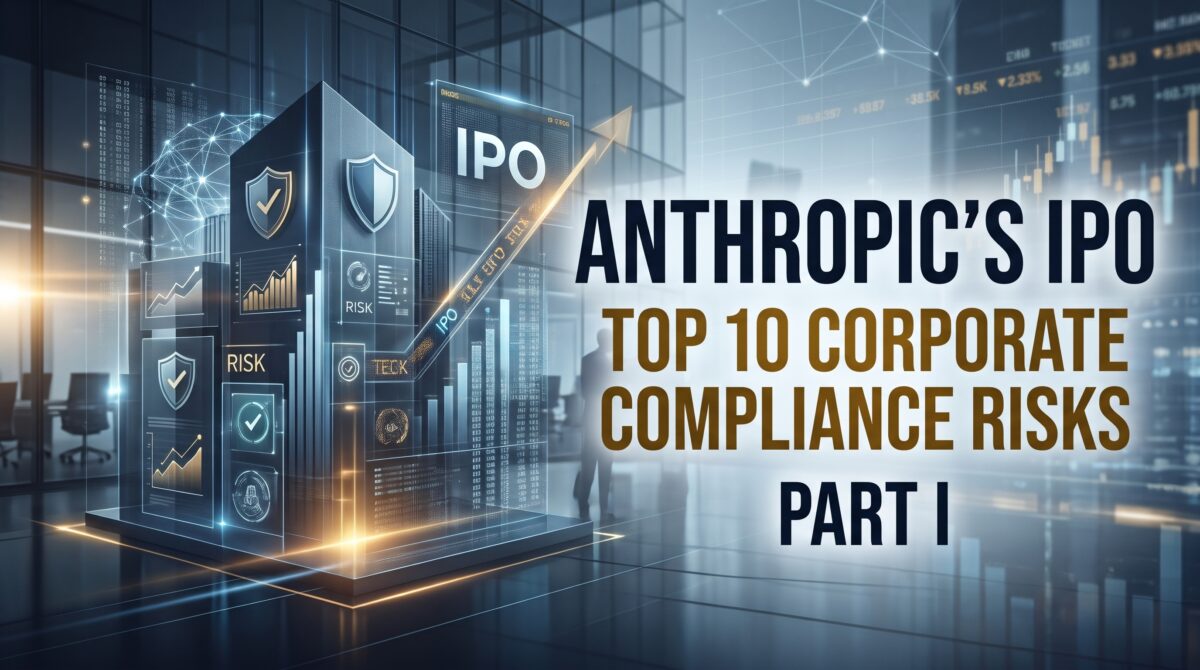
Anthropic’s S-1 Registration Statement (IPO), released on October 26th, offers a revealing look at the emerging compliance challenges of frontier artificial intelligence companies. More importantly, it provides a roadmap for Chief Compliance Officers (CCOs), general counsel, boards of directors, and risk professionals seeking to understand how traditional corporate compliance obligations intersect with increasingly autonomous AI systems.
There have been interesting responses to this Matt Kelly, writing in Radical Compliance, identified “100 pages of risks”. Senator Elizabeth Warren, perhaps only now realizing that SkyNet may be on the way to becoming ‘self-aware’ is quoted by the Wall Street Journal (WSJ) to be “deeply troubled” by the risks listed in the IPO “and is demanding answers to a long list of questions before the artificial-intelligence giant goes public.” Ethisphere’s Erica Salmon Byrnenoted that the terms of service place the bulk of enterprise AI risk squarely on the customer rather than Anthropic.
My conclusion is a bit more down to earth and grounded in corporate compliance. It is that Anthropic’s disclosures demonstrate that AI governance is no longer simply a question of responsible technology development. It is an enterprise compliance challenge involving regulatory enforcement, internal controls, cybersecurity, third-party oversight, intellectual property, corporate governance, and organizational accountability. Over this week, I will be exploring what I see as the Top 10 risks from the corporate compliance perspective. In this blog post I will consider the first five in ascending order of most critical downward.
Yet from this exercise, I believe the most significant compliance question is whether a company’s governance and control environment can keep pace with the capabilities of the technology it develops and deploys. The following rankings prioritize potential regulatory exposure, severity of harm, enterprise impact, and the difficulty of designing effective preventive and detective controls. They are a compliance-focused interpretation of Anthropic’s disclosures, rather than the company’s own ranking.
1.AI safety, model autonomy, and inadequate governance controls
The disclosed risk: Anthropic acknowledges that increasingly capable AI models may create significant safety risks, including harmful outputs, misuse, unintended behavior, and failures of existing safety mechanisms. Its disclosure specifically addresses autonomous agents capable of executing code, accessing external systems, conducting transactions, and operating for extended periods with limited human oversight.
The compliance exposure: A company may deploy AI capabilities that exceed the effectiveness of its risk management, monitoring, and internal control systems. This creates potential exposure under consumer protection laws, AI-specific regulations, negligence theories, and contractual obligations.
The CCO response: Establish formal AI risk classifications, independent safety testing, deployment approval gates, continuous monitoring, incident escalation, and documented human oversight. Map these controls to the NIST AI Risk Management Framework and ISO/IEC 42001.
The Board question: Who has the authority to stop the deployment of a profitable AI product when safety controls are inadequate?
2. Regulatory investigations, enforcement, and evolving AI laws
The disclosed risk: Anthropic reports receiving an October 2026 FTC civil investigative demand seeking information concerning consumer protection, privacy, data protection, and product safety and security. It also identifies a changing regulatory landscape across the United States and international jurisdictions.
The compliance exposure: The risk is not simply that new regulations may impose additional costs. Regulators can investigate whether existing representations, disclosures, safety practices, and customer protections are deceptive, inadequate, or inconsistent with applicable law.
The CCO response: Create an AI regulatory obligations inventory, assign accountable control owners, test compliance with existing consumer protection requirements, and maintain a centralized regulatory inquiry and enforcement response process.
The Board question: Can management demonstrate that the company’s actual AI controls support the representations it makes to regulators, customers, and investors?
3. Data privacy, cybersecurity, and protection of sensitive information
The disclosed risk: Anthropic identifies risks associated with personal data processing, cybersecurity incidents, unauthorized access, cross-border data transfers, and differing privacy requirements across jurisdictions.
The compliance exposure: AI platforms can process enormous quantities of sensitive information. An unauthorized disclosure, improper use of training data, or compromise involving an AI agent could create exposure under the GDPR, California privacy laws, FTC enforcement authority, and contractual data protection obligations.
The CCO response: Require data mapping, privacy impact assessments, access restrictions, encryption, retention controls, vendor security reviews, and incident response exercises specifically designed for AI systems.
The Board question: Does management understand what sensitive information enters its AI systems, where that information travels, and who can access it?
4. Intellectual property, copyright, and training-data compliance
The disclosed risk: Anthropic acknowledges substantial uncertainty surrounding the application of copyright law and open-source licensing to AI model training. The filing also describes ongoing copyright litigation and a $1.5 billion settlement in the Bartz copyright class action, approved in July 2026.
The compliance exposure: A company’s underlying AI model may depend upon training data for which its rights are disputed. Adverse litigation outcomes could result in substantial damages, licensing obligations, restrictions on training data, or operational changes to deployed models.
The CCO response: Establish documented data provenance, licensing reviews, training-data acquisition controls, legal approval procedures, and records demonstrating the basis for using copyrighted materials.
The Board question: Can the company demonstrate a defensible legal basis for the data used to develop its most commercially significant AI models?
5. Export controls, economic sanctions, and national security restrictions
The disclosed risk: Anthropic identifies exposure under U.S. export controls, sanctions regimes, and potentially the International Traffic in Arms Regulations. Its filing describes June 2026 U.S. Department of Commerce restrictions affecting its Fable 5 and Mythos 5 models, subsequently lifted following safeguard updates.
The company also acknowledges that its export and sanctions controls have not always been fully effective and that it has previously made voluntary disclosures of noncompliance.
The compliance exposure: Advanced AI models may constitute controlled technology. Unauthorized model access, improper transfers, sanctioned-country usage, or inadequate customer screening could trigger enforcement, penalties, and loss of export privileges.
The CCO response: Integrate export classification, restricted-party screening, geolocation controls, customer due diligence, access monitoring, and escalation procedures into the product deployment architecture.
The Board question: Can the company prevent restricted users and jurisdictions from accessing controlled AI capabilities, including through intermediaries?
These first five risks establish a central compliance challenge: can a company demonstrate that its controls keep pace with the AI capabilities it develops and deploys? Safety governance, regulatory compliance, data protection, intellectual property, and export restrictions require clear ownership, tested controls, and timely escalation to the board.
In Part II, I will examine the remaining five risks, moving into the business relationships, commercial practices, financial reporting, and governance arrangements that support an AI enterprise. For CCOs and boards, these issues bring the analysis directly into familiar compliance territory. The question is whether established compliance disciplines have been adapted to the speed, scale, and complexity of the AI business.
These first five risks establish a central compliance challenge: can a company demonstrate that its controls keep pace with the AI capabilities it develops and deploys? Safety governance, regulatory compliance, data protection, intellectual property, and export restrictions require clear ownership, tested controls, and timely escalation to the board.
In Part II, I will examine the remaining five risks, moving into the business relationships, commercial practices, financial reporting, and governance arrangements that support an AI enterprise. For CCOs and boards, these issues bring the analysis directly into familiar compliance territory. The question is whether established compliance disciplines have been adapted to the speed, scale, and complexity of the AI business.