Over the weekend I saw Joel Coen’s The Tragedy of Macbeth on Apple TV. To say it blew me away would be putting it mildly. I have been reviewing the film this week and exploring my love of all things Shakespeare in this week’s blog posts. Today, I want to consider Frances McDormand in her starring role as Lady Macbeth and how her experiences of life point to learning curves.
McDormand herself said that she was destined to play the role. Stephen Schaefer, writing in the Boston Herald, quoted her for the following, ““The first thing that got me hooked on being an actor the rest of my life was the sleepwalking scene from ‘The Tragedy,’” she said of Shakespeare’s guilt-ridden murderess Lady Macbeth, who can never wash the blood from her hands. “I did it when I was 14,” she said. “Then I’ve been pretty much practicing and rehearsing for it for 50 years. It had kind of a fated inevitability to it.””
While other versions of Macbeth, notably Roman Polanski’s 1972 version, used younger actors in the lead roles, here Director Coen focused on older versions of the Macbeths. Schaefer also focused on the experience of the actors, McDormand and Denzel Washington, playing the lead roles. Both actors understand about the drive to achieve the next success, which for Macbeth was to take over the Kingdom of Scotland. Schaefer also noted, “McDormand, 64, agreed. “You might think they don’t understand. But guess what? We understand because when we first talked about the film, Denzel and I (it was our own private conversation), both understood about each other: There’s always been a fight. We fought it as gracefully as possible. The fight’s never going to be over. “So we brought that to it. We still know how to fight. Maybe we were limping a little bit. Maybe it took us a little bit longer to get there, but the fight was still there.””
In a recent Harvard Business Review (HBR) article, entitled “Managing Your Organization as a Portfolio of Learning Curves”, author Whitney Johnson, posited, “As people develop competence in a new domain of expertise, they move along an S Curve: Growth is slow and effortful at the outset, or launch point. It then progresses rapidly as people acquire new skills in a stretch known as the sweet spot. At the peak is mastery, when work becomes easier but the curve flattens. Understanding where your employees are on this S Curve of Learning will help you coach them appropriately, craft thoughtful succession plans, and build a team with diverse but complementary strengths.” I use the article as a starting point for the Chief Compliance Officer (CCO) to use it to aid in developing a strong compliance bench at your organization.
The ‘S’ learning curve has three components; (1) launch point, (2) sweet spot and (3) mastery. It was originally developed by Everett M. Rogers, “to show how new ideas and technologies spread.” However, Johnson also saw it as “the trajectory that people move along as they develop competence in a new domain of expertise.” She calls it the “S Curve of Learning;” where growth is slow and effortful at the outset, which is the launch point. The initial phase is “followed by rapid upward progress as people acquire new skills and overcome setbacks: a stretch I think of as the sweet spot. At the peak is mastery—when work becomes easier, but the curve flattens because there is little left to learn. When that happens it’s time to jump to the bottom of a new S Curve, put in the effort, and experience the thrill of climbing again.”
Johnson applied this concept to three areas which are also important to the corporate compliance team; talent development, succession planning and building an “A Team’. Many have said that talent development, acquisition and retention will be one of the most critical corporate endeavors going into the 2020’s. This is even more true for the compliance function. Our discipline is at a cross-roads with many non-legal concepts becoming more important. Such skills as data analytics, behavioral psychology and others are replacing the need to be able to recite the text of the Foreign Corrupt Practices (FCPA). The S Curve in talent development gives CCOs and their compliance team members a “common language for discussions about personal growth and talent development—about people’s progress in their roles and their future with the organization. When one of your reports says, “I’m at the launch point,” you’ll know that person is struggling to gain traction. When someone says, “I’m in the sweet spot,” he or she has momentum and is feeling competent and confident. And when you hear an employee say, “I’m in mastery,” the message is clear—“I know I’m good at this, but I can’t keep doing it—I need a new challenge.””
Under succession planning, it is not enough to plan what is next for the organization or even your compliance team; you also need to consider what is next for the individual. Johnson wrote, “Doing this well involves anticipating which people might move on and when, identifying team members who might assume this role, and then thinking about those who could backfill that role.” In other words, you need think of it as a multi-dimensional chess game; not only thinking several moves ahead but also on X, Y and Z axes. Such an approach allows you to “see when the high-contribution sweet spot is about to yield to mastery, and shortly thereafter, boredom and stagnation. Keeping people who’ve reached the mastery stage in a role for too long carries risks. An employee can become complacent or a flight risk. And if, as an organization or team, most of your people are in the sweet spot, humming along, you may be courting the danger that your entire team could suddenly be in mastery, setting off a wave of departures. Counter these risks with succession planning for each individual.”
Now think about all of the above in building out your ‘A’ compliance team. Johnson advocates diversity in talent on the ‘S’ curve so that some team members are on the sweet spot and some in the others. She stated, “You want people who have a variety of aptitudes and ambitions, and you want a balanced portfolio of people at different stages of growth. People in mastery have deep experience, people at the launch point bring fresh perspectives, and those in the sweet spot have both the enthusiasm and competence to breathe life into a project. Although every team is different, many look like a bell curve, with most members in the sweet spot at any given time and a small percentage of people at the launch point and in mastery. When putting together a team, smart leaders make sure they have people on all major phases of the curve—what I call a matched team.”
Just as McDormand’s portrayal of Lady Macbeth is thought-provoking so is Johnson’s piece. If you are looking for a low-cost way to improve your compliance team, this approach gives you several ways to think through talent development, retention and advance.
Tomorrow, the sisters.
Author: admin
OFAC Sanctions AirBnB
OFAC – Airbnb Payments, Inc. settlement: Cuba sanctions violations.

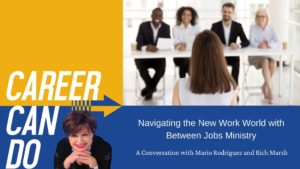
In this episode of Career Can Do, Mary Ann Faremouth chats with Mario Rodriguez and Rich Marsh of Between Jobs Ministry, a nonprofit organization dedicated to helping people navigate the new work world. Mario is the administrator of the Senior Manager’s Group, established to help those seeking senior manager positions. Rich is the leader of the Orange Job Search Work Team, as well as an author, editor, proofreader.
Between Jobs Ministry has over 50 volunteers and provides their services – which include job search and salary negotiation training – free of charge. They hold meetings every Wednesday morning, where they facilitate job search work teams, networking sessions, and resume workshops, and they invite recruiters to conduct short interviews and collect resumes.
Job search work teams are located all over Spring, Texas for the convenience of those who live further away.
A major theme that the job search work teams teach is self-care: if their members are going to do 40 hours a week of job searching, at least 10 of those hours are allocated for doing things that make them feel better about themselves, because job searches are tumultuous.
Resources
Faremouth.com
Mario Rodriguez on LinkedIn
Rich Marsh on LinkedIn | Twitter
Welcome to the Great Women in Compliance Podcast, co-hosted by Lisa Fine and Mary Shirley.
Corporate Integrity is something that is a core component of a strong compliance program, and today’s guest is a leader in helping organizations globally understand and provide guidance on in this area, as well as hosting a wonderful podcast on this topic “The Human Factor: Why Corporate Integrity Matters.” Sonja Stirnimann.is the Founder and Managing Director at Structuul AG, a consultancy based in Switzerland which focuses on preventing fraud and non-compliance, as well as hosting her podcast.
Lisa had the opportunity to discuss how Sonja defines corporate integrity, as well as why humans are the key to building a strong program (as well as indicators of one that needs improvement). She shares some of the challenges she has faced as a woman leader and entrepreneur, and also one where she had her own integrity challenges very early in her career.
We also have the chance to Sonja to share some of her favorite places to visit in Switzerland and allows Lisa to reminisce about that amazing place.
GWIC is excited about our winter season, and always happy to get suggestions on guests, recommendations or ideas to make our podcast and community even stronger.
As always, we are so grateful for all of your support and if you have any feedback or suggestions for our line up or would just like to reach out and say hello, we always welcome hearing from our listeners. If you are enjoying this episode, please rate it on your preferred podcast player to help other likeminded Ethics and Compliance professionals find it. You can also find the GWIC podcast on Corporate Compliance Insights where Lisa and Mary have a landing page with additional information about them and the story of the podcast.
You can subscribe to the Great Women in Compliance podcast on any podcast player by searching for it and we welcome new subscribers to our podcast.
Join the Great Women in Compliance community on LinkedIn here.
Compliance into the Weeds is the only weekly podcast which takes a deep dive into a compliance related topic, literally going into the weeds to more fully explore a subject. This week, Matt and Tom take up compliance training and messages insights Matt had from the book, Get It Done, a newly released book by business professor Ayelet Fishbach. Some of the issues we consider
· How has compliance training evolved?
· The differences in values-based training and rules-based training.
· How can you build aspirational goal setting into your compliance training and compliance messaging?
· Incorporation of aspirational goal setting into your internal controls.
· What is the bottom line on your compliance goal setting?
Resources
Matt in Radical Compliance
Get It Done by Ayelet Fishbach
Over the weekend I saw Joel Coen’s The Tragedy of Macbeth on Apple TV. To say it blew me away would be putting it mildly. I have been reviewing the film this week and exploring my love of all things Shakespeare in this week’s blog posts. Today, I want to consider Denzel Washington in his starring role as Macbeth.
Jourdain Searles, writing in okayplayer.com, said, Washington’s “acting style has always been theatrical, and he’s an obvious choice for any role that requires the ability to monologue while still keeping the audience engaged. Washington is definitely up to the task, making a meal out of every scene. And yet, his motivations in the film feel murky. Due to his age and visible exhaustion, it seems like Washington’s Macbeth would rather retire than vie for the Scottish throne. When his wife Lady Macbeth (Frances McDormand) urges him to seize the throne, it comes off more of a burden than a shining opportunity. Having the couple be older is an inspired choice, transforming the characters from youthful schemers to weary elders making their final grasps at greatness.” I noted this world-weariness, as well as the issue of succession. I want to use those twin concepts to introduce today’s subject of your compliance team leadership.
In a recent Harvard Business Review (HBR) article, entitled “Reinventing Your Leadership Team”, authors Paul Leinwand , Mahadeva Matt Mani, and Blair Sheppard, all with PwC, posited that “in our increasingly complex world, what companies really need to do is build new forms of competitive advantage and transform themselves for the future. And that requires fundamental changes in their top leaders—not just in individuals’ capabilities but in the way they collectively steer the ship. Drawing on their research at 12 prominent global firms, the authors note the contradictory-seeming skills that leaders are expected to have—being both great visionaries and expert executors.” I use their article as a starting point for the Chief Compliance Officer (CCO) to put together a top-notch compliance leadership team.
As legally trained CCOs continue to become less relevant to a corporate compliance function and with the new-found compliance framework focused largely on digitizing and digital analysis, what companies and their employees need from compliance leadership is evolving. CCOs must be able to reimagine a compliance function’s place in the world and transform the organization to live up to a more ambitious purpose. That will mean fundamental change not only in CCOs themselves but also in how they collectively manage and lead a corporate compliance function.
Within the broader context of corporate leadership, the authors stated, “Consider, for example, how the skills that leaders need for success have evolved—and the degree to which many executives are seen to struggle with these new demands. A recent survey conducted by Strategy&, PwC’s global strategy consulting business, highlighted the importance of balancing certain characteristics that on the surface look paradoxical. We used to accept, for instance, that leaders could be either great visionaries or great operators. No longer. Companies now need their top people to perform both roles—to be strategic executors, in other words. They’re also expected to be tech-savvy humanists, high-integrity politicians, humble heroes, globally minded localists, and traditioned innovators. Not only did large majorities of the survey respondents agree on the importance of those roles, but they also voiced alarming concern about leaders’ lack of proficiency in them. Addressing a company’s leadership gaps, however, is not merely a matter of building individual executives’ skills. Although that’s certainly desirable, the need to improve collective leadership is urgent.” That certainly holds true for the compliance function.
The authors identified four key components for leadership change, which I have adapted for the corporate compliance function.
Identifying the leadership roles needed to transform compliance for the future. For compliance to remain relevant, it will need distinct capabilities that allows it to deliver on its purpose, along with leaders who can envision its new place in the world and mobilize it to get there. What positions does your CCO need on their team to make that happen? Obviously, the basic legal skills of reading and writing are now only the basics. There must be digital talent, innovation talent, behavioral psychology talent, as well as communications. Moreover, all these roles will need to work collaboratively not simply with each other but with a much wider variety of internal and external stakeholders than ever.
Assembling the right people. Having the right roles is not enough as once you have identified the roles your compliance function needs, “you next have to think about who will best fill them. Which individuals should you bring together so that you have the necessary talent and diversity…to generate new ideas, challenge traditional thinking, and collaborate on meaningful change?” You will need team members who can not only see around corners but also respond to the ever-changing compliance landscape of today’s business as usual, through continually recalibrating the risks your organization faces.
Focusing your leadership team on driving your compliance transformation. Obviously as CCO, you and your compliance team “will need to advance the company’s agenda—and that means spending energy and time on the big priorities for the future, not just responding to the demands of the organization today. What structures and mechanisms will help you lead the company to its new destination?” How can compliance initiatives work to increase business efficiencies, drive greater employee engagement and move the need on overall company profitable? It is not simply business efficiencies you must master as you must build trust in your organization to create a true ‘speak-up culture’ so you can reap the benefits of this increased efficiency.
Taking ownership of your team’s behavior. At first blush this would seem like a natural for compliance. Afterall, compliance is all about taking ownership and transparency. However, the authors’ focus is a bit different, “Creating ownership around the vision isn’t enough. You must also create a shared purpose: Why does your team exist? What big issues is it here to solve? When defining their areas of responsibility, your people should believe that leading the company through its transformation is their most important task and that success will depend on the collaboration of team members rather than on the sum of individual units’ performance.” In other words, build on the trust you created by giving the credit out so that all will be invested in your compliance transformations.
No major corporate transformation can be successfully achieved by the compliance team alone. There must be engagement, buy-in and not simply acceptance but an embracing by the employees. The authors conclude that you should “Surround yourself with talented people who can balance seemingly paradoxical leadership behaviors and challenge one another to collectively accomplish big things. Most importantly, make sure your leadership team truly leads—setting aside the time and energy to define a bold agenda and launch the ambitious initiatives that your future relies on. Failing to do that will be a costly mistake. Succeed and you will have a powerful team that can position your firm to thrive in an increasingly complex world.”
Tomorrow, Frances McDormand and Lady Macbeth.
The Compliance Life details the journey to and in the role of a Chief Compliance Officer. How does one come to sit in the CCO chair? What are some of the skills a CCO needs to success navigate the compliance waters in any company? What are some of the top challenges CCOs have faced and how did they meet them? These questions and many others will be explored in this new podcast series. Over four episodes each month on The Compliance Life, I visit with one current or former CCO to explore their journey to the CCO chair. This month, my guest is Valerie Charles, partner at StoneTurn. We discuss Valerie’s journey to the CCO chair, then to a ComTech start up, to her current role at StoneTurn and look down the road at where ComTech and compliance will be in 2025 and beyond.
From Gan Integrity, Valerie moved to StoneTurn where she saw an opportunity to leverage all the skill sets she had developed in her professional career or as she said “use all the tools in my toolbox”. In her work she is able to combine using data to provide insights into the continuous improvement of corporate compliance programs, such as using HR data together with traditional compliance data to prevent compliance violations before they arise.
Resources
Valerie Charles LinkedIn Profile
Valerie Charles at StoneTurn
Treasury lists 8 companies as part of the PRC’s Military-Industrial Complex.
Welcome to the Greetings and Felicitations, a podcast where I explore topics which might not seem to be directly related to compliance but clearly influence our profession. In this episode, I discuss the recently released Tragedy of Macbethand a Harvard Business Review article. I use both of these different types of media to explore transformation in your corporate compliance program. Highlights include:
- Macbeth and descent into madness.
- Coen production of Macbeth.
- Transforming your compliance program through ‘you’.
- Why the user experience is so critical.
- The 3-step process to transform you compliance program.
Resources
The “New You” Business: How to compete on personal transformations by Lance A. Bettencourt, B. Joseph Pine II, James H. Gilmore, and David W. Norton