Categories
Hill Country Hustlers

Hill Country Hustlers: From Podcast DM to 70-Day Merger: How Eager Plumbing Built a High-Trust, High-Tech Team in the Texas Hill Country

Host Zachary Green interviews Dalton Hatch and Steve Eager, owners of Eager Plumbing, LLC, about how their plumbing companies rapidly merged into Eager Plumbing with investor/mentor Jeff, after Steve persistently reached out to Dalton following a podcast.

They explain how Aaron Plumbing (custom home new construction, started over 30 years ago) and Hager Plumbing (service) became two divisions, and how Dalton’s service systems and culture complemented Steve’s construction-focused background in oil and gas and commercial building. They describe building a transparent, team-first culture, involving field plumbers in estimating, investing in people, and improving operations through software and AI (for estimates, customer-friendly invoice summaries, policies, training, and navigating commercial job documents). They discuss major hurdles like account transitions, fraud during an attempted school donation, building and later replacing a service price book, scaling from a small shop to about 30 people, and the workload and family sacrifices required. The episode closes with a customer pitch for service across San Antonio, Boerne, Fredericksburg, and Kerrville, a recruitment call for unhappy plumbers, and their vanity number: 830-999-PIPE.

Key highlights:

  • From First Meeting to Fast Merger
  • Building a Culture Before Building the Business
  • Modernizing a Traditional Trade
  • People First, Always
  • Partnership Without Ego
  • Using AI and Technology the Right Way
  • Customer Service as the Ultimate Differentiator

Resources:

Follow Eager Plumbing, LLC on:

Eager Plumbing, LLC Website

Facebook

LinkedIn

Instagram

Categories
Red Flags Rising

Red Flags Rising: S01 E37: Carole Basri on Subsidizing World Peace: The U.S. Experiment, and the Dynamic Relationship between National Security & Corporate Compliance

Back in January 2024, Mike and Brent had the good fortune to meet Carole Basri at an event at NYU Law School. On this episode of Red Flags Rising, they welcome her as a guest to talk about her specialties: national security, geopolitics, and corporate compliance. They specifically discuss Carole’s extensive professional background (00:59), a new treatise on National Security Law that Carole, Mike, and Brent are writing for the Practising Law Institute (PLI) (04:00), an upcoming event co-hosted by the New York State Bar Association’s International Section, Corporate Compliance Committee and Morgan Lewis, to which the new Assistant Secretary for Export Enforcement David Peters is an invited keynote speaker (08:18), why public enforcement officials remarks are relevant under U.S. export controls and other probability-based (i.e., “red flags”-driven) national security laws (09:26), how the U.S. Foreign Corrupt Practices Act (FCPA) was not only an example of that but also was really a child of an era where economic interdependency required a level of transparency and clean commerce to continue (12:00), and the relationship between Bretton Woods, Belt and Road, and Mike’s favorite book, Tales of an Economic Hitman, and what could be viewed with hindsight as effectively a U.S. policy decision to trade its own economic security for decades of (relative) world peace, increased global productivity, and increased living standards (16:52). Brent then closes out the discussion with the latest installment of his “Managing Up” segment (21:57), after which Mike makes some (further) book recommendations based on the discussion for those interested in further exploring some of the idea and concepts covered during the discussion:

More about Carole

Contact Brent: brent@redflagsrising.com

Contact Mike: michael.huneke@morganlewis.com

Interested in learning more about the March 10, 2026, event? Contact Mike & Brent at the email addresses above.

Categories
Blog

The Dog Bite Defense Fails Again – Defendant Found Guilty in FCPA Trial

To the surprise of absolutely no one, former Corsa Coal executive Charles ‘Hunter’ Hobson was found guilty last week for FCPA violations. As most readers of this blog know, I am a recovering trial lawyer. I almost always represented corporations as defense counsel during my trial lawyer career. In the trial lawyer world, there are four recognized defenses to any claim, which are known as the “Dog Bite Defenses”. They are:

  1. My dog didn’t bite you.
  2. Even if my dog did bite you, it’s because you provoked him.
  3. Even if my dog did bite you, you really aren’t injured.
  4. My dog didn’t bite you because I don’t have a dog.

The fourth version of the Dog Bite defense is certainly an ‘all-in’ move. You had either (1) better be right or (2) have some big kahunas to make that argument to a jury with a straight face.

Defense No. 1 – Hobson did not pay or direct anyone to pay.

Hobson’s attorneys said the government was overreaching by charging Hobson with FCPA violations on several grounds. His lawyer argued that Hobson did not know, pay, or direct Nassar to bribe anyone. “Mr. Hobson never saw Ahmed the broker pay any money to anyone,” his attorney told the jury in the opening. Further, Hobson never hired Ahmed, the broker, and claimed that Mr. Hobson never paid him. Corsa hired Ahmed, the broker; Corsa paid Ahmed, the broker; and Corsa approved Ahmed’s commissions, not Mr. Hobson.

Defense No. 2- Social custom in Egypt says it’s OK to pay a bribe.

Attorneys for Hobson tried to undermine the government’s expert witness by pointing to opinions he had given that bribery was not only not illegal in Egypt but actually socially acceptable. They confronted Mohamed Arafa, an adjunct professor focusing on comparative law at Cornell University, with law review articles he had previously written, where he said that corruption was “commonly accepted and had become the ‘social law’” in Egypt. The Professor distinguished the expert opinion on Egyptian law that he offered at trial and “his prior, scholarly opinions on whether people adhered to that law in modern Egypt. Santoni quoted him saying, “I’m not here to talk about that; I’m here to talk about the law,” Arafa said. ” … Saying something like that does not make the act legal.””

Defense No. 3- His bosses approved it.

Here, Hobson tried to argue that once Nassar was paid his commission, which was due and owing, it was not up to Hobson what Nassar did with it, nor was it “Corsa’s money” any longer. Hobson’s attorney also said that “Mr. Hobson never saw Ahmed, the broker, pay any money to anyone,” Price said. “Mr. Hobson never hired Ahmed the broker, Mr. Hobson never paid Ahmed the broker. Corsa hired Ahmed the broker, Corsa paid Ahmed the broker, and Corsa approved Ahmed’s commissions, not Mr. Hobson.” His counsel also said that Hobson had been tasked with opening up new foreign markets for Corsa. Having never dealt in Egypt before, he spoke with employees of a company that had recently merged with Corsa and had done business there, who connected him with Nassar.

Defense No. 4-Ahmed wasn’t a government official.

Here was the truly all-in defense (I don’t own a dog). It was that Ahmed was not a government official or did not work at an instrumentality of the Egyptian government. In his cross-examination of cooperating witness Frederick Cushmore, Jr., who worked for Hobson, his defense counsel questioned Cushmore about any indications he had that Al Nasr was affiliated with the Egyptian government. Obviously, trying to take the entire case out of an FCPA criminal action by alleging that one of the elements of an FCPA was not present. The issue is that payments are being directed to a government official or to someone at a government-affiliated company. But Cushmore said it was “industry knowledge” and pointed to a 2017 email from Hobson that said both the shipping company and Al Nasr were “Egyptian-owned companies”. Counsel then questioned whether Hobson really meant that to indicate “owned by the Egyptian government.”

Two prosecution witnesses eviscerated Hobson’s defense. The first was Frederick Cushmore Jr., who pled guilty to conspiring to violate the FCPA. He agreed to testify against Hobson, said their emails and WhatsApp messages talked about people at Al Nasr Co. for Coke and Chemicals being “taken care of” by keeping Corsa’s agent, Ahmed Nassar, paid high commissions for the sales he brought in, implying that Nassar’s higher-than-normal pay was being passed on as bribes to Al Nasr officials.

According to Matthew Santoni reporting in Law360, “Cushmore read a November 2016 email from Hobson, then a vice president of sales at the Somerset County, Pennsylvania-based coal mining company, that said there were “a few the agent has to take care of” during an early discussion of Nassar’s proposed commission payments. “I took that as people at Al Nasr who would be receiving bribes… I was shocked at how open the discussion was,” Cushmore, whom prosecutors said held various international sales positions with Corsa Coal. “I simply said, I suspected… ‘What’s he doing with all that money?’ Mr. Hobson said, ‘What do you think he’s doing with all that money?'””

The second was Mohamed Arafa, an adjunct professor focusing on comparative law at Cornell University. He made clear, in no uncertain terms, that bribery of government officials was illegal under Egyptian law, not a matter of social custom. The defense had no rebuttal for either witness’s testimony.

Although the trial lasted over one week, the jury was out for less than one day before finding the defendant guilty. The sentencing date has not been set.

Join us tomorrow, where we look at the lessons a compliance professional can draw from the Hobson trial.

Resources:

Articles by Matthew Santoni in Law360

Coal Exec Knew Egyptian Broker Paid Bribes, Jury Told

Coal Exec’s Co-Worker Says Emails Hinted At Egypt Bribes

Egypt’s ‘Social Law’ Doesn’t Endorse Bribery, Jury Told

Coal Exec Used ‘Mr.. Yen’ To Talk Kickbacks, FBI Testifies

Coal Exec ‘Had No Ability’ To OK Paying Bribes, Jury Told

Jury Finds Ex-Coal Exec Guilty Of Authorizing Bribes

Categories
AI Today in 5

AI Today in 5: February 25, 2026, The Spotting AI Fakes Edition

Welcome to AI Today in 5, the newest addition to the Compliance Podcast Network. Each day, Tom Fox will bring you 5 stories about AI to start your day. Sit back, enjoy a cup of morning coffee, and listen in to the AI Today In 5. All, from the Compliance Podcast Network. Each day, we consider five stories from the business world, compliance, ethics, risk management, leadership, or general interest about AI.

Top AI stories include:

  1. No code AML. (FinTechGlobal)
  2. Applying AI in sanctions compliance. (FTI)
  3. AI agents for investment banking and HR. (Bloomberg)
  4. 4 AI strategies for healthcare. (Forbes)
  5. Tools to spot AI fakes. (NYT)

For more information on the use of AI in Compliance programs, my new book, Upping Your Game, is available. You can purchase a copy of the book on Amazon.com.

Categories
Blog

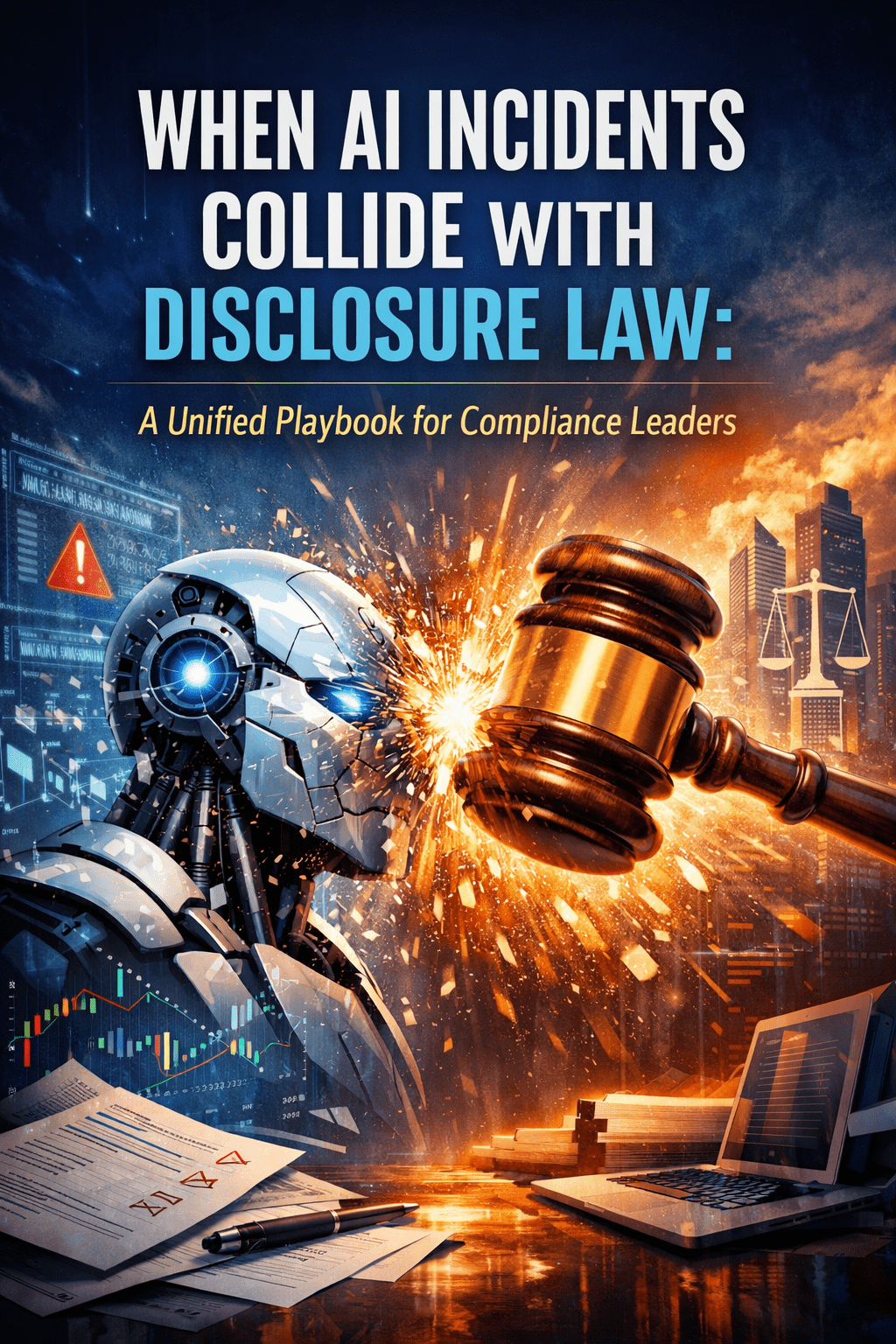
When AI Incidents Collide with Disclosure Law: A Unified Playbook for Compliance Leaders

There was a time when the risk of artificial intelligence could be discussed as a forward-looking innovation issue. That time has passed. AI governance now sits squarely at the intersection of operational risk, regulatory enforcement, and securities disclosure. For compliance professionals, the question is no longer whether AI risk will mature into a board-level issue. It already has.

If your organization deploys high-risk AI systems in the European Union, you face post-market monitoring and serious incident reporting obligations under the EU AI Act. If you are a U.S. issuer, you face potential Form 8-K disclosure obligations under Item 1.05 when a cybersecurity incident becomes material. Add the NIST AI Risk Management Framework for severity evaluation, ISO 42001 governance expectations for evidence and documentation, and the compliance function, which stands at the crossroads of law, technology, and investor transparency.

The challenge is not understanding each framework individually. The challenge is integrating them into one operational escalation model. Today, we consider what that means for the Chief Compliance Officer.

The EU AI Act: Post-Market Monitoring Is Not Optional

The EU AI Act requires providers of high-risk AI systems to implement post-market monitoring systems. This is not a paper exercise. It requires structured, ongoing collection and analysis of performance data, including risks to health, safety, and fundamental rights. Where a “serious incident” occurs, providers must notify the relevant national market surveillance authority without undue delay. A serious incident includes events that result in death, serious harm to health, or a significant infringement of fundamental rights. The obligation is proactive and regulator-facing. Silence is not an option.

This means that if your AI-enabled hiring tool systematically discriminates, or your AI-driven medical device produces dangerous outputs, you may face mandatory reporting obligations in Europe even before your legal team finishes debating causation. The compliance implication is straightforward: you need an operational definition of “serious incident” embedded inside your incident response process. Waiting to interpret the statute after the event is not governance. It is risk exposure.

SEC Item .05: The Four-Business-Day Clock

Across the Atlantic, the Securities and Exchange Commission (SEC) has made its expectations equally clear. Item 1.05 of Form 8-K requires disclosure of material cybersecurity incidents within four business days after the registrant determines the incident is material. Here is where compliance professionals must lean forward: AI incidents can trigger cybersecurity implications. Data exfiltration through model vulnerabilities, adversarial manipulation of training data, or unauthorized system access to AI infrastructure may constitute cybersecurity incidents.

The clock does not start when the breach occurs. It starts when the company determines materiality. That determination must be documented, defensible, and timestamped. If your AI governance framework does not feed into your materiality assessment process, you have a structural weakness. Compliance must ensure that AI incident severity assessments are directly connected to the legal determination of materiality. The board will ask one question: When did you know, and what did you do? You must have an answer supported by contemporaneous documentation.

NIST AI RF: Speaking the Language of Severity

The NIST AI Risk Management Framework provides the operational vocabulary compliance teams need. Govern, Map, Measure, and Manage are not theoretical constructs. They form the backbone of defensible severity assessment. When an AI incident arises, you must evaluate:

  • Scope of affected stakeholders
  • Magnitude of operational disruption
  • Likelihood of recurrence
  • Financial exposure
  • Reputational harm

This impact-likelihood matrix is what transforms noise into signal. It allows the organization to distinguish between model drift requiring retraining and systemic failure requiring regulatory notification. Importantly, severity classification must not be left solely to engineering teams. Compliance, legal, and risk must participate in the evaluation. A purely technical assessment may underestimate regulatory or investor impact.

If the NIST severity rating is high-impact and high-likelihood, escalation must be automatic. There should be no debate about whether the issue reaches executive leadership. Governance means predetermined thresholds, not ad hoc discussions.

ISO 42001: If It Is Not Logged, It Did Not Happen

ISO 42001, the emerging AI management system standard, adds another layer of discipline: documentation. It requires structured governance, defined roles, documented controls, and demonstrable evidence of monitoring and incident handling. For compliance professionals, this is where audit readiness becomes real. When regulators ask for logs, you must produce:

  • Model version identifiers
  • Training data provenance
  • Decision traces and outputs
  • Operator interventions
  • Access logs and export records
  • Timestamps and system configurations

In other words, you need a chain of custody for AI decision-making. Without logging discipline, you will not survive regulatory scrutiny. Worse, you will not survive shareholder litigation. ISO 42001 forces organizations to treat AI systems with the same governance rigor as financial controls under SOX. That alignment should not surprise anyone. Both concern trust in automated decision systems.

One Incident, Multiple Obligations

Consider a practical scenario. A vulnerability in a third-party model component has compromised your AI-driven customer analytics platform. Sensitive customer data is exposed. The compromised system also produced biased credit scores during the attack window. You now face:

  • Potential serious incident reporting under the EU AI Act
  • Cybersecurity disclosure analysis under SEC Item 1.05
  • Data protection obligations under GDPR
  • Internal audit review of governance controls
  • Reputational fallout

If your organization handles each of these as separate tracks, you will lose time and coherence. Instead, you need a unified incident command structure with embedded regulatory triggers. As soon as the issue is identified, you preserve logs. Within 24 hours, severity scoring occurs under NIST criteria. Within 48 hours, the legal team evaluates materiality. By 72 hours, the evidence packet is assembled for board review. The board should receive:

  • Incident timeline
  • Severity classification
  • Regulatory reporting analysis
  • Financial exposure estimate
  • Remediation plan

This is not overkill. This is operational discipline.

The Board’s Oversight Obligation

Boards are increasingly being asked about AI governance. Institutional investors want transparency. Regulators want accountability. Plaintiffs’ lawyers want leverage. Directors should demand:

  1. Clear definitions of serious AI incidents.
  2. Pre-established escalation thresholds.
  3. Integrated disclosure decision protocols.
  4. Evidence preservation policies aligned with ISO standards.
  5. Regular tabletop exercises involving AI scenarios.

If your board has not run an AI incident simulation that includes SEC disclosure timing and EU reporting triggers, it is time to schedule one. Calm leadership during a crisis does not happen spontaneously. It is built through preparation.

The CCO’s Moment

This convergence of AI regulation and securities disclosure creates an opportunity for compliance professionals. The CCO can position the compliance function as the integrator between engineering, legal, cybersecurity, and investor relations. That requires proactive steps:

  • Embed AI into enterprise risk assessments.
  • Update incident response playbooks to include AI-specific triggers.
  • Align AI logging architecture with evidentiary standards.
  • Train leadership on materiality determination for AI incidents.
  • Report AI governance metrics to the board quarterly.

The compliance function should not be reacting to AI innovation. It should be shaping its governance architecture.

Governance Is Strategy

Too many organizations treat AI governance as defensive compliance. That mindset is outdated. Effective governance builds trust. Trust drives adoption. Adoption drives competitive advantage.

A well-documented post-market monitoring system demonstrates operational maturity. A disciplined severity assessment process demonstrates strong internal control. Transparent disclosure builds investor confidence. Conversely, fragmented incident handling erodes credibility. The market will reward companies that demonstrate responsible AI oversight. Regulators will scrutinize those who do not.

Conclusion: Integration Is the Answer

The EU AI Act, SEC Item 1.05, NIST AI RMF, and ISO 42001 are not competing frameworks. They are complementary lenses on the same reality: AI systems create risk that must be monitored, measured, disclosed, and documented.

Compliance leaders who integrate these frameworks into a single escalation and reporting architecture will protect their organizations. Those who treat them as separate checklists will struggle. AI risk is no longer hypothetical. It is operational, regulatory, and financial. The compliance function must be ready before the next incident occurs. Because when it does, the clock will already be ticking.


 

Categories
Compliance Into the Weeds

Compliance into the Weeds: FCPA Trial Rarity: Charles Hobson Convicted

The award-winning Compliance into the Weeds is the only weekly podcast that takes a deep dive into a compliance-related topic, literally going into the weeds to explore it more fully. Looking for some hard-hitting insights on compliance? Look no further than Compliance into the Weeds! In this episode of Compliance into the Weeds, Tom Fox and Matt Kelly look at the recent conviction of Charles ‘Hunter” Hobson for FCPA violations.

Former Corsa Coal senior sales executive Charles Hunter Hobson was found guilty in Pennsylvania of helping arrange roughly $4.8 million in bribes to officials tied to a state-owned Egyptian coal company, using an intermediary, to secure about $143 million in contracts. Also, Hobson allegedly pocketed about $200,000. Tom and Matt  Hobson’s unsuccessful “dog bite” defenses. They also discuss tensions between corporate and individual accountability, the practical reality that companies may cooperate and “turn on” individuals, and that individuals can also expose companies by cooperating with prosecutors. Finally, they speculate on why DOJ pursued trial amid shifting enforcement signals, referencing other recent FCPA matters (Millicom DPA, Smartmatic indictment) and past DOJ trial losses, and conclude that the best approach is to avoid bribery and avoid being the “last man standing.”

Key highlights:

  • Hobson Case Overview
  • Dog Bite Defense Breakdown
  • Payment Red Flags
  • Declinations and Individual Risk
  • Why Go to Trial?

Resources:

Matt in Radical Compliance

Tom

Instagram

Facebook

YouTube

Twitter

LinkedIn

A multi-award-winning podcast, Compliance into the Weeds was most recently honored as one of the Top 25 Regulatory Compliance Podcasts, a Top 10 Business Law Podcast, and a Top 12 Risk Management Podcast. Compliance into the Weeds has been conferred a Davey, a Communicator Award, and a W3 Award, all for podcast excellence.

Categories
Daily Compliance News

Daily Compliance News: February 25, 2026, The Reframing Business Risk Edition

Welcome to the Daily Compliance News. Each day, Tom Fox, the Voice of Compliance, brings you compliance-related stories to start your day. Sit back, enjoy a cup of morning coffee, and listen in to the Daily Compliance News. All, from the Compliance Podcast Network. Each day, we consider four stories from the business world, compliance, ethics, risk management, leadership, or general interest for the compliance professional.

Top stories include:

  • How the TI-CPI is reframing a business risk analysis. (WEF)
  • Senate opens inquiry into Binance over its transactions with Iran. (NYT)
  • Do you have to be a citizen to open a bank account? (WSJ)
  • Malaysian Minister wants the ABC commission investigated. (Bloomberg)
Categories
Great Women in Compliance

Great Women in Compliance: Proof, Patterns & Power: The Real Art of Workplace Investigations

In this roundtable episode, Sarah Hadden and Ellen M. Hunt explore the real art of workplace investigations with guests Lloydette Bai-Marrow and Onyinye Asala-Olojola through these three lenses:

  • Proof: What evidence do you need to support your finding that not only holds up in a court of law but also withstands scrutiny
  • Patterns: How to connect the dots so that the investigation tells a meaningful story that leads to action
  • Power: How to manage leaders so that the best resolution for the organization is the path forward


If you are looking for expert advice on how to increase the value of workplace investigations to your organization, tune in on your favorite podcast platform, on Corporate Compliance Insights, and the Compliance Podcast Network

#WorkplaceInvestigations #RootCause #CorrectiveMeasures #Retaliation #EthicalLeadership

Categories
Blog

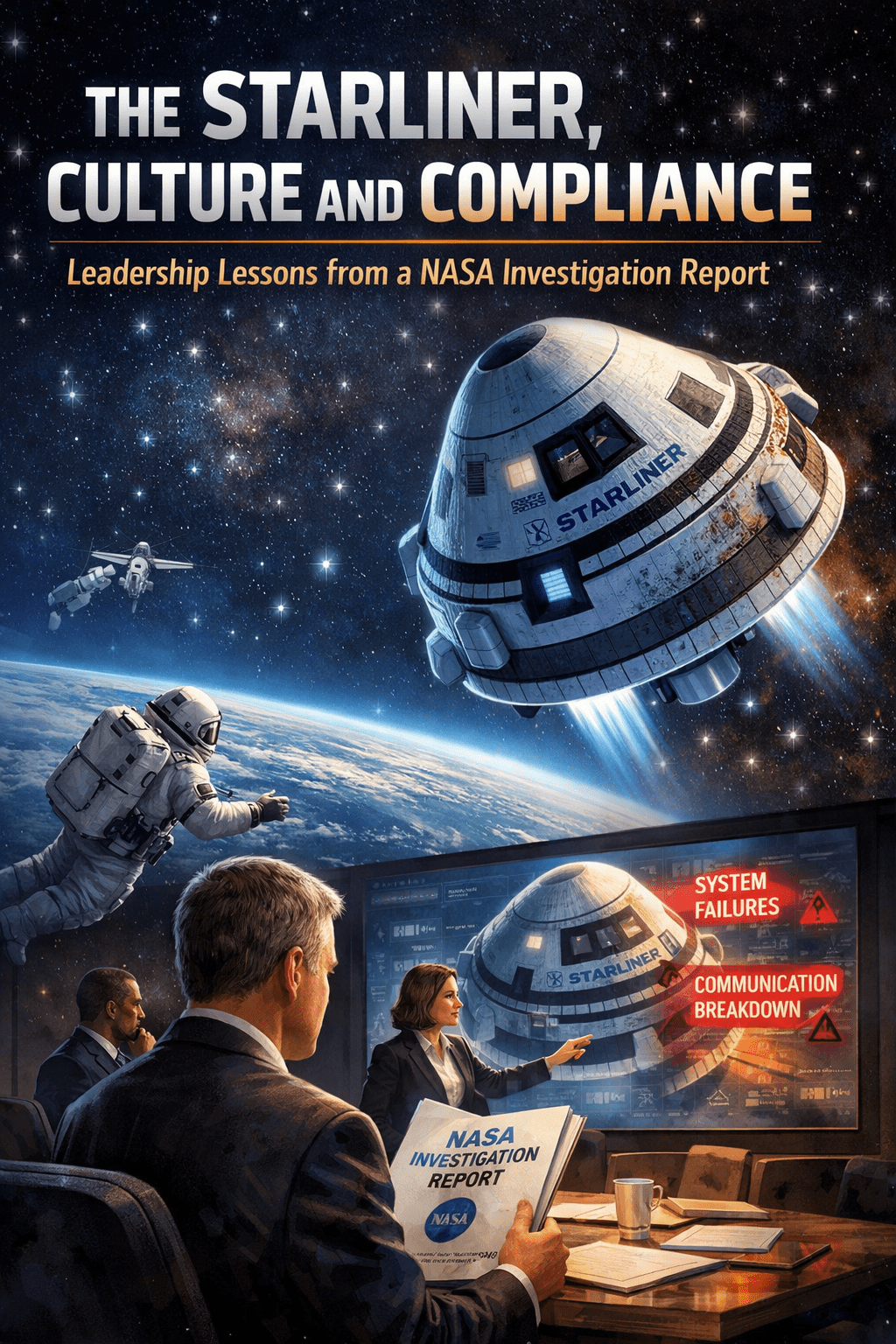
The Starliner, Culture and Compliance: Leadership Lessons from a NASA Investigation Report

Corporate compliance professionals spend a lot of time talking about controls, training, third parties, and investigations. Yet the hard truth is that the most important control environment sits above all of that: leadership behavior and the culture it creates. That is why this NASA investigation report on the Boeing CST-100 Starliner Crewed Flight Test (CFT) is such a useful case study. It is a technical report, to be sure. But it is also a cultural, leadership, and governance report. NASA’s bottom line is unambiguous: technical excellence and safety require transparent communication and clear roles and responsibilities, not as slogans, but as operating requirements that must be institutionalized so safety is never compromised in pursuit of schedule or cost.

If you are a Chief Compliance Officer, General Counsel, or business leader, you should read this report the way you read an enforcement action. Not to gawk. Not to assign blame. But to harvest lessons for your own organization before you have your own high-visibility close call.

The incident(s) that led to the report

The CFT mission launched June 5, 2024, as a pivotal step toward certifying Starliner to transport astronauts to the International Space Station. It was planned as an 8-to-14-day mission but was extended to 93 days after significant propulsion system anomalies emerged. Ultimately, the Starliner capsule returned uncrewed, while astronauts Barry “Butch” Wilmore and Sunita “Suni” Williams returned aboard SpaceX’s Crew-9 Dragon in March 2025. In February 2025, NASA chartered a Program Investigation Team (PIT) to examine the technical, organizational, and cultural factors contributing to the anomalies.

The report describes four major hardware anomaly areas, including Service Module RCS thruster fail-offs that temporarily caused a loss of 6 Degrees of Freedom control during ISS rendezvous and required in-situ troubleshooting to recover enough capability to dock, a Crew Module thruster failure during descent that reduced fault tolerance, and helium manifold leaks where seven of eight Service Module helium manifolds leaked during the mission. The PIT further determined that the 6DOF loss during rendezvous met criteria for a Type A mishap (or at least a high-visibility close call), underscoring how close the program came to a very different ending.

That is the “what.” For compliance professionals, the “so what” is that NASA did not treat this as a purely engineering problem. It treated it as an integrated system failure, in which culture and leadership either reduce risk or magnify it.

Lesson 1: Decision authority is culture, not paperwork

One of the report’s clearest threads is that fragmented roles and responsibilities delayed decision-making and eroded confidence. In the compliance world, unclear decision rights become the breeding ground for “informal governance”: private conversations, end-runs around committees, and decisions that are never fully documented. Over time, that becomes a shadow-control environment that your policies cannot touch.

Compliance action steps

  • Define decision rights for the riskiest calls (high-risk third parties, market entry, major remediation, critical incidents).
  • Require a short, written record of: facts reviewed, options considered, dissent captured, decision made, and owner accountable.
  • Separate “recommendation authority” from “approval authority” so everyone knows where they sit.

Lesson 2: Transparency is a control, and selective data sharing destroys trust

The report explicitly flags that the lack of data access fueled concerns about selective information sharing. Interviewees described frustration that information could be filtered, selectively chosen, or sanitized, which eroded confidence in the process and people. It also notes reports of questions being labeled “too detailed” or “out of scope” without mechanisms to ensure concerns were addressed. That is the compliance danger zone. When teams believe the narrative matters more than the data, they stop escalating early. They start documenting defensively. They seek safety in silence.

Compliance action steps

  • Build “open data” expectations into your incident response and investigative protocols.
  • Create a defined pathway for technical or subject-matter dissent to be logged, reviewed, and dispositioned.
  • Treat meeting notes and decisions as governed records, not optional artifacts.

Lesson 3: Risk acceptance without rigor becomes “unexplained anomaly tolerance”

NASA calls out “anomaly resolution discipline” and warns that repeated acceptance of unexplained anomalies without root cause can lead to recurrence. That single lesson belongs on a poster in every compliance office. In corporate terms, “unexplained anomalies” are recurring control exceptions, repeat hotline themes, repeated third-party red flags, and audit findings that are “managed” rather than fixed. If leadership normalizes that pattern, it teaches the organization that closure is more important than correction.

Compliance action steps

  • Require root cause analysis for repeat issues, not just incident closure.
  • Set escalation thresholds for “repeat with no root cause” findings.
  • Audit remediation quality, not only remediation completion.

Lesson 4: Partnerships fail when “shared accountability” is not operationalized

The report emphasizes that shared accountability in the commercial model was inconsistently understood and applied. It also notes that historical relationships and private conversations outside formal forums created perceptions of blurred boundaries, favoritism, and lack of objectivity, whether or not those perceptions were accurate. Compliance teams have seen this movie. Think distributors, joint ventures, outsourced compliance support, and major technology partners. If accountability is shared in theory but siloed in practice, something will fall through the cracks. Usually, it falls right into your lap when regulators arrive.

Compliance action steps

  • Define “shared accountability” in contracts, governance charters, and escalation protocols.
  • Ensure independence and objectivity are protected by design, not by personality.
  • Create joint forums where data is shared broadly, dissent is recorded, and decisions are made openly.

Lesson 5: Burnout is a risk factor, and meeting chaos is a governance failure

The report’s recommendations recognize the operational reality: high-pressure environments can degrade decision quality. It calls for “pulse checks,” rotation of high-pressure responsibilities, contingency staffing, and time protection for deep work to proactively address burnout and improve decision-making under mission conditions. Compliance professionals should take that to heart. Crisis cadence is sometimes unavoidable. Permanent crisis cadence is a leadership choice. And it carries predictable consequences: shortcuts, missed details, weakened documentation, and poor judgment.

Compliance action steps

  • Build surge staffing plans for investigations and incident response.
  • Rotate incident commander roles when events extend beyond days.
  • Protect time for analysis, not just meetings and status updates.

Lesson 6: Accountability must be visible, not performative

NASA does not bury the human dimension. The report contains leadership recommendations to speak openly with the joint team about leadership accountability, including concurrence with the report and reclassification as a mishap, and to hold a leadership-led stand-down day focused on reflection, accountability concerns, and rebuilding trust. For corporate leaders, this is where trust is won or lost after a crisis. Employees can tolerate a hard outcome. They struggle to tolerate spin. If your organization communicates externally with confidence but internally with vagueness, your culture learns the wrong lesson: optics first, truth second.

Compliance action steps

  • After a major incident, publish an internal accountability and remediation plan with owners and timelines.
  • Provide regular updates on what has been completed, what is delayed, and why.
  • Make it safe for the workforce to ask questions in interactive forums, as NASA recommends.

Lesson 7: Trust repair requires a plan, not a pep talk

One of the most useful artifacts in the report is a sample Organizational Trust Plan. It sets a goal to rebuild trust by establishing clear expectations, open accountability, and shared commitment to safety and mission success. It includes objectives around transparent communication, acknowledging past challenges, reinforcing shared values, and structured engagement. It then lays out action steps: leadership engagement, facilitated sessions, outward expressions of accountability, teamwide rollout, training and coaching, and communication through a written plan and regular updates.

That is exactly the kind of operational discipline compliance leaders should bring to culture work. Culture does not change because someone gives a speech. Culture changes when the organization changes how it makes decisions, treats dissent, and follows through.

Five key takeaways for the compliance professional

  1. Clarify decision rights before the crisis. Ambiguity becomes politics under pressure.
  2. Make transparency non-negotiable. Perceived filtering of data destroys credibility.
  3. Do not normalize unexplained anomalies. Repeat issues without a root cause are future failures.
  4. Operationalize shared accountability with partners. Otherwise, it is a slogan.
  5. Rebuild trust with a written plan and visible accountability. Trust repair is a managed process.

In the end, the Starliner lesson for compliance is simple: controls matter, but culture decides whether controls work when it counts. If leadership cannot run disagreements well, cannot share data broadly, and cannot demonstrate accountability after the fact, the best-written compliance program in the world will fail the moment the pressure rises.

Categories
AI Today in 5

AI Today in 5: February 24, 2026, The AI in Pharma Edition

Welcome to AI Today in 5, the newest addition to the Compliance Podcast Network. Each day, Tom Fox will bring you 5 stories about AI to start your day. Sit back, enjoy a cup of morning coffee, and listen in to the AI Today In 5. All, from the Compliance Podcast Network. Each day, we consider five stories from the business world, compliance, ethics, risk management, leadership, or general interest about AI.

Top AI stories include:

  1. AI-powered pharma compliance. (FastCompany)
  2. Shadow AI in healthcare. (AHCJ)
  3. Stronger compliance is needed to mitigate AI liability. (CW)
  4. AI in banking. (TheFinancialBrand)
  5. Anthropic accuses China of hacking Claude. (WSJ)

For more information on the use of AI in Compliance programs, my new book, Upping Your Game, is available. You can purchase a copy of the book on Amazon.com.