Categories
Blog

Design-Centric Internal Controls: The Foundation for Compliance Excellence

The dynamic world of compliance is continually evolving. New regulations, emerging technologies, and changing market conditions demand that organizations remain vigilant and proactive in their compliance efforts. One crucial aspect of this ongoing vigilance is the design and implementation of internal controls. Recently, I had the pleasure of discussing this topic with Adrienne Bellehumeur. In this blog post, we will explore the key insights from our conversation and delve into the importance of design-centric internal controls.

Adrienne is a chartered accountant and entrepreneur in Canada who has advocated for a design-first approach to internal controls for many years. Adrienne says design-centric internal controls are essential because they lay the foundation for effective compliance. She likens this approach to baking a cake: the design is the cake itself, while testing and other compliance activities are the icing. Without a solid foundation, no amount of testing can ensure the effectiveness of internal controls.

The necessity of robust internal controls has never been more critical. With the increasing complexity of regulatory requirements (on both sides of the border) and the rapid advancement of technology, organizations must continuously assess and improve their internal control systems. Adrienne points out that while internal controls have existed for over two decades, many organizations have become complacent. This complacency can lead to outdated processes that may not adequately address current risks and regulatory expectations.

Adrienne outlined five principles to improve and energize control design work:

  1. Think of Design as the Cake and Testing as the Icing: Focus on building solid and well-thought-out processes before jumping into testing. This approach ensures that the foundation is solid and can withstand scrutiny.
  2. Assess the Organization’s Level of Maturity: Tailor the internal control program to the organization’s stage of development. A one-size-fits-all approach is ineffective, as different organizations have varying needs and challenges.
  3. Focus on Habits, Not Theory: Practical, habitual practices are more effective than theoretical concepts. Encourage habits like regular access control reviews and inventory management to embed compliance into the organizational culture.
  4. Support Continuous Improvement: Internal controls should not be static. Regularly review and update controls to ensure they remain effective and relevant. Continuous improvement helps organizations stay ahead of emerging risks and regulatory changes.
  5. Keep It Interesting: Vary the techniques used in internal control assessments to maintain engagement and effectiveness. Workshops, interviews, and creative diagramming can provide fresh perspectives and uncover new insights.

One of the most intriguing aspects of Adrienne’s approach is her use of workshops to discuss and improve internal controls. These workshops involve stakeholders, including internal auditors, compliance officers, and business unit leaders. By fostering open dialogue and collaboration, these sessions can identify inefficiencies, propose improvements, and build stronger relationships between auditors and the internal team.

Adrienne emphasizes that these workshops should occur before external audits. This pre-audit preparation allows organizations to address issues internally, reducing the likelihood of negative findings during the audit. Moreover, involving the internal team in the design process helps build a sense of ownership and commitment to maintaining robust controls.

For the internal auditor, leveraging technology is crucial for adequate internal controls. Adrienne highlighted the decreasing reliance on transactional testing, thanks to automation and data analytics advancements. Modern internal controls must adapt to these changes by incorporating technology that enhances efficiency and accuracy.

AI and data analytics can provide deeper insights into organizational processes, helping identify potential risks and areas for improvement. By integrating these technologies into the internal control framework, organizations can achieve higher precision and responsiveness.

Adrienne’s expertise in documentation is particularly relevant to internal controls. I wholeheartedly agree that good documentation practices are the backbone of any effective compliance program and form the basis of information management. Clear, accurate, accessible documentation supports transparency, accountability, and continuous improvement.

Companies must establish simple rules for naming, classifying, and managing documents. This foundational step ensures that all relevant information is readily available for internal reviews, audits, and regulatory inspections.

The compliance landscape continually evolves, with new challenges like ESG and AI gaining prominence. Adrienne articulated that a back-to-basics approach can help organizations navigate these new areas. Organizations can build a solid foundation that supports emerging compliance requirements by focusing on fundamental principles of good information management and documentation.

For instance, effective ESG reporting relies on accurate and comprehensive data. Similarly, AI systems must be underpinned by robust data management practices to ensure transparency and accountability. By strengthening these foundational elements, organizations can more easily adapt to new regulatory expectations and technological advancements.

Adrienne and I also discussed the role of internal controls in supporting whistleblower programs. With the Department of Justice (DOJ) formulating new rules for financial incentives in whistleblower programs, organizations must ensure their internal controls can detect and address issues before they escalate. Adequate internal controls can help prevent whistleblower claims by identifying and mitigating risks early. For example, strong documentation practices provide a clear audit trail that can validate the organization’s actions and decisions. Additionally, fostering a culture of transparency and accountability encourages employees to report concerns internally, allowing the organization to address them proactively.

Design-centric internal controls are essential for building a robust and effective compliance program. By focusing on the principles outlined by Adrienne Bellehumeur, organizations can enhance their internal control frameworks, support continuous improvement, and stay ahead of emerging compliance challenges. A proactive approach to internal controls is crucial for long-term compliance success, whether through innovative workshops, leveraging technology, or strengthening documentation practices.

Categories
FCPA Compliance Report

FCPA Compliance Report: Jonathan Armstrong on Sweeping Changes in The UK Government: Insights on Compliance

Welcome to the award-winning FCPA Compliance Report, the longest running podcast in compliance. In this edition of the FCPA Compliance Report, Tom Fox welcome Jonathan Armstrong to discuss the seismic shift in the UK’s political landscape following the election last week.

The election was literally one for the ages. It led to a significant Labor victory over the Conservatives. They delve into the implications for compliance and governance in both the UK and globally. Topics include the new government’s proactive approach, anticipated shifts in bribery enforcement, and fiscal policies.

They also explore potential changes in AI regulation, employment law, data protection, and international relations, especially concerning Russia and China. The conversation highlights Labor’s balanced strategy, aiming for sensible, centrist policies while addressing key issues like corruption, AI, and data privacy.

Highlights in this Episode:

  • An election result for the ages
  • Impact on Bribery and Corruption Enforcement
  • Trade Sanctions, Russian Oligarch’s and Forced Labor
  • AI and Beyond
  • Data Privacy and Data Protection
  • Labor and Employment Rights

 Resources:

Jonathan Armstrong on LinkedIn

UK General Election 2024 – What Might This Mean for Compliance?

Tom Fox

Instagram

Facebook

YouTube

Twitter

LinkedIn

For more information on the Ethico ROI Calculator and a free White Paper on the ROI of Compliance, click here.

Categories
Blog

Elevating Your Risk Assessment Game with AI and Machine Learning, Part II

We conclude this two-part blog post on using Artificial Intelligence (I) and Machine Learning (ML) in risk assessments. By embracing AI and machine learning, compliance professionals can elevate their risk assessment capabilities, drive more informed decision-making, and position their organizations for long-term success in an increasingly complex and volatile business landscape. Today, we conclude with how to use these tools and some use cases.

When adopting AI-powered risk assessment solutions, compliance functions will face several key challenges, which can be addressed through a well-planned and strategic approach. Key challenges include implementing a robust data governance framework to ensure data quality, integration, and accessibility across the organization. Invest in data cleansing, normalization, and enrichment processes to prepare the data for AI models. You must be able to demonstrate how you got to certain decisions. To do so, you can use tools such as decision trees or logistic regression to explain their decision-making process better.

Your risk management model should ensure the accuracy, reliability, and fairness of the AI-powered risk assessment. To do so, you can establish a comprehensive model validation and governance framework, which includes regular performance monitoring, stress testing, and bias testing. The model validation process involves cross-functional teams, including risk experts, data scientists, and compliance professionals.

Multiple compliance areas lend themselves to use cases for AI and machine learning in risk assessment.

  1. Fraud Detection and Prevention. Machine learning algorithms can analyze transaction data, user behavior patterns, and other relevant information to identify suspicious activities and detect potential fraud in real-time. AI-powered anomaly detection can flag unusual transactions or account activities that deviate from the norm, allowing organizations to investigate fraud risks quickly and mitigate them.
  2. Vendor and Third-Party Risk Management. AI can rapidly assess the risk profiles of vendors, suppliers, and other third parties by aggregating and analyzing structured and unstructured data from various sources, including news reports, social media, and regulatory filings. Machine learning models can continuously monitor third-party relationships, detect changes in risk factors, and provide dynamic risk scoring to support vendor due diligence and ongoing risk mitigation.
  3. Compliance and Regulatory Risk. AI-driven natural language processing can help organizations stay on top of evolving regulatory requirements by automatically scanning and interpreting new laws, regulations, and industry guidelines. Machine learning can assist in identifying potential compliance gaps, policy violations, and other regulatory risks by analyzing internal data, such as employee activities, communications, and transactions.
  4. Operational Risk Assessment. AI and machine learning can model and simulate complex business processes, identify potential points of failure, and predict the likelihood and impact of operational disruptions. These technologies can also be leveraged to monitor and analyze real-time data from IoT devices, sensors, and other operational systems to detect anomalies and emerging risks.
  5. Enterprise Risk Management. AI-powered risk aggregation and correlation analysis can help organizations gain a more holistic, enterprise-wide view of their risk landscape, identifying interdependencies and potential risk concentrations. Machine learning algorithms can assist in prioritizing risks based on factors such as likelihood, impact, and velocity, enabling more informed decision-making and resource allocation.
  6. Emerging Risk Identification. AI and machine learning can scour vast amounts of external data, including news, social media, and industry reports, to identify emerging risks and trends that may not be apparent through traditional risk assessment methods. These technologies can also simulate future scenarios and stress test the organization’s resilience against potential black swan events or disruptive changes in the business environment.

By focusing on these traditional corporate risks, compliance professionals can enhance their risk assessment capabilities, improve decision-making, and better position themselves to navigate the increasingly complex and dynamic risk landscape. Integrating AI and machine learning into risk assessment requires a strategic, well-planned approach, commitment to continuous improvement, and a culture of innovation.

As you embark on this transformative journey, remember that integrating AI and ML is not a one-time event but a continuous refinement, learning, and adaptation process. Stay agile, keep an open mind, and be prepared to navigate the evolving compliance and risk management landscape.

The future of risk assessment is here, and it is powered by the extraordinary potential of artificial intelligence and machine learning for compliance professionals. Embrace this opportunity to unlock new levels of insight, efficiency, and proactivity – and lead your organization towards a more resilient and compliant future.

Categories
Blog

Elevating Your Risk Assessment Game with AI and Machine Learning, Part I

I am on a mission to explore how AI and machine learning (ML) can impact the compliance profession, the compliance profession, and the corporate compliance function. Today, I want to explore using AI and ML in risk assessment. I believe that they both have the potential to transform the way we approach risk identification, analysis, and mitigation. By harnessing the capabilities of AI and ML, compliance teams can elevate their risk assessment game and position their organizations for long-term success. Today, in Part I, we consider why you should utilize AI and ML in your risk assessment process and the first steps to take.

For years, organizations have relied on manual, human-driven risk assessment approaches. This often involves painstaking data gathering, expert interviews, document reviews, and applying risk frameworks and methodologies. While these time-tested methods have their merits, they are inherently limited in several ways:

  • Subjectivity and Bias: Human risk assessors bring their own experiences, perspectives, and biases to the table, which can lead to inconsistent or skewed risk evaluations.
  • Scalability Challenges: As businesses grow in size and complexity, manually assessing every risk factor becomes overwhelming and resource-intensive.
  • Reactivity vs. Proactivity: Traditional risk assessment tends to be retrospective, focusing on known or historical risks. Anticipating emerging threats requires a more forward-looking, proactive approach.
  • Lack of Real-Time Responsiveness: The pace of change in today’s business environment means that risk profiles can shift rapidly. Manual processes may need help to keep up with these dynamic conditions.

AI and ML offer promising solutions to overcome the limitations of manual risk assessment. By leveraging these technologies, compliance teams can identify a more significant overall set of risks. AI-powered systems can scour vast internal and external datasets to uncover potential risk factors that human analysts may have overlooked. Machine learning algorithms can identify patterns, anomalies, and correlations, providing a more comprehensive, data-driven view of the risk landscape.

However, it is not simply the ability to uncover more risks through greater data sets but also the ability to use AI and ML tools. Compliance professionals can quantify and model risk variables with greater precision, considering a broader range of factors and their interdependencies. This allows for more accurate risk scoring, prioritization, and scenario planning. This leads directly to anticipating emerging threats and vulnerabilities, empowering organizations to take proactive measures.

Consistency and objectivity are critical for any risk assessment. In this area, AI and ML-based systems can apply consistent, standardized risk assessment methodologies, reducing the impact of individual biases and subjectivity. Automated risk assessment powered by AI and ML can also process large volumes of data and handle complex risk evaluation tasks, freeing compliance professionals to focus on strategic decision-making. The goal is to move towards a more continual monitoring system, and here,  AI-driven risk assessment can be integrated into real-time monitoring and alert systems, allowing organizations to quickly identify and respond to changes in their risk profiles.

How does a compliance function implement all of this AI and ML? There are several steps you should consider.

  • Assess Your Data Readiness: Effective AI and ML-powered risk assessment relies on high-quality, structured data availability. The DOJ mandates that you have access to your company’s data, including identifying any gaps or limitations and developing a plan to enhance data governance and management.
  • Identify Use Cases and Prioritize: Conduct a thorough analysis of your risk assessment needs and pain points. In other words, what are your high-risk areas? Determine which specific areas – such as fraud detection, vendor risk management, or third parties – could benefit the most from AI and ML-driven solutions.
  • Evaluate and Select the Right Tools: Research and evaluate a range of AI and ML-powered risk assessment platforms and solutions. Consider factors like integration capabilities, user-friendliness (it’s all about the UX), scalability, and the provider’s track record in compliance and risk management.
  • Pilot and Iterate: Start with a targeted pilot project to test the viability and effectiveness of your chosen AI and ML-based risk assessment approach. (Hint: Start small with a low-risk target.) Closely monitor the results, gather feedback, and continuously refine the solution to optimize its performance.
  • Train Your Team: Ensure compliance and risk management professionals have the necessary skills and knowledge to effectively leverage AI and ML technologies. Invest in training, workshops, and collaboration with data science and technology experts.
  • Establish Governance and Oversight: Develop robust governance frameworks to ensure the responsible and ethical use of AI and ML in risk assessment. This includes addressing algorithm bias, data privacy, and human oversight.
  • Foster a Culture of Innovation: Encourage a mindset of continuous improvement and experimentation within your compliance function. Empower team members to explore new ways of leveraging emerging technologies to enhance risk assessment and drive organizational resilience.

Join us tomorrow to consider implementation and some compliance use cases.

Categories
Compliance Tip of the Day

Compliance Tip of the Day: Why Use Ai and ML in Risk Assessments?

Welcome to “Compliance Tip of the Day,” the podcast where we bring you daily insights and practical advice on navigating the ever-evolving landscape of compliance and regulatory requirements.

Whether you’re a seasoned compliance professional or just starting your journey, our aim is to provide you with bite-sized, actionable tips to help you stay on top of your compliance game.

Join us as we explore the latest industry trends, share best practices, and demystify complex compliance issues to keep your organization on the right side of the law.

Tune in daily for your dose of compliance wisdom, and let’s make compliance a little less daunting, one tip at a time.

In this episode, we consider why you should move away from human-driven risk assessment to AI and ML-assisted risk assessments.

For more information on the Ethico ROI Calculator and a free White Paper on the ROI of Compliance, click here.

Categories
Compliance Tip of the Day

Compliance Tip of the Day: Strategic Considerations for Implementing AI in Compliance

Welcome to “Compliance Tip of the Day,” the podcast where we bring you daily insights and practical advice on navigating the ever-evolving landscape of compliance and regulatory requirements.

Whether you’re a seasoned compliance professional or just starting your journey, our aim is to provide you with bite-sized, actionable tips to help you stay on top of your compliance game.

Join us as we explore the latest industry trends, share best practices, and demystify complex compliance issues to keep your organization on the right side of the law.

Tune in daily for your dose of compliance wisdom, and let’s make compliance a little less daunting, one tip at a time.

In today’s episode, we consider some of the strategic considerations for implementing AI in  your compliance program.

For more information on the Ethico ROI Calculator and a free White Paper on the ROI of Compliance, click here.

Categories
Trekking Through Compliance

Trekking Through Compliance – Episode 21 – Return of the Archons

In this episode of Trekking Through Compliance, we consider the episode Return of the Archons, which aired on February 9, 1967, with a Star Date of 3156.2.

The Enterprise arrives at the planet Beta III in the C-111 system, where the USS Archon was reported lost nearly 100 years earlier. They find the inhabitants living in a 19th-century Earth-style culture, ruled by cloaked and cowled “Lawgivers” and a reclusive dictator, Landru.

It turns out that Landru “pulled the Archons down from the skies.” They learn that Landru saved their society from war and anarchy 6,000 years ago and reduced the planet’s technology to a simpler level.
Marplon takes Kirk and Spock to the Hall of Audiences, where priests commune with Landru. A projection of Landru appears and threatens them. Kirk and Spock use their phasers to blast through the wall and expose a computer programmed by Landru, who died 6,000 years ago. The computer neutralizes their phasers. Kirk and Spock argue that because the computer has destroyed people’s creativity by disallowing their free will, it is evil and should self-destruct, freeing the people of Beta III. The computer complies.

Commentary

The Enterprise crew encounters a repressive society ruled by an ancient computer, highlighting the dangers of centralized power and control. Key compliance takeaways include the need for decentralized governance structures, transparency and auditability, failsafe mechanisms, federated architectures, empowered redress and appeals processes, and human-centric design principles. These lessons aim to mitigate the risks of centralized power and safeguard individual liberties.

Key Highlights

  • Plot Summary: Return of the Archons
  • Compliance Lessons from the Episode
  • Decentralized Governance in Compliance
  • Ensuring Transparency and Auditability
  • Failsafe Mechanisms and Federated Architectures

Resources

Excruciatingly Detailed Plot Summary by Eric W. Weisstein

MissionLogPodcast.com

Memory Alpha

Categories
Blog

How Transparency Reporting is Transforming Life Sciences

What is transparency reporting in life sciences? How does it impact your compliance program? I recently had the opportunity to visit with Lucas Croteau, an innovator in the life sciences compliance sector, to explore these and other questions, highlighting the challenges, opportunities, and innovative solutions that are reshaping compliance practices in the life sciences sector today. (The full podcast is available here.) Croteau shared his journey and expertise in transparency reporting—a critical yet often overlooked component of life science compliance.

Lucas Croteau’s professional journey is nothing short of fascinating. With over a decade in consulting and eight years dedicated to compliance, Lucas has become a leading figure in transparency reporting. His initial foray into this niche area began at Medispend, a pioneer in software solutions for compliance. Over the years, Lucas noticed a significant gap: while many tools existed, the expertise to implement and manage transparency programs effectively was lacking.  This realization led Lucas to found TracedData, a company dedicated to bridging the gap between technology and practical application. His mission? Compliance should be manageable and accessible, particularly for small to mid-sized life sciences companies.

Since 2010, the most recurring theme in all my compliance-related speeches, talks, and presentations has been the critical importance of documentation. As I often say, any compliance program’s three most important aspects are document, document, document. Croteau shares this sentiment, emphasizing that meticulous documentation is the backbone of any successful transparency program. It is not simply about meeting regulatory requirements but about creating an auditable, transparent system that can withstand scrutiny from regulators and business partners.

Croteau identified a market need for expert support in transparency reporting, especially for small to mid-sized companies, which need to be more significant to have a dedicated Chief Compliance Officer or corporate compliance function. These organizations often run lean compliance programs, requiring more internal resources to handle the complexities of transparency reporting. This is where TracedData steps in, offering a solution that is both cost-effective and comprehensive.

Croteau prefers “insourced” over “outsourced” to describe his approach. His team integrates seamlessly into client organizations, functioning as an extension of their staff. This model ensures compliance is a checkbox activity and a well-managed, ongoing process.

TracedData’s primary customers are small to mid-sized pharmaceutical, medical device, and biotech companies. These organizations often struggle to maintain robust compliance programs due to limited resources. For them, outsourcing transparency reporting to a specialized partner like TracedData provides significant value. It allows them to focus on their core business activities while ensuring compliance with regulatory requirements.

Croteau explained that many small—to mid-sized companies either need to help hire full-time compliance experts or delegate tasks to employees who lack the necessary expertise. TracedData fills this gap by offering specialized services at a fraction of the cost of an in-house team. Lucas and his team handle everything from data capture to report submission. They work closely with clients to build audit-ready programs, ensuring all documentation and regulatory requirements are in place. This comprehensive approach allows companies to achieve compliance without the associated stress and resource drain.

Artificial Intelligence (AI) is a hot topic in compliance, and for good reason. It has the potential to revolutionize how we manage and report data. Lucas sees AI as a significant opportunity in the life sciences sector, particularly for data monitoring and proactive risk mitigation. While AI is still emerging, its potential to streamline compliance processes and enhance accuracy is undeniable.

Croteau highlighted the work of Helio, a company at the forefront of AI in life sciences. They utilize AI to monitor data effectively, providing a glimpse into the future of compliance management. At TracedData, AI is already used to identify and correct misclassified transactions, demonstrating its practical benefits.

Compliance in the life sciences sector is not confined to the United States. Companies operating globally face myriad regulatory requirements, each with its own nuances. Lucas explained that transparency reporting varies significantly from country to country, making it a complex and ever-evolving challenge. Some companies build global reporting structures to manage this, while others handle compliance country-by-country. This tailored approach ensures that local regulations are met but also requires a deep understanding of each market’s requirements.

My conversation with Croteau underscored the importance of expertise, documentation, and innovative solutions in life sciences compliance. Companies must adapt as the regulatory landscape evolves by leveraging specialized partners and embracing new technologies like AI. For small to mid-sized companies, outsourcing transparency reporting to experts can provide the assurance and efficiency needed to thrive in this challenging environment.

Categories
2 Gurus Talk Compliance

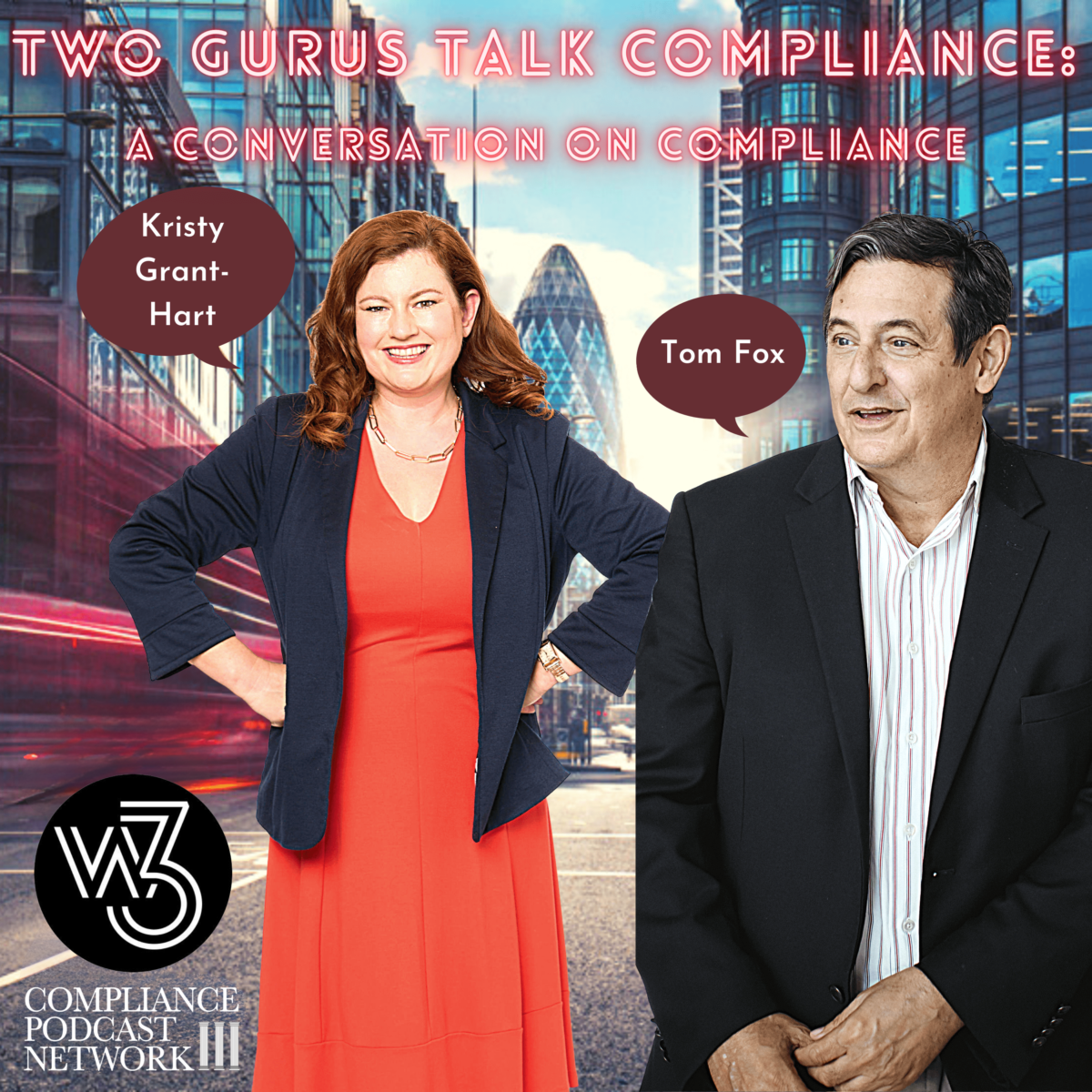
2 Gurus Talk Compliance: Episode 31— AI, Compliance and Crypto

What happens when two top compliance commentators get together? They talk compliance, of course. Join Tom Fox and Kristy Grant-Hart in 2 Gurus Talk Compliance as they discuss the latest compliance issues in this week’s episode!

In this episode of 2 Gurus Talk Compliance Podcast, hosts Kristy Grant-Hart and Tom Fox discuss AI’s role in unmasking whistleblowers, the latest fallout from cryptocurrency firms under SEC scrutiny, advancements in tracking sanctioned commodities, and the humorous mishap involving a Florida man and laxatives. They also delve into the implications of workplace violence prevention laws, BP’s new office relationship rules, and check in on corruption and legal developments involving figures like Bob Menendez and Benny Steinmetz. Ending on a lighter note, a Florida man finds himself in trouble after substituting opioids with laxatives.

Stories Include:

  • Tyson Foods CFO was suspended for drunk driving. (Bloomberg)
  • 5 takeaways from Menendez trial.(CNN)
  • FAA says greater oversight needed over Boeing.(NYT)
  • Terraform settles with SEC for $4.5bn.(FT)
  • Beny Steinmetz profile.(OCCPR)
  • The Double-Edged Impact of AI Compliance Algorithms on Whistleblowing (National Law Review)
  • BP Tightens Rules Over Office Relationships in Wake of Former CEO’s Departure (WSJ)
  • Keeping Sanctioned Russian Timber Out of the EU Is Tricky. This Nonprofit Has a Solution (WSJ)
  • New York Bill Would Provide Protections Against Workplace Violence for Retail Employees (Seyfarth)
  • Florida Man Steals Constipation Drugs Thinking They Were Opioids (Florida has a right to know) 

Resources:

Kristy Grant-Hart on LinkedIn

Spark Consulting

Prove Your Worth

Tom

Instagram

Facebook

YouTube

Twitter

LinkedIn

Categories
Compliance and AI

Compliance and AI: Lucas Croteau on AI and Reporting within Life Sciences Compliance

What is the role of Artificial Intelligence in compliance? What about Machine Learning? Are you using ChatGPT? These are but three of the many questions we will explore in this cutting-edge podcast series, Compliance and AI, hosted by Tom Fox, the award-winning Voice of Compliance.

In this episode, Tom visits Lucas Croteau, a leader in life sciences compliance.

This podcast delves into Lucas’s professional journey, his work with transparency reporting for companies, and his tenure with MediSpend, which led him to co-found TracedData. Croteau discusses his target market, primarily small to midsize pharmaceutical, medical device, and biotech companies, and the pressing need for transparency and compliance in these industries. The conversation also explores the role of artificial intelligence in compliance reporting, the challenges of managing regulatory requirements globally, and the importance of strategic partnerships for efficient compliance programs.

Key Highlights:

  • Lucas Croteau ‘s Professional Background
  • Founding TracedData and Market Needs
  • Making Compliance Easy with TracedData
  • Data Capture in Life Sciences Compliance
  • AI in Compliance Reporting
  • Global Regulatory Challenges
  • Future of Life Sciences Compliance

Resources:

Lucas Croteau on LinkedIn

TracedData

Tom Fox

Instagram

Facebook

YouTube

Twitter

LinkedIn