Categories
Blog

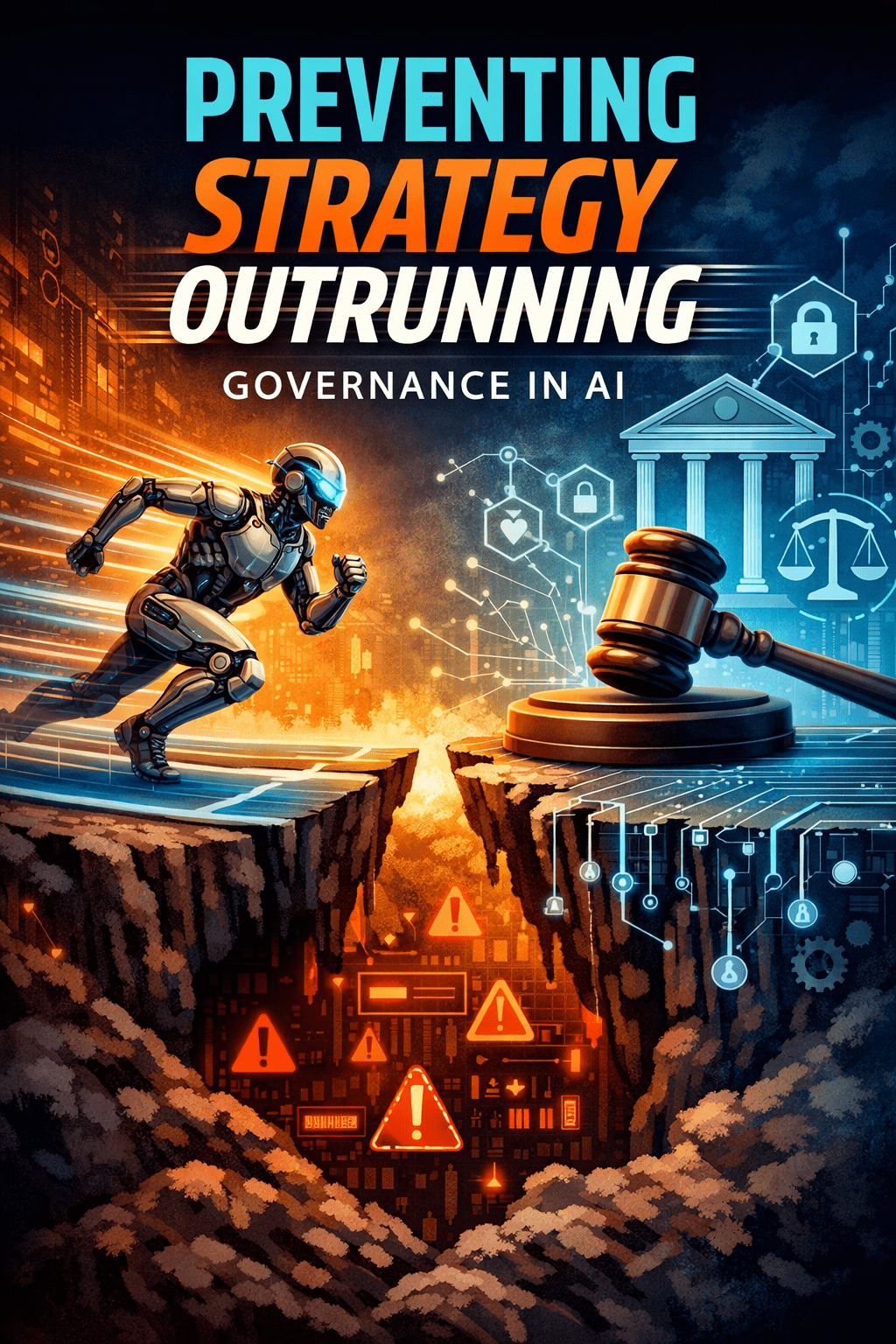
Preventing Strategy Outrunning Governance in AI

One of the clearest AI governance challenges facing companies today is not a failure of ambition. It is a failure of pacing. Put simply, strategy is moving faster than governance. Business teams want results. Senior executives hear daily about efficiency gains, lower costs, faster decision-making, enhanced customer engagement, and competitive advantage. Vendors are more than happy to promise it all. Employees are already experimenting with AI tools on their own. In that environment, the pressure to move quickly is relentless.

That is where the compliance function must step forward. Not to say no. Not to slow innovation for the sake of slowing it. But to ensure that innovation moves with structure, discipline, and accountability. Governance is not the enemy of AI strategy. Governance is what allows an AI strategy to scale without becoming an enterprise risk event.

The Central Question for Boards and CCOs

For boards, Chief Compliance Officers, and business leaders, the central question is straightforward: has the company defined the rules of the road before putting AI into production? If the answer is no, the company is already behind.

This is not a theoretical problem. It is happening every day. A business unit buys an AI-enabled tool before legal, compliance, IT, privacy, and security have reviewed it. A vendor pitches a product as low-risk automation, even though it actually makes consequential recommendations. An employee uploads sensitive data into a generative AI platform for convenience. A use case that began as internal support quietly migrates into customer-facing decision-making. A pilot project becomes business as usual without anyone documenting who approved it, what risks were considered, or what human oversight is supposed to look like.

That is what it means when strategy outruns governance. The business has a faster process for adopting AI than it has for understanding, controlling, and monitoring AI risk.

What the DOJ Expects

The Department of Justice has been telling compliance professionals for years that an effective compliance program must be dynamic, risk-based, and integrated into the business. That lesson applies directly here. Under the ECCP, prosecutors ask whether a company has identified and assessed its risk profile, whether policies and procedures are practical and accessible, whether responsibilities are clearly assigned, whether decisions are documented, and whether the program evolves as risks change. AI governance sits squarely in that framework.

What “Rules of the Road” Means in Practice

What do the “rules of the road” look like in practice?

First, the company must define which AI use cases are permissible. These are lower-risk applications that can be used within established controls. Think internal drafting support, workflow automation for non-sensitive administrative tasks, or summarization tools used on approved data sets. Even here, there should be basic conditions: approved tools only, no confidential data unless authorized, user training, logging, and manager accountability.

Second, the company must identify restricted or high-risk use cases. These are situations where AI may be allowed, but only after enhanced review. This can include uses involving personal data, HR decisions, customer communications, pricing, fraud detection, credit or eligibility decisions, compliance surveillance, or any function where bias, opacity, or error could create legal, regulatory, or reputational harm. These use cases should trigger a more formal process that includes a documented risk assessment, legal and compliance review, data governance checks, testing, defined human oversight, and ongoing monitoring.

Third, the company must be clear about prohibited use cases. If an AI application cannot be used consistently with the company’s values, control environment, legal obligations, or risk appetite, it should be off-limits. That might include tools that process sensitive data in unapproved environments, systems that make fully automated consequential decisions without human review, or applications that cannot be explained, tested, validated, or monitored sufficiently for their intended use.

Fourth, the company must establish escalation thresholds. Not every AI decision belongs at the board level, but some certainly do. Use cases involving strategic transformation, material legal exposure, major customer impact, significant third-party dependency, or high-consequence decision-making may need escalation to senior management, a designated AI or risk committee, or the board itself. If management cannot explain when a matter gets elevated, governance is too vague to be trusted.

Why the NIST AI RMF Matters

This is where the NIST Framework is so useful. NIST does not treat AI governance as a one-time signoff exercise. It organizes governance as an ongoing discipline through four connected functions: Govern, Map, Measure, and Manage. For compliance professionals, that is a practical operating model.

Governance means setting accountability, policies, oversight structures, and risk tolerances. It answers who is responsible, who decides, and what standards apply. A map means understanding the use case, context, stakeholders, data, and risks. It answers what the system is actually doing and where exposure lies. Measure means testing, validating, and assessing performance and controls. It answers whether the system works as intended and whether the company can prove it. Managing means acting on what is learned through oversight, remediation, change management, and continual improvement. It answers whether the company is prepared to respond when reality diverges from the plan.

How ISO 42001 Reinforces Governance Discipline

ISO 42001 reinforces the same message from a management systems perspective. It brings structure, accountability, controls, and continual improvement to AI governance. That matters because many organizations do not fail because of a lack of policy language. They fail because they do not operationalize accountability. ISO 42001 pushes companies to embed AI governance into defined processes, assign responsibilities, document controls, conduct internal reviews, and take corrective action. In other words, it turns aspiration into a management discipline.

What Happens When Strategy Outruns Governance

What happens when none of this is done well?

Shadow AI is usually the first warning sign. Employees use public or lightly reviewed tools because they are easy to use, fast, and readily available. Sensitive data may be entered without approval. Outputs may be used in business decisions without validation. The organization tells itself it is still in the experimentation phase, while the risk has already gone live.

Vendor-driven deployment is another danger. The company relies too heavily on what the vendor says the product can do and not enough on its own evaluation of what the product should do, how it works, what data it uses, and what controls are required. When something goes wrong, accountability becomes murky. Procurement says the business wanted speed. The business says IT approved the integration. IT says legal reviewed the contract. Legal says compliance owns the policy. Compliance says no one submitted the use case for formal review. That is not governance. That is institutional finger-pointing.

Undocumented approvals are equally dangerous. An AI tool is launched because everyone generally agrees it seems useful. But there is no record of the intended purpose, risk rating, required controls, human review standard, or approval rationale. Six months later, the company cannot explain why the system was deployed, what guardrails were put in place, or whether its use has drifted beyond its original scope.

The Compliance Mechanisms Companies Need Now

That is why companies need concrete compliance mechanisms now. They need an intake process for AI use cases to enter a formal review channel before deployment. They need risk tiering so not every use case gets the same treatment, but higher-risk applications receive enhanced scrutiny. They need approval workflows with defined roles for the business, legal, compliance, privacy, security, IT, and, where appropriate, model risk or internal audit. They need board reporting triggers to inform leadership when AI adoption crosses materiality or risk thresholds. They need a current model and use-case inventory so the company knows what is in operation. They need change management, so updates, retraining, vendor changes, and scope shifts are reviewed rather than assumed. And they need periodic review because AI risk does not stand still after launch.

The Special Role of Compliance

The compliance professional has a special role here. Compliance is often the function best positioned to connect governance, process, accountability, documentation, and escalation. That is precisely what the DOJ expects in an effective program. If the company can buy AI faster than it can classify risk, document controls, assign accountability, and test outcomes, the program is not keeping pace with the business. That gap will not stay theoretical for long. It will harden into enterprise risk.

Conclusion: Governance Must Keep Pace With Strategy

The lesson is direct. Strategy and governance must move together. AI governance is not a brake pedal. It is the steering system. A company that wants the benefits of AI must be disciplined enough to define where AI can go, where it cannot go, who decides, what gets documented, and when the business must stop and reassess. If the company can move faster on AI strategy than on AI governance, it is creating risk faster than it can manage. That is not innovation. That is exposure.

Categories
Blog

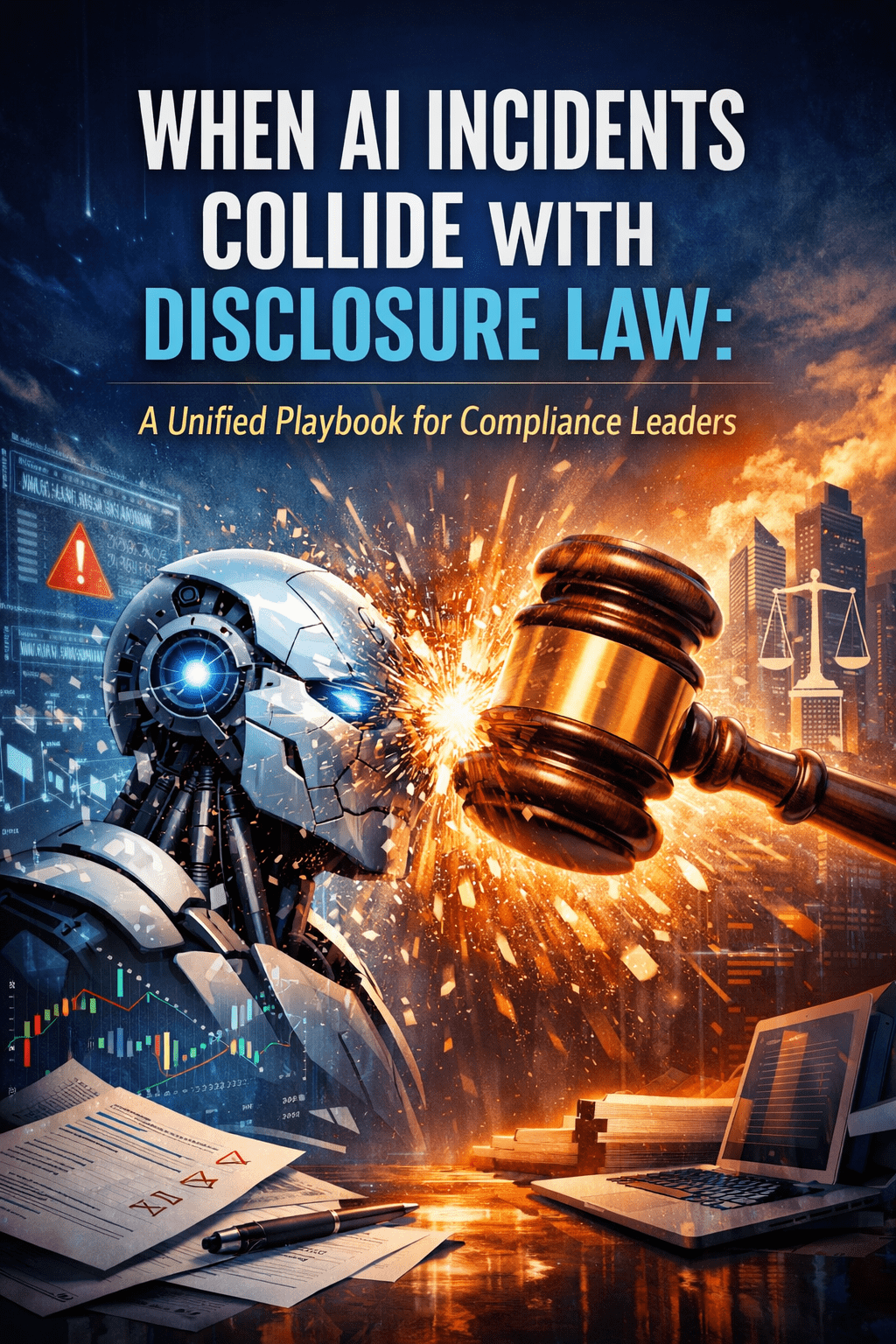
When AI Incidents Collide with Disclosure Law: A Unified Playbook for Compliance Leaders

There was a time when the risk of artificial intelligence could be discussed as a forward-looking innovation issue. That time has passed. AI governance now sits squarely at the intersection of operational risk, regulatory enforcement, and securities disclosure. For compliance professionals, the question is no longer whether AI risk will mature into a board-level issue. It already has.

If your organization deploys high-risk AI systems in the European Union, you face post-market monitoring and serious incident reporting obligations under the EU AI Act. If you are a U.S. issuer, you face potential Form 8-K disclosure obligations under Item 1.05 when a cybersecurity incident becomes material. Add the NIST AI Risk Management Framework for severity evaluation, ISO 42001 governance expectations for evidence and documentation, and the compliance function, which stands at the crossroads of law, technology, and investor transparency.

The challenge is not understanding each framework individually. The challenge is integrating them into one operational escalation model. Today, we consider what that means for the Chief Compliance Officer.

The EU AI Act: Post-Market Monitoring Is Not Optional

The EU AI Act requires providers of high-risk AI systems to implement post-market monitoring systems. This is not a paper exercise. It requires structured, ongoing collection and analysis of performance data, including risks to health, safety, and fundamental rights. Where a “serious incident” occurs, providers must notify the relevant national market surveillance authority without undue delay. A serious incident includes events that result in death, serious harm to health, or a significant infringement of fundamental rights. The obligation is proactive and regulator-facing. Silence is not an option.

This means that if your AI-enabled hiring tool systematically discriminates, or your AI-driven medical device produces dangerous outputs, you may face mandatory reporting obligations in Europe even before your legal team finishes debating causation. The compliance implication is straightforward: you need an operational definition of “serious incident” embedded inside your incident response process. Waiting to interpret the statute after the event is not governance. It is risk exposure.

SEC Item .05: The Four-Business-Day Clock

Across the Atlantic, the Securities and Exchange Commission (SEC) has made its expectations equally clear. Item 1.05 of Form 8-K requires disclosure of material cybersecurity incidents within four business days after the registrant determines the incident is material. Here is where compliance professionals must lean forward: AI incidents can trigger cybersecurity implications. Data exfiltration through model vulnerabilities, adversarial manipulation of training data, or unauthorized system access to AI infrastructure may constitute cybersecurity incidents.

The clock does not start when the breach occurs. It starts when the company determines materiality. That determination must be documented, defensible, and timestamped. If your AI governance framework does not feed into your materiality assessment process, you have a structural weakness. Compliance must ensure that AI incident severity assessments are directly connected to the legal determination of materiality. The board will ask one question: When did you know, and what did you do? You must have an answer supported by contemporaneous documentation.

NIST AI RF: Speaking the Language of Severity

The NIST AI Risk Management Framework provides the operational vocabulary compliance teams need. Govern, Map, Measure, and Manage are not theoretical constructs. They form the backbone of defensible severity assessment. When an AI incident arises, you must evaluate:

  • Scope of affected stakeholders
  • Magnitude of operational disruption
  • Likelihood of recurrence
  • Financial exposure
  • Reputational harm

This impact-likelihood matrix is what transforms noise into signal. It allows the organization to distinguish between model drift requiring retraining and systemic failure requiring regulatory notification. Importantly, severity classification must not be left solely to engineering teams. Compliance, legal, and risk must participate in the evaluation. A purely technical assessment may underestimate regulatory or investor impact.

If the NIST severity rating is high-impact and high-likelihood, escalation must be automatic. There should be no debate about whether the issue reaches executive leadership. Governance means predetermined thresholds, not ad hoc discussions.

ISO 42001: If It Is Not Logged, It Did Not Happen

ISO 42001, the emerging AI management system standard, adds another layer of discipline: documentation. It requires structured governance, defined roles, documented controls, and demonstrable evidence of monitoring and incident handling. For compliance professionals, this is where audit readiness becomes real. When regulators ask for logs, you must produce:

  • Model version identifiers
  • Training data provenance
  • Decision traces and outputs
  • Operator interventions
  • Access logs and export records
  • Timestamps and system configurations

In other words, you need a chain of custody for AI decision-making. Without logging discipline, you will not survive regulatory scrutiny. Worse, you will not survive shareholder litigation. ISO 42001 forces organizations to treat AI systems with the same governance rigor as financial controls under SOX. That alignment should not surprise anyone. Both concern trust in automated decision systems.

One Incident, Multiple Obligations

Consider a practical scenario. A vulnerability in a third-party model component has compromised your AI-driven customer analytics platform. Sensitive customer data is exposed. The compromised system also produced biased credit scores during the attack window. You now face:

  • Potential serious incident reporting under the EU AI Act
  • Cybersecurity disclosure analysis under SEC Item 1.05
  • Data protection obligations under GDPR
  • Internal audit review of governance controls
  • Reputational fallout

If your organization handles each of these as separate tracks, you will lose time and coherence. Instead, you need a unified incident command structure with embedded regulatory triggers. As soon as the issue is identified, you preserve logs. Within 24 hours, severity scoring occurs under NIST criteria. Within 48 hours, the legal team evaluates materiality. By 72 hours, the evidence packet is assembled for board review. The board should receive:

  • Incident timeline
  • Severity classification
  • Regulatory reporting analysis
  • Financial exposure estimate
  • Remediation plan

This is not overkill. This is operational discipline.

The Board’s Oversight Obligation

Boards are increasingly being asked about AI governance. Institutional investors want transparency. Regulators want accountability. Plaintiffs’ lawyers want leverage. Directors should demand:

  1. Clear definitions of serious AI incidents.
  2. Pre-established escalation thresholds.
  3. Integrated disclosure decision protocols.
  4. Evidence preservation policies aligned with ISO standards.
  5. Regular tabletop exercises involving AI scenarios.

If your board has not run an AI incident simulation that includes SEC disclosure timing and EU reporting triggers, it is time to schedule one. Calm leadership during a crisis does not happen spontaneously. It is built through preparation.

The CCO’s Moment

This convergence of AI regulation and securities disclosure creates an opportunity for compliance professionals. The CCO can position the compliance function as the integrator between engineering, legal, cybersecurity, and investor relations. That requires proactive steps:

  • Embed AI into enterprise risk assessments.
  • Update incident response playbooks to include AI-specific triggers.
  • Align AI logging architecture with evidentiary standards.
  • Train leadership on materiality determination for AI incidents.
  • Report AI governance metrics to the board quarterly.

The compliance function should not be reacting to AI innovation. It should be shaping its governance architecture.

Governance Is Strategy

Too many organizations treat AI governance as defensive compliance. That mindset is outdated. Effective governance builds trust. Trust drives adoption. Adoption drives competitive advantage.

A well-documented post-market monitoring system demonstrates operational maturity. A disciplined severity assessment process demonstrates strong internal control. Transparent disclosure builds investor confidence. Conversely, fragmented incident handling erodes credibility. The market will reward companies that demonstrate responsible AI oversight. Regulators will scrutinize those who do not.

Conclusion: Integration Is the Answer

The EU AI Act, SEC Item 1.05, NIST AI RMF, and ISO 42001 are not competing frameworks. They are complementary lenses on the same reality: AI systems create risk that must be monitored, measured, disclosed, and documented.

Compliance leaders who integrate these frameworks into a single escalation and reporting architecture will protect their organizations. Those who treat them as separate checklists will struggle. AI risk is no longer hypothetical. It is operational, regulatory, and financial. The compliance function must be ready before the next incident occurs. Because when it does, the clock will already be ticking.


Categories
AI Today in 5

AI Today in 5: January 5, 2026, The Does The World Have Time Edition

Welcome to AI Today in 5, the newest edition to the Compliance Podcast Network. Each day, Tom Fox will bring you 5 stories about AI to start your day. Sit back, enjoy a cup of morning coffee, and listen in to the AI Today In 5. All, from the Compliance Podcast Network. Each day, we consider four stories from the business world, compliance, ethics, risk management, leadership, or general interest about AI.

Top AI stories include:

  1. Does the world have time to prepare for AI? (The Guardian)
  2. Colombia adopts an international standard for AI. (Global Compliance News)
  3. Client enablement with AI. (FinTechWeekly)
  4. Agentic AI rewriting rules for compliance. (Dallas Business Journal)
  5. Why AI Compliance needs to build operating systems. (Forbes)

For more information on the use of AI in Compliance programs, my new book, Upping Your Game, is available. You can purchase a copy of the book on Amazon.com.

Categories
Compliance and AI

Compliance and AI: Revolutionizing Risk Management with John Byrne

What is the role of Artificial Intelligence in compliance? What about Machine Learning? Are you using ChatGPT? These are but three questions we will explore in this cutting-edge podcast series, Compliance and AI, hosted by Tom Fox, the award-winning Voice of Compliance. In this episode, Tom welcomes John Byrne, founder and CEO at Corlytics, to discuss the company’s groundbreaking ISO 42001 certification and its significance for RegTech.

They delve into the evolving role of compliance, emphasizing the transition from reactive to proactive problem-solving. John highlights the shift towards AI-centric operations at Corlytics, aiming for enhanced accuracy, consistency, and traceability in compliance processes. The conversation explores the benefits and risks of AI, including data poisoning and the practical differences between large and small language models. They also touch upon integrating compliance into core business operations, aiming for better client outcomes and speeding up processes like account opening. John envisions RegTech becoming widely accessible, benefiting even the smallest regulated players by enabling proactive business solutions and reducing bottlenecks.

Key highlights:

  • ISO 42001 Certification and Its Importance
  • AI in Compliance and Security
  • AI as an Everyday Tool in Banking
  • Large Language Models vs. Small Language Models
  • Data Poisoning and Its Risks
  • Dynamic Traceability and Policy Lifecycle
  • Compliance as a Strategic Risk Management Tool

Resources:

John Byrne on LinkedIn

Corlytics

Tom Fox

Instagram

Facebook

YouTube

Twitter

LinkedIn

Check out my latest book, Upping Your Game: How Compliance and Risk Management Move to 2030 and Beyond, available from Amazon.com.

Categories
Compliance and AI

Compliance and AI: Harnessing Generative AI for Compliance: An Interview with Eric Sydell

What is the role of Artificial Intelligence in compliance? What about Machine Learning? Are you using ChatGPT? These are but three questions we will explore in this cutting-edge podcast series, Compliance and AI, hosted by Tom Fox, the award-winning Voice of Compliance. In this episode, Tom is joined by Eric Sydell, co-founder and CEO of Vero AI, to discuss the intersection of AI and compliance.

Eric shares his unique journey from industrial psychology to HR technology and ultimately to the realm of compliance through AI. They explore how Vero AI utilizes generative AI to analyze and interpret vast amounts of unstructured data at scale, such as text, video, and imagery. Eric emphasizes that AI provides a scalable solution for compliance processes, reducing manual labor and increasing efficiency.

Eric discusses the importance of AI governance in compliance, particularly in light of emerging standards like ISO 42001 and the EU AI Act. He introduces the Vero AI’s Violet Impact Model, which provides a comprehensive framework for evaluating the impact of algorithms and complex systems. The conversation covers practical applications of Vero AI in corporate procurement and risk management, highlighting how the tool can assist compliance officers in continuously monitoring and improving their compliance programs. Eric concludes by explaining how businesses can reach out to learn more about implementing these advanced AI-driven solutions.

Key highlights:

  • Generative AI and Unstructured Data
  • AI in Compliance and Predictive Models
  • AI Governance and Monitoring
  • The Violet Impact Model
  • Vero AI in Risk Management and Procurement

Resources:

Eric Sydell on Linkedin

Vero AI

Tom Fox

Instagram

Facebook

YouTube

Twitter

LinkedIn

Categories
Compliance and AI

Compliance and AI: Ali Khan on Implementing AI Risk Management Systems

What is the role of Artificial Intelligence in compliance? What about Machine Learning? Are you using ChatGPT? We will explore these three questions in this cutting-edge podcast series, Compliance and AI, hosted by Tom Fox, the award-winning Voice of Compliance. In this episode, Tom is joined by Ali Khan, Head of Governance Risk & Compliance at Kandji and an Advisory Board Member (CAB) at Drata.

This episode discusses the essential steps to effectively implement an artificial intelligence management system, as defined by ISO 42001. They start by understanding the standard requirements and expectations, performing a scoping exercise and gap assessment, and securing management’s commitment to the project. Key steps include revamping the risk assessment process to align with ISO 23894, which guides managing AI-related risks and using the NIST AI risk management framework. The design and implementation phase involves creating various AI policies, integrating AI deployment plans, and performing impact and risk assessments. They also discuss Kandji’s internal audit plan, third-party vendor assessment processes, and security awareness training to include AI-specific considerations. The beauty of ISO 42001 is its applicability to organizations of any size and industry that develop, produce, or use AI products or services.

Key highlights:

  • Understanding the Standard Requirements
  • NIST AI Risk Management Framework
  • Design and Implementation
  • Creating AI Policies and Procedures
  • Performing AI Impact and Risk Assessments
  • Steps Taken for ISO 42001 Implementation

Resources

Ali Khan on Linkedin

Kandji Website

Kandji on LinkedIn and X

Tom Fox

Instagram

Facebook

YouTube

Twitter

LinkedIn