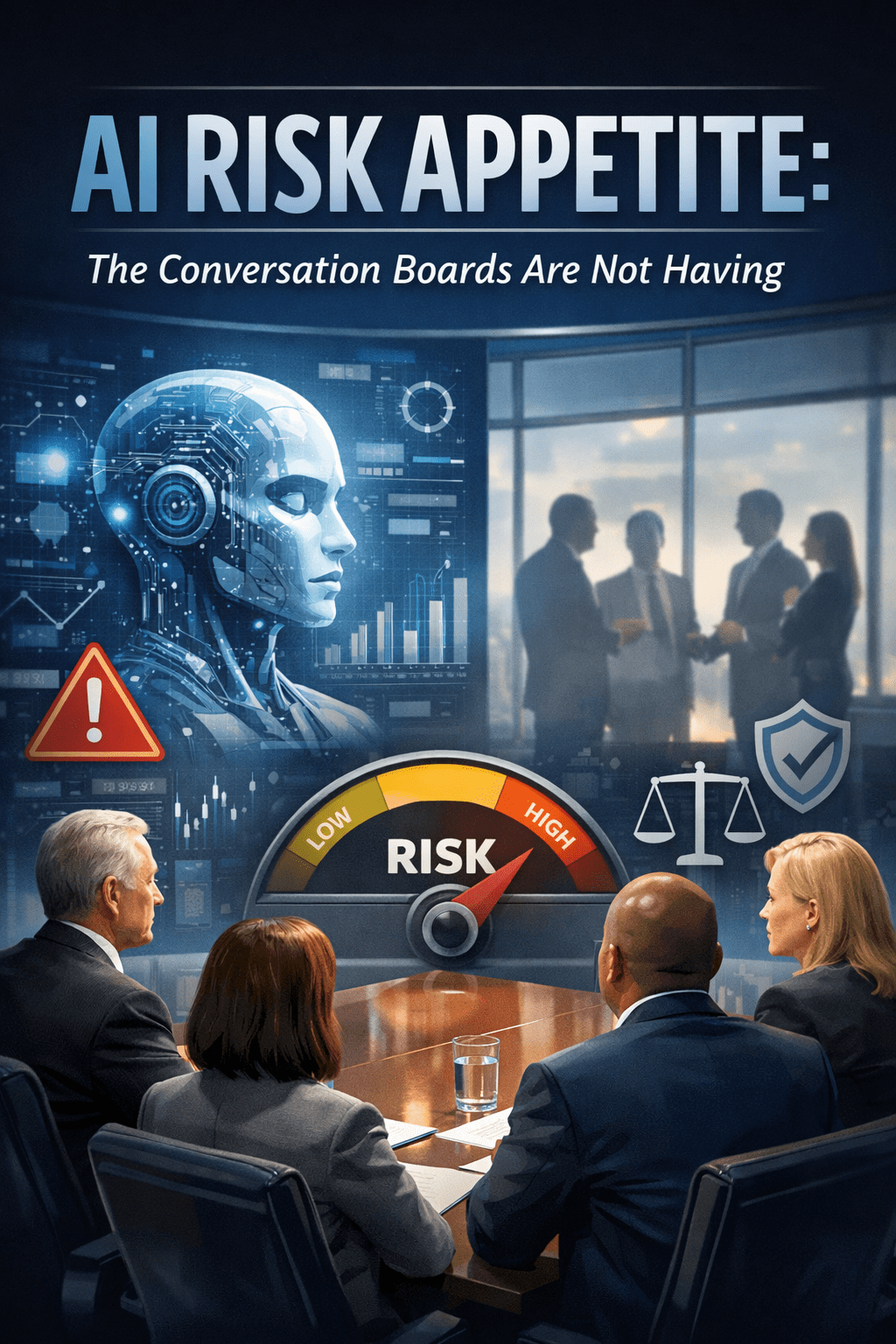
There is a quiet but serious problem developing in boardrooms around AI. Directors are hearing about innovation. They are hearing about productivity gains. They are hearing about competitive pressure, transformation, and speed. What they are not hearing enough about is risk appetite. That is the missing conversation.
Most companies are already using AI in one form or another. Some are deploying enterprise tools. Some are approving vendor solutions with embedded AI. Some are allowing business units to experiment in a controlled fashion. Some, of course, are doing all of the above and pretending it is a strategy. Yet for all the discussion about adoption, there has been far less focus on a basic governance question: what level of AI-driven decision risk is acceptable for this company? That is not a technical question. It is a board question.
The Risk Appetite Gap in AI Governance
AI is not simply another software purchase. It can influence recommendations, rankings, forecasts, summaries, classifications, and decisions. It can operate upstream from business judgments or directly within them. It can affect customer communications, hiring decisions, compliance monitoring, internal investigations, financial analysis, and reporting workflows. So the central governance challenge is not whether AI exists in the enterprise. It is how much authority the company is willing to give it, in what contexts, with what controls, and with what margin for error. If you do not define that, you do not have AI governance. You have AI optimism.
What Is AI Risk Appetite?
At its core, AI risk appetite is the level and type of AI-related risk an organization is willing to accept in pursuit of business value. That includes a series of questions boards ought to be asking. How much error is acceptable in AI-generated output before a human must intervene? Which uses are low-risk productivity enhancements, and which are sensitive, consequential, or reputation-threatening? In what contexts can AI make recommendations only, and in what contexts can it influence or automate action? How much dependence on opaque third-party models is acceptable? What degree of explainability does the company require for different use cases? When does speed stop being a benefit and start becoming exposure?
Many boards are currently discussing AI deployment without ever discussing AI tolerance. That is like approving a global third-party strategy without deciding what level of distributor risk, sanctions exposure, or bribery risk the company is prepared to accept. No compliance professional would recommend that. Yet in AI, organizations do versions of it every day.
Why Boards Avoid the Conversation
There are several reasons boards have been slow to engage on AI risk appetite.
First, the technology moves fast, and the terminology can become a fog machine. Directors do not want to look uninformed, so discussions often stay broad and strategic. Second, management may not yet have the internal inventory or classification framework needed to make a risk-appetite conversation concrete. Third, many companies are still in an experimentation phase, which creates the illusion that formal governance can come later. Fourth, there is a natural tendency to believe AI risk belongs to IT, legal, or security, rather than to enterprise oversight.
AI risk appetite cannot be delegated away because it intersects with business judgment, ethics, records, privacy, data governance, resilience, and culture. It cuts across functions. It also cuts across reputational boundaries. If a company uses AI in a way that produces unfair results, faulty decisions, poor disclosures, or customer harm, nobody is going to say, “Well, that was a technical issue, so the board need not have been involved.” Boards do not get a hall pass when the governance system is missing.
The Conversations Boards Need to Be Having
Risk Map. The first conversation is about where AI sits on the company’s risk map. Is AI a productivity tool, a strategic platform, a decision-support capability, or some combination of all three? The answer matters because it affects the level of oversight. A company using AI for internal drafting support faces one type of exposure. A company using AI in customer-facing interactions, underwriting, hiring, fraud detection, or compliance monitoring faces another challenge.
Decision Significance. Boards need to ask where AI is being used in decisions that affect legal rights, financial outcomes, customer treatment, employment status, compliance judgments, or public disclosures. Not all uses are equal. A board that treats AI use in marketing copy the same as AI use in employee discipline is not governing. It is lumping.
Acceptable Error and Human Review. Boards should ask: what level of inaccuracy can the company tolerate in a given use case, and who is accountable for checking the output before action is taken? Human oversight has become one of those phrases everybody likes, and few define. Directors need something more disciplined. When is review mandatory? What does a meaningful review look like? What evidence shows that the reviewer is not simply rubber-stamping machine output?
Data and Model |Dependency. What data is being used? Who owns it? Who has the right to it? How current is it? Are third-party vendors changing capabilities under existing contracts? Is the company becoming dependent on systems it does not fully understand or cannot easily audit? Boards should not need to know how the engine works, but they absolutely need to know whether the company is driving a car with uncertain brakes.
Incident Tolerance and Escalation. What types of AI failures must be reported to senior leadership or the board? A hallucinated internal memo may be embarrassing. A flawed AI-assisted hiring screen or customer communication may be far more serious. The board should ensure management has defined materiality thresholds before an incident occurs, not after the headlines begin.
The CCO’s Role in Shaping the Conversation
This is where compliance officers can be enormously helpful.
The CCO is often the person in the enterprise most experienced at turning abstract risk into operating discipline. Compliance knows how to frame risk-based governance. It knows how to create escalation structures, policy frameworks, investigations protocols, and oversight dashboards. It knows that culture and control design matter just as much as rules. Here are four ways to do so.
- A CCO can help management develop a tiered inventory of AI use cases. This is essential. Boards cannot discuss appetite in the abstract. They need to see the map. Which uses are low risk? Which are medium? Which are high? Which are prohibited absent specific approval?
- Compliance can help translate legal, ethical, and operational concerns into board-level language. Directors do not need a seminar on neural networks. They need clear framing around consequences, control points, accountabilities, and thresholds.
- A CCO can help build governance around human review, documentation, and escalation. If the company says a human is responsible, compliance can help test whether that responsibility is real, documented, and operational.
- Compliance can keep the conversation grounded in how people actually behave. Employees will choose convenience. Business teams will move quickly. Vendors will market aggressively. Managers may trust the generated output more than they should. A good compliance officer knows that policy must be built for actual human behavior, not ideal behavior.
Compliance as Risk Mitigation and Business Enablement
One of the enduring frustrations in compliance is that governance is often viewed as a speed bump until something goes wrong. AI gives us another chance to make the larger point. Governance does not slow innovation. Bad governance slows innovation by causing rework, distrust, remediation, and public embarrassment.
A well-defined AI risk appetite does the opposite. It gives the business clarity. It tells innovation teams where they can move quickly and where they must slow down. It helps procurement negotiate the right terms. It helps managers know when to escalate. It helps employees understand when they may rely on AI and when they must verify it. Most importantly, it gives the board a strategic rather than reactive basis for oversight.
That is compliance at its best. Not Dr. No, from the Land of “no,” but the function that makes responsible growth possible.
Final Thoughts
Boards need not fear AI. But they do need to govern it. And governance begins with clarity about appetite. If your board has discussed an AI opportunity but not AI tolerance, it has only had half the conversation. If your company has adopted tools but has not defined acceptable levels of error, autonomy, dependency, and oversight, it is operating on hope. Hope, as every compliance professional knows, is not a strategy and certainly not a control.
Here are the questions I would leave you with. Has your board defined what level of AI-driven decision risk it is willing to accept? Can management explain how that appetite changes across low-risk and high-risk use cases? And can your compliance function show, with evidence, whether the company is operating inside those lines? If the answer is no, then the conversation boards may be the most important AI conversation of all.