Categories
Innovation in Compliance

Don’t Lose the Learner with Asha Palmer

Asha Palmer is on a mission to revolutionize the ethics and compliance profession. She joins Tom Fox in this episode of Innovation in Compliance to discuss how marrying technology with ethics and compliance can lead to unprecedented strides in the profession. She shares her new role at Skillsoft, insights on leveraging technology to support learning objectives, and why it’s important to understand different learning styles for more effective training outcomes.

Asha Palmer is the Senior Vice President of Compliance Solutions at Skillsoft, where she leads the strategy and product roadmap, delivering transformative learning experiences. She has a wealth of experience from her previous roles, including her time in the U.S. Attorney’s office, as well as working at Conversant and OneTrust. A seasoned compliance professional, Asha is applying the skills she’s honed throughout her career to enhance the ethics and compliance profession.


You’ll hear Tom and Asha discuss:

  • Technology plays a crucial role in the scalability and sustainability of the ethics and compliance profession.
  • Asha advocates for an understanding of different learning styles to deliver more effective training and compliance communications.
  • It’s important to understand the ‘why’ behind business operations to drive meaningful outcomes for both administrators and learners.
  • Trainers need to provide a varied learning experience to cater to different types of learners, fighting the forgetting curve and ensuring information retention.
  • Asha stresses the importance of delivering compliance training in a way that is tailored to the audience’s comfort, language, and culture. 
  • The speed of delivery can affect comprehension, especially for non-native English speakers. As such, training should be delivered at a pace that enables learners to retain and apply the information.
  • Asha discusses the challenge of delivering compliance learning globally. It involves adapting to various languages, cultures, and legal and regulatory requirements.
  • Skillsoft updates training modules in response to new or changing regulations, and emerging risks. Their strategy includes listening to customer needs and creating a roadmap to meet those needs.
  • It’s important to create a sustainable ethical and compliant culture within organizations. Asha encourages open conversation and learning from successes and failures in order to improve the effectiveness of ethics and compliance programs.


KEY QUOTES:

“I have a hashtag, don’t lose the learner. Because if you lose the learner, you’ll never get them back.” – Asha Palmer


“One of the great things I’ve learned is that we can’t be sustainable or scalable without the help and benefit of technology.” – Asha Palmer


“We listen to our customers. I talk to customers a lot. As I said earlier, if there is something that they need to educate on that we haven’t thought about, we go think about it and we think about how we can effectively then present learning and engagement so that they are able to educate their employee population on that.” – Asha Palmer


Resources:

Asha Palmer on Skillsoft | LinkedIn 

Skillsoft

Categories
Blog

Phillips FCPA Enforcement Action: Violations, Remediation and Recidivism – Part 2

We continue our exploration of the Koninklijke Philips N.V. (Philips) Foreign Corrupt Practices Act (FCPA) enforcement action involving the Securities and Exchange Commission (SEC), for Phillips actions in China and its Chinese subsidiary, Phillips China. As set out in the SEC Order, Philips was order to “pay disgorgement of $41,126,170, prejudgment interest of $6,047,633, and a civil monetary penalty of $15,000,000” for a total fine and penalty of $62 million. Yesterday we considered the bribery schemes employed by Phillips China. Today we consider the responses made by Phillips which led to its internal investigation, Phillips remediation and the prior FCPA enforcement action.

A. The FCPA Violations

In the SEC Order, Phillips was not charged with the payment of bribes. Rather, Phillips was charged with a failure of internal controls. Under the FCPA, companies which are issuers are required “devise and maintain a system of internal accounting controls sufficient to provide reasonable assurances.”

  1. Transactions are executed in accordance with management’s general or specific authorization;
  2. Transactions are recorded as necessary (I) to permit preparation of financial statements in conformity with generally accepted accounting principles or any other criteria applicable to such statements, and (II) to maintain accountability for assets;
  3. Access to assets is permitted only in accordance with management’s general or specific authorization; and
  4. The recorded accountability for assets is compared with the existing assets at reasonable intervals and appropriate action is taken with respect to any differences.

Philips violated the FCPA “failing to devise and maintain an adequate system of internal accounting controls regarding distributor transactions and the use of these third parties.” Additionally, “Philips’ internal accounting controls were not sufficient to provide reasonable assurances that transactions were executed in accordance with management’s general or specific authorization and that access to assets was permitted only in accordance with management’s general or specific authorization.”

B. Cooperation and Remediation

Interestingly Phillips did not self-disclose this issue. Nor did Phillips appear to engage in any ‘extraordinary” cooperation. This cooperation was noted in the Order as “Philips undertook an internal investigation and regularly shared with Commission staff the facts developed in its inquiry, including facts previously unknown to the staff, and identified and voluntarily provided translations of key non-privileged documents.” I was particularly intrigued by the statement “facts previously unknown to the staff” which would seem to indicate there were some facts which were previously known to the SEC (and not by the way of a self-disclosure.)

Phillips did engage in remediation efforts which were recognized by the SEC. These included:

  • Phillips made structural improvements to its policies and procedures;
  • The company improved its tone at the top and the middle, with a focus on Philips China;
  • Phillips increased accountability for enforcing compliance policies by its business leaders;
  • The company highlighted compliance as a key component of ethical business practices;
  • Phillips terminated or disciplined Philips China employees involved in the conduct;
  • Phillips terminated business relationships with distributors involved in the conduct;
  • The company also improved its internal accounting controls relating to distributors;
  • Phillips improved its ability to monitor its subsidiaries bidding practices and their use of discounts and special pricing; and
  • Finally, Philips has revised its compliance training.

 C. Prior FCPA Enforcement Action

In 2013 (the year before these actions began) Phillips agreed to its first FCPA enforcement action, also involving the SEC (2013 Order). That matter related to the company’s action in Poland. According to the FCPA Blog, “from 1999 to 2007, in at least 30 bids, employees of Philips’ subsidiary in Poland ‘made improper payments to public officials of Polish healthcare facilities to increase the likelihood that public tenders for the sale of medical equipment would be awarded to Philips. The bribes and kickbacks were 3% to 8% of the contract amounts.” In that 2012 enforcement action, “Philips agreed to pay $4.5 million in the settlement, consisting of disgorgement of $3.1 million and prejudgment interest of $1.4 million.” Of course, Phillips also agreed to “cease and desist from committing or causing any violations and any future violations of” the FCPA.

As for the remedial actions taken by Phillips for the 2013 Order it stated, “Philips also retained three law firms and two auditing firms to conduct the investigation and design remedial measures to address weaknesses in its internal controls. Included in changes to internal controls, Philips established strict due diligence procedures related to the retention of third parties, formalized and centralized its contract administration system and enhanced its contract review process, and established a broad-based verification process related to contract payments. In addition, Philips has made significant revisions to its Global Business Principles policies and continually revises the policies to keep them current and relevant. Philips also established and enhanced an anti-corruption training program that includes a certification process and a variety of training applications to ensure broad-based reach and effectiveness.”

Given that the Phillips China bribery scheme started in 2014 does it sound like Phillips took these obligations very seriously. I wonder just where those three law firms and two audit firms were looking when they conducted an investigation and designed “design remedial measures to address weaknesses in its internal controls.”  Finally I am not sure where the company’s “certification process” went after the 2013 Order, but apparently not as far as China.

All this means that Phillips is yet another FCPA recidivist. There was no statement in the 2023 Order that Phillips self-disclosed the illegal conduct in China to the SEC. Nevertheless, Phillips seemed to get the benefit of the doubt from the DOJ. In a May 10, 2023 Press Release,  Phillips announced that “The U.S. Department of Justice (DOJ) has closed its parallel inquiry into these matters” and the company intoned that it “fully cooperated with the SEC and DOJ.” Phillips also reported that the FCPA matter had “previously been disclosed in Philips’ Annual Reports 2019 through 2022.”

There has been no statement by the Department of Justice (DOJ) regarding Phillips. Further there has been no declination regarding Phillips publicly announced by the DOJ. Given the strong statement about recidivists by Deputy Attorney General Lisa Monaco in announcing the Monaco Doctrine last September and the need for speed referenced by Kenneth Polite in announcing changes to the Corporate Enforcement Policy in January 2023; one might have expected some statement from the DOJ.

Or perhaps not. Tomorrow, we conclude with some final thoughts.

Categories
Daily Compliance News

Daily Compliance News: May 16, 2023-the AI and Compliance Edition

Welcome to the Daily Compliance News. Each day, Tom Fox, the Voice of Compliance brings to you compliance related stories to start your day. Sit back, enjoy a cup of morning coffee and listen in to the Daily Compliance News. All, from the Compliance Podcast Network. Each day we consider four stories from the business world, compliance, ethics, risk management, leadership or general interest for the compliance professional.

Stories Include

  • Using AI to manage risk. (InsideBigData)
  • How will AI change the workplace. (WSJ)
  • Using AI to manage regulatory risk frameworks. (PYMNTS)
  • Will AI help compliance? (Forbes)
Categories
Sustainability

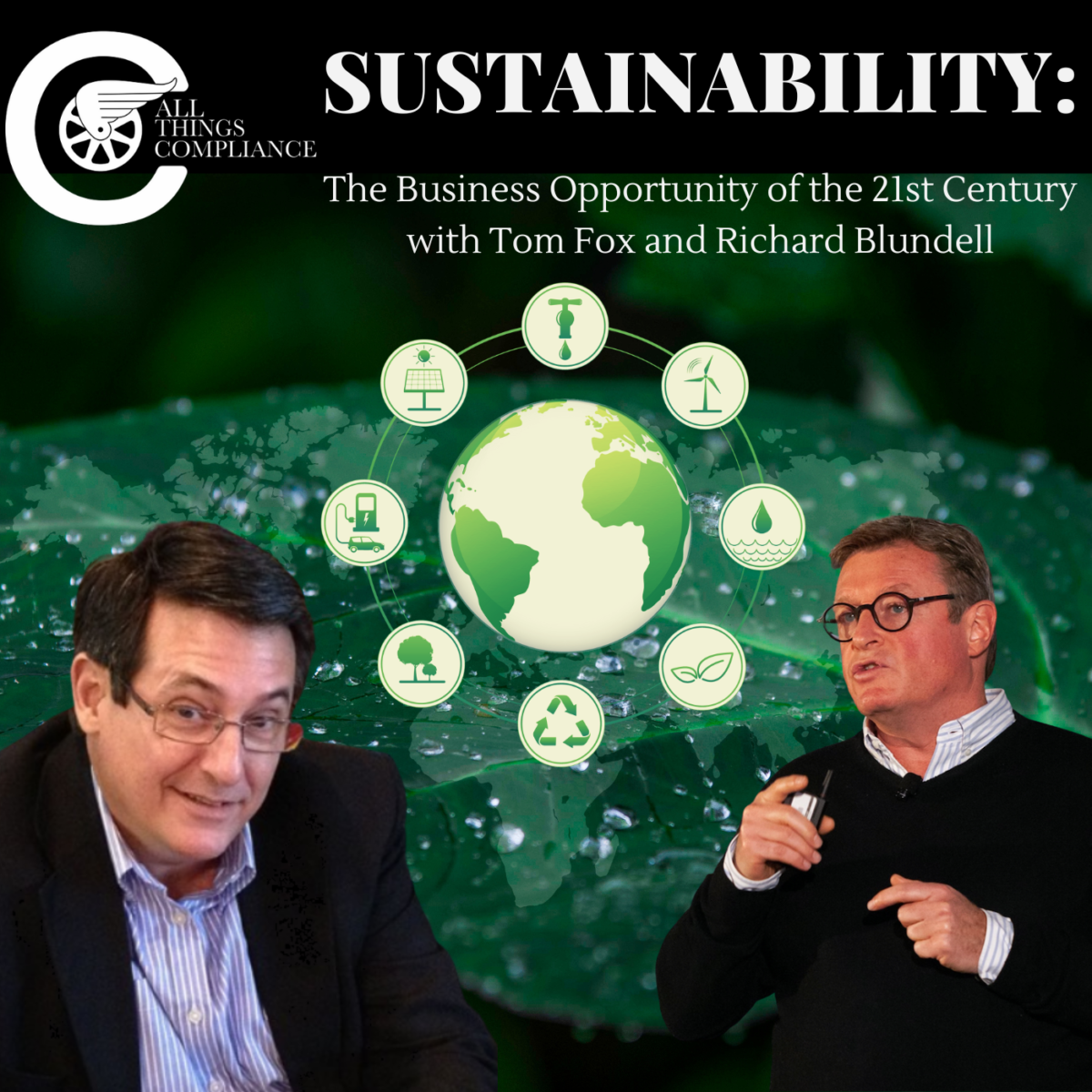
Sustainability: The Business Opportunity of the 21st Century – Episode 1, Introduction

We are at a defining moment in human history, a moment for change, in which climate is the single biggest commercial opportunity of our time.  In this podcast, Tom Fox and Sustainability guru Richard Blundell explore the opportunities open to businesses that embrace sustainability from the business perspective. Find out why sustainability is the greatest opportunity of the 21st century, and you can prepare your business to take advantage of the unprecedented global opportunity.

In this inaugural episode of the Sustainability podcast, Tom Fox and Richard Blundell, a Sustainability guru and maven, discuss how his unwavering passion for sustainability led him to see it as a business opportunity. Richard shares his journey from being counseled against pursuing geology to starting a business with little industry knowledge. His company morphed into an environmental services provider and expanded into cleaning sewers and recycling oil.

Richard’s passion for sustainability is evident, as he sees it not only as an environmental issue but also as a financial opportunity. His vision is for businesses to shift towards sustainable practices to reduce costs while contributing to environmental preservation. “I think the big opportunity we’ve got here is by working sustainably, and we can create a better world than we have today. But we can do that in a way where the business case makes sense,” says Richard.

For businesses looking to implement sustainability practices, here are three tips from the podcast episode:

1. Identify areas where sustainability can reduce costs and enhance efficiency

2. Approach sustainability as a long-term investment instead of a short-term expense

3. Collaborate with stakeholders to create a sustainable ecosystem.

Listen to the full episode for insights and practical tips for incorporating sustainability into business practices. Richard’s enthusiasm and practicality will inspire you to explore sustainability as a business opportunity.

Resources

Richard Blundell

Tom Fox

Instagram

Facebook

YouTube

Twitter

LinkedIn

Categories
31 Days to More Effective Compliance Programs

One Month to a More Effective Compliance Program in Training and Communications – Multiplying the Influence of Compliance

What if you could multiply the impact and effectiveness of your compliance program throughout your company? That would be a great boon to any compliance practitioner and compliance program. It is also possible by considering a 360-degree view of communications in compliance using multipliers.

Liz Wiseman is the co-author with Greg McKeown of “Multipliers: How the Best Leaders Make Everyone Smarter,” a book about the various types of leaders. They focus on two different types of leaders, Diminishers and Multipliers. Multipliers are leaders who encourage their workers’ growth and creativity, while Diminishers hinder and otherwise keep their employees’ productivity at a minimum.

Now imagine applying this leadership technique as you are trying to operationalize your compliance program fully. If you take this approach of leading by asking questions, you not only guide the functional unit but you get greater buy-in to the entire concept and process as it becomes their process. The non-compliance team may design it and have ownership over it.
Wiseman concluded by challenging each of us to multiply our influence to make those we work with work even better. You can use these skills to operationalize your compliance program more fully. If you do so, you will not only fulfill the requirements of the DOJ, as laid out in the Evaluation, but you will integrate compliance into the DNA of your company by making it a part of how you conduct your business.

Three key takeaways:

  1. Multipliers are leaders who encourage growth and creativity from their workers.
  2. Diminishers hinder and otherwise keep their employees’ productivity at a minimum.
  3. Multiply the influence of the compliance function inside and outside the company in this manner.
Categories
Career Can D0

Mastering Sales With Optimism with James Rankin

Sales is not about being pushy or manipulative; it’s about building trust and relationships. In this episode of Career Can Do, Mary Ann Faremouth interviews sales expert James Rankin about the art of selling and the key skills required to be successful in this field. James is the Chief Marketing Officer for Moody Insurance Group, and the author of over 14 books on sales, training, philosophy, and literature. He has extensive experience in sales and sales management. In this episode, James shares his insights on the power of persuasion, the importance of product knowledge, and the changing landscape of sales in the post-COVID world. He also emphasizes the crucial role of trust in the sales process and highlights the need for salespeople to be ethical and passionate about what they do.

According to James, sales professionals are drawn to the economic opportunities that come with the profession. In sales, a person’s value is directly related to their efforts: this means that they maximize their time. He believes that a salesperson’s optimism and hope are what keep them productive and balanced. On the other hand, many people are afraid to go into sales because of low self-esteem, James tells Mary Ann. He introduces his Diamond Program, which assesses the four areas everyone needs to succeed. These include self-image, self-esteem, meaning, and philosophy. Your self-image is what you see so you’ll never rise above your self-assessment. Your self-esteem is how you feel about what you see, and it’s important to understand your strengths and weaknesses to build your self-esteem. He believes that meaning and purpose are necessary to find satisfaction in your work, and your philosophy is essential in determining your life’s direction.

For corporations to attract and retain salespeople, James believes they must follow Doss’ Theory P formula, which emphasizes preparation, performance, and potential. He also stresses the importance of attitude, skill set, and the ability to present a persuasive presentation. Additionally, corporations should focus on creating a positive company culture, providing opportunities for growth and development, and rewarding their employees for their efforts. By doing so, companies can reduce turnover, which can directly impact revenues.

James emphasizes that salespeople should not only focus on selling, but they should also become experts in marketing. James emphasizes the need for ethics and long-term relationships with clients, and Marianne agrees that trust is the common denominator in any relationship. A solid relationship can turn a client into an advocate and influencer. Social media has become a significant marketing tool, and salespeople must do their due diligence and understand their clients’ needs to build trust.

Resources:

James Rankin Email | LinkedIn | (800) 252-4002, Ext. 114

Faremouth.com

Categories
Corruption, Crime and Compliance

Cryptocurrency and Sanctions Compliance with Matt Stankiewicz

Cryptocurrency has become a popular way to invest and transact, but with that comes the need for sanctions compliance. In this episode, Michael Volkov and Matt Stankiewicz discuss the recent enforcement actions against Poloniex, Bittrex, and Kraken for violating US sanctions regulations with cryptocurrency transactions. Matt is a Partner at Volkov Law and a leading cryptocurrency expert. He and Michael dive into the common themes and basic failures that led to these enforcement actions, including IP blocking, transaction monitoring, and the use of screening tools. They also explore the challenges of compliance when dealing with regions like Crimea and Ukraine, as well as the importance of voluntary disclosure.

You’ll hear Michael and Matt talk about:

  • Cryptocurrency companies are struggling to implement KYC and geo-blocking controls, which is leading to violations involving sanctioned jurisdictions.
  • OFAC is taking an aggressive stance against cryptocurrency companies. Companies in the cryptocurrency industry need to implement effective sanctions compliance programs to avoid hefty fines and enforcement actions from regulatory authorities.
  • There is no materiality requirement for sanctions violations, and even small transactions can result in multimillion-dollar fines.
  • Retroactively applying controls to existing customers is important, and failing to do so can lead to violations.
  • Companies need to have a comprehensive and automated system in place to detect and prevent violations.
  • Companies need to be vigilant about screening individuals and transactions against the relevant sanctions lists, including screening field text, addresses, and ID cards.
  • Geo-blocking for IP addresses is a crucial compliance control, but it is not perfect and can be circumvented by VPNs.
  • Voluntary disclosure of violations can lead to more favorable outcomes and lower fines from regulatory authorities.
  • OFAC and other regulatory authorities are using analytical tools to monitor transactions and flag potential violations, so cryptocurrency companies should not assume they can go under the radar.
  • Companies can use the public blockchain to monitor transactions and identify potential sanctions risks.
  • Sanctions compliance programs should be regularly reviewed and updated to address new risks and changes in regulations.


KEY QUOTES
“There are a lot of tools available to these companies to monitor transactions, maybe better than in the traditional finance world, just because everything on the blockchain is public record essentially.” – Matt Stankiewicz


“It’s just interesting to see OFAC go so aggressively against these companies. Not too surprising considering the extreme sanctions risk that cryptocurrency poses. Very importantly, there’s still a lot of takeaways that really any industry can take away from these enforcement actions.” – Matt Stankiewicz


“If you find problems, obviously you want to remediate them, but figure out what you need to do in terms of voluntary disclosures, because typically you’ll be much better off than if OFAC figures it out on their own, which they usually do.” – Matt Stankiewicz


Resources:

Matt Stankiewicz on LinkedIn | Twitter 

Michael Volkov on LinkedIn | Twitter

The Volkov Law Group

Categories
Daily Compliance News

Daily Compliance News: May 15, 2023 – The Like a Cancer Edition

Welcome to the Daily Compliance News. Each day, Tom Fox, the Voice of Compliance, brings you compliance-related stories to start your day. Sit back, enjoy a cup of morning coffee, and listen to the Daily Compliance News. All from the Compliance Podcast Network. Each day we consider four stories from the business world, compliance, ethics, risk management, leadership, or general interest for the compliance professional.

Stories we are following in today’s edition:

  • PwC is facing potential criminal actions in Australia. (The Guardian)
  • Binance to UK-regulate us.  (FT)
  • FIFA corruption witness gets no jail time. (Reuters)
  • Who wants to be a CEO. (NYT)
Categories
FCPA Compliance Report

FCPA Compliance Report – Virginia Newman on Enhancing UFLPA Compliance: Solutions for Forced Labor Prevention

Welcome to the award-winning FCPA Compliance Report, the longest-running podcast in compliance. In the latest episode of FCPA Compliance Report, Tom Fox visits Virginia Newman from Miller & Chevalier, an expert on the Uyghur Forced Labor Prevention Act (UFLPA) and supply chain ESG work. Together, they discuss the UFLPA, its affirmative obligation on companies to comply with US import laws, and the burden of proof on businesses to prove their goods were not made using forced labor. Virginia shares valuable insight into the CBP’s enforcement efforts and how companies can exercise reasonable care to avoid having their goods detained. They also delve into trade compliance and third-party screening, predictive mapping, and the long-term changes companies must make to their compliance and sourcing programs. Thomas recommends Virginia as a source of knowledge on the subject because of her passion. Listen to this engaging and informative podcast to better understand the UFLPA and its impact on businesses.

Key Highlights:

  • Virginia’s background and UFLPA
  • US Law Prohibiting Import of Xinjiang-made Goods
  • US Customs’ Role in Enforcing UFLPA
  • CBP’s Forced Labor Technical Expo Solutions
  • Types of Companies for Supply Chain Mapping
  • Impact of a trade war on supply chain compliance

Notable Quotes:

“The US government had an import prohibition for any goods made in whole or in part with forced labor.

“The US import prohibition is one of the longstanding ones that has had the most effect on companies, but it wasn’t enforced too much until about 3 years ago.”

“If your goods are coming from Xinjiang, and you accept that they’re coming from Xinjiang, Then, really, the burden is on you to prove that they’re not made with any forced labor, which is an incredibly high burden and to our knowledge importers have not been trying meet it.”

“Customs put together this enforcement dashboard that contains all of these statistics on how they’ve been enforcing the UFLPA.”

Resources

Virginia Newman on LinkedIn

Miller & Chevalier

Tom Fox

Instagram

Facebook

YouTube

Twitter

LinkedIn

Categories
Blog

Phillips FCPA Enforcement Action: The Risks with Distributors – Part 1

Last week the Amsterdam based Koninklijke Philips N.V. (Philips) agreed pay more than $62 million to the Securities and Exchange Commission (SEC) to resolve charges that it violated the Foreign Corrupt Practices Act (FCPA) with respect to conduct related to the sales of medical diagnostic equipment in China. This case is yet another recent FCPA enforcement matter involving distributors. It demonstrates once again some of the inherent risks in a distributor sales model, as opposed to the model traditionally seen as the highest risk, the commissioned sales-agent. (Shout out to Harry Cassin at the FCPA Blog for breaking the story to the compliance community.)

According to the SEC Press Release announcing the matter, “Philips’ subsidiaries in China, cumulatively referred to in the order as Philips China, used special price discounts with distributors that created a risk that excessive distributor margins could be used to fund improper payments to government employees.” Equally significant was that the “SEC’s Order also found that employees, distributors, or sub-dealers of Philips’ subsidiaries in China engaged in improper conduct to influence hospital officials to draft technical specifications in public tenders to favor Philips’ products.” The SEC pointed to two examples, “in one instance, a district sales manager at Philips China provided funds to a hospital director in return for the director’s assistance in the procurement process, and, in another instance, Philips China employees discussed tailoring technical specifications for a public tender with hospital directors so that only Philips China and two other manufacturers would qualify for the bid.” As a result of its conduct, Philips was unjustly enriched by approximately $41 million.

I. Introduction

According to the Order, in “China the majority of hospitals and other healthcare providers are state-owned enterprises. These government-owned entities purchase the majority of their diagnostic imaging equipment through public tenders. By 2016, the majority of Philips China’s sales were made indirectly through authorized distributors or sub-dealers engaged by the authorized distributors. By 2018, 91% of Philips’ diagnostic imaging revenue in China was earned through this indirect sales channel.”

Philips China aggressively grew its diagnostic imaging business, winning public tenders in an increasingly competitive market. Phillips was aggressive in its pricing discounts to do so. According to the Order, “in some transactions, at the request of distributors, Philips China provided special pricing discounts on the health technology equipment that it sold to its distributors. However, Philips China’s approval processes and its recording of the special pricing discounts were not subject to sufficient internal accounting controls to ensure appropriate management authorization of the discounts.”

II. The Corruption Schemes

  1. The Hospitals

The Order related that in multiple transactions between 2014 through 2019, Philips China employees, distributors, or sub-dealers engaged in improper bidding practices to increase the likelihood that Philips China’s distributors or their sub-dealers were awarded public tenders to sell medical equipment to government-owned hospitals. There were three general prongs to these bribery schemes. The employee responsible for writing the technical specifications, in consultation with a bidder such as Phillips would provide that same bidder “with a competitive advantage in the public tender prior to the opening of the bidding period” by providing the information to the bidder prior to the formal beginning of the bidding process.

Another scheme was to draft specifications which would meet that bidder’s equipment “to increase the likelihood that the selected manufacturer would qualify for the winning bid.” In the final bribery scheme the “hospital employee directed the winning bidder or its distributor or sub-dealer to prepare the manufacturer’s bid and also two additional accompanying bids to meet the three-bid requirement of public tenders and give the appearance of legitimacy.” Further, “Phillips China employees who participated in the conduct described above included district sales managers, sales employees, and employees in the technical group that supported sales.”

  1. Phillips Responses

The SEC Order pointed to three examples of bribery schemes engaged in by Philips in response to the corruption perpetrated by the health care providers.

a. Bribes for Inside Information

In one example a Philips China district sales manager for Hainan Province delivered approximately $14,500 directly to the home of a director of the hospital’s radiology department in return for the director’s assistance in the procurement process. With the inside information obtained through this payment, “the sales team discussed the specifications to be included in the bid with the relevant hospital director, and its distributor prepared an accompanying bid with another manufacturer’s products.” It ended with a “procurement award for two Philips devices valued at $4.6 million.”

b. Bribes to Obtain Unlawful Influence

In another example, the decision-making directors at a hospital discussed tailoring the technical specifications with Philips China employees so that only Philips China and two other manufacturers would qualify to compete in the bidding process. In October 2017, a Philips China distributor won the bid to sell two Philips devices to the hospital. This tender was won as a result of inappropriately influencing the tender specifications, netting Philips a tender valued at $475,000.

c. Excessive Discounts Provided to Distributors

In perhaps the most classic distributor bribery model, Philips China’s use of special price discounts with distributors created the risk that excessive distributor margins could be used to fund improper payments to employees of government-owned hospitals. The SEC Order did not specify the amount of the discounts or how it differed from the standard (if any) discount provided to Philips distributor.

Join us tomorrow where we consider Philips lack of internal controls, the fine and penalty, the recidivism of Philips and any potential Department of Justice (DOJ) enforcement action.