Categories
Daily Compliance News

Daily Compliance News: July 22, 2025, The I-9 Hell Edition

Welcome to the Daily Compliance News. Each day, Tom Fox, the Voice of Compliance, brings to you compliance-related stories to start your day. Sit back, enjoy a cup of morning coffee, and listen in to the Daily Compliance News. All, from the Compliance Podcast Network. Each day, we consider four stories from the business world, including compliance, ethics, risk management, leadership, or general interest, relevant to the compliance professional.

Top stories include:

  • What is the cost of culture of silence at NASA? (WSJ)
  • Corruption tainting Milan skyline. (Bloomberg)
  • Companies stuck in ‘I-9 hell’ of paperwork. (FT)
  • Credit Suisse flagged Sanjeev Gupta for corruption, but the bank ignored it. (Bloomberg)

You can donate to flood relief for victims of the Kerr County flooding by going to the Hill Country Flood Relief here.

Categories
Word of the Week

Word of the Week with Kenneth O’Neal – The Power of Ambition: Lessons from Historical and Modern Leaders

Each week, Kenneth O’Neal discusses a word which describes a principle or value of the Qualities of Success. We suggest that you use the Word of the Week in your thoughts, deeds, and actions. You might currently possess the quality and desire to develop it to a higher level.  You could replace a bad habit with a good habit. Write an action step and use it daily to develop the Quality in your life. In this episode, Kenneth discusses the word – Ambition.

In this episode, Rick and Kenneth explore the theme of ambition, highlighting its significance and how it drives personal growth, vision, and innovation. They look at figures such as Alexander the Great, Abraham Lincoln, Steve Jobs, and Elon Musk. The discussion also explores the role of integrity in guiding ambition to create a positive legacy. Abraham Lincoln’s life and leadership exemplify the blend of ambition, purpose, and integrity. The speaker encourages listeners to align their ambition with their deepest values and to serve a greater cause, highlighting that true ambition involves serving others. The episode concludes with a call to action to rise with purpose, embrace integrity, and lead with humility.

Key highlights:

  • Word of the Week: Ambition
  • Abraham Lincoln’s Legacy
  • Questions for Self-Reflection
  • Call to Action: Serve with Integrity

Resources:

KRONEAL Consulting

Categories
Innovation in Compliance

Innovation in Compliance – The Power of Accountability and Team Culture with Gina Cotner

Innovation comes in many areas, and compliance professionals need to be ready for it and embrace it. Join Tom Fox, the Voice of Compliance, as he visits with top innovative minds, thinkers, and creators in the award-winning Innovation in Compliance podcast. In this engaging episode, Tom Fox sits down with Gina Cotner, the founder and CEO & Founder of Athena Executive Services, to explore the importance of team culture and accountability in corporate settings.

Cotner delves into her professional background and the organic development of a strong team culture at Athena. She emphasizes the critical role of accountability as a cultural standard and provides actionable insights for leaders on how to instill this within their organizations. Key takeaways include the significance of consistency, the balance between compassion and accountability, and the role of follow-up as a leadership tool. With real-world examples and practical advice, Cotner provides a comprehensive guide to building and maintaining a high-performing, accountable team.

Key highlights:

  • Gina Cotner’s Professional Background
  • The Importance of Team Culture
  • Accountability in High-Performing Teams
  • Misunderstandings About Accountability
  • Building a Culture of Accountability
  • Consistency and Psychological Safety
  • Follow-Up as a Leadership Tool
  • Compassion in Leadership

Resources:

Follow Athena Executive Services on:

Company’s Website

LinkedIn

Instagram

Tom Fox

Instagram

Facebook

YouTube

Twitter

LinkedIn

Categories
Red Flags Rising

Red Flags Rising: S01 E20 – China, AI, and Export Controls – Facing a Moment of Truth

Mike and Brent follow-up on Episode 19’s discussion of “stack sweeps” with a discussion of the current “moment of truth” facing trade compliance teams dealing with high-probability, catch-all enforcement risks as explained in their recent WorldECR (Issue No. 141, July/August 2025) and Dow Jones Risk Journal article, “Anticipating the moment of truth: how to prepare for ‘high probability’ catch-all enforcement.” Specifically, they discuss the recent decision by the U.S. to allow (licensed) sales of certain advanced integrated circuits to China (00:42), their WorldECR/DJRJ article and how the Bureau of Industry & Security (BIS) guidance of May 13, 2025, which emphasized the “high probability” standard and catch-all provisions of the U.S. Export Administration Regulations (EAR), inspired the article (or at least inspired Tom Blass of WorldECR to ask us for an article) (07:10), how the underlying catch-all provisions are not “new” as of May 13, 2025 (10:26), how compliance teams can’t “zero-risk” export controls risk and need to adopt risk-based approaches (12:17), the relevance of the “inchoate” offenses under the EAR, i.e., aiding, abetting, conspiracy, evasion, acting with knowledge, and misrepresentations (13:21), the limitations of end-use and end-user certificates under the May 13, 2025 policy and guidance documents (14:47), their thoughts on the reportedly pending “50% rule” for the Entity List (18:32), the impact of the ability of malign actors, political parties, and military-intelligence actors to exercise influence even without shareholdings (19:25), why the most risky counterparties are those not on the Entity List (20:49), and the three key takeaways in their WorldECR/DJRJ article (24:09). They conclude with another installment of Brent Carlson’s “Managing Up” segment (30:28).

Resources:

WorldECR

Brent LinkedIn

Mike LinkedIn

Mike & Brent’s “Fresh Looks” Series

Categories
SBR - Authors' Podcast

SBR-Authors Podcast: Finding True Happiness Through Acts of Kindness: A Conversation with Karen Olson

Welcome to the SBR-Authors Podcast! In this podcast series, host Tom Fox visits with authors in the compliance arena and beyond. In this episode, Tom Fox interviews Karen Olson, the founder and CEO Emeritus of Family Promise and the author of ‘Meant for More.’

Olson shares her journey from aspiring nurse to being an influential advocate for homeless families. She elaborates on the importance of acts of kindness in achieving genuine happiness. She describes how the Family Promise organization supports families experiencing homelessness through various programs, including prevention, sheltering, and volunteer services. Olson discusses changes in the homelessness landscape since the 1980s and shares personal stories of volunteers making a difference. She also talks about the inspiration behind her book and the critical role of community involvement in addressing homelessness.

Key highlights:

  • The Story Behind ‘Meant for More’
  • Karen’s Journey
  • The Birth of Family Promise
  • The Current State of Homelessness
  • Inspiring Volunteer Stories
  • Family Promise Initiatives
  • Acts of Kindness and Inspiration

Resources:

Meant for More: Following Your Heart and Finding Your Purpose on Amazon

Visit Family Promise Website

Karen Olson Website

PR by the Book Website

Follow Karen Olson at

PR by the Book

Facebook

Instagram

LinkedIn

Tom Fox

Instagram

Facebook

YouTube

Twitter

LinkedIn

Categories
Blog

The Compliance Guide to Designed Intelligence: Part 1 – Rethinking Governance for the Age of AI

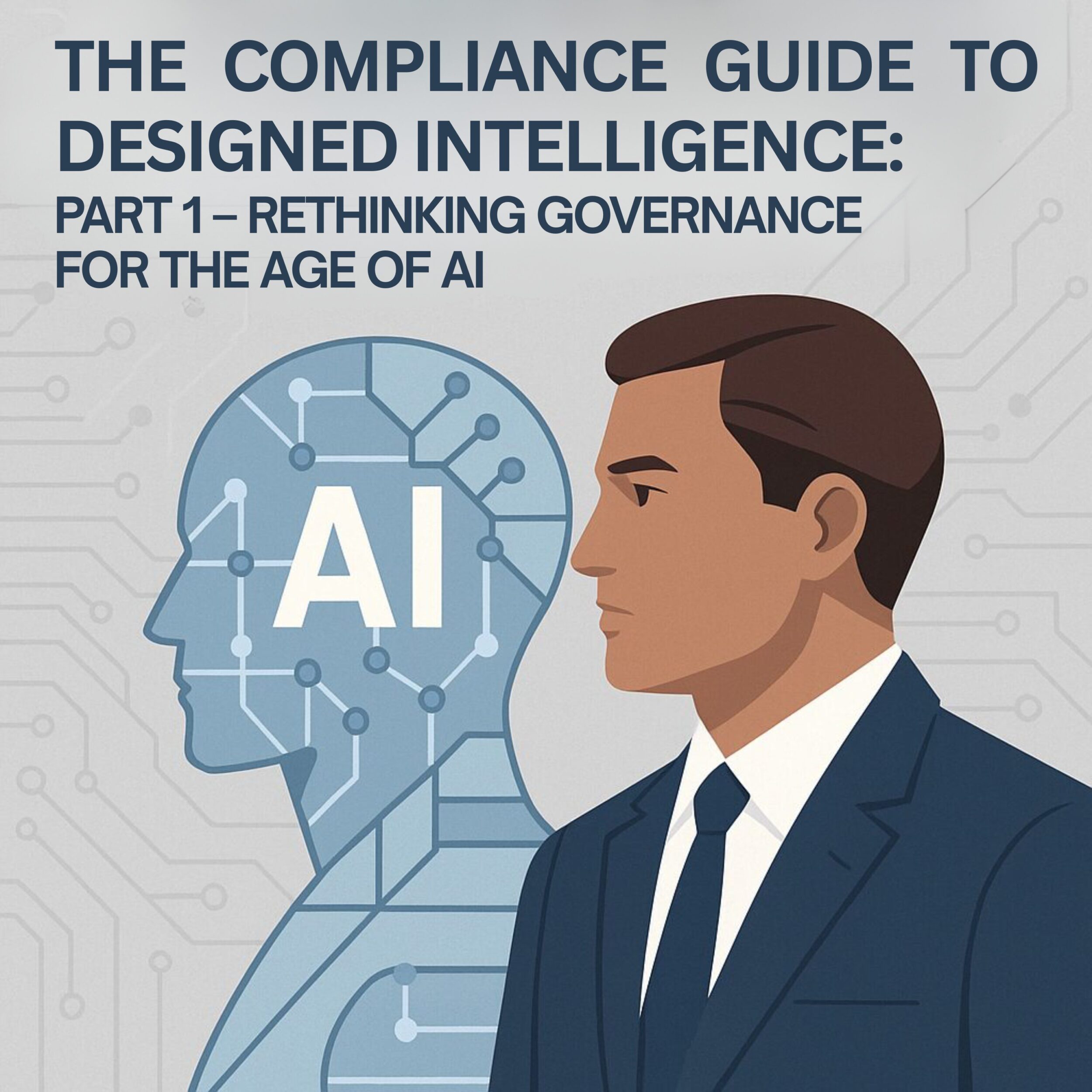
If there is one constant in the world of compliance, it is the reality of change. However, in 2025, change takes on a new vector: artificial intelligence, not just as a tool, but as a force reshaping how organizations think, decide, and act. In their article “What Is a Designed Intelligence Environment?” authors Michael Schrage and David Kiron examined how enterprises must rethink their intelligence and compliance strategies to survive and thrive in the new world of AI-rich operations. I found their insights for compliance professionals both practical and transformative. Today, I begin a short two-part blog post series on Designed Intelligence. Today, in Part 1, we consider what is meant by Designed Intelligence. Tomorrow, we take a deeper dive into what it means for compliance.

From Managing Compliance to Orchestrating Intelligence

Traditional compliance frameworks have always focused on managing risk, enforcing controls, and responding to regulatory shifts. But what happens when decision-making itself is no longer exclusively human? In a designed intelligence environment, humans and machines learn, reason, adapt, and improve together. This is not simply the automation of existing workflows; it’s the emergence of a new kind of enterprise, where “epistemic engineering”—the design of how knowledge is generated, shared, and executed—becomes the bedrock of effective compliance.

The first insight for compliance professionals is that we can no longer assume governance is solely about drawing lines around human behavior. Our job is to architect environments in which both human and machine intelligences operate responsibly and transparently, ensuring that knowledge, decisions, and accountability flow where they are needed most.

Computational Irreducibility: The End of Predictive Planning

Stephen Wolfram’s principle of computational irreducibility may sound academic, but its implications are anything but theoretical for compliance leaders. In a nutshell, this principle holds that in highly complex systems, such as those created when humans and AI interact, the future cannot be predicted without running the system in real-time. In other words, the classic compliance cycle of “predict, plan, execute, and measure” is mathematically impossible in many AI-rich contexts.

For compliance professionals, this means shifting from static policy planning to dynamic, real-time oversight. Consider an example from pharmaceutical R&D. A global company faced paralysis in prioritizing compounds for its oncology pipeline. Instead of relying on fixed rankings or endless meetings, leadership created a computational observatory: multiple agentic models simultaneously analyzed each compound from different perspectives (biological plausibility, market readiness, synthetic feasibility)—cross-model consensus and visualization, rather than managerial heuristics, guided decisions, surfacing previously hidden breakthroughs.

Compliance Lesson: Build for Observability, Not Just Control

In today’s world, compliance cannot rely solely on auditing after the fact. The future lies in building observability into the core of decision environments: real-time monitoring, feedback loops, and experimental frameworks that enable compliance to identify emergent risks as they arise, not just when it’s too late. This is the heart of “runtime intelligence.”

Semantic Formalization: Making Compliance Computable

Most compliance programs are based on documentation, training, and knowledge management. But semantic formalization, another key concept, goes much further. It requires organizations to define core business concepts (like “customer value,” “operational risk,” or “conflict of interest”) so precisely that both humans and AI agents can “compute” with them. This is not a matter of semantics for its own sake; it is about ensuring that rules, policies, and standards are unambiguously actionable by both people and machines.

For example, a multinational retailer’s use of large language models (LLMs) for customer support faced breakdowns because definitions of customer experience (CX) varied by region and role. By creating a semantic kernel, which is an enterprise ontology that maps complaints, resolution pathways, sentiment clusters, and CX metrics, the company trained its models (and its people) to reason with consistent, computable definitions. This enabled root-cause analysis and adaptive, system-wide learning that wasn’t possible in the old script-driven model.

Compliance Lesson: Define, Don’t Just Describe

Compliance teams must become architects of semantic infrastructure. That means working cross-functionally to formally define compliance concepts, risks, and obligations so that every AI, dashboard, and human team member speaks the same language, in the same way, everywhere. This is how you build “reasoning standardization” and reduce the friction, ambiguity, and risk that come with AI-driven scale.

Rulial Space: Translating Between Multiple Realities

Perhaps the most disruptive insight for compliance comes from the concept of rule-based space: the recognition that different “intelligences”—whether human teams, AI systems, or even other departments—operate under distinct rule sets, generating unique realities. Finance assesses risk through Monte Carlo simulations, operations analyze it through failure mode analysis, and AI identifies it through statistical correlations. Traditional efforts to force alignment through training or incentives may be fundamentally flawed. What is needed is translation, not assimilation.

In aerospace manufacturing, for example, friction between design engineers and LLMs led to productivity-killing standoffs. Instead of forcing one side to conform to the other, leadership installed an honest mediator: an explicit layer for mapping, negotiating, and reconciling the assumptions, rules, and heuristics of both human and AI systems. This moved the organization from “compliance by enforcement” to “compliance by comprehension,” a far more powerful and sustainable model for managing both risk and innovation.

Compliance Lesson: Become a Translator, Not Just an Enforcer

The future of compliance is not just about enforcing standards but about building systems and processes that can explicitly map and translate between different rule sets: human, machine, and hybrid. This requires cognitive compilers: protocols and infrastructure for negotiating meaning, resolving conflicts, and arbitrating outputs across diverse intelligences. The result is intelligent orchestration of more innovative, safer, and more adaptive enterprises.

Why Smarter Tools Aren’t Enough: Compliance by Design, Not Just Technology

It’s tempting to think that more innovative tools or more sophisticated AI models will solve all compliance challenges. But as the article warns, deploying intelligence as automation—without rethinking the architecture of decision environments—will leave most enterprises stuck with mediocre results. Intelligence, whether human or machine, must be designed into the very infrastructure of the organization: how decisions are made, how meaning is generated, and how value and risk are understood.

For compliance professionals, this means a dramatic expansion of your remit. You must help design the runtime environment for intelligence where learning, adaptation, and ethical execution are embedded, not bolted on. This requires technical fluency, cross-disciplinary collaboration, and a willingness to challenge the old boundaries of policy, training, and audit.

Conclusion: The Compliance Opportunity in Designed Intelligence

The transition to designed intelligence environments represents both a challenge and a once-in-a-generation opportunity for compliance leaders. Those who lean in, who help architect real-time observability, semantic formalization, and rule-based mediation, will become essential strategic partners in their organizations’ transformation. Those who don’t risk being left behind by systems they can neither see, steer, nor secure.

The era of “predict and control” is coming to an end. The age of “orchestrate and observe” is here. As compliance professionals, our calling is clear: to lead the design, governance, and stewardship of intelligence environments that are fit for the complexity and promise of AI. Only then can we ensure that innovation and integrity go hand in hand in the enterprises of tomorrow.

Join us tomorrow for Part 2, where we delve deeper into the compliance considerations.

Categories
Trekking Through Compliance

Trekking Through Compliance: Episode 50 – Five Ethics Lessons from ‘Patterns of Force’ for the Modern Compliance Professional

One of the defining strengths of Star Trek: The Original Series (TOS) is its willingness to confront the thorniest questions of morality, leadership, and power. Few episodes tackle these issues as directly, or as provocatively, as “Patterns of Force.” For compliance professionals, “Patterns of Force” offers a cautionary tale about the dangers of compromising ethical principles, even for seemingly pragmatic reasons. The story serves as a powerful reminder that organizations cannot pursue “efficiency” or “success” at the expense of their core values. The lessons are as relevant for today’s boardrooms and C-suites as they are for starships in the 23rd century.

Lesson 1: The Danger of Ethical Shortcuts—The Ends Never Justify the Means

Illustrated By: John Gill, the Federation historian, justifies the creation of a Nazi-like regime on Ekos by arguing that it is the “most efficient state Earth ever knew.”

Compliance Lesson: One of the oldest ethical traps is believing that good intentions justify unethical means. John Gill’s fatal error is to separate efficiency from morality, imagining that a “system” can be controlled and its inherent evils contained.

Lesson 2: Leadership Responsibility—Ethics Must Flow from the Top

Illustrated By: Throughout the episode, the regime’s horror is magnified by the passivity and silence of John Gill, who, under the manipulation of his subordinate Melakon, allows atrocities to proceed. Gill’s abdication of responsibility is a direct contributor to the disaster.

Compliance Lesson: Tone at the top is not a cliché; it is a living, breathing necessity. Leaders who abdicate their ethical responsibilities or look the other way empower bad actors and create environments where misconduct flourishes.

Lesson 3: Unintended Consequences—Control Over Ethical Outcomes is an Illusion

Illustrated By: Gill’s initial plan is to use the Nazi system “without the hate.” But he is quickly manipulated by Melakon, who exploits the machinery of power for his ends.

Compliance Lesson: Rationalizing minor code of conduct violations or tolerating small acts of corruption can quickly escalate beyond your ability to contain them.

Lesson 4: The Importance of Speaking Up—Silence Enables Unethical Behavior

Illustrated By: On Ekos, many citizens and officials are complicit in the regime’s crimes, not through malice but through silence and inaction.

Compliance Lesson: A culture of silence is fertile ground for ethical misconduct. If employees feel they cannot speak up or if whistleblowers are punished or ignored, misconduct becomes normalized.

Lesson 5: Vigilance Against Ethical Blind Spots—History Repeats if We Forget

Illustrated By: The episode closes with a pointed warning that “the price of liberty is eternal vigilance.”

Compliance Lesson: Patterns of Force” reminds us that even the best intentions can lead to disaster if we forget the lessons of the past.

Final ComplianceLog Reflections

Patterns of Force” remains a chilling, relevant parable for compliance professionals. It warns us that even the noblest intentions can go awry when ethical principles are sacrificed for expedience or efficiency. The lessons are clear. As compliance officers, our mission is to ensure that our organizations stay true to their core values, never allowing expediency, pressure, or misguided reasoning to compromise our ethical bearings. In the words of Captain Kirk, “The first duty of every Starfleet officer is to the truth.” For us, the first duty of every compliance professional is to ethics, no matter the circumstances.

Resources:

Excruciatingly Detailed Plot Summary by Eric W. Weisstein

MissionLogPodcast.com

Memory Alpha

Categories
Blog

“Patterns of Force”: Five Ethics Lessons from Star Trek for the Modern Compliance Professional

One of the defining strengths of Star Trek: The Original Series (TOS) is its willingness to confront the thorniest questions of morality, leadership, and power. Few episodes tackle these issues as directly, or as provocatively, as “Patterns of Force.” In this controversial episode, the crew of the USS Enterprise discovers a planet where a well-intentioned Federation historian has recreated the organizational structure of Nazi Germany, believing its efficiency could bring order and peace. Instead, the society devolves into oppression and brutality, proving once again that the ends can never justify the means when it comes to ethics.

For compliance professionals, “Patterns of Force” offers a cautionary tale about the dangers of compromising ethical principles, even for seemingly pragmatic reasons. The story serves as a powerful reminder that organizations cannot pursue “efficiency” or “success” at the expense of their core values. The lessons are as relevant for today’s boardrooms and C-suites as they are for starships in the 23rd century. Today, we explore five key ethics lessons for the modern compliance professional, drawn straight from the pivotal scenes of “Patterns of Force.”

Lesson 1: The Danger of Ethical Shortcuts—The Ends Never Justify the Means

Illustrated By: John Gill, the Federation historian, justifies the creation of a Nazi-like regime on Ekos by arguing that it is the “most efficient state Earth ever knew.” He believes that by adopting its organizational structure, but stripping away its evil, he can bring order and peace to a chaotic planet. The result is a nightmare: the re-emergence of fascism, oppression, and genocide.

Compliance Lesson: One of the oldest ethical traps is believing that good intentions justify unethical means. John Gill’s fatal error is to separate efficiency from morality, imagining that a “system” can be controlled and its inherent evils contained. In the corporate world, this translates to shortcuts: ignoring policies for expediency, rationalizing small acts of fraud for the sake of business survival, or tolerating toxic cultures for the sake of “results.”

Compliance officers must reinforce that ethical lapses, no matter how small or “practical,” are never justified. Once the door is opened to compromising values for perceived efficiency, the consequences can be catastrophic. Gill’s experiment failed because the foundation itself was rotten. Embed ethical decision-making frameworks into your risk assessments and strategic planning. Make it clear that no result, no matter how profitable, can ever excuse unethical conduct.

Lesson 2: Leadership Responsibility—Ethics Must Flow from the Top

Illustrated By: Throughout the episode, the regime’s horror is magnified by the passivity and silence of John Gill, who, under the manipulation of his subordinate Melakon, allows atrocities to proceed. Gill’s abdication of responsibility is a direct contributor to the disaster.

Compliance Lesson: Tone at the top is not a cliché; it is a living, breathing necessity. Leaders who abdicate their ethical responsibilities or look the other way empower bad actors and create environments where misconduct flourishes. Those in charge set the moral climate of any organization. If leadership is disengaged, passive, or silent on matters of ethics, the consequences can spiral rapidly, just as on Ekos.

A compliance program must ensure that senior leaders not only model ethical behavior but also actively reinforce it at every opportunity. Passivity in the face of unethical conduct is itself dishonest. Develop ongoing training and communications for leadership, focusing on ethical accountability, the importance of speaking up, and the personal responsibility of setting the right example.

Lesson 3: Unintended Consequences—Control Over Ethical Outcomes is an Illusion

Illustrated By: Gill’s initial plan is to use the Nazi system “without the hate.” But he is quickly manipulated by Melakon, who exploits the machinery of power for his ends. The regime becomes a vehicle for oppression, anti-Semitism, and war—exactly what Gill intended to prevent.

Compliance Lesson: When an organization embraces questionable tactics or overlooks ethical red flags for the sake of “greater good,” it can never fully control where those choices will lead. Rationalizing minor code of conduct violations or tolerating small acts of corruption can quickly escalate beyond your ability to contain them. Compliance officers should remember that the ethical “slippery slope” is real, and you rarely control where it leads.

The episode’s warning is clear: systems built on unethical foundations are easily hijacked and can have far-reaching, destructive consequences. Implement regular ethics audits and scenario testing. Encourage employees at all levels to challenge policies or practices that may risk unintended harm, regardless of their good intentions.

Lesson 4: The Importance of Speaking Up—Silence Enables Unethical Behavior

Illustrated By: On Ekos, many citizens and officials are complicit in the regime’s crimes, not through malice but through silence and inaction. Only a handful, like the underground resistance leader Isak, speak out and act against the injustice.

Compliance Lesson: A culture of silence is fertile ground for ethical misconduct. If employees feel they cannot speak up or if whistleblowers are punished or ignored, misconduct becomes normalized. Compliance professionals must cultivate a speak-up culture where ethical concerns can be raised without fear of retribution.

Organizations should provide multiple, easily accessible avenues for employees to report concerns anonymously and without retaliation. Moreover, employees should be trained to recognize that failing to report is itself a form of complicity. Regularly communicate and reinforce the importance of speaking up. Celebrate examples of ethical courage and ensure that every employee knows how to report concerns and is confident they will be heard.

Lesson 5: Vigilance Against Ethical Blind Spots—History Repeats if We Forget

Illustrated By: Kirk and Spock are horrified by the resurgence of Nazi imagery and tactics, and work to remind the people of Ekos—and the audience—that history’s darkest chapters must never be repeated. The episode closes with a pointed warning that “the price of liberty is eternal vigilance.”

Compliance Lesson: Ethical blind spots are the hidden risks that can undo organizations, especially when we convince ourselves that “it couldn’t happen here.” “Patterns of Force” reminds us that even the best intentions can lead to disaster if we forget the lessons of the past. Compliance officers must continually review, update, and stress-test ethics and compliance programs to ensure they are relevant, resilient, and responsive to evolving threats.

Never assume your organization is immune to ethical lapses. The most successful compliance cultures are those that actively seek out and address blind spots—before they grow into existential risks. Include historical case studies, both from inside and outside your industry, in compliance training. Use them as springboards for honest discussion about ethical risk and organizational vulnerability.

Final ComplianceLog Reflections

Patterns of Force” remains a chilling, relevant parable for compliance professionals. It warns us that even the noblest intentions can go awry when ethical principles are sacrificed for expedience or efficiency.

As compliance officers, our mission is to ensure that our organizations stay true to their core values, never allowing expediency, pressure, or misguided reasoning to compromise our ethical bearings. In the words of Captain Kirk, “The first duty of every Starfleet officer is to the truth.” For us, the first duty of every compliance professional is to ethics, no matter the circumstances.

In the ongoing journey of compliance, let “Patterns of Force” serve as both a warning and a guidepost. Only by holding fast to our ethical compass can we boldly go where no organization has gone before, successfully, sustainably, and with integrity.

Resources:

Excruciatingly Detailed Plot Summary by Eric W. Weisstein

MissionLogPodcast.com

Memory Alpha

Categories
Compliance Tip of the Day

Compliance Tip of the Day – Avoiding CCO Liability

Welcome to “Compliance Tip of the Day,” the podcast that brings you daily insights and practical advice on navigating the ever-evolving landscape of compliance and regulatory requirements. Whether you’re a seasoned compliance professional or just starting your journey, our goal is to provide you with bite-sized, actionable tips to help you stay ahead in your compliance efforts. Join us as we explore the latest industry trends, share best practices, and demystify complex compliance issues to keep your organization on the right side of the law. Tune in daily for your dose of compliance wisdom, and let’s make compliance a little less daunting, one tip at a time.

Today, we look at the issue of CCO liability in regulated industries and how to avoid it.

For more information on this topic, refer to The Compliance Handbook: A Guide to Operationalizing Your Compliance Program, 6th edition, recently released by LexisNexis. It is available here.

Categories
Daily Compliance News

Daily Compliance News: July 21, 2025, The More Reasons Not to Go to China Edition

Welcome to the Daily Compliance News. Each day, Tom Fox, the Voice of Compliance, brings to you compliance-related stories to start your day. Sit back, enjoy a cup of morning coffee, and listen in to the Daily Compliance News. All, from the Compliance Podcast Network. Each day, we consider four stories from the business world, including compliance, ethics, risk management, leadership, or general interest, relevant to the compliance professional.

Top stories include:

  • Astronomer CEO resigns. (BBC)
  • Wells Fargo employee under investigation, 2 more can’t leave. (NYT)
  • Meta refuses to agree to EU Code of AI Practice. (WSJ)
  • X to fight French investigation. (Reuters)

You can donate to flood relief for victims of the Kerr County flooding by going to the Hill Country Flood Relief here.