Categories
Daily Compliance News

Daily Compliance News: June 13, 2025, The All Boeing Edition

Welcome to the Daily Compliance News. Each day, Tom Fox, the Voice of Compliance, brings you compliance-related stories to start your day. Sit back, enjoy a cup of morning coffee, and listen in to the Daily Compliance News. All from the Compliance Podcast Network. Each day, we consider four stories from the business world: compliance, ethics, risk management, leadership, and general interest, all of which are relevant to the compliance professional.

Top stories include:

  • A Boeing whistleblower warned about the 787. (TMZ)
  • Will ‘Sweetheart Deal’ continue? (Common Dreams)
  • What does the crash mean for Boeing? (BBC)
  • What about the 737 MAX settlement? (Yahoo)
Categories
Blog

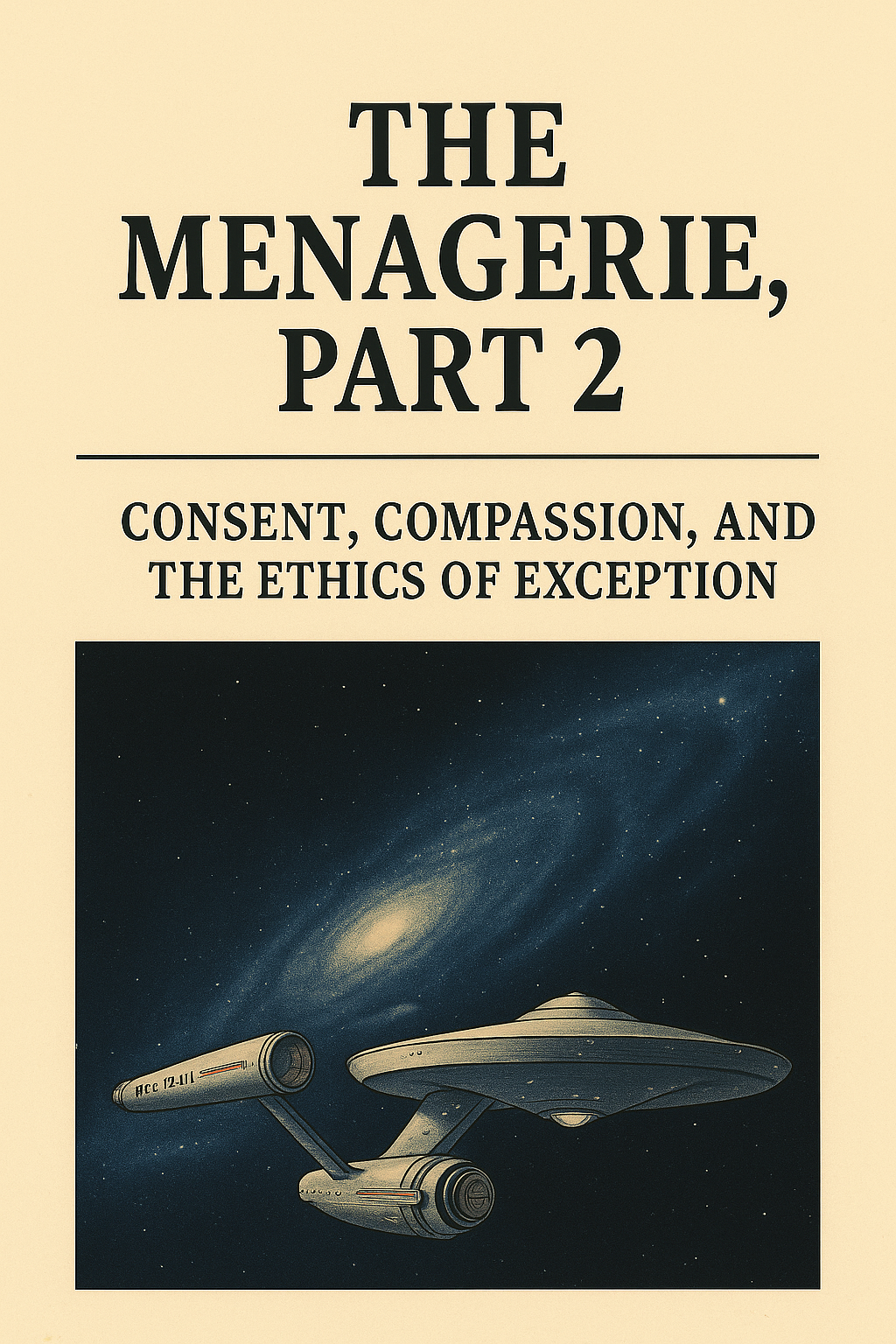
The Menagerie, Part 2 – Consent, Compassion and the Ethics of Exceptional Compliance

Show Summary

Today, we conclude the two-part saga of The Menagerie, a story that redefined what ethical decision-making looks like in leadership. When we left off in Part 1, Spock had surrendered himself for court-martial after hijacking the Enterprise and transporting his former captain, the severely disabled Christopher Pike, to the forbidden world of Talos IV. As Part 2 unfolds, we learn the true motivation behind Spock’s defiance and the profound ethical reasoning that underpins it.

This episode is not simply a continuation of a trial. Instead, it can be seen as a meditation on autonomy, empathy, and what it means to act ethically in a rigid system. For compliance professionals, The Menagerie, Part 2, is rich with insights into the complex choices we must make when policy, principle, and human dignity are at odds. In today’s blog post, we examine five major ethical themes from this story and illustrate how each one is grounded in a specific scene from the episode, providing compliance leaders with a framework for navigating real-world dilemmas within their organizations.

1. Autonomy and Informed Consent—Giving Voice to the Voiceless

Illustrated by: At the heart of this episode is Pike—a former starship captain, now paralyzed and confined to a life support chair, capable only of answering “yes” or “no” via a blinking light. When the Talosians offer him the chance to live in a world of illusion, he is asked if he wants to stay. He says, “Yes.”

Ethical Lesson:

This moment underscores a foundational principle of ethics: the right to self-determination. Pike is not coerced. He is not manipulated. He is fully informed of what Talos IV offers—freedom through illusion—and he consents. In compliance terms, this is the gold standard of ethical choice: voluntary, informed, and communicated.

For compliance professionals, it serves as a reminder that we must go beyond the checkbox approach to obtaining consent. Whether the issue is data privacy, workplace investigations, or employee monitoring programs, “informed consent” means more than legal formality. It means the individual understands the choice, has time to consider it, and is free to say no without fear of retaliation. Pike’s “yes” only matters because he has the freedom to say no.

2. Compassion as Compliance—Bending the Rules to Uphold Human Dignity

Illustrated by: Spock’s entire plan is illegal. He falsifies orders, hijacks a starship, and brings Pike to a planet that is off-limits under the most severe Federation regulation. Why? Because it’s the only place where Pike can live a life of meaning and peace.

Ethical Lesson:

This is perhaps the most potent lesson of The Menagerie, Part 2: sometimes, strict adherence to policy can result in cruelty. And in those moments, compliance must yield to compassion. Spock’s decision to act outside the rules was not made lightly; instead, it was made because no other pathway would preserve Pike’s dignity.

In real-world corporate ethics, this translates into the idea that rules should serve people, not the other way around. A zero-tolerance policy without exceptions is often a warning sign of a compliance culture that lacks empathy and understanding. Compliance leaders must ask, is the rule doing what it was meant to do, or has it become a barrier to doing what’s right?

3. Leadership, Legacy, and Ethical Loyalty

Illustrated by: The entire reason Spock risks his career and his freedom is because of Pike’s legacy. Pike once led with integrity, courage, and fairness—and now, Spock is repaying that leadership with a courageous act of his own. It’s a profoundly emotional portrayal of ethical loyalty.

Ethical Lesson:

This theme touches on a more profound truth for compliance professionals: how you lead today shapes how others will behave tomorrow. If you foster a culture of fairness, transparency, and ethical behavior, your team will carry those values forward, even when you’re no longer in charge. Pike’s silent presence throughout the episode reminds us that leadership never truly ends. Compliance officers who mentor, guide, and uphold ethical values may not see the immediate benefits of their work. Still, they build organizations that continue to act ethically, even in times of crisis. Spock is evidence of that.

4. Ethics and Illusion – When Appearance Isn’t Reality

Illustrated by: On Talos IV, Pike appears whole again, walking beside Vina in a paradise shaped entirely by illusion. The Talosians, with their extraordinary mental abilities, create an environment that allows Pike to escape his physical limitations. And yet, they ask for his consent. They do not impose.

Ethical Lesson:

This plot element speaks to the fine ethical line between influence and manipulation. Illusions are not inherently unethical, provided the subject is aware of and agrees to them. In corporate settings, this theme is reflected in marketing ethics, internal communications, and the deployment of AI or surveillance tools. Are you presenting employees or customers with reality or a version that has been curated to control behavior? The Talosians’ decision to inform Pike and let him choose demonstrates the ethical use of influence. Compliance professionals must ensure the same: transparency about tools and methods, respect for personal agency, and a refusal to exploit trust.

5. Strategic Deception and Transparency in Purpose

Illustrated by: The court-martial is revealed to be a ruse, a diversion designed to buy time to reach Talos IV. Commodore Mendez himself turns out to be an illusion projected by the Talosians, orchestrated to ensure Pike’s safe arrival. Yet, once the objective is achieved, the Talosians shut off the illusion and reveal everything.

Ethical Lesson:

Here, we see a nuanced, almost paradoxical ethical lesson: strategic deception, when used to advance truth and dignity, can be morally justifiable only if it ultimately leads to complete transparency. The court believed Spock’s actions to be treason. In the end, they see them as mercy. But that re-evaluation is only possible because Spock allows the process to run its course and discloses all.

In compliance work, this is akin to delaying disclosure of a suspected fraud to complete an internal investigation, but only if the delay is justified, temporary, and ultimately resolved through complete transparency. Ethical leadership means not only making the right call but also being willing to explain it afterward.

Final ComplianceLog Reflections

The Menagerie, Part 2, brings to a close one of the most deeply ethical stories in the entire Star Trek franchise. It’s a courtroom drama, but more importantly, it is a test of values. Spock breaks the law not to defy it but to defend a higher truth. Pike chooses not to escape reality but to find peace. And the Federation, to its credit, sees that sometimes rules must serve people, not imprison them.

For compliance professionals, the takeaway is this: never forget the humans behind the policies. Whether you’re writing a code of conduct, leading an investigation, or implementing controls, ask yourself: Does this uphold dignity and respect? Does it protect the agency? Does it serve the truth?

Ultimately, compliance isn’t solely about preventing risk. It’s about protecting people just as Spock protected Pike, not by obeying policy but by honoring his legacy, his dignity, and his will.

Categories
Regulatory Ramblings

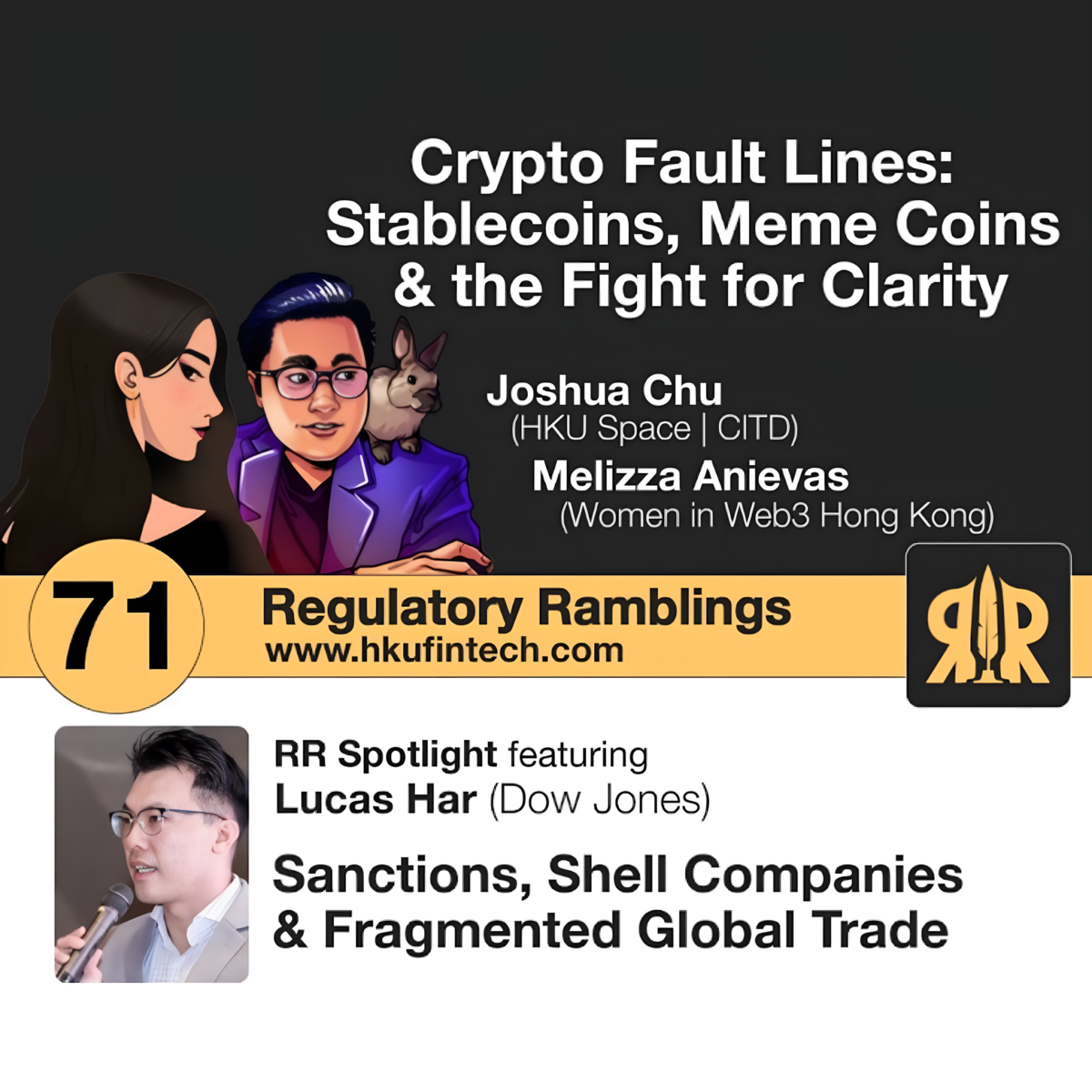
Regulatory Ramblings: Episode 71 – Crypto Fault Lines: Stablecoins, Meme Coins & the Fight for Clarity PLUS: Sanctions, Shell Companies & Fragmented Global Trade

This episode begins with a brief spotlight chat with Lucas Har from Dow Jones in Singapore, discussing trade compliance, sanctions, dual-use goods, and supply chain risk, particularly in the context of the currently strained US-China trade relationship following the recent increase in US tariffs on China and Hong Kong.

We then proceed to a discussion with Hong Kong-based Joshua Chu and Melizza Anievas to explore Hong Kong’s recently enacted Stablecoin Ordinance, including the distinction between meme coins and stablecoins, as well as the ever-evolving global landscape for virtual assets in light of recent regulatory developments in the US.

On May 21, 2025, the Hong Kong Legislative Council passed the Stablecoins Ordinance, creating a formal licensing regime for fiat-referenced stablecoin (FRS) issuers. While local in implementation, the regulatory milestone decisively places Hong Kong at the forefront of a broader Asian effort to shape the future of legitimate, rules-based decentralized finance (DeFi) and tokenized financial infrastructure.

The move came just one day after the US Senate passed the GENIUS Act. Against this backdrop, Hong Kong’s move added momentum to global harmonization efforts on stablecoin regulation, directing the policy debate more towards developing trustworthy digital asset ecosystems with practical, real-world utility and functionality.

The territory’s new framework requires all issuers promoting fiat-backed stablecoins to the general public locally to be licensed by the Hong Kong Monetary Authority (HKMA)—the city’s banking regulator and de facto central bank.

Additionally, issuers must hold reserves in either cash or high-quality, highly liquid assets, such as short-term government securities. Stablecoins must be redeemable at par value at any time. Issuers must regularly disclose their reserve holdings and undergo audits. AML/CFT compliance and risk controls are also required.

This regulatory clarity is paired with active development. For example, Hong Kong’s Stablecoin Sandbox, launched last year, has enabled companies such as Standard Chartered, Animoca Brands, and JD Coinlink to test real-world use cases across payments, capital markets, and trade finance. Ultimately, it reflects a coordinated effort to turn policy into practical rails for tokenized activity.

Joshua Chu

Joshua Chu is a prominent Hong Kong lawyer specializing in fintech and crypto matters, as well as a prolific writer. His opinion and insights are much sought after by the local press and correspondents of major foreign news organizations operating in the city. You can often hear him at his most candid on the radio at RTHK.

Joshua is also co-chair of the Hong Kong Web 3 Association and legal advisor to the Hong Kong Blockchain Association.


Melizza Anievas

Melizza Anievas is a co-founder and executive director of Women in Web3 Hong Kong. Under her leadership, Women in Web3 Hong Kong has grown to over 1,500 members and secured over HK$300,000 in sponsorships within a year, establishing working relationships with notable partners such as Google Cloud Hong Kong, The Sandbox, and Animoca Brands. A Web3 veteran since 2019, Melizza excels at devising growth-driven strategies and operating hyper-growth businesses.


Lucas Har

Lucas Har is based in Singapore and has been with Dow Jones Risk & Compliance for nearly a decade. He began his career with a focus on Anti-Money Laundering (AML) and Counter-Terrorism Financing (CTF) research across a diverse portfolio of Asia-Pacific jurisdictions.

Later, Lucas took on a leadership role overseeing the company’s content curation team, where he was responsible for news curation and monitoring adverse media.

In his current position, he manages the firm’s global trade compliance product suite, spearheading innovation and strategic growth.

He has also extensively engaged with financial institutions, corporations, and regulators across multiple regional jurisdictions, fostering discussions on export control compliance and further strengthening Dow Jones’s expertise in such an increasingly vital and complex area.

Discussion:

As our guests flesh out, several common threads emerge linking the two segments of today’s episode. The first is that of regulatory fragmentation across jurisdictions such as the US, mainland China, Hong Kong, and the EU.

There is also the issue of extraterritorial overreach and competition, particularly between China’s export rules and US crypto laws, as well as a global push for clarity in fast-moving, high-risk sectors, including the international trade of goods and virtual assets more broadly. Simply put, the heavy geopolitical undertones in both export control and digital asset regulation cannot be avoided, as they cast a shadow on the role of trust and credibility, or the lack thereof, in navigating both trade and cryptocurrency systems.

With that in mind, the podcast begins with Regulatory Ramblings host Ajay Shamdasani asking Lucas about the evolving regulatory landscape shaping international trade and its implications for Hong Kong businesses, as well as the impact of mainland China’s new export control regulations on dual-use goods.

Lucas shares what legal and compliance specialists need to know about the regulatory hurdles the firms they serve must adhere to, including sanctions and export control regulations, as well as best practices for enhancing due diligence procedures to mitigate trade-related risks.

Following that, Joshua and Melizza share their thoughts on what the new stablecoin ordinance will mean for Hong Kong, as well as the importance of recent US regulations. Securities and Exchange Commission clarifications on meme coins and their potential impact on legal, risk, and compliance strategies for developers and investors.

The three of them go on to discuss the key operational and regulatory challenges stablecoin issuers face under Hong Kong’s new licensing regime and how the US GENIUS and STABLE Acts might reshape the US stablecoin market and influence global regulatory approaches.

Indeed, something worth asking—and which Joshua and Melizza do not shy away from commenting on⁠ — is whether the relatively ‘light touch’ regulation of meme coins encourages innovation or exposes investors to undue risk.

The conversation concludes with a chat about how projects can effectively balance innovation with regulatory compliance amid differing US and APAC frameworks. Most memorable is how Melizza distinguishes between Web 3.0 and Web3.

Useful links in this episode:

You might also be interested in:

Connect with RR Podcast at:

LinkedIn: https://hk.linkedin.com/company/hkufintech 
Facebook: https://www.facebook.com/hkufintech.fb/
Instagram: https://www.instagram.com/hkufintech/ 
Twitter: https://twitter.com/HKUFinTech 
Threads: https://www.threads.net/@hkufintech
Website: https://www.hkufintech.com/regulatoryramblings 

Connect with the Compliance Podcast Network at:

LinkedIn: https://www.linkedin.com/company/compliance-podcast-network/
Facebook: https://www.facebook.com/compliancepodcastnetwork/
YouTube: https://www.youtube.com/@CompliancePodcastNetwork
Twitter: https://twitter.com/tfoxlaw
Instagram: https://www.instagram.com/voiceofcompliance/
Website: https://compliancepodcastnetwork.net

Categories
Blog

Wells Fargo, Risk Management and Reputational Recovery: Part 2 – Lessons Learned

On June 3, 2025, the Federal Reserve lifted its unprecedented $2 trillion asset cap on Wells Fargo, marking the symbolic end to one of the most consequential compliance enforcement actions in modern U.S. banking history. For the compliance and risk management community, this moment is not a victory lap; it is a case study of how compliance failures cascade, reputational risk becomes operationally tangible, and regulatory patience has its limits.

Over these two blog posts, I have explored what happened, why it mattered, and what lessons every compliance professional should carry forward. Yesterday, we examined the unique penalty imposed on Wells Fargo. Today, we reflect on the lessons learned by compliance professionals.

1. Sales Incentives Must Be Auditable and Aligned with Ethics

Incentive structures sit at the very core of behavioral risk. At Wells Fargo, the sales-driven “Gr-eight” initiative, designed to sell eight products per customer, transformed from a marketing aspiration into an existential risk. The program rewarded aggressive cross-selling, but without effective compliance oversight, it became a toxic engine of misconduct. Employees, facing immense pressure to meet unrealistic sales goals, began opening unauthorized accounts and manipulating customer data, led by the very highest levels of the company. This was not isolated behavior; it was systemic fraud incentivized by misaligned performance metrics.

For compliance professionals, the lesson is straightforward: incentive programs must be co-designed with risk and compliance in the room. It is not enough to reward growth; companies must also reward growth achieved in an ethical manner. This means conducting behavioral audits of how incentive programs are experienced in practice, not just how they appear on paper. Are salespeople bending the rules to meet targets? Are managers discouraging whistleblowing to protect metrics?

Moreover, all incentive plans should undergo compliance risk assessments. This includes mapping the downstream effects of reward systems, integrating compliance KPIs, and instituting real-time monitoring mechanisms. Transparency is key; employees must understand that ethical behavior is not just expected but tracked and rewarded.

Wells Fargo’s downfall was a direct result of a cultural failure to align incentives with values. When success is measured solely by numbers, ethics become expendable. Compliance leaders must ensure that incentive systems pass both the audit test and the mirror test: can they be audited for integrity, and can you look in the mirror knowing they support the organization’s stated values?

In the modern regulatory environment, misaligned incentives are no longer just a business risk—they are a regulatory and reputational time bomb waiting to detonate.

2. Regulatory Fatigue Is Not an Excuse

One of the most sobering realities of the Wells Fargo asset cap was its duration: seven years. That’s nearly a decade of constrained growth, investor frustration, and board-level scrutiny. Some might assume that regulatory attention naturally fades over time, but the Wells Fargo case proves otherwise. Regulators did not relent. They did not forget. And they did not lift the restrictions until the institution proved it had earned back the trust lost through systemic misconduct.

For compliance professionals, this underscores a critical truth: regulatory fatigue is no excuse for underperformance or delay. Treating compliance obligations as a burdensome box-checking exercise is what led Wells Fargo into this mess in the first place. Real remediation requires patience, perseverance, and, above all, a cultural shift in how the organization views compliance.

This shift is not cosmetic. Instead, it is strategic. It means compliance is embedded in daily operations rather than being relegated to periodic reports. It means senior leadership engages deeply in control redesigns, audits, and training rather than just approving them. It means boards of directors receive regular updates that go beyond dashboards to include narrative risk insights, root cause analyses, and forward-looking risk indicators.

Wells Fargo’s journey illustrates the high cost of superficial remediation. CEO Charlie Scharf’s arrival in 2019 marked a turning point because he treated compliance not as an obstacle but as a foundation. His willingness to restructure the operating model around risk oversight demonstrated that regulatory trust must be rebuilt brick by brick, meeting by meeting, order by order.

There are no shortcuts. Compliance professionals must prepare their organizations for the long haul. When the pressure to “move on” arises, as it inevitably will, it is the CCO’s duty to say: not yet. True cultural transformation takes time, and regulators will accept nothing less.

3. Asset Caps and Structural Penalties Are the New Frontier

The $2 trillion asset cap imposed on Wells Fargo was unprecedented, but it may not be the last of its kind. It has become a powerful precedent for how regulators can discipline systemically critical financial institutions that fail to meet compliance and ethical standards. Unlike traditional fines, which can be absorbed as the cost of doing business, the asset cap was a structural constraint on the company’s operations. It limited the bank’s ability to grow, serve customers, issue loans, and participate in high-margin Wall Street business lines. It was a living penalty, a regulatory scarlet letter that reshaped how Wells Fargo operated at every level.

For the compliance and risk community, this evolution is of profound significance. It suggests that enforcement tools are expanding beyond punitive monetary settlements to include operational restrictions that fundamentally alter business strategy. This signals a clear shift in regulatory philosophy: punishment should not only be proportional to misconduct. Still, it should also force organizations to re-engineer the systems that enabled that misconduct in the first place.

Compliance leaders must now broaden their risk lens. A mature compliance risk assessment framework must consider not only reputational and financial risks but also operational penalties that can hinder competitiveness. Could your business withstand a regulator-imposed halt to product launches? A limitation on asset growth? A prohibition on acquisitions? These are no longer hypothetical concerns; they are real enforcement options, as Wells Fargo learned.

Moreover, structural penalties create long-term internal pressure. Wells Fargo invested heavily, incurring more than $2.5 billion in extra costs and hiring 10,000 additional compliance personnel to satisfy the consent orders. That level of expenditure may not be feasible for smaller institutions, making early detection and proactive compliance investment even more critical.

The future of enforcement is structural. Innovative compliance programs must prepare for this new reality before regulators force the issue.

4. Invest in the Right People

Wells Fargo’s long road to regulatory redemption was not paved by technology alone or process overhauls, and people drove it. After years of reputational damage, CEO turnover, and regulatory gridlock, the appointment of Charlie Scharf in 2019 signaled a fundamental shift. Scharf understood what prior leadership had not: you cannot reform risk culture without reforming the people responsible for it. He replaced key executives, restructured risk and compliance teams, and built a leadership bench equipped to navigate the demands of a post-scandal environment.

For compliance professionals, the takeaway is clear: people are the heart of your program. You can build a library of policies and procure the most advanced analytics platforms, but without qualified, empowered, and appropriately incentivized professionals, those systems will fail. Effective compliance begins with hiring not just for expertise but also for integrity and courage. Your CCO must have access to the board, independence from business pressures, and the authority to challenge decisions without fear of reprisal.

At Wells Fargo, the turnaround required hiring an “army” of more than 10,000 new risk and compliance professionals. While most companies will not need to scale at that level, the principle remains: a token compliance function cannot defend against systemic risk. The right people in the right roles with clear mandates and sufficient resourcing are the first line of defense.

Equally important is leadership. Scharf’s experience leading Visa and BNY Mellon gave him a strategic understanding of regulatory expectations. He began each executive meeting with a regulatory update, not as a formality but as a signal. This was not compliance theater. This was operational DNA.

In today’s risk environment, talent is your most significant differentiator. Invest in leaders who understand governance, not just growth. Because when crisis strikes, the question isn’t what systems are in place. It’s who is leading them.

What’s Next for Wells Fargo—and You

Now that the cap is lifted, Wells Fargo is poised to grow again. It can expand lending, scale its wealth management services, and bolster its Wall Street business. But as Scharf and analysts have noted, this is “still a journey.”

Even without the cap, consent orders remain in effect. More critically, public trust is still under repair.

For the rest of the financial sector and, frankly, any large organization, the lesson is this: enforcement is not just about punishment. It’s about operational reform. The Wells Fargo story serves as a blueprint for how misconduct can metastasize when culture, incentives, and oversight fail to align and how painfully slow and expensive the path back to credibility can be.

Compliance Is Not a Department—It’s a Discipline

The Wells Fargo saga is not merely a tale of scandal and sanction. It is a real-world case study of how compliance failures metastasize when unchecked and how painful, expensive, and prolonged the road to recovery becomes when structural change is delayed. For seven years, Wells Fargo was held in regulatory purgatory not because of a single incident but because its culture, controls, and leadership failed to recognize that ethics and governance are non-negotiable pillars of business continuity.

Each of the four lessons discussed ethical incentive alignment, stamina in regulatory remediation, preparing for structural penalties, and investing in the right people—reinforces a central truth: compliance is not episodic. It is continuous, cultural, and deeply tied to leadership.

When incentives ignore integrity, misconduct becomes inevitable. When organizations view compliance obligations as burdens rather than opportunities for reform, they erode trust. When regulators respond with operational penalties as they now can and will, compliance becomes not just a cost center but a barrier to growth. And when companies finally decide to rebuild, it is the strength and credibility of their people that determines whether that effort will succeed.

Wells Fargo survived its reckoning. But survival came at a steep price: lost market share, damaged reputation, investor doubt, and a compliance bill in the billions. For the rest of us, the goal is not to weather such a storm but to avoid it entirely. That means taking compliance seriously before the headlines, before the enforcement actions, and before the crisis.

In the post-Wells era, corporate compliance is no longer optional or siloed; it is a fundamental aspect of business operations. It is embedded, empowered, and expected to lead. As compliance professionals, our charge is clear: build systems that promote integrity, protect the enterprise, and earn the trust that regulators can’t mandate but can take away.

Resources:

  1. Wells Fargo Is Allowed to Grow Again After 7 Years Under Asset-Cap Penalty, by Gina Heeb in the Wall Street Journal.
  2. Wells Fargo Asset Cap Lifted by Fed, Paving Way for Growth by Yizou Wang in Bloomberg.
  3. Wells Fargo’s Asset Cap Has Been a Good Punishment in Bloomberg by Paul Davies.

Categories
10 For 10

10 For 10: Top Compliance Stories For the Week Ending June 12, 2025

Welcome to 10 For 10, the podcast which brings you the week’s Top 10 compliance stories in one podcast each week. Tom Fox, the Voice of Compliance brings to you, the compliance professional, the compliance stories you need to be aware of to end your busy week. Sit back, and in 10 minutes hear about the stories every compliance professional should be aware of from the prior week. Every Saturday, 10 For 10 highlights the most important news, insights, and analysis for the compliance professional, all curated by the Voice of Compliance, Tom Fox. Get your weekly filling of compliance stories with 10 for 10, a podcast produced by the Compliance Podcast Network.

You can check out the Daily Compliance News for four curated compliance and ethics related stories each day, here.

Connect with Tom 

Instagram

Facebook

YouTube

Twitter

LinkedIn

You can purchase a copy of my new book, Upping Your Game, on Amazon.com

Categories
FCPA Compliance Report

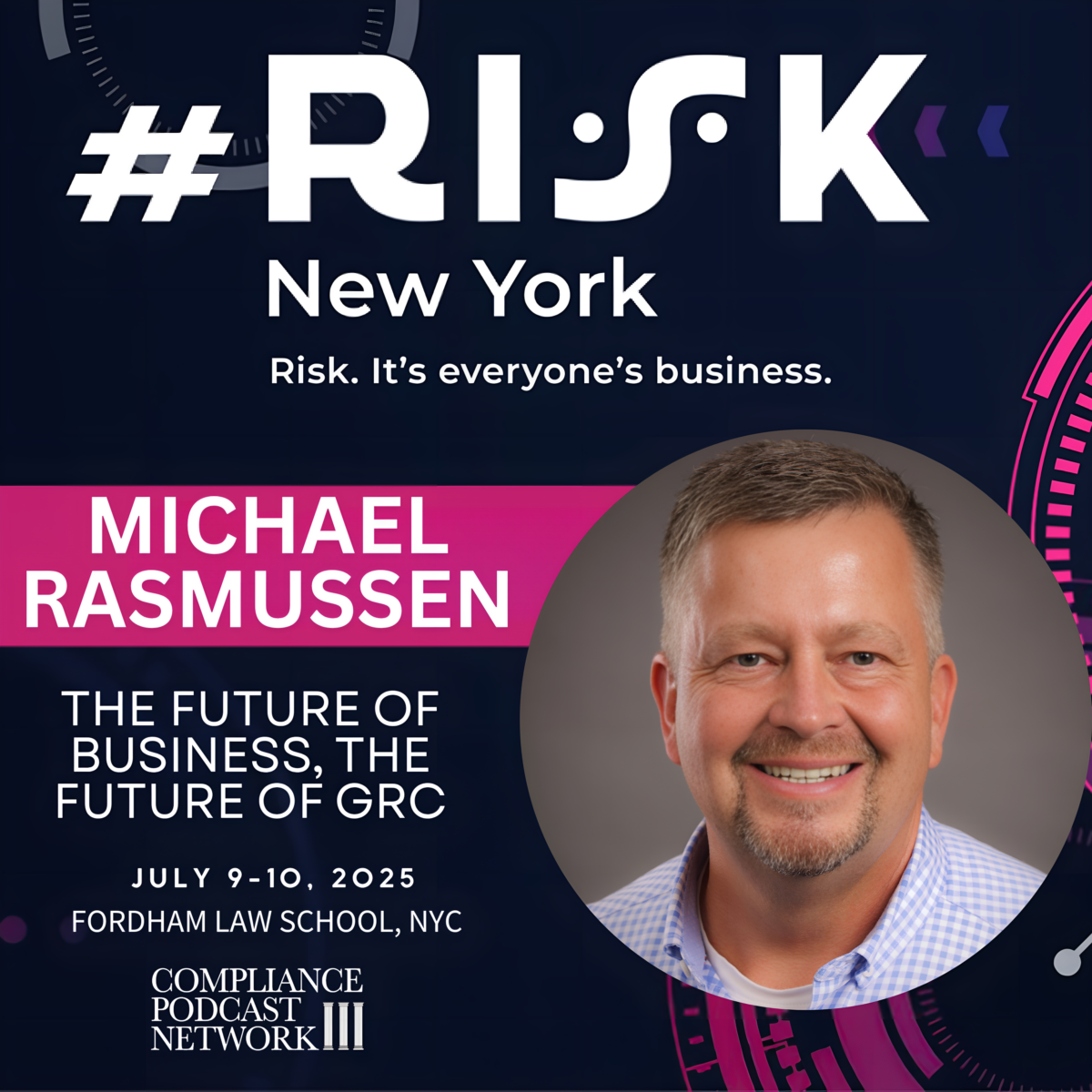
#Risk New York Speaker Series – Exploring the Future of GRC with Michael Rasmussen

Join Tom Fox and hundreds of other GRC professionals in the city that never sleeps, New York City, on July 9 & 10 for one of the top conferences around, #Risk New York. The current US landscape, shaped by evolving policies, rapid advancements in AI, and shifting global dynamics, demands adaptive strategies and cross-functional collaboration.

At #RISK New York, you will master the New Regulatory Reality by getting ahead of US regulatory shifts and their impact. Conquer AI and Tech Risk by Safeguarding Your Organization in an AI-Driven World and Understanding the Implications of Major Tech Investments. Navigate Financial and Crypto Volatility by Protecting Your Assets and Exploring Solutions in a Dynamic Market. Strengthen Your GRC Framework by Leveraging Governance, Risk, and Compliance for Strategic Advantage. Protect Digital Trust by addressing challenges in cybersecurity and data privacy and combating misinformation. All while meeting with the country’s top #Risk management professionals.

In this episode, Tom Fox welcomes Michael Rasmussen, a renowned expert in Governance, Risk Management, and Compliance (GRC), often referred to as the ‘father of GRC.’ Michael shares insights into his contributions to the field, including his work with the SEG GRC Capability Model. The conversation highlights Michael’s anticipated presentation on ‘The Future of GRC’ at the upcoming risk conference in New York City. Drawing inspiration from Star Trek (TOS, and how can you not love that?), Michael emphasizes the importance of managing business risks effectively. The discussion also touches on the benefits of face-to-face interactions and networking opportunities at such conferences.

Resources:

#Risk Conference Series

#RiskNYC—Tickets and Information

Michael Rasmussen on LinkedIn

Categories
Everything Compliance

Everything Compliance: Episode 155, To Tesla and Beyond Edition

Welcome to this edition of the award-winning Everything Compliance. In this episode, we have the quartet of Matt Kelly, Jonathan Marks, Jonathan Armstrong, and special guest panelist Hemma Lomax, all hosted by Tom Fox, the Compliance Evangelist.

  1. Hemma Lomax examines the customers of a compliance program and introduces us to the terms EX and CX. She shouts out to AI for podcasters.
  2. Matt Kelly delves into Google’s compliance spending announcement and asks why the company does not have a Chief Compliance Officer. He both shouts out and rants about Marjorie Taylor Greene and her reading list.
  3. Jonathan Marks gives us a primer on corporate governance. He shouts out the quiet compliance professionals who do the day-to-day spadework of compliance.
  4. Jonathan Armstrong takes a deep dive into the finances of Tesla and its profitability. He shouts out to Operation Spider’s Web.
  5. Tom Fox highlights Wells Fargo’s compliance remediation, the Fed’s asset cap placed on Wells Fargo, and its subsequent removal.

The members of Everything Compliance are:

Tom Fox, the Voice of Compliance, is the host, producer, and sometimes panelist of Everything Compliance. He can be reached at tfox@tfoxlaw.com. The award-winning Everything Compliance is part of the Compliance Podcast Network.

Categories
Compliance Tip of the Day

Compliance Tip of the Day – Code of Conduct as an Internal Control

Welcome to “Compliance Tip of the Day,” the podcast that brings you daily insights and practical advice on navigating the ever-evolving landscape of compliance and regulatory requirements. Whether you’re a seasoned compliance professional or just starting your journey, our goal is to provide you with bite-sized, actionable tips to help you stay ahead in your compliance efforts. Join us as we explore the latest industry trends, share best practices, and demystify complex compliance issues to keep your organization on the right side of the law. Tune in daily for your dose of compliance wisdom, and let’s make compliance a little less daunting, one tip at a time.

How does your Code of Conduct act as an internal control?

For more information on this topic, refer to The Compliance Handbook: A Guide to Operationalizing Your Compliance Program, 6th edition, recently released by LexisNexis. It is available here.

Categories
Daily Compliance News

Daily Compliance News: June 12, 2025, The Brutal Truth Edition

Welcome to the Daily Compliance News. Each day, Tom Fox, the Voice of Compliance, brings you compliance-related stories to start your day. Sit back, enjoy a cup of morning coffee, and listen in to the Daily Compliance News. All from the Compliance Podcast Network. Each day, we consider four stories from the business world: compliance, ethics, risk management, leadership, and general interest, all of which are relevant to the compliance professional.

Top stories include:

  • 4 questions to ask employees. (WSJ)
  • The Brutal Truth About Layoffs in 2025. (FT )
  • The CITGO auction date has been extended (yet again). (Reuters)
  • Rubio is pressing the DOJ to investigate Harvard. (NYT)
Categories
Blog

Wells Fargo, Risk Management and Reputational Recovery – Part 1: The Penalty

On June 3, 2025, the Federal Reserve lifted its unprecedented $2 trillion asset cap on Wells Fargo, marking the symbolic end to one of the most consequential compliance enforcement actions in modern U.S. banking history. For the compliance and risk management community, this moment is not a victory lap—it is a case study of how compliance failures cascade, reputational risk becomes operationally tangible, and regulatory patience has its limits.

Over the next two blog posts, I want to explore what happened, why it mattered, and what lessons every compliance professional should carry forward. These blog posts are based on two primary articles. The First Wells Fargo Is Allowed to Grow Again After 7 Years Under Asset-Cap Penalty, by Gina Heeb in the Wall Street Journal. The second is “Wells Fargo Asset Cap Lifted by Fed, Paving Way for Growth” by Yizhu Wang in Bloomberg. The final is an op-ed piece in Bloomberg, entitled “Wells Fargo’s Asset Cap Has Been a Good Punishment,” by Paul Davies.

The Scandal That Shook the System

The Wells Fargo saga began with a simple, albeit stunning, revelation: employees had opened millions of unauthorized deposit and credit card accounts to meet aggressive internal sales goals. Between 2009 and 2016, over 3.5 million accounts were opened without the customer’s consent. Many of these accounts generated fees, tarnishing customer relationships and shaking public trust in one of the most storied names in American banking.

As the crisis deepened, it was not just a case of bad apples. It was a system-wide failure of controls, risk oversight, and a corporate culture that incentivized misconduct. The sales quotas that fueled the behavior were directly tied to compensation and job security, creating a high-pressure environment where fraud became a means of survival.

Regulators acted swiftly. In 2016, Wells Fargo was fined $185 million. In 2018, the Federal Reserve took the rare and dramatic step of capping the bank’s total assets at approximately $2 trillion, essentially freezing its ability to grow until it could demonstrate a wholesale overhaul of its risk management and governance practices.

The Asset Cap: Punishment with Purpose

We need to be clear: this was not just a penalty. It was a structural constraint that directly impacted Wells Fargo’s ability to operate and compete in its core business. The $2 trillion asset cap imposed by the Federal Reserve in 2018 did not simply send a signal; it built a wall. It limited Wells Fargo’s ability to grow its balance sheet, take on new deposits, issue new loans, and expand into revenue-generating business lines, such as investment banking, trading, and wealth management. Unlike traditional enforcement actions, which often result in fines or deferred prosecution agreements, the asset cap attacked the bank’s future potential, not just its past misdeeds.

In short, it was a period of growth stagnation. For a publicly traded institution that relies on growth to attract investors, increase shareholder value, and maintain market position, such a freeze is devastating.

The restriction forced the bank into a defensive crouch. Instead of competing for market share or innovating with new financial products, Wells Fargo was compelled to pour resources into compliance remediation and cultural rehabilitation. According to public filings and internal estimates, the bank spent more than $2.5 billion above its 2018 baseline to maintain the risk, control, and compliance infrastructure needed to satisfy dozens of consent orders. This included the hiring of more than 10,000 employees dedicated to risk and regulatory functions—a remarkable mobilization of resources that most firms would struggle to afford.

As Davies aptly observed, “The asset cap has become a feared punishment for banks in the U.S.; they will want to avoid it at all costs.” And banks should. Because it not only restricts current operations, it sends a clear signal to markets, analysts, and regulators: this institution is not yet trusted to grow.

However, here’s the twist: in the case of Wells Fargo, it did work.

The asset cap’s forced pause compelled the bank to undertake a comprehensive review of its governance and culture. Under the leadership of CEO Charlie Scharf, who joined BNY Mellon in 2019 and previously held senior roles at Visa and JPMorgan, Wells Fargo began the arduous but necessary work of rebuilding. Scharf wasted no time restructuring the risk and compliance functions, streamlining reporting lines, and replacing much of the leadership team that had presided over the bank’s previous failures. Perhaps most importantly, he made compliance the focal point of executive decision-making, beginning every operating committee meeting with a thorough review of regulatory progress.

In effect, the asset cap did not simply punish Wells Fargo; it saved the bank from itself. It forced the kind of systemic, sustainable change that no fine or press release could have achieved. Wells Fargo emerged leaner, more disciplined, and more compliant. In many ways, it became a model for what the Federal Reserve, the Department of Justice (DOJ), and numerous other regulatory agencies now expect. Not simply accountability but a demonstrable and lasting commitment to cultural transformation.

This is remediation before reward. It is tone at the top in action. And for compliance professionals everywhere, it is proof that when structural enforcement is coupled with leadership willing to change, reform is not only possible but, as Theranos might say, “inevitable.”

Why It Worked: Enforcement as a Governance Driver

For corporate compliance professionals, Wells Fargo is more than a cautionary tale. It is proof that regulatory enforcement, when aligned with structural consequences, can drive actual change. The asset cap was not a mere symbolic gesture. It constrained Wells Fargo’s operations at its core, limiting everything from loan issuance to deposit intake to investment banking expansion.

Even more significantly, it reshaped how the bank’s board and senior executives prioritized compliance. For years, every operating committee meeting began with updates on regulatory matters. This became the bank’s daily bread.

The message is clear: when enforcement bites into business, executives listen.

Join us tomorrow as we delve into Part 2, where we examine lessons learned for the compliance professional.