Categories
Innovation in Compliance

Innovation in Compliance – Healthcare Compliance: Fraud, Waste & Abuse, Culture, and Data-Driven Risk Management with Evan Sampson

Innovation occurs across many areas, and compliance professionals need not only to be ready for it but also to embrace it. Join Tom Fox, the Voice of Compliance, as he visits with top innovative minds, thinkers, and creators in the award-winning Innovation in Compliance podcast. In this episode,  host Tom Fox welcomes Evan Sampson, a noted health care compliance attorney.

Sampson traces his path from commercial litigation to representing healthcare practices on HIPAA/privacy and reimbursement matters, then moving in-house at a network of plastic surgery centers, where he managed compliance focused on fraud, waste, and abuse, and on evolving out-of-network billing rules leading into the No Surprises Act. Sampson explains how compliance programs can create business value beyond risk mitigation by uncovering inefficiencies and opportunities, such as identifying downcoding in medical billing and using complaint investigations to spot growth areas. He describes how his litigation background helps him anticipate how issues will unfold over time in investigations and litigation, thereby improving his credibility with business leaders. They discuss building a culture of compliance in fast-growing healthcare organizations, tracking regulatory changes across primary and secondary sources, and leveraging AI and data analytics to detect claim outliers and strengthen compliance.

Key highlights:

  • Healthcare Compliance Shift
  • Fraud, Waste, and Abuse
  • Compliance Creates Value
  • Building Compliance Culture
  • Tracking Regulatory Changes
  • AI in Compliance Analytics

Resources:

Evan Sampson on LinkedIn

Post & Schell

Innovation in Compliance was recently honored as the Number 4 podcast in Risk Management by 1,000,000 Podcasts.

Categories
Daily Compliance News

Daily Compliance News: March 3, 2026, The Law Firms Cleared Edition

Welcome to the Daily Compliance News. Each day, Tom Fox, the Voice of Compliance, brings you compliance-related stories to start your day. Sit back, enjoy a cup of morning coffee, and listen in to the Daily Compliance News. All, from the Compliance Podcast Network. Each day, we consider four stories from the business world, compliance, ethics, risk management, leadership, or general interest for the compliance professional.

Top stories include:

  • The Trump Administration gives up on illegal actions against law firms. (WSJ)
  • Trump, tariffs, and corruption. (NYT)
  • Getting complacent about the next financial meltdown. (FT)
  • Microsoft is cooperating with Japan’s anti-trust probe. (Bloomberg)
Categories
The PfBCon Podcast

The PFBCon Podcast: Regulatory Ramblings Wins the 2025 Agora Award: Inside the Podcast Bringing Clarity to Global Financial Regulation

At a conference, the 2025 Agora Award for Excellence in Podcasting is formally presented to Regulatory Ramblings, recognizing its role in clarifying complex global financial regulation through expert, long-form dialogue and its contribution to transparency, accountability, and informed public discourse. Host Ajay Shamdasani (a veteran financial and legal journalist and senior research fellow at the University of Hong Kong) discusses the show’s origins—modeled on the idea of telling “the story of money” through the interconnections of law, regulation, finance, and capital—and how its scope has evolved to include ESG, sustainability, inclusion, and geopolitical risk alongside topics like money laundering, sanctions, fraud, crypto/Web3, cybercrime, anti-corruption, and human trafficking.

Ajay outlines the production team and roles (Professor Douglas Arner as team leader with editorial freedom; producer Prospero Laput as the technical backbone; admin support from Neo; research support, including Ying Man Chan) and explains a format change, adding a short topical segment before a longer interview to accommodate audience attention spans while keeping conversations authentic. The discussion also covers the podcast’s growing global reach through the Compliance Podcast Network, increased inbound guest and collaboration requests, listener feedback on episodes about U.S. regulatory shifts (including the FCPA, AML enforcement, and the GENIUS Act), and how the show anchors global issues back to Hong Kong and Asia-Pacific. Ajay reflects on the emotional impact of the human trafficking episode with Matt Friedman and comments on Hong Kong’s regulatory and fintech landscape versus Singapore and Dubai, the role and reputation of HKU Law, and broader themes of shifting global power centers, sanctions, and managed globalization. The episode closes with Ajay’s view that podcasting can be a public service that spreads ideas, builds awareness of institutions and research, and creates opportunities for collaboration.

Key highlights:

  • Agora Award Announcement: 2025 Excellence in Podcasting
  • Why They Won: “We’re Still Here” and Hong Kong’s Global Role
  • Origin Story & Mission: Telling the Story of Money (and Everything Connected)
  • Behind the Mic: Who Does What on the Show
  • Format Evolution: Spotlight Segments, Audience Attention, and Editorial Choices
  • Toughest Topics: Human Trafficking Episode and the Emotional Toll
  • HKU’s Role: Hong Kong’s Legal Education Powerhouse
  • Hong Kong Finance Today: FinTech, Crypto Rules, and Traditional Banking Reality
  • Growing the Audience: Compliance Podcast Network, Brand Awareness, and Listener Impact
  • Covering a Region (and the World): Balancing Local Hong Kong Anchors with Global News
  • US–China Thaw? Decoupling, Trade Realities, and What Comes Next
  • Why Professionals Should Podcast: Influence, Public Service, and Collaboration

Resources:

Follow Regulatory Ramblings on:

HKU FinTech Website

Apple Podcast

Spotify

YouTube

Amazon Music

Podcast Addict

Follow HKU FinTech on:

LinkedIn

Instagram

X

Facebook

Categories
Blog

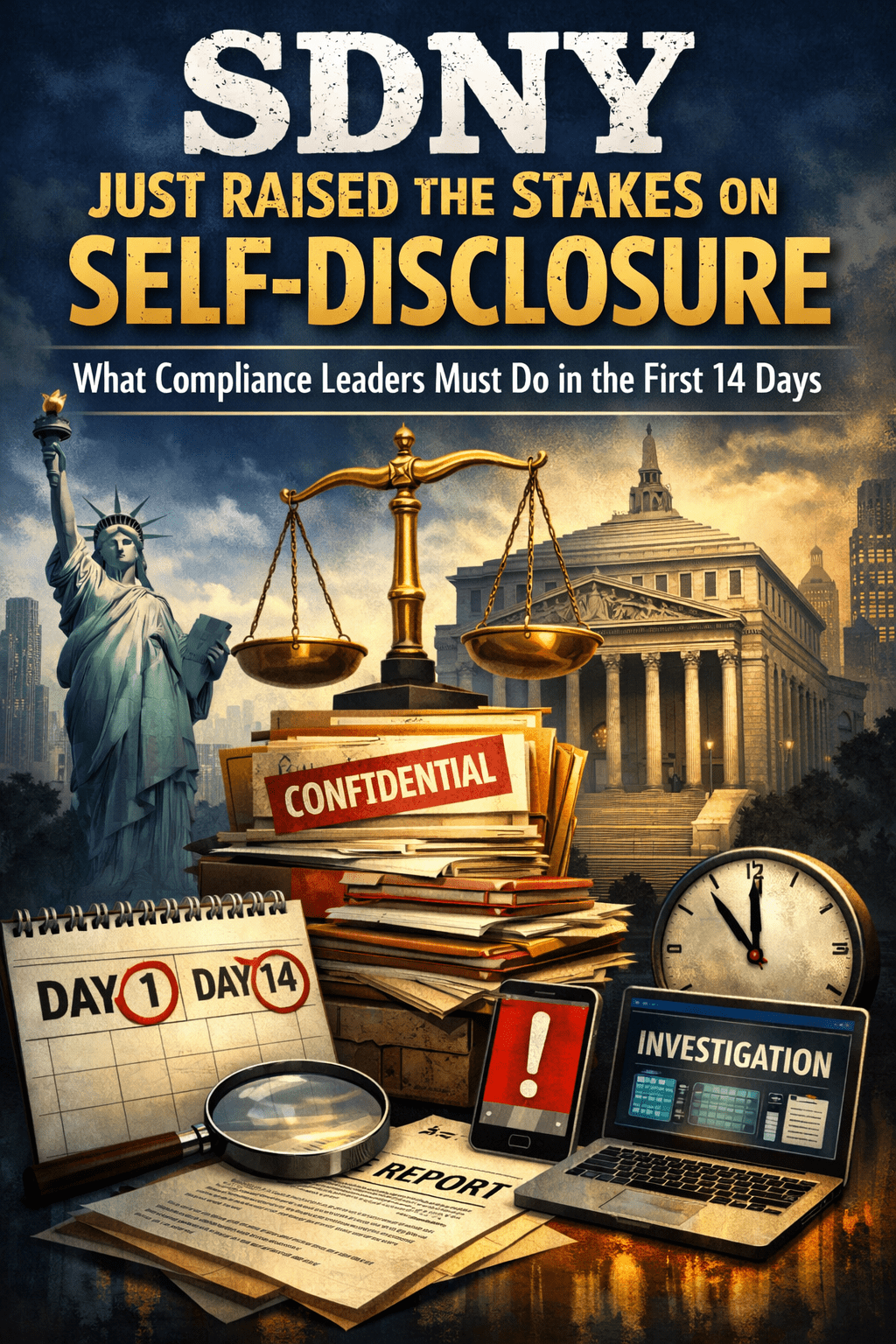
SDNY Just Raised the Stakes on Self-Disclosure: What Compliance Leaders Must Do in the First 14 Days

For years, compliance leaders have worked under a simple reality: if the government learns about a problem from someone else first, you have already lost leverage. The Southern District of New York (SDNY) just sharpened that reality into a clear, public framework. Its Corporate Enforcement and Voluntary Self-Disclosure Program for Financial Crimes, effective February 24, 2026, is not subtle. It is designed to force an earlier decision and reward companies that make it; this means making it fast, transparent, and with meaningful remediation and restitution.

This is not just a fraud prevention or reporting program. It reaches conduct that can show up in any company: accounting games, deceptive disclosures, market-facing misconduct, and the broader universe of financial crime risks that sit adjacent to bribery-and-corruption controls. If you are running a compliance program, you should read this initiative as a warning: even when the underlying misconduct is not charged as “bribery,” the financial-crimes hook is often where prosecutors live. You may think you are managing “corruption risk.” SDNY is telling you it is also “market integrity” and “victim harm” risk.

And SDNY is pairing that message with something rare in enforcement policy: speed. SDNY says qualifying companies “can expect to receive a conditional declination letter within two to three weeks of self-reporting”. That is a flashing sign for CCOs: the window for decision-making just got smaller.

The SDNY is pushing fiduciary duty and stewardship.

Business executives usually talk about self-disclosure as a tactical choice. Compliance professionals have long known better, and now the SDNY frames it as something deeper: governance and duty. The program states that corporate leaders are “fiduciaries” with a “fundamental duty” to ensure integrity and transparency, and it positions voluntary self-disclosure as a core act of good corporate citizenship and stewardship. It will be interesting to see whether this “fundamental duty” to ensure integrity and transparency, and the corporate leaders as ‘fiduciaries’, bring a new level of Caremark scrutiny to Delaware.

That language matters. It is not only prosecutors describing a pathway to leniency. It is prosecutors telling boards and executives what they believe ethical leadership requires when the company discovers misconduct that harms markets, counterparties, customers, or investors. In other words, SDNY is trying to turn self-disclosure into a leadership test.

The Carrot is Real and Designed to Change Behavior

SDNY’s incentives are intentionally strong. If a company meets the program requirements, including timely voluntary self-disclosure, full cooperation, and timely remediation, the SDNY says it will issue a declination and will not prosecute the company. It also states that there will be no criminal fine and that, if the company pays appropriate restitution to victims, SDNY will not require forfeiture. Even more significant for compliance leaders is the following: SDNY says it “generally will not require” an independent compliance monitor for a qualifying company.

Those are meaningful benefits. They are the kind of benefits that can change what a board is willing to authorize in the first two weeks of a crisis. But the benefits only matter if you can move fast enough, gather credible facts, and maintain control of the narrative.

The First 14 Days: what compliance leaders should do now, not later

If SDNY is telling you it can issue a conditional declination letter in “two to three weeks”, then your internal process cannot take three weeks to decide whether you even have a problem. The ethical governance move is to treat the first 14 days as a disciplined sprint, one that protects truth, protects victims, and protects the integrity of your program.

Days 1–2: Triage without spinning

Your first obligation is to stop the bleeding and preserve facts. That means:

  • immediate escalation into a controlled response team (Compliance, Legal, Finance, Internal Audit, IT/security, and, if needed, HR),
  • an evidence preservation hold that includes chat platforms, mobile devices, third-party messaging, deal rooms, and personal email, where permitted, and
  • a decision to ring-fence relevant individuals, accounts, and transactions so you do not create new harm.

Ethically, this is where senior leadership proves it wants the truth, not just a version of it.

Days 3–5: Board notice and decision rights

If you are waiting for “certainty” before you brief the board or a board committee, you are already behind the SDNY clock. The goal is not to accuse. The goal is to establish governance: decision rights, cadence, and oversight. SDNY’s fiduciary framing means this cannot be treated as a management-only event. The board must be positioned to make an informed decision on disclosure, remediation, and restitution as facts develop.

Days 6–10: Outside counsel, scoped investigation, and credibility building

This is when you decide whether to engage outside counsel and forensic support to ensure independence and speed. For SDNY purposes, credibility is currency. The company needs to show it can:

  • Identify the misconduct,
  • identify who was involved,
  • quantify harm, including victims and losses,
  • explain control failures, and
  • demonstrate remediation beyond “we are reviewing policies.”

Remember: SDNY’s program is built around concrete action, self-reporting, cooperation, remediation, and restitution. If your internal processes create delays and ambiguity, you are squandering the very benefits SDNY offers.

Days 11–14: Regulator strategy and the self-disclosure decision

This is the moment of ethical leadership. You will not know everything. You will know enough to determine whether misconduct occurred and whether it falls into a category SDNY will view as market-harming or integrity-compromising. SDNY is offering a structured benefit for early self-reporting, but it is also signaling that waiting for a subpoena is not a strategy.

Five Lessons for the Compliance Professional

Lesson 1: SDNY is reframing self-disclosure as a fiduciary duty rather than optional crisis PR.

The program’s emphasis on leaders as “fiduciaries” with a “fundamental duty” of integrity and transparency is a direct ethical challenge to boards and executives. If your organization treats disclosure solely as a legal risk calculation, SDNY is telling you that you have already missed the governance point.

Lesson 2: Speed is now a moral and operational requirement.

The “two to three weeks” commitment to a conditional declination letter is SDNY saying: “Do not slow-walk the truth.” In compliance terms, timeliness is not merely a matter of efficiency. It is ethical stewardship. Delay increases harm, increases victim loss, and increases the chance that someone else tells your story first.

Lesson 3: Restitution is not a side issue; it is a core ethical outcome.

SDNY’s program explicitly states that paying “appropriate restitution to victims” is central, and it links that to the decision not to pursue forfeiture. Compliance leaders should read this as a directional signal: the government is measuring corporate ethics by whether the company makes harmed parties whole, not merely by whether it updates a policy.

Lesson 4: The benefits are real, but they are earned through cooperation and remediation that changes behavior.

No prosecution, no fine, and generally no monitor are extraordinary incentives. But SDNY is also telling you what it values: companies that step forward, cooperate fully, remediate quickly, and do not play games with facts. Ethically, this is “clean hands” enforcement: if you want mercy, show you deserve it.

Lesson 5: Some conduct is simply disqualifying, and compliance must stop pretending every risk is manageable with process.

SDNY calls out aggravating circumstances that can make a company ineligible for a declination under the program. The list includes conduct tied to terrorism, sanctions evasion, foreign corruption, trafficking, cartels, forced labor, violence, and related financing or laundering. That matters because it draws an ethical boundary: there are categories of wrongdoing so corrosive that the “cooperate and remediate” story is not enough. For CCOs, the lesson is to build escalation protocols that treat these risks as existential and non-negotiable.

A Blunt Wake-up Call: The Cost of Not Self-Reporting is Going Up

SDNY is trying to end the era of corporate hesitation. The program signals that a company’s decision not to self-report will weigh heavily against it when prosecutors later assess resolutions. This is the part compliance leaders must say out loud internally: the old playbook of “let us wait and see” is increasingly incompatible with how prosecutors say they will exercise discretion. If your organization has not pre-built a rapid disclosure decision tree, you are asking to miss the window SDNY is dangling in front of you. You will not get the benefit of a program you were not prepared to use.

Conclusion: Compliance and Ethics that Move at Prosecutorial Speed

The SDNY initiative is not merely a new memo. It is a redefinition of what “responsible corporate conduct” looks like in real time. It asks boards and senior executives to behave like fiduciaries: to choose integrity and transparency early, to protect victims through restitution, and to treat cooperation and remediation as proof that the company is worthy of trust. For the compliance professional, the message is simple and uncomfortable: your program will not be judged by the elegance of your policies. It will be judged by whether your leadership can tell the truth quickly, act with stewardship, and make hard decisions when the facts are incomplete but the duty is clear.


Categories
AI Today in 5

AI Today in 5: March 2, 2026, The Silent Failure at Scale Edition

Welcome to AI Today in 5, the newest addition to the Compliance Podcast Network. Each day, Tom Fox will bring you 5 stories about AI to start your day. Sit back, enjoy a cup of morning coffee, and listen in to the AI Today In 5. All, from the Compliance Podcast Network. Each day, we consider five stories from the business world, compliance, ethics, risk management, leadership, or general interest about AI.

Top AI stories include:

  1. AI rewriting compliance governance. (FinTechGlobal)
  2. Where AI, Security, and Compliance Meet. (CyberMagazine)
  3. Limits of voluntary AI Bill of Rights. (SLS)
  4. The biggest risk for businesses and AI. (CNBC)
  5. New Spanish DPA. (GlobalComplianceNews)

For more information on the use of AI in Compliance programs, my new book, Upping Your Game, is available. You can purchase a copy of the book on Amazon.com.

Categories
FCPA Compliance Report

FCPA Compliance Report: Venezuela Re-Entry: A Strategy of Watchful Waiting

Welcome to the award-winning FCPA Compliance Report, the longest-running podcast in compliance. In this episode, Tom welcomes Morgan Lewis partners Carl Valenstein (international corporate law, Latin America) and Katelyn Hilferty (international trade, export controls and sanctions) on whether businesses should consider returning to Venezuela after Maduro’s arrest and President Trump’s announcement. Ed. Note: this podcast was recorded in February, and since then, OFAC has issued New and amended Venezuelan-related General Licenses. The situation remains fluid.

Valenstein leads off by noting that he is counselling businesses to engage in “watchful waiting” due to continued instability, corruption, weakened institutions, security risks, uncertainty about elections, and a lack of clear U.S. incentives, such as political risk insurance. Hilferty explains that sanctions relief is narrow: two limited OFAC general licenses focused on Venezuelan-origin oil and U.S.-origin diluents, while most sanctions and broad export control restrictions remain in effect, with licenses revocable. They discuss payment and transparency concerns, large outstanding debts, and major capital and operational challenges to restore oil production. They advise companies to review licenses, establish compliance guardrails, screen counterparties, and draft contract and payment terms before pursuing opportunities.

Key highlights:

  • What Changed in Venezuela
  • Watchful Waiting Reality Check
  • License Reversals and Uncertainty
  • Compliance Starting Point Checklist
  • Cartels and Terror Designations
  • Beyond Oil and Gas Opportunities

Resources:

Morgan Lewis

Carl Valenstein

Katelyn Hilferty

Tom Fox

Instagram

Facebook

YouTube

Twitter

LinkedIn

Returning to Venezuela on Amazon.com

Categories
Daily Compliance News

Daily Compliance News: March 2, 2026, The Texas Independence Day Edition

Welcome to the Daily Compliance News. Each day, Tom Fox, the Voice of Compliance, brings you compliance-related stories to start your day. Sit back, enjoy a cup of morning coffee, and listen in to the Daily Compliance News. All, from the Compliance Podcast Network. Each day, we consider four stories from the business world, compliance, ethics, risk management, leadership, or general interest for the compliance professional.

Top stories include:

  • GAGE loses US Olympic sanction. (Fox4)
  • Tariff payback time is here for the Trump Administration. (TicoTimes)
  • Former FirstEnergy CEO faces damning evidence of ‘brazen bribery’. (Cleveland.com)
  • The liquor minister in China is charged with corruption. (SCMP)
Categories
All Things Investigations

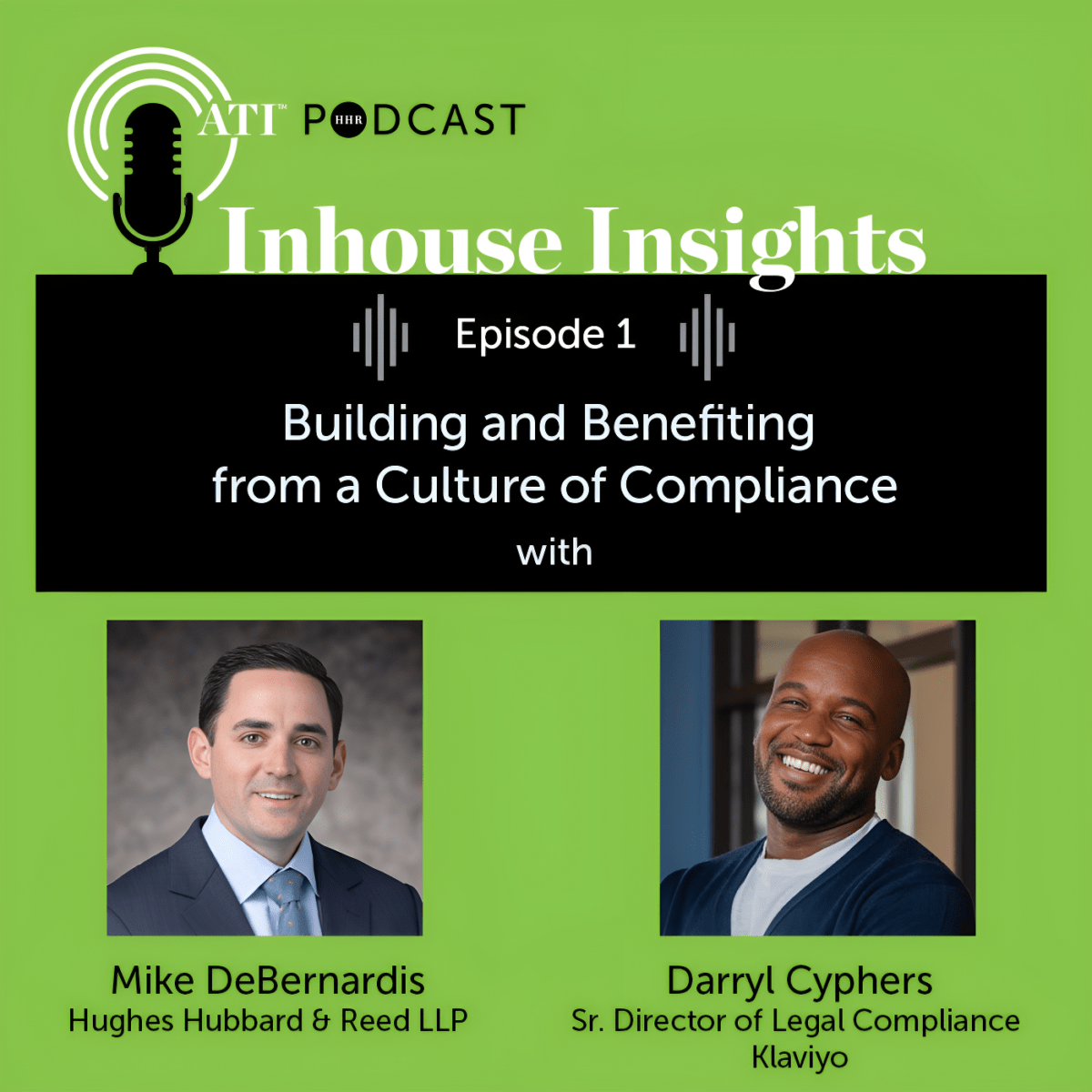
ATI Podcast: Inhouse Insights – Building and Benefiting from a Culture of Compliance

Welcome to the inaugural episode of the newly rebranded ATI Podcast: Inhouse Insights—formerly known as All Things Investigations.

Presented by the Hughes Hubbard & Reed LLP Anti-Corruption & Internal Investigations Practice Group, this premiere episode sets the tone for a bold new chapter—bringing practical, in-house perspectives to today’s most pressing compliance challenges.

Host Michael DeBernardis welcomes Darryl Cyphers Jr., Senior Director of Legal Compliance at Klaviyo, for a candid and forward-looking conversation on how organizations can build—and sustain—a culture of compliance that actually works.

Together, they explore how compliance leaders can move beyond policies on paper to create real organizational impact—through measurable culture metrics, smarter use of AI to drive policy engagement, authentic tone at the top, and meaningful collaboration with HR and business partners. Darryl also shares practical guidance for navigating compliance gray areas and strengthening trust through continuous employee engagement and feedback.

Highlights include:

  • Defining a modern culture of compliance
  • Metrics and tools for measuring cultural effectiveness
  • Employee engagement and feedback that drive results
  • Building partnerships across HR and business teams
  • Innovative and engaging compliance training approaches
  • Navigating gray areas with confidence and credibility

Resources:

Hughes Hubbard & Reed Website

Klaviyo

Darryl Cyphers Jr. on LinkedIn

Categories
Blog

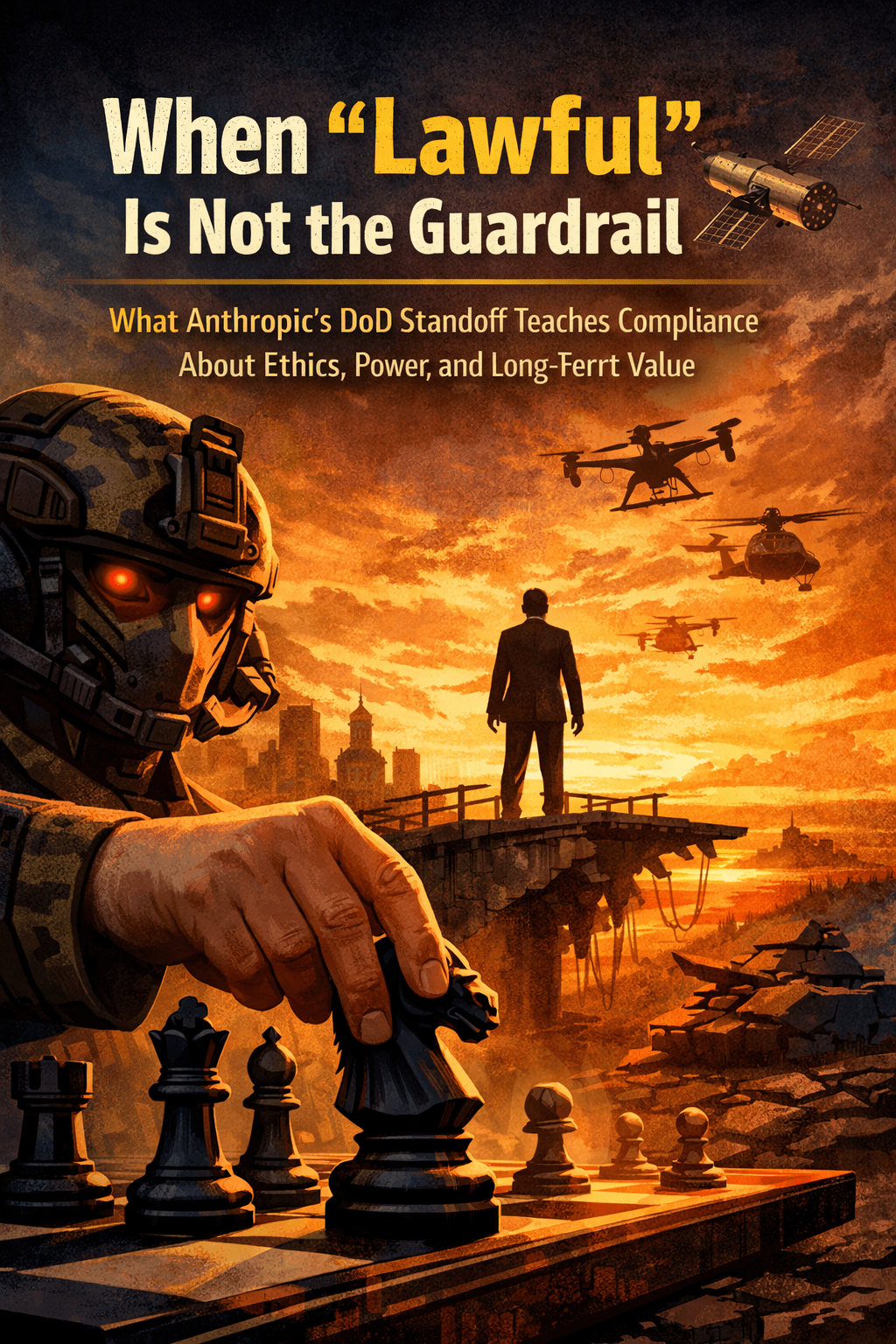
When “Lawful” Is Not the Guardrail: Anthropic’s and the DoD

If you work in compliance, you know the easiest slogan in the world is “we follow the law.” It is also one of the most dangerous. The law is a floor, not a ceiling. And in fast-moving technology, the law can be late, incomplete, and, at times, bent to serve the priorities of whoever holds power.

That is why the Anthropic decision to hold the line on two AI guardrails in its work with the US Department of Defense (DoD) deserves a close look by every Chief Compliance Officer. This is not only a tech story. It is an ethics story. It is also a governance story. And it is a business story about whether values are real when money and political pressure show up in the same room.

The facts that matter for compliance

According to Fortune, the DoD contract allowed use of Anthropic’s Claude model with two explicit limits: it could not be used to power fully autonomous weapons, and it could not be used for mass surveillance of American citizens. Those are not vague, feel-good commitments. They are operational guardrails tied to specific high-risk use cases.

The political blowback was immediate and personal. Fortune reports that President Donald Trump and Defense Secretary Pete Hegseth were “livid,” and that Undersecretary Emil Michael accused CEO Dario Amodei of having a “god complex”. Fortune also notes that “AI czar” David Sacks had been publicly agitated by Anthropic, accusing it of being run by “woke” AI alarmists. The message to business leaders was clear: do not constrain executive power, even with contract terms.

The Financial Times reported the government’s position as a demand for “any lawful use” of the model, with safeguards removed. Anthropic’s response, in Amodei’s public statement, was equally direct: “we cannot in good conscience accede to their request”.

Now, here is the compliance point that should stop you cold: “any lawful use” sounds reasonable until you remember what Anthropic argues in the same statement. On mass domestic surveillance, Anthropic says the practice is incompatible with democratic values and that, if it is legal today, it is only because “the law has not yet caught up with the rapidly growing capabilities of AI.” In other words, legality is not the ethical test. It is a lagging indicator.

Anthropic also laid out its second red line: fully autonomous weapons. The company said frontier AI systems “are simply not reliable enough” for that use and that it “will not knowingly provide a product that puts America’s warfighters and civilians at risk”. That is not politics. That is a duty of care.

Why this is really a “tone at the top” case study

Compliance professionals talk about the tone at the top because it is measurable in moments like this. When the pressure is existential, ethics is no longer a poster on the wall. It is a choice.

Anthropic’s founder framed the company’s posture as both mission and restraint. He wrote that some uses of AI can “undermine, rather than defend, democratic values,” and he identified mass domestic surveillance and fully autonomous weapons as two categories that “should not be included” in DoD contracts. He also emphasized that Anthropic had acted in ways “against the company’s short-term interest,” including foregoing revenue to cut off use tied to adversary-linked firms.

That is what tone at the top looks like when it costs money.

And as Alison Taylor put it, Amodei is making a bet that many leaders will not make: that the company’s “biggest source of long-term, intangible advantage, is being more trustworthy than the other AI firms”. That is a business thesis built on ethics, not ethics as decoration.

The compliance friction point: “Any lawful use” under a permissive executive

Every compliance officer has lived some version of this conversation:

  • Business: “It is legal.”
  • Compliance: “Legal does not mean acceptable.”
  • Business: “If we do not do it, someone else will.”
  • Compliance: “Then we should be the company that can explain our decision to a regulator, a court, our employees, and the public.”

Anthropic goes further and makes the key argument explicitly: powerful AI changes the risk profile so dramatically that existing surveillance rules are not a meaningful guardrail. For the compliance professional, this is the same principle you apply to third parties and bribery. You do not ask whether a payment can be papered as legal. You ask whether it violates your values, creates unacceptable risk, and will look indefensible when facts are laid bare.

Under the Trump administration, the “any lawful use” standard carries a sharper edge because the executive branch may interpret “lawful” aggressively, and because enforcement priorities can shift. That is exactly when companies need internal red lines that are not dependent on the political weather.

Five ethics-first lessons for the compliance professional

Lesson 1: Ethics must be contractual, not aspirational.

Anthropic did not merely publish principles. It embedded guardrails into the deal structure: no mass domestic surveillance; no fully autonomous weapons. Compliance should treat high-risk AI use cases the same way you treat anti-corruption controls: you operationalize them in contract terms, audit rights, and enforceable restrictions, not in marketing language.

Lesson 2: “Lawful” is not a control when the law is behind the technology.

Anthropic’s statement is blunt: surveillance might be legal only because the law has not caught up. That is your cue to stop using legality as your ethical compass. For AI, the pace of capability growth means the compliance function must define internal standards that anticipate harm rather than merely react to statutes.

Lesson 3: Tone at the top is proven when it is expensive.

This episode illustrates the real test: will leadership accept short-term pain to preserve long-term integrity? Anthropic says threats and pressure do not change its position, concluding, “we cannot in good conscience” comply. If your leadership supports ethics only when it is convenient, you do not have a tone at the top. You have tone in the brochure.

Lesson 4: Political retaliation risk is now part of the ethics calculus.

The Financial Times describes an unprecedented move to treat the company as a supply-chain risk, coupled with pressure on contractors. Fortune frames the response as an effort to crush a business for refusing to accept terms. Compliance leaders must plan for the modern reality: ethical stands can trigger political and commercial blowback. Your program has to be resilient enough to survive it.

Lesson 5: Ethics can be a competitive strategy, but it requires discipline.

Rivals moved quickly. The Financial Times reported that OpenAI signed a deal and publicly highlighted safety principles, including prohibitions on domestic mass surveillance and on human responsibility for the use of force. That is competition reacting to an ethics-driven market signal. Alison Taylor’s point is that the strategic frame is: trust is a durable advantage. The lesson for compliance is not to chase slogans. It is to build credibility through consistent decisions that align governance, product design, and customer commitments.

The business implications of standing on your ethics

Let us be clear: ethical leadership can hurt in the short run. Fortune notes the scale of federal contracting and its potential impact on business prospects. The Financial Times describes immediate restrictions and the scramble for alternatives. This is what it looks like when ethical constraints collide with power.

But the long-term business value is not hypothetical. In regulated and high-stakes markets, trust is currency. Customers want to know whether your controls can withstand pressure. Employees want to know whether leadership will protect the mission when it is unpopular. Regulators and courts want to know whether your governance is real.

Ethics is not the opposite of business. Ethics is risk management, reputation, retention, and resilience. Or, put more bluntly: ethics is what keeps you in business when the next crisis hits.

Compliance call to action: three moves to make this real

  1. Review your AI vendor contracts now. Identify and hard-code your red lines for high-risk uses, audit rights, incident reporting, and termination triggers. If your contract says “any lawful use,” you have not done your job.
  2. Update your AI use policy with explicit prohibitions and escalation paths. Do not rely on general language about “responsible use.” Name the use cases you will not support and build a governance process for exceptions.
  3. Run a tabletop exercise on an “any lawful use” demand. Put your leadership team in the scenario: a major customer pressures you to remove safeguards. Practice your decision rights, communications plan, and offboarding strategy before you face them in real time.

Anthropic’s decision is a reminder that compliance is not only about controls. It is about character. And when the DoD-sized spotlight hits your company, character is the only guardrail that never fails.

Categories
Sunday Book Review

Sunday Book Review: March 1, 2026, The Top Books on Alamo Edition

In the Sunday Book Review, Tom Fox considers books that would interest compliance professionals, business executives, or anyone curious. It could be books about business, compliance, history, leadership, current events, or anything else that might interest Tom. In this episode, we look at 4 top books on the fall of the Alamo.

  1. A Time to Stand by Walter Lord
  2. The Gates of the Alamo by Stephen Harrigan
  3. Three Roads to the Alamo by William C. Davis
  4. Forget the Alamo by Bryan Burrough, Chris Tomlinson, and Jason Stanford