Categories
Compliance Into the Weeds

Compliance into the Weeds: Surveying Retaliation Against Compliance Officers

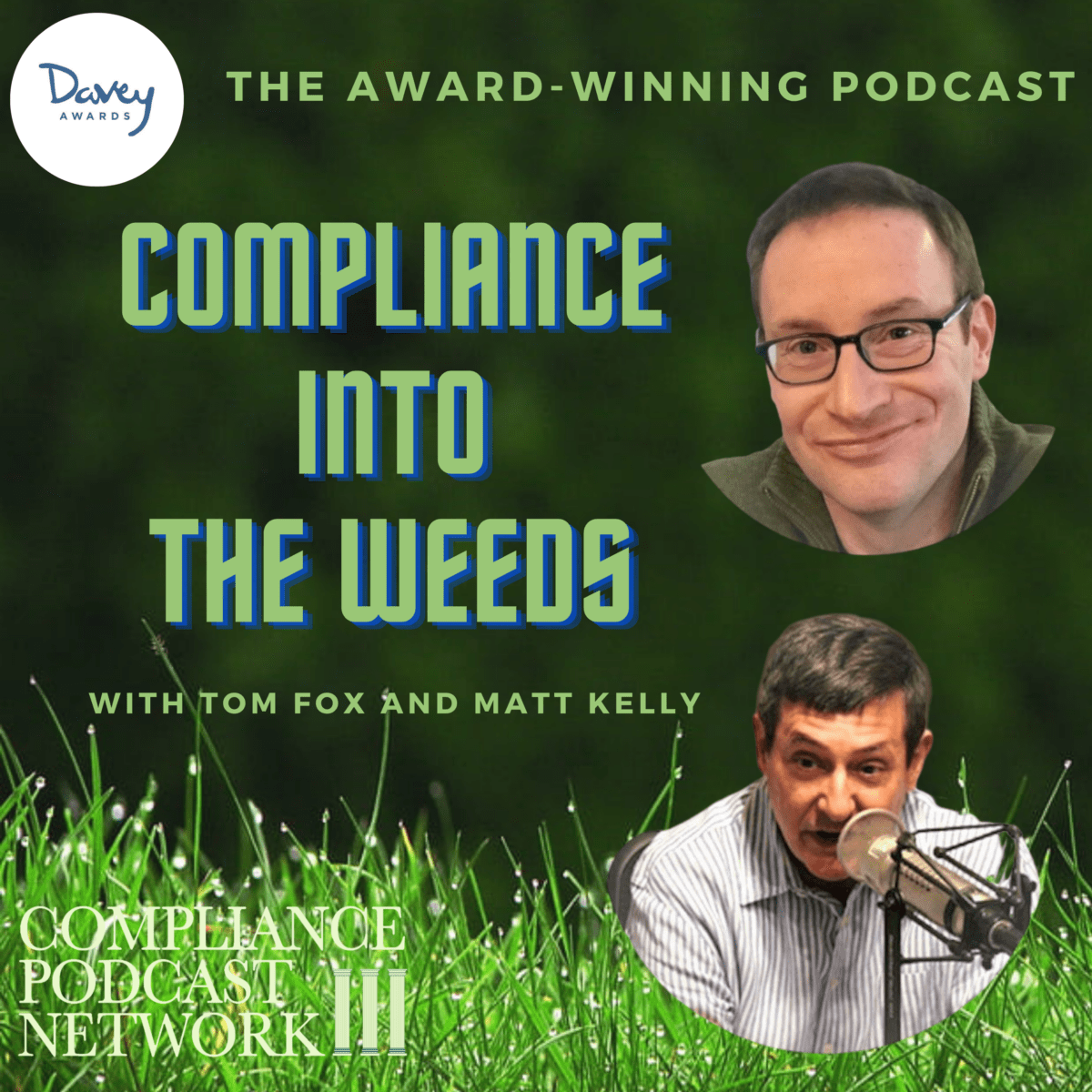
The award-winning Compliance into the Weeds is the only weekly podcast that takes a deep dive into a compliance-related topic, literally going into the weeds to explore it more fully. Looking for some hard-hitting insights on compliance? Look no further than Compliance into the Weeds! In this episode of Compliance into the Weeds, Tom Fox and Matt Kelly discuss a new anonymous Radical Compliance survey, launched with Case IQ and Compliance Week, to quantify retaliation against compliance officers who raise compliance concerns to senior management.

The survey asks what misconduct was reported, who retaliated, what forms of retaliation occurred, such as firing, demotion, harassment, budget cuts, blacklisting, and what actions followed. Matt also encourages responses from those who have not experienced retaliation. Tom and Matt have previously discussed anecdotally but have not systematically studied, and plan to publish their findings and host a webinar later in the spring, likely in June. They also discuss potential structural protections informed by data, such as disclosure expectations around CCO departures (e.g., 8-K concepts) and contract/regulatory-approval models like those in India’s banking sector, and suggest that the findings could inform DOJ views on compliance autonomy and effective compliance programs.

Key highlights:

  • Survey Launch Explained
  • Retaliation Questions
  • Why This Study Matters
  • Defining Prevalence
  • Using Findings for Change
  • Final Call to Participate

Resources:

Matt on Radical Compliance

Survey on Retaliation Against Compliance Professionals

Tom

Instagram

Facebook

YouTube

Twitter

LinkedIn

A multi-award-winning podcast, Compliance into the Weeds was most recently honored as one of the Top 25 Regulatory Compliance Podcasts, a Top 10 Business Law Podcast, and a Top 12 Risk Management Podcast. Compliance into the Weeds has been conferred a Davey, a Communicator Award, and a W3 Award, all for podcast excellence.

Categories
Daily Compliance News

Daily Compliance News: April 15, 2026, The Decoupling Edition

Welcome to the Daily Compliance News. Each day, Tom Fox, the Voice of Compliance, brings you compliance-related stories to start your day. Sit back, enjoy a cup of morning coffee, and listen in to the Daily Compliance News. All, from the Compliance Podcast Network. Each day, we consider four stories from the business world, compliance, ethics, risk management, leadership, or general interest for the compliance professional.

Top stories include:

For more information on the use of AI in Compliance programs, my new book, Upping Your Game, is available. You can purchase a copy of the book on Amazon.com.

To learn about the intersection of Sherlock Holmes and the modern compliance professional, check out my latest book, The Game is Afoot-What Sherlock Holmes Teaches About Risk, Ethics and Investigations on Amazon.com.

Categories
Great Women in Compliance

Great Women in Compliance: Clarity, Confidence, Results: Women Over 50 at Work

In this episode, Sarah Hadden and Caveni Wong explore the unique strengths women over 50 bring to today’s workplace—and why those strengths are often overlooked.

Drawing on a career that spans consulting, sales, and ethics & compliance leadership, Caveni reflects on the power of experience, the value of judgment and relationship-building, and the kind of leadership that doesn’t rely on title or authority. They talk candidly about nonlinear career paths and what it means to reach a stage where you can choose what’s next with clarity and confidence.

Along the way, they find an unexpected metaphor in sourdough bread—patient, resilient, and built over time—much like the careers and capabilities we develop across decades.

Categories
Blog

When AI Becomes Evidence of Bad Governance: What CCOs and Boards Can Learn from Fortis Advisors

The Delaware Court of Chancery has handed compliance leaders and boards a timely lesson: generative AI is not a substitute for judgment, legal discipline, or governance. When leaders use AI to validate a predetermined objective, the technology does not reduce risk. It can become powerful evidence of intent, bad faith, and control failure.

A Cautionary Tale for Corporate Leaders

The recent Delaware Court of Chancery decision in Fortis Advisors, LLC v. Krafton, Inc. should be read by every Chief Compliance Officer (CCO), board member, general counsel, and corporate deal professional. The article describing the decision recounts a dispute in which a buyer, apparently unhappy with a substantial earnout obligation, turned to ChatGPT for advice on how to escape the economic consequences of the deal. According to the court’s account, the buyer then executed an AI-generated strategy designed to renegotiate the arrangement or take control from the seller management team. The court ultimately found that the buyer had wrongfully terminated key employees, improperly seized operational control, reinstated the seller’s CEO, and extended the earnout window to restore a genuine opportunity to achieve the payout.

The Real Compliance Lesson

For compliance professionals, the most important lesson is not that AI is dangerous. The lesson is that leadership can use AI in dangerous ways when governance is absent. That is a far more important point.

Too many organizations still approach AI governance as a technology problem. They focus on model performance, cybersecurity, or procurement review. Those are important issues, but this case reminds us that AI governance begins with human purpose. What question was asked? What objective was embedded in the prompt? What controls existed before action was taken? Who challenged the proposed course of conduct? Who documented the legal and ethical analysis? Those are compliance questions. Those are board questions.

Viewing the Case Through the DOJ ECCP Lens

This is also where the DOJ’s Evaluation of Corporate Compliance Programs (ECCP) provides a useful lens. The ECCP asks whether a company’s program is well designed, adequately resourced, empowered to function effectively, and actually works in practice. Put that framework over this fact pattern, and the governance gaps become painfully clear. Was there a control around the use of generative AI in strategic or legal decision-making? Was there escalation to legal, compliance, or the board when a significant earnout exposure was at stake? Was there any meaningful challenge function, or did leadership use AI as a convenient amplifier for a business objective it had already chosen?

The case suggests the latter. That should concern every board. Generative AI can be useful in brainstorming, summarizing, and scenario testing. But when executives use it to reinforce a desired outcome, particularly one touching contractual obligations, employment decisions, or post-closing governance rights, the tool can become a mechanism for rationalizing misconduct.

When AI Chats Become Discoverable Evidence

Worse, it creates a record. The Court notes that the AI chats were not privileged, were discoverable, and vividly underscored the buyer’s efforts to avoid its legal obligations. That point alone should stop corporate leaders in their tracks.

Many executives still treat AI chats as an informal thinking space, almost like talking to themselves. That is a serious mistake. Prompt histories, outputs, internal forwarding, and downstream use can all become evidence. If employees use public or enterprise AI tools to explore termination strategies, dispute positions, or ways around contractual commitments, they may be creating exactly the documentary record that plaintiffs, regulators, and judges will later find most compelling. In other words, the issue is not simply data leakage. It is discoverability, privilege erosion, and self-generated evidence of intent.

That is why CCOs and boards need to move beyond generic AI-use policies and build governance around high-risk use cases. The question should not be, “Do we allow ChatGPT?” The question should be, “Under what circumstances can generative AI be used in decisions involving legal rights, employee discipline, regulatory exposure, strategic transactions, or board-level matters?” If the answer is unclear, the company has work to do.

The M&A and Earnout Governance Lesson

The dealmaking lesson here is equally important. Earnouts are already fertile ground for post-closing disputes because they sit at the intersection of incentives, control, and timing. Buyers often want flexibility. Sellers want protection from interference. This case illustrates what can happen when a buyer attempts to manipulate operations in a way that affects the achievement of the earnout. The court not only found wrongful interference but also equitably extended the earnout period by 258 days and preserved a further contractual right to extend, thereby materially altering the deal’s economic landscape.

That is a governance lesson hiding inside an M&A lesson. Once a company acquires a business with earnout rights and operational covenants, post-closing conduct is no longer just integration management. It is compliance management. Interference with operational control, pretextual terminations, or actions designed to suppress performance metrics can lead to litigation, destroy value, and trigger judicial remedies that boards did not expect. CCOs should therefore insist that M&A integration playbooks include compliance review of earnout governance, decision rights, escalation protocols, and documentation standards.

Five Lessons for Boards and CCOs

What should boards and compliance officers do now? Here are five lessons.

  1. Govern the objective before you govern the tool. AI is only as sound as the purpose for which it is deployed. If leadership starts with a bad objective, AI can scale the problem. Boards should require management to define prohibited uses of AI in areas such as contract avoidance, pretextual employee actions, retaliation, and legal strategy without oversight by counsel.
  2. Treat high-risk AI prompts and outputs as governed business records. If a prompt relates to litigation, terminations, regulatory response, deal rights, or board matters, it should fall within clear policies on retention, review, and escalation. Employees need to understand that AI interactions may be discoverable and may not be privileged.
  3. Embed legal and compliance into consequential AI use cases. The ECCP emphasizes whether compliance has stature, access, and authority. That principle applies directly here. Strategic uses of AI that touch contractual rights, employment decisions, or fiduciary issues should not proceed without legal and compliance review.
  4. Build AI governance into M&A and post-closing integration. Earnout structures, operational covenants, and seller management rights are precisely the areas where incentives can distort behavior. Boards should ask whether integration teams have controls preventing actions that could be viewed as interference, manipulation, or bad-faith conduct.
  5. Document challenge, not just action. A single final decision does not prove good governance. It is proved by the process surrounding it. Was there dissent? Was there an analysis? Was there an escalation memo? Was there a documented rationale grounded in law, contract, and fiduciary duty? If not, the company may be left with a record that tells the wrong story.

Governance Must Come Before AI

In the end, this case is not really about a video game company. It is about a governance failure dressed in modern technology. Leaders appear to have used AI not to improve judgment, but to reinforce a course of conduct they already wanted to pursue. That is the compliance lesson. AI does not remove the need for fiduciary discipline, legal oversight, or ethical restraint. It makes those requirements more urgent.

For boards and CCOs, the mandate is clear. Governance must come first. Because when AI is used without guardrails, it does not merely create risk; it creates it. It can become the evidence.

Categories
AI Today in 5

AI Today in 5: April 14, 2026, The AI Tastes Like Twinkies Edition

Welcome to AI Today in 5, the newest addition to the Compliance Podcast Network. Each day, Tom Fox will bring you 5 stories about AI to start your day. Sit back, enjoy a cup of morning coffee, and listen in to the AI Today In 5. All, from the Compliance Podcast Network. Each day, we consider five stories from the business world, compliance, ethics, risk management, leadership, or general interest about AI.

Top AI stories include:

  1. Kara Swisher says AI: ‘It tastes like a Twinkie. ’(Fortune)
  2. AI must move beyond name matching in sanctions. (FinTechGlobal)
  3. Healthcare needs to prepare for enforcement around AI use. (HealthcareITNews)
  4. Getting AI insurance. (CCI)
  5. Balancing AI innovation with compliance for RIAs. (FinTechGlobal)

For more information on the use of AI in Compliance programs, my new book, Upping Your Game, is available. You can purchase a copy of the book on Amazon.com.

To learn about the intersection of Sherlock Holmes and the modern compliance professional, check out my latest book, The Game is Afoot-What Sherlock Holmes Teaches About Risk, Ethics and Investigations on Amazon.com.

Categories
Daily Compliance News

Daily Compliance News: April 14, 2026, The Annoyance Economy Edition

Welcome to the Daily Compliance News. Each day, Tom Fox, the Voice of Compliance, brings you compliance-related stories to start your day. Sit back, enjoy a cup of morning coffee, and listen in to the Daily Compliance News. All, from the Compliance Podcast Network. Each day, we consider four stories from the business world, compliance, ethics, risk management, leadership, or general interest for the compliance professional.

Top stories include:

  • How much does the Annoyance Economy cost you? (NYT)
  • Texas AG to probe ‘chemicals in clothes’. (Reuters)
  • Spanish PM’s wife charged with corruption. (Bloomberg)
  • KPMG reduces the role of humans in audits. (WSJ)

For more information on the use of AI in Compliance programs, my new book, Upping Your Game, is available. You can purchase a copy of the book on Amazon.com.

To learn about the intersection of Sherlock Holmes and the modern compliance professional, check out my latest book, The Game is Afoot-What Sherlock Holmes Teaches About Risk, Ethics and Investigations on Amazon.com.

Categories
Innovation in Compliance

Innovation in Compliance: Carole Switzer on Mastering GRC, the AI-Enabled Law Firm, and the Future of Legal Leadership

Innovation spans many areas, and compliance professionals need not only to be ready for it but also to embrace it. Join Tom Fox, the Voice of Compliance, as he visits with top innovative minds, thinkers, and creators in the award-winning Innovation in Compliance podcast. In this episode,  host Tom visits with GRC expert and OCEG co-founder Carole Switzer.

They highlight her new books, “Mastering GRC: The Lawyer’s Guide to Success in Governance, Risk and Compliance” and “The AI-Enabled Law Firm” (co-authored with Lee Denner). Carole explains she wrote “Mastering GRC” to help lawyers applying legal skills in GRC roles move from reactive problem-solvers to proactive enterprise leaders by embedding in business objectives, asking better questions, and collaborating across audit, risk, legal, and compliance. She recounts OCEG’s origins and its GRC Capability Model, certifications, and global growth. Carole discusses balancing legal oversight with business partnership, including the risks of privilege when acting in business roles. Looking ahead, she predicts rapid AI-driven change in legal practice, stressing technology and data-meaning (“semantic layer”) issues, and the need to adapt existing GRC frameworks for speed and volatility.

Key highlights:

  • Why These Two Books
  • From Counselor to Leader
  • Integrated Governance Mindset
  • How OCEG Built GRC Standards
  • Oversight vs Business Partner
  • Future of Legal GRC and AI
  • Managing Volatility With Frameworks

Resources:

Carole Switzer on LinkedIn

OCEG

The AI-Enabled Law Firm

Mastering GRC: The Lawyer’s Guide to Success in Governance, Risk and Compliance

Innovation in Compliance, a multi-award-winning podcast, was recently honored as the Number 4 podcast in Risk Management by 1,000,000 Podcasts.

Categories
SBR - Authors' Podcast

SBR-Author’s Podcast: Bribery Beyond Borders: The Hidden History and Future of the FCPA with Severin Wirz

Welcome to the SBR-Author’s Podcast! In this podcast series, Host Tom Fox visits with authors in the compliance arena and beyond. In this episode, Tom Fox welcomes Severin Wirz, Senior Director for Ethics and Compliance at Applied Materials and author of “Bribery Beyond Borders: The Story of the Foreign Corrupt Practices Act.”

The book is about the origins, narrative approach, and future of FCPA enforcement. Severin explains he used storytelling to challenge conventional views that the FCPA was merely post-Watergate morality or the product of Stanley Sporkin alone, tracing a longer lineage of U.S. anti-corruption laws (Federal Corrupt Practices Act, Travel Act, Hobbs Act, RICO, Bank Secrecy Act) instead. He recounts the United Brands/Eli Black scandal, Wall Street Journal reporting that broke key bribery revelations, Stanley Sporkin’s role at the SEC, and the legislative influence of Frank Church and William Proxmire amid debates over disclosure, criminalization, and books-and-records provisions. Severin discusses shifting geopolitical drivers of enforcement and recommends related reading and contact options.

Key highlights:

  • Severin’s Compliance Journey
  • Writing FCPA as a Thriller
  • Eli Black Scandal Breaks
  • Sporkin and SEC Momentum
  • Journalists Connect the Dots
  • Frank Church and Cold War Stakes
  • Proxmire Gets It Passed
  • Three Visions of the FCPA
  • Future Enforcement and Geopolitics

Resources:

Severin Wirz on LinkedIn

Bribery Beyond Borders: The Story of the Foreign Corrupt Practices Act on CCI and Amazon.

Tom Fox

Instagram

Facebook

YouTube

Twitter

LinkedIn

Categories
Blog

Culture, Speak-Up, and Human Judgment: The Human Side of AI Governance

Artificial intelligence may be built on data, models, and code, but governance ultimately rests on people. For boards and Chief Compliance Officers, one of the most important questions is not only whether the organization has responsibly approved AI tools, but also whether employees are prepared to challenge them, report concerns, and apply human judgment when something does not look right. In many organizations, the earliest warning system for AI failure is not a dashboard. It is the workforce.

Over the course of this series, I have explored four critical governance challenges in AI: board oversight and accountability, strategy outrunning governance, data governance and privacy, and ongoing monitoring. This final blog post turns to the fifth and most underappreciated challenge of all: culture, speak-up, and human judgment.

Underappreciated because organizations often begin AI governance with structure in mind. They build committees, draft policies, classify risks, and establish approval gates. All of that is necessary. But structure alone is not sufficient. If the human beings closest to the work do not understand their role in AI governance, do not feel empowered to raise concerns, or begin to defer too readily to machine-generated outputs. The governance framework will be weaker than it appears on paper.

This is the point many companies miss. AI governance is not only about the technology. It is about whether the organization’s culture supports the responsible use of technology.

Employees Will See AI Failures First

In many companies, the first person to notice an AI problem will not be a board member, a Chief Executive Officer, or even a member of the governance committee. It will be an employee interacting with the tool in daily operations. It may be the customer service representative who sees the system generating inaccurate responses. It may be the HR professional who notices troubling patterns from an AI-supported screening tool. It may be the sales employee who sees a generative tool overstating product claims. It may be the finance professional who questions an automated summary that does not match underlying records. It may be the compliance analyst who sees a tool being used for an unapproved purpose.

That matters because early visibility is one of the most valuable protections a company can have. But visibility only becomes a control if employees know what to do with what they see. That is why culture is a governance issue. A workforce may spot the problem, but if employees do not understand that AI-related concerns are reportable, are unsure where to raise them, or believe management will ignore them, the warning system fails.

For boards and CCOs, that means AI governance cannot stop at policy creation. It must extend into behavior, reporting norms, and organizational trust.

Speak-Up Culture Is an AI Governance Control

Compliance professionals have long known that a speak-up culture is a control. It is often the first way a company learns of misconduct, process breakdowns, weak supervision, retaliation, harassment, fraud, or control evasion. The same principle now applies with equal force to AI.

Employees may observe biased outputs, inaccurate recommendations, privacy concerns, unexplained model behavior, misuse of tools, inappropriate reliance on machine-generated content, or efforts to bypass required human review. If they do not report those concerns, management may have no timely way to know what is happening.

This is where the Department of Justice’s Evaluation of Corporate Compliance Programs (ECCP) remains highly instructive. The ECCP places substantial emphasis on whether employees are comfortable raising concerns, whether the company investigates them appropriately, and whether retaliation is prohibited in practice. Those same questions should now be asked in the context of AI. Does the company’s reporting framework explicitly include AI-related concerns? Are managers trained to recognize and escalate those concerns? Are reports investigated with the same seriousness as other compliance issues? Are employees protected if they raise uncomfortable questions about a tool the business wants to use?

If the answer is no, the company may have AI procedures, but does not yet have embedded AI governance in its culture.

Human Judgment Cannot Be Optional

One of the most significant risks in AI governance is not simply that a model will be wrong. It is that people will stop questioning it. AI systems can produce outputs quickly, fluently, and with apparent confidence. That creates a powerful temptation for users to over-trust the tool. When a system sounds polished, appears efficient, and reduces workload, people may assume that its conclusions deserve deference. This is precisely where governance needs the corrective force of human judgment.

Human judgment cannot be treated as a ceremonial step or a paper requirement. It must be meaningful. That means the people reviewing AI outputs must have the authority, time, training, and confidence to challenge those outputs when needed. A human review requirement that exists only on paper is not much of a safeguard. If reviewers are overloaded, insufficiently trained, or culturally discouraged from slowing the process, the control may be largely illusory.

Boards should care about this because one of the easiest mistakes management can make is to describe human oversight in governance documents without testing whether it is functioning in practice. CCOs should care because this is a classic compliance problem. A control may be designed elegantly but fail in daily operations because the supporting culture is too weak to sustain it.

Training Must Change with AI

A company cannot expect good judgment around AI if it has not trained people on what good judgment looks like. That means AI training should go beyond technical usage instructions. Employees need to understand what risks may arise, what concerns are reportable, what approved use looks like, what prohibited use looks like, and why human challenge matters. Managers need additional training because they are often the first informal escalation point when an employee raises a concern. If managers dismiss AI concerns as overreactions, inconveniences, or resistance to innovation, the speak-up system will quickly lose credibility.

Training should also be role-based. The risks faced by a customer-facing team may differ from those faced by teams in HR, legal, procurement, marketing, finance, or internal audit. A generic AI training module may create awareness, but it will not create the operational judgment needed in high-risk areas.

This is where the NIST AI Risk Management Framework provides practical value. NIST’s emphasis on governance is not limited to formal structures. It contemplates culture, accountability, and the need for organizations to support informed decision-making across the enterprise. ISO/IEC 42001 similarly reinforces the importance of organizational competence, awareness, and defined responsibilities. Both frameworks point to a critical truth: responsible AI use depends not only on controls over the technology, but also on the capabilities of the people who use and oversee it.

Managers Matter More Than Companies Often Realize

If culture is the operating environment of governance, managers are often its most important local translators. An employee may not begin by filing a formal report. More often, an employee may raise a concern informally with a supervisor or colleague. “This output does not seem right.” “I do not think we should be using it this way.” “This seems to be pulling in sensitive information.” “This recommendation may be biased.” “The human review is not really happening anymore.”

The manager’s response in that moment matters enormously. Does the manager take the concern seriously? Does the manager know it should be escalated? Does the manager see it as a governance issue or as resistance to efficiency? Does the manager understand the difference between a minor usability complaint and a potentially significant compliance concern?

This is why boards and CCOs should not think about speak-up solely in hotline terms. AI governance depends on the broader management culture. If supervisors are not equipped to receive and escalate AI concerns appropriately, many issues will die in the middle of the organization before they ever reach a formal channel.

Anti-Retaliation Must Be Real in the AI Context

There is another dimension that cannot be overlooked: the risk of retaliation. In some organizations, employees may hesitate to raise AI concerns because they fear being labeled anti-innovation, obstructionist, or not commercially minded. That creates a subtle but serious governance risk. If the corporate atmosphere celebrates rapid AI adoption without equally celebrating responsible challenge, then employees may conclude that silence is safer than candor.

This is why anti-retaliation messaging must be explicit in the AI context. The company should make clear that raising concerns about inaccurate outputs, misuse, privacy risks, unfairness, or control breakdowns is part of responsible business conduct. It is not a failure to embrace innovation. It is a contribution to the effective governance of innovation.

The CCO should ensure that AI-related concerns are incorporated into existing anti-retaliation frameworks, investigations protocols, and communications. Boards should ask whether employee sentiment data, hotline trends, and internal investigations provide any signal that people are reluctant to question AI initiatives. If the organization is moving aggressively on AI, it should be equally serious about protecting those who raise governance concerns about it.

Documentation and Escalation Still Matter

As with every other aspect of AI governance, culture and judgment must be integrated into the process. A company should document how AI-related concerns can be reported, how they are triaged, who reviews them, what escalation triggers apply, and how resolutions are tracked. Concerns about AI should not be dismissed as vague general complaints. They should be reviewable and analyzable over time.

This is essential not only for accountability but for learning. Patterns in employee concerns may reveal weaknesses in training, design, vendor management, access controls, or oversight. A single report may be an isolated event. Repeated concerns within a single function may point to a systemic governance problem. That is why speak-up is not just about receiving reports. It is about turning those reports into organizational intelligence.

The ECCP again offers a useful framework. It asks whether investigations are timely, whether root causes are examined, and whether lessons learned are fed back into the compliance program. AI governance should work the same way. A reported concern should not end with a narrow answer to the immediate complaint. It should prompt management to ask what the issue reveals about the broader governance environment.

Boards Must Model the Right Tone

This final point may be the most important. Culture is shaped by what leadership rewards, tolerates, and asks about. If the board only asks about AI efficiency, adoption, and speed, management will take the signal. If the board asks whether employees are raising concerns, whether human oversight is meaningful, whether managers are trained, and whether retaliation protections are working, management will take that signal as well.

For CCOs, this is a vital opportunity. The compliance function can help boards understand that governance is not only about structure and controls, but also about whether the organization has preserved the human capacity to question, escalate, and correct. In the AI context, that may be the most important governance capability of all.

Because in the end, even the most advanced system will not govern itself. An enterprise must govern it. That requires culture. It requires trust. It requires the courage to speak up. And it requires strong human judgment to look at an impressive output and still ask, “Is this right?”

The Human Side of Governance Is the Decisive Side

This final article brings the series back to a simple truth. AI governance is not only about what the company builds. It is about how the company behaves.

Boards may establish oversight. Management may create structures. Compliance may build controls. But if employees are not prepared to report concerns or exercise judgment, the organization will remain vulnerable. A strong AI governance program does not merely control the system. It empowers the people around the system to challenge it responsibly.

That is the human side of governance, and in many ways it is the decisive side. 

Categories
The Ethics Experts

Episode 248 – Emily Miner

In this episode of The Ethics Experts, Nick Gallo welcomes Emily Miner.

Emily is a Director at Ethisphere in the Data & Services team. She helps organizations advance business integrity through strategic consultation on effective ethics and compliance program design and implementation. This includes program evaluation, benchmarking against peer practices, and executive alignment. She also partners with large organizations to assess and enhance the compliance maturity of companies along their value chain.

Prior to joining Ethisphere, Emily spent over a decade advising global corporations on ethical culture, program effectiveness, and codes of conduct. Most recently, she was a Vice President and leader of LRN Corporation’s advisory practice. Her earlier career was spent in the environmental science and sustainability sectors, both in non-profit and academia, where a highlight was contributing to drafting international climate policy goals as part of the UN Framework Convention on Climate Change.