Categories
The Hill Country Podcast

The Hill Country Podcast: Greg Faldyn: Leadership and Legacy in Rotary

Welcome to the award-winning The Hill Country Podcast. The Texas Hill Country is one of the most beautiful places on earth. In this podcast, Hill Country resident Tom Fox visits with the people and organizations that make this one of the most unique areas of Texas. In this episode, host Tom Fox speaks with Greg Faldyn, a seasoned insurance industry professional and a long-time Rotarian.

Greg, an insurance professional with over 40 years of experience and a dedicated Rotary Club member for nearly 25 years, views the 100th anniversary of Rotary in Kerrville as a landmark achievement in the organization’s enduring commitment to community service. Having played a pivotal role in organizing the celebration as the foundation chair, Greg has been instrumental in highlighting Rotary’s century-long partnerships with key local organizations, such as the Peterson Foundation and the Raphael Clinic. He proudly points to the Hill Country community’s collective resilience, particularly in the wake of events like the July 4th flood, as a testament to Rotary’s strength and impact. Passionate about engaging young professionals, Greg believes that the milestone anniversary serves not only as a celebration of past achievements but also as a call to future service and community enhancement.

Highlights include:

  • Rotary’s Centennial Celebration in Kerrville’s Community
  • Community Support through Rotary Foundation Grants
  • Rotary Club Weekly Engagement
  • Why Join Rotary?

Resources:

Rotary Club of Kerrville

Rotary District 5840

Rotary International

 Other Hill Country Focused Podcasts

Hill Country Authors Podcast

Hill Country Artists Podcast

Texas Hill Country Podcast Network

Cover Art

Nancy Huffman

Categories
Great Women in Compliance

Great Women in Compliance: The New Architecture of Legal and Compliance with AI

In this episode of Great Women in Compliance, Dr. Hemma R. Lomax speaks with Sam Flynn, co-founder of Josef, about the transformation of legal and compliance functions through technology. They discuss the importance of human-centered design, the role of AI in legal architecture, and the need for trust in AI tools. Sam shares his journey from creating Myki Fines to building self-service legal solutions that bridge the access-to-justice gap. The conversation emphasizes the importance of user experience, governance practices, and the need to rethink traditional professional roles in the legal field.

Takeaways:

  • Legal and compliance functions must evolve to be more human-centered.
  • AI can significantly enhance legal decision-making processes.
  • Trust in technology is crucial for successful implementation.
  • User experience should be prioritized in legal tech solutions.
  • Automation can free up valuable time for legal professionals.
  • Access to justice is a critical issue that can be addressed with technology.
  • Rethinking traditional roles in law can lead to better outcomes.
  • Data-driven insights can improve compliance practices.
  • Collaboration between experts and end-users is essential for success.
  • Legal technology should focus on delivering real value to users.

Sound Bites:

  • “AI should unleash human potential.”
  • “Trust is the key to unlocking value.”
  • “We need to build trust in our technology.”

Chapters:

00:00 Introduction to Legal Transformation

02:32 The Journey of Sam Flynn and Mickey Finds

05:30 Rethinking Legal Systems and Design

08:10 Substance Over Form in Legal Processes

10:56 The Role of AI in Legal Architecture

13:39 Building a Legal Front Door

16:24 User Experience in Compliance

18:54 Engagement and Data Utilization

21:56 The Future of Legal Workflows

24:29 Deciding Between Automation and Human Input

26:56 Navigating High-Risk Inquiries

27:50 Strategic Automation for Stakeholder Engagement

28:58 The Importance of Human Expertise in AI

30:57 Transforming Fear into Opportunity with AI

32:59 Building Trustworthy AI in Legal Settings

36:56 Governance Practices for AI Deployment

43:51 Access to Justice: Bridging Gaps with Technology

Guest Biography:

Sam Flynn is the Co-Founder and Chief Operating Officer of Josef, a legal automation platform that empowers legal and compliance teams to create reliable, self-serve tools — no coding required. In his role, Sam leads Josef’s business operations, governance, marketing, and customer success functions, scaling both product impact and organizational trust.

An ex-BigLaw litigator and experienced legal technologist, Sam has long been passionate about using technology to bridge the access-to-justice gap and elevate the delivery of legal services. In 2016, he built Myki Fines, a public-facing legal tech solution that attracted more than 60,000 users in its first month and helped catalyze reforms to unfair laws.

At Josef, Sam combines legal expertise with product and operational leadership to help teams rethink how legal and compliance work gets done — shifting from inbox-driven bottlenecks to strategic architectures that deliver decision-useful guidance at scale. He is a frequent speaker on generative AI in legal, a board member of the Center for Legal Innovation, and an advocate for human-centered legal design.

Categories
Blog

AI and Work Intensification – The Compliance Response

There is a comforting myth circulating in corporate hallways and boardrooms: if we deploy AI across governance, risk, and compliance, the work will shrink. Investigations will move faster. Monitoring will get smarter. Policies will draft themselves. Third-party diligence will become push-button. The compliance function will finally “do more with less.” That myth was challenged in a recent Harvard Business Review article, “AI Doesn’t Reduce Work—It Intensifies It by Aruna Ranganathan and Xingqi Maggie Ye.

The authors believe that what happens is work intensification. AI expands throughput, increases expectations, and generates more outputs that still require human judgment, verification, and accountability. Instead of fewer tasks, you get more tasks. Instead of simpler work, you get faster cycles, more iterations, and new forms of quality risk. For the Chief Compliance Officer (CCO) leading AI governance, this is not a side effect. It is a core operating model issue.

If compliance owns AI governance across the enterprise, compliance must also own the discipline of how humans and AI work together. I call that discipline an AI practice standard, management guidance that sets expectations for pace, quality, verification, escalation, and sustainable workload.

Today, we consider how to consider this issue as a compliance operating model challenge across all GRC workflows: policy management, investigations, hotline intake, monitoring and surveillance, third-party due diligence, regulatory change management, audit planning, training, and reporting. The tone is cautionary because the risk is real: a compliance function that mistakes AI output volume for compliance effectiveness.

The Compliance Operating Model Problem: More Output, More Review, More Risk

Compliance work is not manufacturing. It is judgment work. It requires discretion, context, and defensible decisions. AI can accelerate inputs and draft outputs, but it does not accept responsibility. The CCO does. The business does. The board does. When AI enters GRC workflows, it tends to create four pressure points:

1. Compression of timelines. If a draft can be produced in five minutes, someone will ask why it cannot be finalized in five more.

2. Explosion of options. AI generates multiple versions, scenarios, and recommendations, which expands decision load and review cycles.

3. Higher volume of “signals.” AI-enabled monitoring produces more alerts, more pattern matches, and more anomalies. Much will be noise. All require triage.

4. Illusion of completion. Teams begin to treat a plausible AI answer as a finished work product. That is how quality defects are born.

The result is a compliance function that looks “faster” while becoming more fragile. Burnout rises. Rework increases. Errors creep into documentation. Controls become less reliable because the humans operating them are overwhelmed by the sheer volume AI makes possible.

All this means the question for the CCO is not, “How do we roll out AI?” The question is, “How do we govern the human work that AI intensifies?”

Five KPIs for Work Intensification Risk

Next, we consider five KPIs specifically designed to measure work intensification. These are board-credible, compliance-owned, and operationally measurable.

1. After-Hours Compliance Work Index

Percentage of compliance work activity occurring outside standard business hours (for example, 6 p.m. to 7 a.m.), measured across key systems (case management, GRC platform activity logs, email metadata, collaboration tool usage). This matters because AI compresses timelines and pushes work into nights and weekends. This index serves as an early warning for burnout and quality failures.

2. AI Rework Rate

Percentage of AI-assisted work products requiring material revision after human review (policies, investigation summaries, risk narratives, diligence reports). This matters because

if AI increases speed but doubles rework, you are not gaining productivity. You are shifting effort downstream.

3. Cycle Time Compression vs. Quality Defect Ratio

Track cycle time reductions alongside quality defects (corrections, escalations, documentation gaps, audit findings). You can express this KPI as Cycle Time Improvement / Defect Increase.

This matters because faster is not better if defects rise. This ratio keeps leadership honest.

4. Alert-to-Action Conversion Rate

Percentage of AI-generated alerts that result in a confirmed issue, investigation, remediation, or control enhancement. This matters because AI intensifies monitoring. This KPI exposes whether you are drowning in noise or generating actionable intelligence.

5. Burnout Signal Composite

A quarterly composite score built from pulse surveys such as fatigue, workload, autonomy, attrition in compliance roles, sick leave usage trends, and employee assistance program utilization patterns. This matters because compliance effectiveness depends on people. Burnout is a control failure risk.

These five metrics give the CCO and board a shared view of whether AI is improving the compliance function or simply accelerating it toward exhaustion.

How to Measure the Leading Indicators

You requested practical recommendations for measuring after-hours work, cycle time, quality defects, and burnout indicators. Here is a measurement approach that is realistic and defensible.

After-Hours Work

  • Use system log data from the case management, GRC, and document management platforms to track timestamped activity.
  • Supplement with email and collaboration metadata to measure volume outside standard hours.
  • Report trends by team and workflow, not individuals. This is about operating model health, not surveillance.

Cycle Time

  • Establish “start” and “stop” definitions for each workflow:
    • Investigations: intake date to closure date
    • Due diligence: request date to clearance date
    • Policy updates: drafting starts from the published version
    • Regulatory change: trigger identification to implementation
  • Track AI-assisted versus non-AI-assisted cycle times to isolate the impact.

Quality Defects

  • Define defects as “items requiring material correction after initial completion,” including:
    • Incomplete documentation
    • Wrong risk rating or missing rationale
    • Incorrect regulatory mapping
    • Reopened cases due to insufficient analysis
    • Audit findings tied to workflow execution
  • Capture defects through QA sampling, supervisor review logs, audit results, and post-incident reviews.

Burnout Indicators

  • Run a quarterly pulse survey with 5–7 questions on workload, pace, clarity, and ability to disconnect.
  • Track voluntary attrition and vacancy duration for compliance roles.
  • Include aggregate HR indicators such as overtime trends or sick leave usage, where available.
  • Use a composite score and trend it. The trend line is what matters.

The key is to build instrumentation without creating a culture of monitoring employees. Your goal is not to watch people. Your goal is to protect the control environment.

Adopt an Enterprise AI Practice Standard Now

For an innovation-forward company, the right move is not to slow down. The right move is to govern how you speed up. Your call to action is simple and strong: to adopt an enterprise AI practice standard as management guidance, owned by Compliance, implemented across all GRC workflows, measured by five work-intensification KPIs, and tested by internal audit and red teaming.

If you do that, you gain three things immediately:

1. A sustainable operating model

2. Defensible governance for regulators and boards

3. A compliance function that remains credible under pressure

AI can make compliance better. But only if the humans who run compliance can still breathe.

Categories
Daily Compliance News

Daily Compliance News: February 17, 2026, The All FT Edition

Welcome to the Daily Compliance News. Each day, Tom Fox, the Voice of Compliance, brings you compliance-related stories to start your day. Sit back, enjoy a cup of morning coffee, and listen in to the Daily Compliance News. All, from the Compliance Podcast Network. Each day, we consider four stories from the business world, compliance, ethics, risk management, leadership, or general interest for the compliance professional.

Top stories include:

  • A KPMG partner was fined for using AI to cheat on a test about AI. (FT)
  • An Indian billionaire and his company’s missing billions. (FT)
  • Rethinking Board pay in the UK. (FT)
  • Measurable gains from using AI are now seen. (FT)
Categories
AI Today in 5

AI Today in 5: February 17, 2026, The Measurable Gains Edition

Welcome to AI Today in 5, the newest addition to the Compliance Podcast Network. Each day, Tom Fox will bring you 5 stories about AI to start your day. Sit back, enjoy a cup of morning coffee, and listen in to the AI Today In 5. All, from the Compliance Podcast Network. Each day, we consider five stories from the business world, compliance, ethics, risk management, leadership, or general interest about AI.

Top AI stories include:

  1. Measurable gains are now being achieved with AI. (FT)
  2. The hidden cost of poor compliance conciliation. (FinTechGlobal)
  3. AI at Kraken Compliance. (Kraken Blog)
  4. Is a memory chip crisis coming? (Bloomberg)
  5. AI worries erase $1tn from Big Tech values. (PYMNTS)

For more information on the use of AI in Compliance programs, my new book, Upping Your Game, is available. You can purchase a copy of the book on Amazon.com.

Categories
Innovation in Compliance

Innovation in Compliance: Navigating AI: Governance, Risk with some Culture Thrown in with Matt Kunkel

Innovation spans many areas, and compliance professionals need not only to be ready for it but also to embrace it. Join Tom Fox, the Voice of Compliance, as he visits with top innovative minds, thinkers, and creators in the award-winning Innovation in Compliance podcast. In this episode,  host Tom Fox interviews Matt Kunkel, CEO and Co-Founder at LogicGate, about the company’s governance, risk, and compliance (GRC) platform and current market trends.

Matt recounts his path into regulatory risk and compliance work that led to founding LogicGate and launching its Risk Cloud platform in 2015. A major focus is AI governance. Tom and Matt explore how and why senior management is asking compliance teams to provide governance frameworks despite the absence of a single standard (e.g., NIST/ISO/SOC). Matt explains organizations need scalable processes to triage and route large volumes of AI usage requests, apply guardrails based on data sensitivity and criticality, and avoid becoming a bottleneck to innovation. He emphasizes training and culture to address employee misuse, highlighting risks of exposing proprietary data and the need to define what information is acceptable to input into AI models.

The discussion turns to LogicGate’s culture and how it has been sustained during rapid, organic growth (no acquisitions). Matt outlines LogicGate’s six values: Be as One, Embrace Your Curiosity, Empower Customers, Raise the Bar, Own It, and Do the Right Thing. For evaluating AI and modernizing compliance programs, he frames value in three outcomes: making money, reducing costs, or reducing risk, and describes LogicGate’s value realization framework that translates efficiency and ROI into business terms. He also describes Risk Cloud as an orchestration layer for compliance programs and anticipates more “intentional AI” and selective use of agentic capabilities rather than fully autonomous end-to-end program execution.


Key highlights:

  • From Consulting to GRC: Coding, Madoff Investigation, and Founding LogicGate
  • Why AI Is Supercharging the “G” in GRC
  • LogicGate’s Culture Playbook: Values That Scale with Hypergrowth
  • How to Evaluate AI Tools in Compliance: Proving Value, ROI, and “Intentional AI”
  • Cybersecurity in 2026: AI-Powered Social Engineering, Deepfakes, and Risk Mapping
  • What’s Next for GRC by 2030: Agents, Responsible AI, and Tech as the Glue

Resources:

Matt Kunkel on LinkedIn

LogicGate

Innovation in Compliance was recently ranked Number 4 in Risk Management by 1,000,000 Podcasts.

Categories
The PfBCon Podcast

The PfBCon Podcast: Unlocking Profitable Podcasting: Megan Dougherty’s Blueprints for Business Success

In this episode of the PfBCon Podcast, Megan Dougherty, the co-founder of One Stone Creative and author of ‘Podcasting for Business,’ presents her five blueprints for creating business podcasts with measurable outcomes.

Megan emphasizes aligning podcasts with business objectives, introduces the concept of ‘podcast value math,’ and shares actionable insights on making a podcast a strategic business tool. The discussion also delves into practical steps for defining, designing, and tracking the success of podcasts, ensuring they serve as valuable long-term business assets. Megan’s fun fact: she is a huge Star Trek fan, particularly of the ‘Voyager’ series.

Key highlights:

  • Megan Dougherty and Podcasting for Business
  • The Five Blueprints for Business Podcasts
  • Understanding Podcast Value Math
  • Choosing the Right Podcast Blueprint
  • Optimizing Your Podcast for Business Goals
  • Tracking Metrics for Podcast Success
  • Practical Application of Business Podcast Blueprints

Resources:

Follow Megan on:

One Stone Creative

LinkedIn

PodMatch

Podcasting for Business

Categories
Blog

Celebrating 300 Episodes of Great Women in Compliance: A Movement, Not Just a Podcast

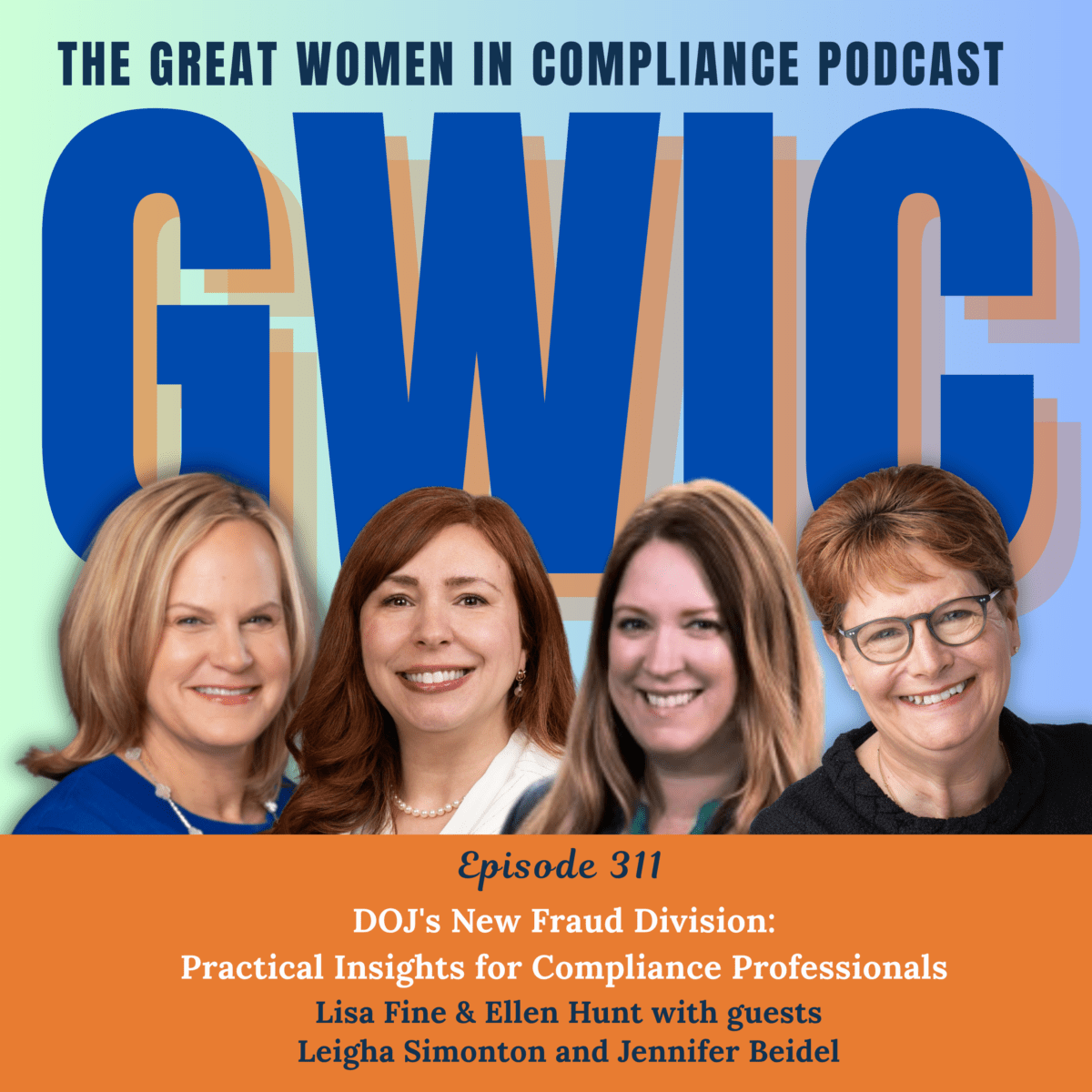
Reaching 300 episodes is no small feat in the world of podcasting. It takes vision. It takes discipline. It takes community. Most of all, it takes purpose. The Great Women in Compliance (GWIC) podcast has reached that remarkable milestone, and it is worth pausing to celebrate what this achievement truly represents. This is not simply the longevity of a show. It is the sustained elevation of voices that has reshaped the compliance profession.

From its founding by Lisa Fine and Mary Shirley to its current hosting team of Lisa Fine, Hemma Lomax, Sarah Hadden, and Ellen Hunt, GWIC has become far more than a podcast. It has become a platform, a mentoring network, and a cornerstone of the compliance community. As part of the Compliance Podcast Network, I am proud to say it stands as one of the most impactful and influential voices in our profession.

The Vision of the Founders

When Lisa Fine and Mary Shirley launched GWIC, they did so with a simple but powerful idea: compliance needed more visible female leadership, more shared stories, and more authentic conversations. Compliance has long been a profession filled with talented, capable, and principled women. Yet historically, their voices were not always amplified equally. The founders recognized that gap and moved to close it.

They did not create a show focused narrowly on technical guidance. They created a forum for professional development, ethical leadership, resilience, career navigation, and community building. They humanized compliance. That matters because compliance is often framed in terms of policies, controls, investigations, and enforcement actions. Great Women in Compliance reframed the conversation around leadership journeys, decision-making under pressure, cultural intelligence, and personal growth. Three hundred episodes later, that founding vision continues to define the show.

The Evolution of Leadership

As the podcast matured, leadership transitioned in a way that mirrors the very principles the show promotes: succession, collaboration, and shared stewardship. Today, the podcast is hosted by Lisa Fine, joined by Hemma Lomax, Sarah Hadden, and Ellen Hunt. Each brings a distinct voice and perspective to the table.

Hemma Lomax contributes a global compliance lens, grounded in regulatory rigor and practical implementation. Sarah Hadden brings strategic governance insight and a board-facing perspective that resonates deeply with senior leaders. Ellen Hunt offers a powerful blend of ethics, integrity, and operational expertise that connects culture to controls. Lisa Fine is well, Lisa Fine, a woman who, along with Mary Shirley, changed the world of compliance.

This team dynamic demonstrates an important aspect of modern compliance leadership: it is not hierarchical. It is collaborative. The podcast models what strong compliance programs aspire to achieve internally: diverse voices, respectful dialogue, and shared accountability.

Why GWIC Matters

The question is not simply why the podcast has endured. The question is: why has it become essential listening for compliance professionals worldwide? There are several reasons.

1. It Elevates Role Models

You cannot be what you cannot see. Great Women in Compliance has consistently highlighted leaders at every stage of their careers, from emerging professionals to chief compliance officers. It has provided visibility to talent that might otherwise remain unseen outside corporate walls. That visibility matters for the next generation. Young professionals entering compliance hear real stories of career pivots, setbacks, ethical dilemmas, and leadership breakthroughs. They hear authenticity instead of perfection. That is empowering.

2. It Bridges Technical and Personal Development

Many compliance resources focus exclusively on regulations and enforcement trends. Those are important, but they are not sufficient. GWIC addresses the human dimension of compliance leadership. It tackles topics such as navigating difficult reporting lines, advocating for resources, handling burnout, negotiating compensation, and managing crises. In other words, it addresses the real-world challenges compliance professionals face daily. The result is a podcast that supports both competence and confidence.

3. It Strengthens Community

One of the most underappreciated aspects of compliance is its isolation. Many compliance officers operate in small teams or even as a “team of one.” They often carry heavy responsibility with limited internal allies. GWIC builds connections. Listeners hear their own experiences reflected to them. They gain practical advice. They gain reassurance that their challenges are shared. They gain community. In a profession defined by independence and integrity, community is a powerful counterbalance.

4. It Normalizes Ambition

There was a time when ambition in compliance, particularly among women, was often underplayed. GWIC normalizes aspiration. Guests openly discuss career advancement, executive presence, board interaction, and strategic leadership. They speak candidly about how to position compliance as a value driver rather than a cost center. That message aligns directly with where the profession is headed. Compliance is no longer confined to checking boxes. It is integrated into corporate strategy, enterprise risk management, and ESG initiatives. The podcast reflects that evolution.

A Platform Within the Compliance Podcast Network

GWIC is a proud part of the Compliance Podcast Network, and its success reflects the broader strength of that platform. The Compliance Podcast Network was built on the idea that compliance conversations should be accessible, practical, and forward-looking. GWIC exemplifies that mission. Within the network, the show occupies a unique space. It is simultaneously technical and personal, strategic and relatable. It broadens the conversation while deepening it. Three hundred episodes within a professional niche is not simply a number. It is evidence of sustained engagement, loyalty, and impact.

The Broader Impact on the Profession

Over 300 episodes, GWIC has done more than spotlight individual careers. It has shaped the culture of the compliance profession itself.

It has reinforced that:

  • Ethical leadership is not optional.
  • Diversity of perspective strengthens governance.
  • Mentorship is a professional obligation.
  • Authenticity enhances credibility.
  • Collaboration drives resilience.

These themes echo across boardrooms, regulatory agencies, and multinational corporations. The podcast has helped elevate compliance from a technical specialty to a leadership discipline.

The Power of Continuity

Longevity in podcasting requires consistency. It requires preparation, thoughtful interviewing, and disciplined production. It requires hosts who are willing to invest time week after week. Three hundred episodes represent years of commitment. The founders, Lisa Fine and Mary Shirley, established the tone and purpose. The current hosts, Lisa Fine, Hemma Lomax, Sarah Hadden, and Ellen Hunt, have carried that purpose forward with energy and professionalism. That continuity is itself a lesson for compliance programs. Strong initiatives endure when they are rooted in shared values and supported by collaborative leadership.

Looking Ahead

If the first 300 episodes were about visibility, empowerment, and connection, the next 300 will likely focus on influence. The compliance profession is evolving rapidly. Artificial intelligence, geopolitical instability, sanctions regimes, ESG reporting, and data privacy are reshaping risk landscapes. Compliance leaders must adapt while preserving integrity. GWIC is well-positioned to guide that conversation. The show will continue to highlight leaders who are not only responding to regulatory change but shaping organizational culture.

A Moment Worth Celebrating

Three hundred episodes is a milestone that deserves recognition.

It represents courage in launching something new.

It represents dedication to sustaining it.

It represents leadership in expanding it.

Most importantly, it represents community. GWIC has become essential listening because it speaks to the whole compliance professional, not just the regulator-facing expert, but the mentor, the strategist, the advocate, and the leader.

Congratulations to Lisa Fine and Mary Shirley for their vision. Congratulations to Lisa Fine, Hemma Lomax, Sarah Hadden, and Ellen Hunt for their stewardship. And congratulations to the broader compliance community for embracing a platform that has strengthened us all. Three hundred episodes in, the impact is clear. Great Women in Compliance is not simply a podcast. It is a movement.

Categories
AI Today in 5

AI Today in 5: February 16, 2026, The Doom Loop Edition

Welcome to AI Today in 5, the newest addition to the Compliance Podcast Network. Each day, Tom Fox will bring you 5 stories about AI to start your day. Sit back, enjoy a cup of morning coffee, and listen in to the AI Today In 5. All, from the Compliance Podcast Network. Each day, we consider five stories from the business world, compliance, ethics, risk management, leadership, or general interest about AI.

Top AI stories include:

  1. Staying ahead of AI regs in housing. (HousingWire)
  2. UN sets up panel on AI impact. (YahooNews)
  3. KPMG examines PE and AI. (CrowdFundInsider)
  4. Continuous learning to scale healthcare. (FilMoGaz)
  5. Everything stock AI touches in ‘Doom Loop’? (Bloomberg)

For more information on the use of AI in Compliance programs, my new book, Upping Your Game, is available. You can purchase a copy of the book on Amazon.com.

Categories
FCPA Compliance Report

FCPA Compliance Report – Navigating Compliance in 2026: Trends and Transformations

Welcome to the award-winning FCPA Compliance Report, the longest-running podcast in compliance. In this episode, we replay a recent webinar Tom Fox participated in, hosted by EQS. The panel moderator was Steph Holmes, and the panelists were Tom Fox, Mary Shirley, and Matt Kelly.

The session focuses on six key 2026 trends for ethics and compliance programs:

(1) AI moving from experimentation to operational use, emphasizing deliberate scaling, human-in-the-loop oversight, governance frameworks, monitoring, and managing “shadow AI,” with practical use cases such as policy chatbots, gift/travel/entertainment reviews, and AI-enabled third-party risk lifecycle management;

(2) enforcement “volatility” and unpredictable regulatory signals, with emphasis on returning to fundamentals such as documenting program inputs and outcomes, and noting continued activity, including record FCA resolutions and a DOJ whistleblower program award leading to a rapid antitrust settlement;

(3) shifting employer–employee dynamics, including Gartner survey findings that 40% of employees would intentionally miss a compliance requirement to harm their organization, discussion of trust, employee sentiment, multi-generational communication differences, and the need to partner with HR while staying within organizational lanes;

(4) heightened third-party and supply chain risk expectations, including cybersecurity, tariffs/tariff evasion, export controls, and the need to unify siloed risk views into a holistic third-party risk assessment;

(5) anticipated increases in whistleblowing and investigation demands amid volatility, highlighting the importance of preventing retaliation, keeping reporters feeling heard through responsive communications, triage protocols, and anonymized case examples to build trust; and

(6) measuring program effectiveness through a shift from outputs to outcomes, including reviewing KPIs and key risk indicators, peer review of investigations, hotline “mystery shopping,” and gap analyses against the DOJ’s ECCP and compliance program hallmarks, with special emphasis on third-party documentation and ongoing monitoring.

Resources:

Mary Shirley on LinkedIn

Steph Holmes on LinkedIn

Matt Kelly at Radical Compliance

EQS

Tom Fox

Instagram

Facebook

YouTube

Twitter

LinkedIn

Returning to Venezuela on Amazon.com