Categories
Blog

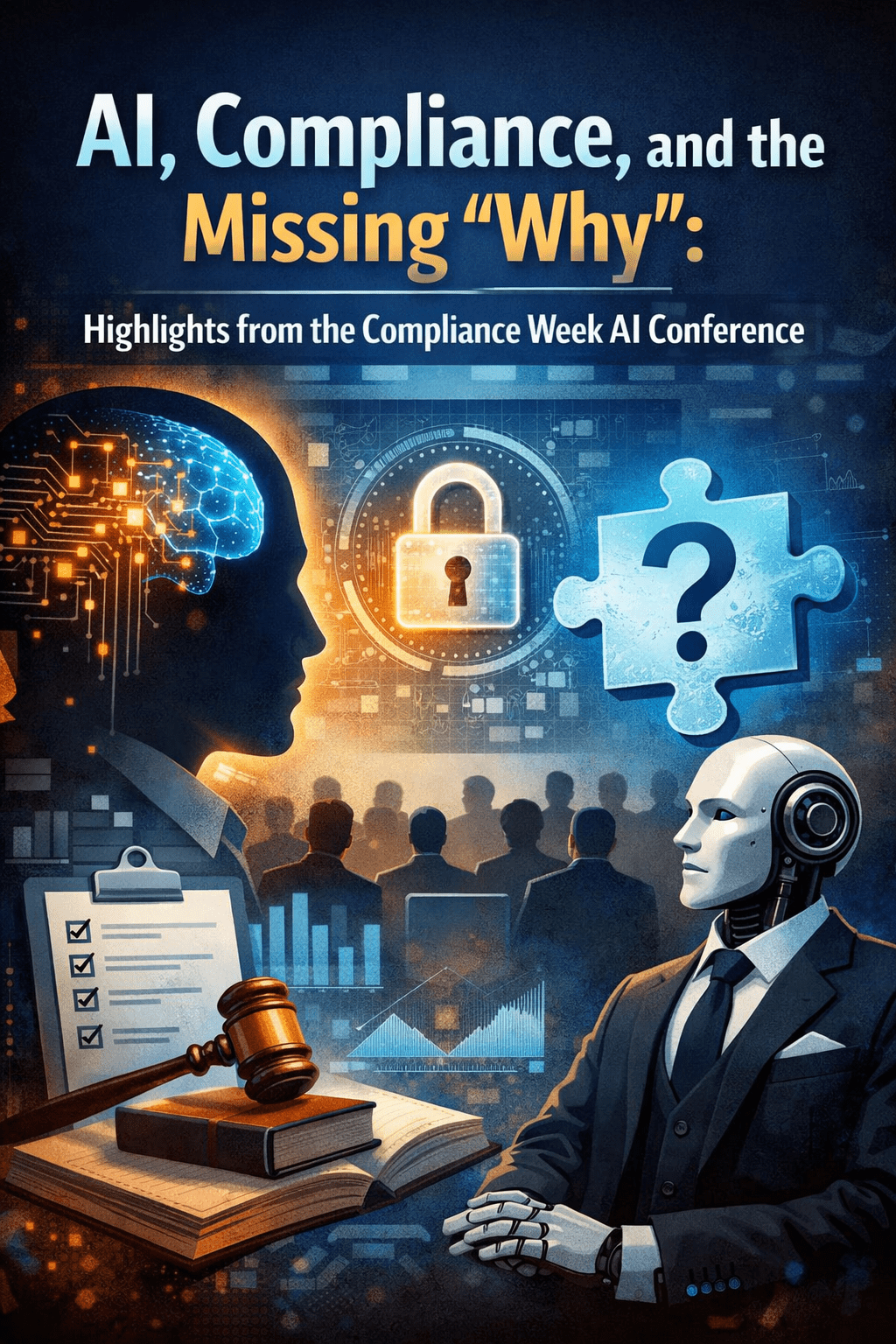
AI, Compliance, and the Missing “Why”: Highlights from the Compliance Week AI Conference

If there was one clear message coming out of Compliance Week’s January 2026 AI conference, The Leading Edge: Applying AI and Data Analytics in E&C, it was not about tools, vendors, or futuristic promises. It was about discipline. More specifically, it was about something compliance professionals have preached for decades and are now being pressured to skip: the “why.”

In a recent episode of the podcast From the Editor’s Desk, I sat down with Compliance Week Editor in Chief Aaron Nicodemus to gather his reflections on the conference and its implications for compliance leaders. What emerged was not a story about artificial intelligence replacing compliance, but about AI exposing weaknesses in how organizations make decisions, manage pressure from the top, and integrate ethics into innovation. For compliance professionals, the discussion was a reminder that AI is not a technology problem. It is a governance problem.

The Step Everyone Is Skipping: Why Before What

One of the most striking takeaways from the conference came from Jen Gennai, former AI Ethics and Compliance Advisor at Google. Her message was deceptively simple: companies are skipping the “why.” Organizations are rushing to implement AI tools without first articulating what problem they are trying to solve or why AI is the appropriate solution. Instead of defining the use case and then selecting the right tool, teams are buying technology first and hoping value emerges later.

For compliance professionals, this should sound uncomfortably familiar. Risk management, third-party due diligence, investigations; every mature compliance process begins with a defined purpose. There is a reason the first step in the third-party risk management process is the Business Rationale. This is the ‘why’, requiring a business sponsor to explain why your organization needs a new or different business partner. Yet when AI enters the picture, that discipline often evaporates. The result is experimentation without accountability and pilots without strategy.

The irony is that compliance already knows how to do this. The failure is not a lack of knowledge; it is pressure.

Tone at the Top, Revisited: Pressure Without Direction

According to a recent Compliance Week and konaAI study released at the conference, more than 60 percent of compliance officers feel pressure from the board or C-suite to “use AI.” Not to use it in a specific way. Not to achieve a defined outcome. To use it. This top-down mandate creates a new kind of compliance risk. When leadership demands adoption without guidance, teams feel compelled to move quickly, sometimes cutting corners they would never cut in other risk domains.

This is not inherently nefarious. Boards are doing what they believe is necessary to keep their organizations competitive. But pressure without clarity creates the conditions for poor governance. Compliance leaders must recognize this moment not as a threat, but as an opening. Because when leadership says “use AI,” compliance has an opportunity to respond with structure: identify manual pain points, define defensible use cases, and align AI deployment with existing policies and ethical standards. The mandate may be broad, but the implementation can and should be deliberate.

Humans in the Loop: Why Oversight Is Not Optional

Another recurring theme from the conference was the danger of letting AI evaluate AI. Scaling tools without human oversight compounds error. One flawed assumption becomes many. Bias multiplies. Outputs drift. The lesson here is not anti-technology; it is pro-governance. AI works best when humans remain embedded throughout the lifecycle: selecting tools, defining scope, reviewing outputs, and deciding whether the system is working at all.

This aligns squarely with long-standing compliance principles. Judgment-heavy decisions, investigations, escalations, and remediations must remain human. Attempting to automate them introduces fairness and defensibility risks that no compliance program can explain away after the fact. AI should accelerate compliance work, not absolve responsibility for it.

Trust and Integrity: The Core Compliance Tension with AI

The most profound tension discussed at the conference was philosophical. Compliance programs are built on trust and integrity. AI, by contrast, is often perceived as opaque, untrustworthy, and occasionally wrong. This creates a credibility problem.

Why would a compliance function that spends years telling employees to act ethically, verify sources, and question assumptions deploy a tool that fabricates answers or cannot explain its reasoning? If compliance cannot articulate why an AI system aligns with the organization’s ethical standards, it should not be deployed, no matter how efficient it appears to be. Trust is not just about outputs. It extends to inputs, data quality, and understanding how systems interact with information. AI amplifies what it is given. Bad data does not improve through automation; it spreads faster.

Iteration Over Perfection: Learning Is Part of the Process

A healthy counterpoint emerged as well: AI is not a one-shot deployment. It requires iteration. Early failures are not proof that AI does not work; they are evidence that learning has begun. Several speakers emphasized that AI improves through feedback. Teams must be willing to correct it, teach it, and refine its outputs over time. Compliance professionals who abandon tools after one or two imperfect attempts misunderstand how the technology functions.

That said, iteration does not excuse carelessness. Learning must occur within guardrails: governance frameworks, usage boundaries, and documentation matter more, not less, when tools evolve.

Compliance as Value Creator, Not Speed Bump

One of the most encouraging insights from the conference was how AI is reshaping compliance’s role inside organizations. When compliance is involved early, before tools are rolled out, it becomes a partner in innovation rather than an obstacle.

Nicodemus pointed out companies like Robinhood, and Hemma Lomax, Deputy General Counsel, Vice President, and Head of Business Integrity at DocuSign, illustrated this point clearly. Compliance teams that embed themselves in product development and operational change help shape tools that work within ethical and regulatory boundaries from the start. That credibility compounds.

Lomax noted that at DocuSign, she and her compliance teams have gone further, creating AI agents that perform defined tasks continuously, with built-in ethical guardrails. When these tools are handed to new users, the hard questions have already been answered. This is how compliance becomes a competitive advantage; not by saying no, but by helping the business say yes safely.

No Experts, Only Practitioners

Another refreshing theme from the conference was humility. No one claimed to be an AI expert. Especially not in compliance. That matters. When technologies move quickly, false certainty is dangerous. Compliance professionals should not be intimidated by those who claim mastery. Instead, they should lean into their strengths: skepticism, documentation, and principled decision-making. AI does not require omniscience. It requires informed judgment.

The Vibe Shift: From Fear to Engagement

Perhaps the most telling insight came not from the stage, but from the hallways. Compared to earlier events, the mood around AI has shifted. Compliance professionals are no longer crossing their arms in resistance. They recognize the benefits and risks and want to engage. No one believes AI will disappear. The debate is no longer whether to use it, but how. Some organizations will lean in aggressively. Others will move cautiously. All will need compliance to guide those choices. The most effective analogy offered was this: AI is like a very confident intern. Smart. Fast. Occasionally wrong. Useful, but never in charge.

Conclusion: AI Is a Compliance Opportunity, If Compliance Leads

The Compliance Week AI conference made one thing clear: AI is not undermining compliance. It is testing it. Programs that lack clarity, governance, or confidence will struggle. Programs that know who they are, what they stand for, and how they make decisions will thrive. For compliance professionals, the question is not whether AI belongs at the table. It already sits there. The real question is whether compliance will claim its seat, not as a roadblock, but as the function that ensures innovation aligns with integrity. That is not a burden. It is an opportunity.

Categories
From the Editor's Desk

From the Editor’s Desk – Aaron Nicodemus on the CW AI Conference Insights: Navigating the Practical Use of AI in Compliance

In this episode of ‘From the Editor’s Desk,’ Tom Fox visits with Aaron Nicodemus to discuss highlights from the recent Compliance Week AI Conference. Key takeaways include the importance of understanding the purpose and practical use of AI tools before implementation, the pressures from C-suite and boards to adopt AI, and the necessity of a human-in-the-loop approach. The conversation also touches on integrating trust and integrity into AI adoption, the evolving role of compliance as a trusted partner in AI initiatives, and the collective willingness to learn and apply AI across compliance operations.

Key highlights:

  • Importance of Understanding AI Implementation
  • Pressure from the Top: Compliance and AI
  • Human Oversight in AI Processes
  • Trust and Integrity in AI
  • Compliance as a Competitive Advantage
  • Real-World Examples: Robinhood and DocuSign
  • The Evolving Role of Compliance in AI
  • Conference Vibes and Final Thoughts

Resources:

Aaron Nicodemus on LinkedIn

Compliance Week

Categories
Daily Compliance News

Daily Compliance News: January 21, 2026, The Excellence in Compliance Awards Edition

Welcome to the Daily Compliance News. Each day, Tom Fox, the Voice of Compliance, brings you compliance-related stories to start your day. Sit back, enjoy a cup of morning coffee, and listen in to the Daily Compliance News. All, from the Compliance Podcast Network. Each day, we consider four stories from the business world, compliance, ethics, risk management, leadership, or general interest for the compliance professional.

Top stories include:

  • Delaware Supreme Court sides with Moelis. (Reuters)
  • CW entries for its Excellence in Compliance are now open. (CW)
  • The Philippines moves to shore up investor sentiment. (Bloomberg)
  • Goldman Sachs’ top lawyer and Epstein. (WSJ)
Categories
FCPA Compliance Report

FCPA Compliance Report: The Role of AI and Data Analytics in Compliance: Preview of The Leading Edge with Roxanne Bras Petraeus and Andrew McBride

Today, we have a special edition of the FCPA Compliance Report, previewing speakers and presentations at the upcoming Compliance Week event, The Leading Edge: Applying AI and Data Analytics in E&C, to be held at The Westin Fort Lauderdale on January 28 and 29. In this episode, Tom Fox is joined by Roxanne Bras Petraeus, CEO of Ethena, and Andrew McBride, Founder & CEO of Integrity Bridge LLC, to discuss their presentation, “Seeing is Believing: Live AI Demos for Ethics and Compliance Leaders.

Roxanne emphasizes the practical integration of AI within Ethena’s services and its utility for compliance leaders, while Andrew shares insights from his extensive experience in risk and compliance consulting. They highlight their upcoming presentation at The Leading Edge conference, where they will demonstrate 10 AI tools and discuss real-life use cases, opportunities, and limitations of AI in compliance. They also reflect on the evolving role of AI in data analytics and the need for transparency and data validation. Both guests express their eagerness to engage with compliance professionals and share practical insights to enhance the industry’s AI adoption.

Key highlights:

  • Preview of the Compliance Week Presentation
  • The Importance of Effective Training
  • AI’s Impact on Data Analytics in Compliance
  • Expectations for the Conference

Resources:

Compliance Week

The Leading Edge: Applying AI and Data Analytics in E&C conference, click here. Compliance Week is offering a 20% discount to the event for listeners of this podcast. Use the discount code TFOX at registration.

 Guests

Roxanne Bras Petraeus on LinkedIn

Ethena

Andrew McBride on LinkedIn

Integrity Bridge

Host

Tom Fox

Instagram

Facebook

YouTube

Twitter

LinkedIn

Categories
From the Editor's Desk

From the Editor’s Desk – Compliance Week’s Insights and Reflections for November and into December 2025

In this episode of ‘The Editor’s Desk’ podcast, hosts Tom Fox and Aaron Nicodemus delve into key compliance issues featured in Compliance Week. Tom and Aaron discuss top stories from Compliance Week in November, look at stories that will appear in December, and provide a preview of upcoming content and events in January and beyond.

They discuss FCPA investigations closed under the Trump administration and the implications for compliance professionals. Aaron highlights stories from Compliance Week, including an FCPA enforcement action involving Millicom Cellular in Guatemala and a detailed look at financial institutions in Latin America involved in money laundering for drug cartels. The hosts also touch on significant interviews and upcoming features, such as compliance wins and fails of the year, an AI and compliance survey, and the upcoming Compliance Week national conference. The episode offers valuable insights into compliance trends and regulatory changes, providing practical advice for compliance officers.

Resources:

Aaron Nicodemus on LinkedIn

Compliance Week

From the Mind of the CCO survey

Categories
From the Editor's Desk

From the Editor’s Desk: Compliance Week’s Insights and Reflections for October and into November 2025

In this episode of ‘From The Editor’s Desk’ podcast, hosts Tom Fox and Aaron Nicodemus delve into key compliance issues featured in Compliance Week. Tom and Aaron discuss the top stories from Compliance Week in October, look at some stories that will appear in November, and provide a preview of upcoming content and events.

They discuss the insights from a case study on Lafarge’s anti-bribery issues linked to cartels and terrorist organizations, as well as challenges in business due diligence in high-risk areas. The episode also covers recent trends around DOJ compliance monitorship under different administrations, insights into Foreign Corrupt Practices Act (FCPA) enforcement, and evolving compliance issues related to artificial intelligence (AI). Finally, they highlight upcoming Compliance Week initiatives and webinars, focusing on career pathways in compliance, the importance of due diligence in high-risk environments, and the practical applications of AI in the compliance field.

Resources:

Aaron Nicodemus on LinkedIn

Compliance Week

Categories
From the Editor's Desk

From the Editor’s Desk – Compliance Week’s Insights and Reflections for September and into October 2025

In this episode of ‘The Editor’s Desk’ podcast, hosts Tom Fox and Aaron Nicodemus delve into key compliance issues featured in Compliance Week.

Tom and Aaron discuss top stories from Compliance Week in September, and provide a preview of upcoming content and events. They delve into a three-part case study on Lafarge’s bribery payments to terrorist groups in Syria, exploring its implications for companies operating in high-risk regions. They also discuss a resurfaced case study involving Jeffrey Epstein, JPMorgan Chase, and Deutsche Bank. The episode also highlights Ruth Prickett’s report on digital wallets in Europe, as well as the related compliance and data privacy issues. Additionally, they cover trends in FCPA enforcement, healthcare compliance with a focus on the FCA, immigration issues, and the importance of proactive compliance programs. The episode wraps up with insights into the upcoming ‘Inside the Mind of the CCO‘ survey and the January conference on AI and data analytics in compliance.

Resources:

Aaron Nicodemus on LinkedIn

Compliance Week

Categories
From the Editor's Desk

From the Editor’s Desk – Compliance Week’s Insights and Reflections from July to August 2025

In this episode of From the Editor’s Desk, co-hosts Tom Fox and Ian Sherr dive into key compliance stories from July, including differences in AI regulation between the U.S., EU, and UK, and shifts in regulatory approaches globally. They discuss notable cases, such as the DOJ’s $14 billion healthcare fraud prosecution tied to transnational crime, and T-Mobile’s acquisition of US Cellular amidst DEI program cuts. Upcoming initiatives in Compliance Week are also highlighted, including in-depth industry coverage and data-driven stories to aid compliance professionals in their roles. The episode concludes with insights into the recent acquisition of ECI by Compliance Week’s parent company, Verdian Insights, which aims to enhance resources available to the compliance community.

Highlights include:

  • Highlighting Key Stories from Compliance Week in July
  • Emerging Patterns in Compliance
  • Tariffs and Their Impact
  • SEC Whistleblower Claims Analysis
  • Upcoming Features and Data Stories
  • ECI Acquisition by Verdian Insights and Its Impact

Resources:

Ian Sherr on LinkedIn

Compliance Week

Categories
From the Editor's Desk

Episode 30 – Inaugural Episode with Ian Sherr: Compliance Week’s Insights and Reflections from June to July 2025

In this inaugural episode for a new season of ”From the Editor’s Desk,” co-host Tom Fox welcomes Ian Sherr, the new Publishing Director and Editor-in-Chief of Compliance Week. Ian shares his background in journalism and discusses his mission to support the compliance community through Compliance Week. They discuss the significant stories and themes from recent issues, including the importance of tone from the top, soft skills, and the role of compliance in navigating complex global issues. The episode also highlights key takeaways from Compliance Week’s recent conferences, including reflections on women in compliance, third-party risk management, and upcoming stories that focus on critical decision points in compliance.

Highlights include:

  • Meet Ian Sherr: Professional Background
  • Reflections on Compliance Week 2025
  • The Compliance Week Reporting Team
  • Highlighting Key Stories and Case Studies
  • June Conferences: Third-Party Risk Management and Women in Compliance
  • Upcoming Stories and Future Insights

Resources:

Ian Sherr on LinkedIn

Compliance Week

Categories
From the Editor's Desk

From The Editor’s Desk: A Celebration of Kyle Brasseur’s Journey: From Sports Journalism to Compliance Week Editor

In this special episode of ‘From the Editor’s Desk,’ host Tom Fox interviews Kyle Brasseur, who recently announced his retirement from Compliance Week, where he served as Editor-in-Chief. Kyle shares his journey from working in sports journalism to his pivot into the compliance field. He discusses his professional growth, the challenges and opportunities he faced, and the important stories covered during his tenure.

The episode also explores the critical role of journalism in the compliance sector and delves into some of Kyle’s most memorable moments, including his first published story and the development of the ‘Inside the Mind of the CCO’ survey. To round off, the discussion shifts to sports, particularly the performance and expectations of the Boston Celtics. Kyle reflects on his experiences and shares his thoughts on the future, expressing gratitude towards the compliance community for their unparalleled support.

Highlights Include:

  • Kyle’s Journey to Compliance Week
  • Transition from Sports Journalism to Compliance
  • Growth and Opportunities at Compliance Week
  • Importance of Compliance Journalism
  • Differences Between Sports and Compliance Journalism
  • Becoming Editor-in-Chief
  • Significant Stories and Editorial Changes
  • Inside the Mind of the CCO Survey
  • Final Thoughts and Farewell

Resources:

Kyle Brasseur on LinkedIn

Compliance Week