Categories
Blog

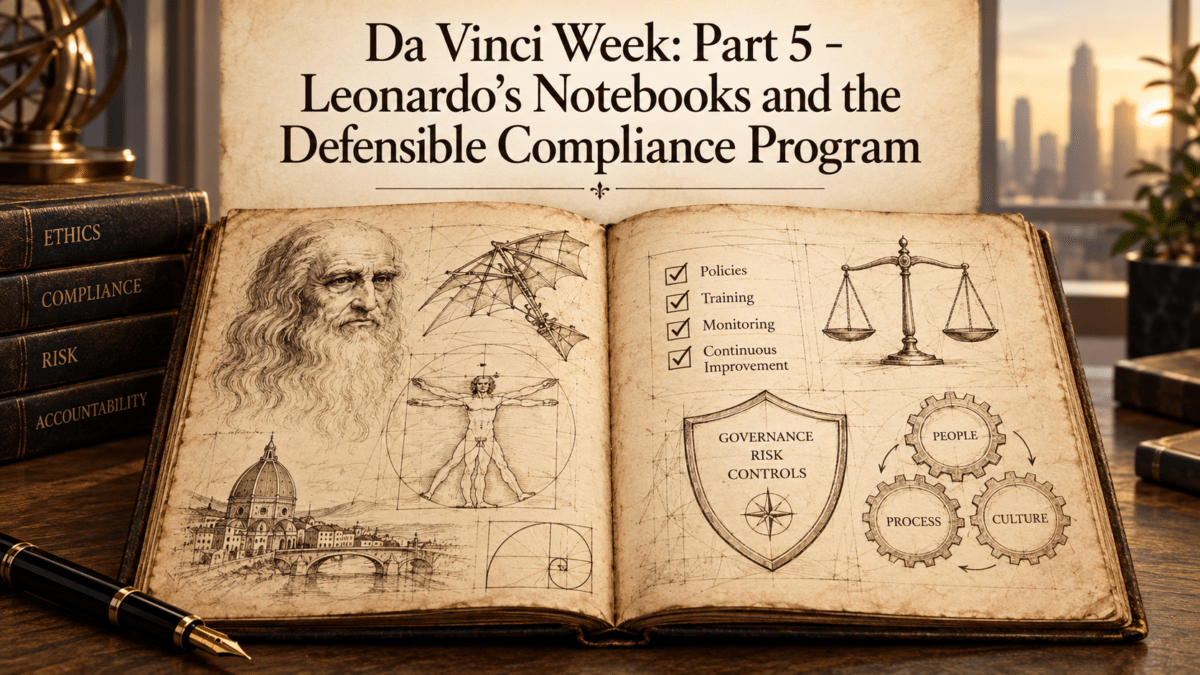
Da Vinci Week: Part 5 – Leonardo’s Notebooks and the Defensible Compliance Program

In the first four posts in the Leonardo Compliance Framework, we used Leonardo’s work to explore the compliance disciplines of Refine, Investigate, Innovate, and Monitor.  For our final blog post, the lesson comes not from a single Leonardo masterpiece but from the extraordinary collection of notebooks he created throughout his life. Leonardo recorded observations about anatomy, engineering, mechanics, water, optics, mathematics, architecture, flight, weapons, and the natural world. He drew machines, recorded experiments, posed questions, explored ideas, and returned repeatedly to subjects that interested him.

The compliance lesson goes beyond good note-taking. Leonardo externalized knowledge. He created a record of observations, ideas, questions, and reasoning that otherwise would have existed only in his mind. Modern corporations face a similar challenge. A CCO may understand why a particular control exists. An investigator may remember why an inquiry was expanded. A regional compliance officer may know why a distributor received enhanced scrutiny. An audit committee may understand why management accepted a particular residual risk. An AI governance committee may know why it approved a particular use case with specific limitations.

Then people leave, responsibilities change, businesses are reorganized, and memories fade. The policy remains, but the reasoning disappears. That is why documentation should be viewed as a component of compliance governance rather than simply an administrative obligation.

If It Is Not Documented, the Organization May Not Know It

Compliance professionals know the maxim that if something is not documented, it did not happen. That formulation can be overly simplistic, but it points toward a genuine problem. Organizations often know more than their systems preserve.

Consider a high-risk distributor approved five years ago. The compliance file may contain due diligence reports, certifications, contractual provisions, and an approval. Yet the people involved may have known far more. They may have discussed a government relationship, considered terminating the proposed engagement, obtained additional information, imposed enhanced controls, and ultimately concluded that the residual risk was manageable.

If the file contains only the final approval, a future reviewer may know what the company decided without understanding why. That distinction matters. Good compliance documentation should preserve significant reasoning, not simply outcomes.

This does not mean every routine decision requires a lengthy memorandum. Documentation should remain proportional to risk. A routine low-risk approval may require little explanation. A significant exception involving elevated corruption risk, a senior executive, a sensitive investigation, or a consequential AI application may warrant considerably more.

Risk-based documentation is part of a defensible compliance program.

Documentation Creates Institutional Memory

One of the most significant vulnerabilities in many compliance programs is the concentration of institutional knowledge in particular individuals. Every organization has employees who know why things work the way they do.

A longtime compliance officer remembers why a control was implemented after an investigation. An internal audit executive understands why a particular business unit receives enhanced testing. A finance employee knows why payments to a particular category of third parties require additional approval. An investigator remembers a series of cases that revealed a recurring management problem.

That knowledge has value. A new CCO should be able to understand why major components of the program exist. A new audit committee chair should understand significant unresolved compliance risks. A new investigator should be able to identify relevant historical matters. A new control owner should understand what problem the control was designed to address. Institutional memory should belong to the institution.

Documentation Supports Accountability

Clear documentation also helps answer one of the most important questions in corporate governance: who decided?

Organizations make thousands of decisions involving compliance risk. Most are routine. Some are consequential.

When a significant risk is accepted, the company should be able to identify the person or governance body with authority to accept it.

This is particularly important for exceptions.

If a high-risk third party is approved despite significant red flags, who approved the relationship? If an investigation involving a senior executive is narrowed, who authorized the scope change? If a remediation deadline is extended, who approved the extension and what interim controls are operating? If an AI system is permitted to influence consequential decisions, who approved the use case and under what conditions?

These are governance questions.

Documentation creates a decision trail.

That trail allows management, internal audit, the board, and, when necessary, regulators or enforcement authorities to understand how the organization exercised judgment.

A defensible compliance program does not require perfect decisions. Business decisions involve uncertainty.

It should, however, be able to demonstrate that significant decisions were made through an appropriate process by people with the authority and information necessary to make them.

Remediation Requires Evidence

The Michelangelo series emphasized the difference between closing a project and solving the underlying problem. Leonardo’s notebooks add another dimension: the organization should preserve evidence of what it changed and why.

Suppose an investigation identifies weak approval controls over distributor discounts. Management agrees to remediate the issue by modifying system permissions and requiring additional review.

The compliance record should identify the deficiency, remediation owner, planned corrective action, expected completion date, and evidence required for closure. When management reports that remediation is complete, the record should support that conclusion.

Was the system actually modified? Were users informed? Did testing confirm that the revised control operates as intended? Were similar vulnerabilities evaluated elsewhere? This creates a defensible chain from problem to solution.

Finding → Root Cause → Remediation → Ownership → Validation → Closure

That chain matters to the CCO because it shows compliance findings lead to management action. Internal Audit values it because it supports assurance. It is valuable to the board because it provides evidence that identified risks are being addressed. Documentation converts remediation from a promise into an accountable process.

AI Makes Documentation More Important

Artificial intelligence may make the documentation principle more important than ever in the modern compliance program. AI governance involves decisions that may be difficult to reconstruct after the fact if they are not documented when made.

A company evaluating a significant AI use case should preserve enough information to understand the system’s intended purpose, business owner, risk classification, relevant data, identified risks, testing, required controls, human oversight, approval conditions, and monitoring expectations.

The record should also reflect material changes.

An AI application approved as a low-risk productivity tool may later gain access to sensitive internal data. A vendor may change the underlying model. A system may become integrated into a consequential business process. An application initially used to recommend actions may eventually be authorized to take them. The governance record should evolve with the system.

This matters because AI can complicate traditional assumptions about decision-making. When a human employee makes a decision, organizations generally know who made it. When an AI system influences or takes an action, accountability can become less obvious.

Documentation should prevent that ambiguity from becoming an accountability gap. The company should be able to reconstruct what the system was authorized to do, who approved that authority, what controls applied, and who was responsible for monitoring its operation.

NIST AI RMF and ISO/IEC 42001 both reinforce the broader value of structured governance, risk management, documentation, monitoring, and continuous improvement. For the CCO, the important point is not simply alignment with a framework. It is the ability to demonstrate how the organization governed the technology in practice.

Documentation Should Feed Organizational Learning

Documentation becomes most valuable when the organization uses it. Investigation records can reveal recurring root causes. Exception records can identify controls employees routinely struggle to follow. Third-party approval records can reveal recurring risk patterns. Remediation documentation can show which corrective actions are effective. AI governance records can identify use cases generating repeated incidents or overrides.

The organization can analyze these records to improve the compliance program. This closes the loop between all five Leonardo principles.

  • Documentation captures what monitoring reveals.
  • Monitoring identifies issues requiring investigation.
  • Investigations generate lessons that drive refinement.
  • Refinement can support responsible innovation.
  • Innovation creates new risks that require monitoring and documentation.

The framework is therefore not linear. It is a learning cycle. That is perhaps the most important Leonardo lesson for the modern CCO.

Completing the Leonardo Compliance Framework

With Leonardo’s notebooks, we complete our five-part framework:

Refine-> Investigate-> Innovate-> Monitor-> Document

Together, these principles describe compliance as an organizational learning system. Effective programs learn from experience, investigate failures to understand root causes, support innovation within appropriate governance, monitor whether controls continue to work, and preserve what the organization learns so that knowledge informs future decisions.

The Mona Lisa taught us to Refine. Compliance programs should improve because organizations learn from experience, changing risks, investigations, employee feedback, and data. Leonardo’s anatomical studies taught us to Investigate. Misconduct should be examined beneath the surface so the organization understands root causes, control failures, incentives, management behavior, and systemic vulnerabilities. His flying machines taught us to Innovate. Compliance should help the company capture the value of emerging technology while maintaining risk-based governance, meaningful human oversight, and clear accountability. The Last Supper taught us to Monitor. Controls can deteriorate as the environment changes, making testing, analytics, ownership, remediation, and continuing oversight essential to program effectiveness. Leonardo’s notebooks teach us to Document.

That provides the essential contrast with Michelangelo. His framework of Challenge, Execute, Defend, Build, and Govern taught a CCO how to construct and operate an effective compliance program. Leonardo teaches a CCO how to keep that program learning and adapting. The modern compliance function needs both disciplines because strong controls can become obsolete if the organization fails to recognize changes in its business, technology, and risk environment.

That combination matters even more in 2026. AI is accelerating business change, geopolitical developments can rapidly alter risk, third-party ecosystems continue to expand, and boards need evidence that compliance systems work in practice. The CCO cannot administer yesterday’s compliance program while the business builds tomorrow’s operating model.

Leonardo’s notebooks leave us with a simple compliance mandate: learn from what the organization does, preserve what it learns, and use that knowledge to make the organization better.
Categories
Blog

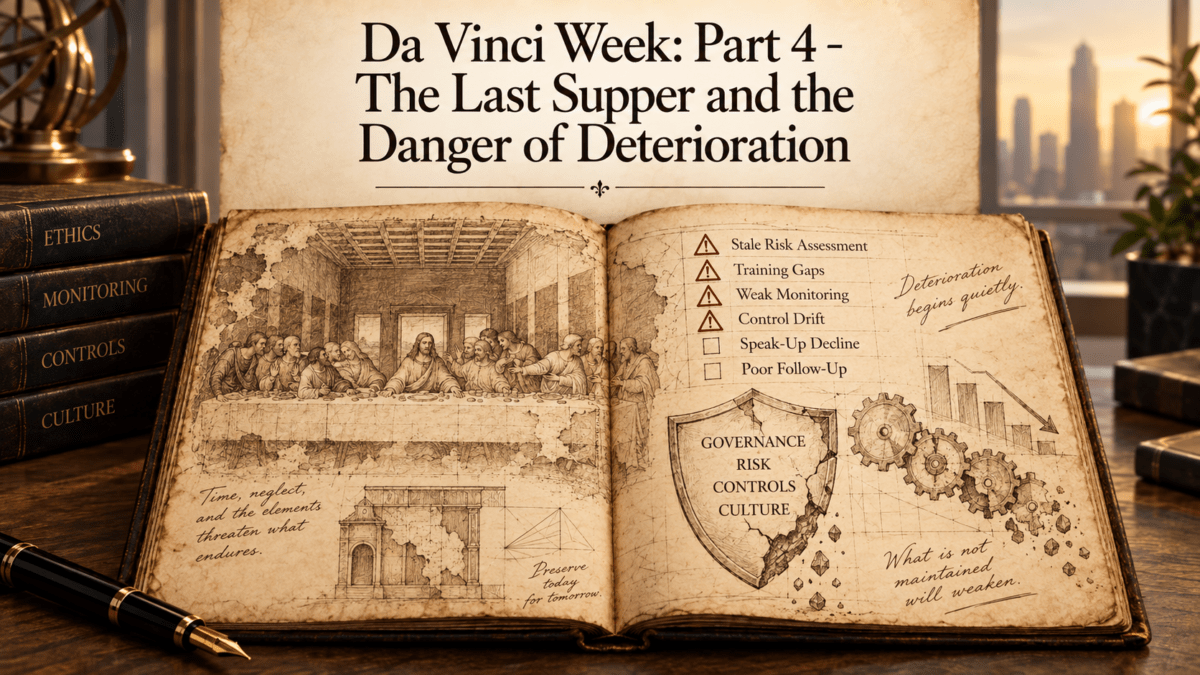
Da Vinci Week: Part 4 – The Last Supper and the Danger of Deterioration

In the previous post in the Leonardo Compliance Framework, Leonardo’s flying machines gave us Innovate, the principle that Compliance should help organizations capture the benefits of emerging technology while establishing governance appropriate to the risks. Yet approving and deploying a new technology, control, or compliance process does not demonstrate that it will remain effective over time. The organization must continue to evaluate whether the system operates as intended as the business and its risk environment change. That brings us to the fourth principle in the Leonardo Compliance Framework: Monitor.

For this lesson, we turn to Leonardo’s The Last Supper. Leonardo experimented with a painting technique that provided greater artistic flexibility than conventional fresco methods. The result was extraordinary, but the physical work proved vulnerable to deterioration, and environmental conditions and later damage compounded those problems.

For compliance professionals, the lesson is not that experimentation was a mistake. It is that implementation marks the beginning of the control lifecycle, not its end. A system that operates effectively when introduced may weaken as people, processes, technology, incentives, and business conditions change. Modern compliance program effectiveness therefore requires more than evidence that a control exists. Management needs evidence that the control continues to work.

Implementation Is Not Effectiveness

Companies appropriately recognize major implementation milestones. A new third-party platform goes live, an updated Code of Conduct is launched, an investigation protocol is approved, or a sanctions-screening system is installed. These accomplishments demonstrate that the organization has taken action, but they do not establish that the underlying risk is being managed effectively.

Consider a third-party due diligence system implemented across a global enterprise. At launch, the workflow operates as designed. Business sponsors submit required information, higher-risk third parties receive enhanced review, approvals are documented, and Compliance can monitor the process. Two years later, an acquisition may have added thousands of vendors, employees may have developed workarounds because they consider the process too slow, regional teams may interpret risk classifications differently, and data feeds may no longer operate consistently. The system still exists, and the policy remains in force, but the control environment has changed.

This is the central monitoring challenge. Controls operate inside dynamic organizations. A gifts and entertainment process may become inadequate when the company enters markets involving greater interaction with government officials. Sanctions controls may require adjustment following significant geopolitical developments. A conflict-of-interest process may become less effective after an acquisition substantially expands the workforce. Controls designed for one business model may no longer fit another.

Effective monitoring should therefore connect directly to risk assessment. When the company’s risk environment changes, management should evaluate whether the controls designed for the previous environment remain appropriate. Successful implementation at one point in time cannot establish continuing effectiveness.

Monitoring and Testing Provide Different Evidence

Compliance professionals should distinguish between monitoring and testing because each provides different information about the control environment. Monitoring is generally continuous or recurring. It observes transactions, trends, exceptions, employee behavior, third-party activity, hotline information, investigation patterns, and other indicators that may reveal changes in risk or control performance. Testing is more focused and determines whether a particular control is appropriately designed and operating as intended.

Consider a control requiring enhanced approval for high-risk third parties. Monitoring may reveal how many high-risk relationships are approved, how long reviews take, which business units generate the most exceptions, and whether particular patterns are developing. Testing may examine a sample of approved relationships to determine whether required due diligence was performed, red flags were resolved appropriately, approvals occurred at the correct level, and documentation supports the final decision.

Monitoring provides signals about what may be changing. Testing provides evidence about whether specific controls perform as expected. Together, they allow the CCO to move beyond control existence and assess effectiveness.

That distinction matters most when presenting compliance information to senior management and the board. Activity metrics may demonstrate that processes are operating, but control testing provides a stronger basis for determining whether those processes are managing the intended risk.

Ownership Turns Monitoring Into Accountability

Monitoring becomes considerably less effective when control ownership is unclear. This is a recurring compliance problem because responsibilities often cross functional boundaries. Compliance may own the policy, Procurement may operate the process, IT may own the technology, Finance may process the payment, and the business may own the commercial relationship. When the control fails, each function may reasonably believe another function was responsible.

Effective control design should therefore identify an accountable owner responsible for ensuring that the control operates as intended. Compliance may provide oversight and challenge, and Internal Audit may provide independent assurance, but first-line functions should understand their responsibility for managing the underlying business risk.

Ownership should extend to the results of monitoring and testing. If testing identifies repeated exceptions, someone must determine whether the process requires modification. If a data feed fails, someone must restore it. If employees routinely circumvent a control, management must address the underlying behavior or process weakness. Monitoring without ownership produces information without accountability. The objective is not simply to identify control deficiencies but to drive a management response.

Use Data to Identify Deterioration Earlier

Data analytics has significantly expanded compliance functions’ ability to identify changes in risk and control performance. Traditional monitoring often depended on periodic reviews of relatively small samples. Modern analytics can help organizations identify patterns across larger populations and, in some circumstances, detect changes earlier.

Payment data may reveal unusual transaction patterns, while procurement information can identify repeated overrides or vendor concentrations. Third-party data may identify expired due diligence or changes in risk characteristics. Hotline and investigation data can reveal shifts in allegations and recurring root causes, while HR information may signal retaliation or cultural issues.

The objective is not to collect the greatest possible volume of information or create the most sophisticated dashboard. The purpose is to identify data that help management determine whether risks are changing or controls are weakening. Exceptions are particularly valuable in this respect. An individual exception is not necessarily evidence of misconduct because legitimate business circumstances may justify deviation from a standard process. Patterns of exceptions, however, can reveal important information about the control environment.

If one business unit generates substantially more third-party exceptions than comparable operations, Compliance should understand the reason. Repeated overrides near quarter-end may indicate commercial pressure. Due diligence consistently completed after engagement may indicate that the formal process no longer reflects how the business actually operates.

A mature program should therefore examine the frequency, rationale, approving authority, concentration, and recurrence of significant exceptions. When exceptions become routine, they can create an unofficial alternative process that exists alongside the formal control environment. Data become valuable when they reveal that divergence early enough for management to respond.

Investigations, Monitoring, and Remediation Should Form a Feedback Loop

Investigations provide some of the strongest evidence about how controls operate under actual business conditions. Their findings should therefore influence what a compliance program monitors. If an investigation discovers that employees circumvented third-party controls by classifying consultants as ordinary vendors, remediation should address the immediate classification weakness, while monitoring should examine whether comparable patterns exist elsewhere. If an investigation identifies improper discounts used to create funds for inappropriate payments, transaction monitoring can be adjusted to identify similar discount patterns. If a retaliation investigation reveals adverse employment consequences shortly after an employee raised a concern, a compliance professional could consider whether HR data can identify comparable patterns.

This creates a feedback loop. Investigations explain how a control failed in a particular case, monitoring helps determine whether the same weakness exists elsewhere or is recurring, and remediation addresses the underlying problem. Monitoring has limited value if the organization does not act on what it learns. When testing identifies a significant deficiency, management should understand why it occurred, whether it is systemic, what risk it creates, what corrective action is required, and who owns that remediation. The organization should then validate that the corrective action addressed the weakness.

This last step is important because remediation completion and remediation effectiveness are different concepts. Issuing a revised procedure or completing additional training may satisfy a project milestone without solving the underlying problem. Follow-up testing provides evidence that the remediation worked.

The compliance learning cycle should therefore move from investigation to monitoring, from monitoring to remediation, and from remediation to validation.

AI Requires Continuing Monitoring

AI provides a particularly clear example of why approval and implementation cannot end the governance process. A company may conduct extensive review before deploying an AI application by assessing the vendor, testing the system, evaluating data use, classifying risk, and establishing human oversight. Those steps are important, but the system and its operating environment can change after deployment.

Vendors may update models, employees may develop new uses, data may change, integrations may expand access, and capabilities may increase. For higher-risk applications, monitoring should therefore match the potential consequences. It may include performance testing, incident monitoring, reviewing material overrides, validating outputs, and reassessing after significant changes in functionality or use.

Agentic systems deserve particular attention because monitoring may need to address not only output quality but also the actions a system performs, the permissions it exercises, and whether it remains within its approved authority. The broader principle is the same as for any other compliance control. Governance should continue for as long as the organization relies upon the system.

Culture Also Requires Monitoring

Corporate culture presents a different monitoring challenge because no single metric establishes whether an organization has a strong ethical culture. Hotline reporting rates provide useful information but require interpretation. High reporting may indicate significant problems or employee confidence in the reporting system. Low reporting may reflect a healthy environment or fear of speaking up. Employee surveys provide additional information but capture sentiment at a particular moment, while investigation data reflect only matters that become known.

Compliance should therefore build a broader picture using multiple indicators, including reporting trends, employee surveys, exit interviews, focus groups, disciplinary information, HR data, investigation findings, and management assessments. Changes across these indicators may reveal emerging issues in particular business units, management teams, or employee populations.

Culture monitoring is especially important after leadership changes, acquisitions, restructurings, layoffs, or significant incentive changes because these events can quickly alter employee perceptions and behavior. Formal policies may remain unchanged while the operating culture deteriorates. As with other compliance risks, the objective is not perfect measurement. It is obtaining enough reliable information to identify material changes and respond appropriately.

The Danger of Deterioration

The Last Supper reminds us that implementation captures a moment in time while organizations continue to evolve. Personnel, technology, incentives, business models, markets, and risks change, and controls that once worked can weaken in response. An effective compliance program therefore needs monitoring, testing, clear ownership, useful data, and validated remediation. These disciplines allow the organization to identify deterioration before a control weakness becomes a larger compliance failure.

The practical lesson for the CCO is that implementation should never be confused with effectiveness. Monitoring and testing should provide different but complementary evidence about control performance. Ownership should ensure findings produce action, analytics should identify meaningful changes rather than simply populate dashboards, and remediation should be validated before the organization concludes the underlying problem is solved. That is Monitor, the fourth principle of the Leonardo Compliance Framework. A control deserves continuing confidence only when the organization has continuing evidence that it works.

From Monitoring to Documentation

Monitoring tells the organization what is happening, but institutional learning depends upon preserving what the organization learns. A company may conduct an effective investigation, identify a root cause, redesign a control, test the remediation, and reach a thoughtful risk decision. Yet, much of that value can disappear if the reasoning exists only in the memories of the people involved.

That brings us to the fifth and final Leonardo principle: Document. In Blog Post Five, Leonardo’s Notebooks: Documentation the Defensible Compliance Program, we will use Leonardo’s extraordinary record of observations, drawings, experiments, and ideas to examine documentation as a governance discipline. The discussion will focus on preserving significant compliance reasoning, establishing accountability, creating institutional memory, documenting remediation and AI governance decisions, and ensuring that what the organization learns today remains available to the people responsible for managing its risks tomorrow.

Categories
Blog

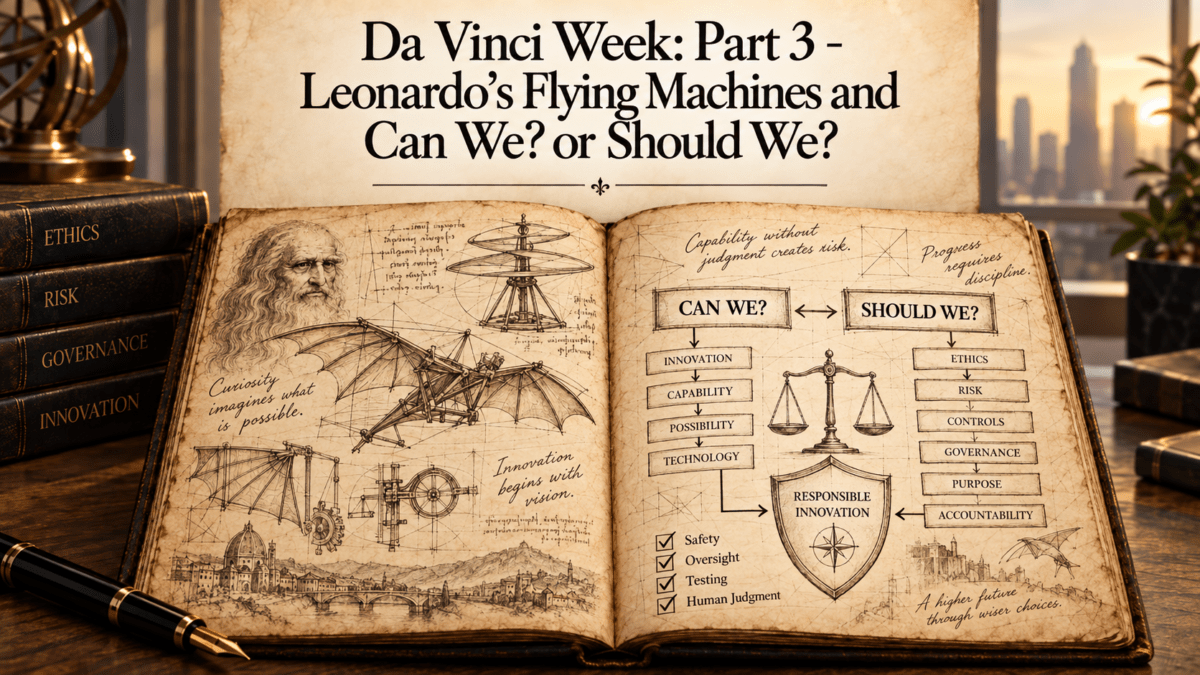
Da Vinci Week: Part 3 – Leonardo’s Flying Machines and “Can We?” or “Should We?”

In the first two posts in the Leonardo Compliance Framework, the Mona Lisa gave us Refine, the principle that an effective compliance program improves as the organization learns from experience. Leonardo’s anatomical studies gave us Investigate, the discipline of looking beneath misconduct to understand root causes, control failures, incentives, management decisions, and the organizational systems that produced the outcome. The third principle is Innovate.

For that lesson, we turn to Leonardo’s studies of flight and his designs for flying machines. Leonardo examined birds, air movement, wings, and mechanical systems as he considered whether technology could allow human beings to fly. Many of his concepts were far beyond the practical capabilities of his time, but they demonstrate an important characteristic of Leonardo’s work: he imagined capabilities that did not yet exist and then studied the systems necessary to make them possible.

For corporate compliance professionals in 2026, the analogy to artificial intelligence is particularly useful. AI is expanding what companies can automate, analyze, predict, generate, and increasingly act upon. Organizations are moving beyond using generative AI to draft documents and summarize information. AI systems are becoming embedded in business processes, interacting with corporate data, supporting consequential decisions, communicating with customers, evaluating third parties, and, through increasingly agentic capabilities, taking actions that previously required human intervention.

The compliance challenge is not whether companies should innovate. They will. The challenge is establishing governance that lets innovation create business value without creating unmanaged legal, ethical, operational, or compliance risk.

AI Governance Is Enterprise Governance

Compliance professionals have sometimes approached emerging technology as primarily the responsibility of IT, Cybersecurity, Data Privacy, or Legal. That division becomes increasingly difficult with AI because these systems can influence many of the activities a corporate compliance team already oversees. Indeed, the Evaluation of Corporate Compliance Programs (ECCP) anticipates these very concepts in its 2024 edition.

AI may assist with third-party due diligence, contract review, procurement, transaction analysis, hiring, customer communications, investigations, fraud detection, marketing, or pricing. Each application creates a different risk profile. A due diligence system may generate inaccurate information about a business partner. An investigation tool may expose privileged or confidential information. A sales application may generate communications inconsistent with company policies. An agent connected to corporate systems may take actions that historically required human approval.

The ECCP asks the following:

  • How does the company assess the potential impact of new technologies, such as artificial intelligence (AI), on its ability to comply with criminal laws?
  • Is management of risks related to the use of AI and other new technologies integrated into broader enterprise risk management (ERM) strategies?
  • What is the company’s approach to governance regarding the use of new technologies such as AI in its commercial business and in its compliance program?
  • How is the company curbing any potential negative or unintended consequences resulting from the use of technologies, both in its commercial business and in its compliance program? 

Visibility and Risk Should Drive the Control Environment

By 2026, asking whether a company uses AI provides little useful information. Management needs to understand how AI is being used and what authority particular systems possess. A tool that summarizes a public document presents a very different risk profile from a system that influences hiring, approves a third party, communicates with customers, accesses confidential information, initiates a transaction, changes corporate records, or takes actions across interconnected systems.

An AI inventory should therefore identify meaningful use cases, including the business owner, intended purpose, relevant data, third parties involved, decisions influenced by the technology, degree of autonomy, and applicable controls. The objective is not simply to count tools. It is to give management sufficient visibility to identify where material risk exists.

That visibility should support risk classification. Not every AI application requires the same level of governance. Classification should consider the system’s purpose, data sensitivity, potential consequences of error, degree of autonomy, affected populations, ability to review or reverse decisions, and applicable legal or regulatory requirements.

This is familiar territory for compliance professionals. Risk-based programs have long applied different levels of scrutiny to third parties, transactions, investigations, and markets. AI should follow the same principle. Higher-risk systems should receive greater review, stronger controls, and more rigorous monitoring.

Human Oversight Must Preserve Accountability

“Human in the loop” has become common language in AI governance, but a human’s presence alone does not create an effective control. Meaningful oversight requires defined responsibilities, appropriate expertise, sufficient capacity to review relevant outputs, and authority to challenge or override the system.

If one employee is nominally responsible for reviewing thousands of AI-generated recommendations each day, human oversight may exist on paper but not function in practice. The same problem arises when employees routinely accept recommendations because they assume the technology is more reliable than their own judgment.

The control should therefore define the reviewer’s responsibilities, the circumstances requiring additional scrutiny, the authority to reject recommendations, and how to handle material overrides or recurring disagreements between the system and human decision-makers. Most importantly, technology should not create an accountability vacuum. If an AI system contributes to a compliance failure, the organization should still be able to identify the business process owner, who approved the use case, who monitored it, and who had authority to intervene.

This becomes increasingly important with agentic systems. Traditional corporate controls generally assume identifiable human actors approve payments, create vendors, review contracts, or authorize higher-risk third parties. When technology performs some of those activities, the organization has effectively delegated authority to a system. The control environment must reflect that delegation while retaining human and organizational accountability for the outcome.

Third-Party AI and Data Risk

Many companies will obtain significant AI capabilities from external vendors rather than develop them internally. Using a vendor does not transfer accountability for the resulting compliance risk. Traditional third-party risk management principles remain relevant. The company should understand the service provided, the information the vendor receives, how data are used and retained, which subcontractors are involved, how incidents are managed, and what contractual rights the company has to obtain information, require remediation, audit, or terminate the relationship.

AI adds a dynamic element because models, features, and business uses can change after initial approval. Monitoring should therefore identify material changes in functionality, data use, vendor practices, or business application that could alter the original risk assessment.

Data governance is equally important. Companies need clear rules regarding which AI systems may access confidential business information, personal data, investigation materials, privileged communications, customer information, trade secrets, source code, and other sensitive information. As enterprise AI systems increasingly operate on internal data, blanket prohibitions will often give way to more precise governance defining approved systems, permissible data, access controls, retention, deletion, and accountability.

These issues require coordination across Compliance, Legal, Privacy, Cybersecurity, IT, Records Management, and the business. Effective governance depends upon clear responsibilities rather than overlapping or fragmented ownership.

Test Before Deployment and Monitor Afterward

Leonardo’s flying machines provide another useful innovation lesson. Test a design before you trust it with a critical task. AI testing should match the risk. Before deployment, the company should understand whether the system performs as intended, where its limitations lie, how it responds to unusual circumstances, whether users can manipulate it, and whether inaccurate or inconsistent outputs could create material consequences. Testing at implementation is not enough. Business conditions change, vendors update models, employees develop new uses, and system capabilities expand. An application that operated within acceptable parameters when approved may later present a different risk profile.

Higher-risk systems therefore require post-deployment monitoring that can identify performance issues, material changes, incidents, and circumstances requiring reassessment. Management should also establish when a system should be modified, restricted, or suspended.

This lifecycle approach connects Innovate to the next Leonardo principle, Monitor. Responsible innovation is not a one-time approval. Governance should continue throughout the period the organization relies on the technology.

Using NIST and ISO as Governance Architecture

Compliance professionals do not need to invent an AI governance structure from scratch. The NIST AI Risk Management Framework provides a useful approach to governance, mapping, measuring, and managing AI risk, while ISO/IEC 42001 offers a management-system perspective built around responsibilities, processes, documentation, monitoring, and continuous improvement.

For the CCO, the value lies in providing governance architecture, not another checklist. The relevant measure is not whether a company can say it follows NIST or ISO. It is whether its governance system addresses the actual risks created by its AI applications and whether the resulting controls work in practice. Frameworks provide structure. Management remains responsible for operating the system.

Compliance Should Enable Responsible Innovation

The CCO should avoid two extremes: allowing enthusiasm for AI to outrun governance or creating an approval structure so burdensome that employees circumvent it. A better model is responsible innovation. Compliance can help create clear pathways for lower-risk experimentation while ensuring that higher-risk applications receive appropriate scrutiny. Employees should understand what uses are permitted, which require approval, what categories of information may be used, and when escalation is necessary.

This approach also creates opportunities for a corporate compliance program. AI may improve due diligence, transaction monitoring, investigations, risk assessment, training, and data analysis. The compliance function should be willing to explore those capabilities under the same risk-based governance it expects the business to follow.

A CCO’s contribution should not be measured by how much innovation Compliance prevents. It should be measured in part by whether Compliance helps the enterprise capture value while maintaining appropriate accountability and control.

Before Leaving the Ground

Leonardo’s flying-machine studies represent the willingness to imagine possibilities beyond current practice. The modern compliance lesson is to combine that willingness with disciplined governance. For the CCO, Innovate means helping the enterprise pursue new capabilities through a risk-based system that provides visibility, assigns ownership, preserves meaningful human accountability, tests higher-risk applications, and monitors them as technology and business use evolve. The objective is neither unrestricted adoption nor blanket prohibition. It is responsible innovation that can produce sustainable business value.

From Innovation to Monitoring

Responsible innovation does not end when technology is approved and deployed. The organization must determine whether systems continue to operate as intended as data, users, vendors, business conditions, and risks change. That brings us to the fourth Leonardo principle: Monitor.

In Blog Post Four, The Last Supper and the Danger of Deterioration, we will use Leonardo’s experimental masterpiece to examine the difference between implementing a control and demonstrating that it remains effective. The discussion will focus on control testing, continuous monitoring, compliance analytics, ownership, remediation, AI monitoring, and the board’s role in evaluating evidence of continuing program effectiveness.

Categories
Blog

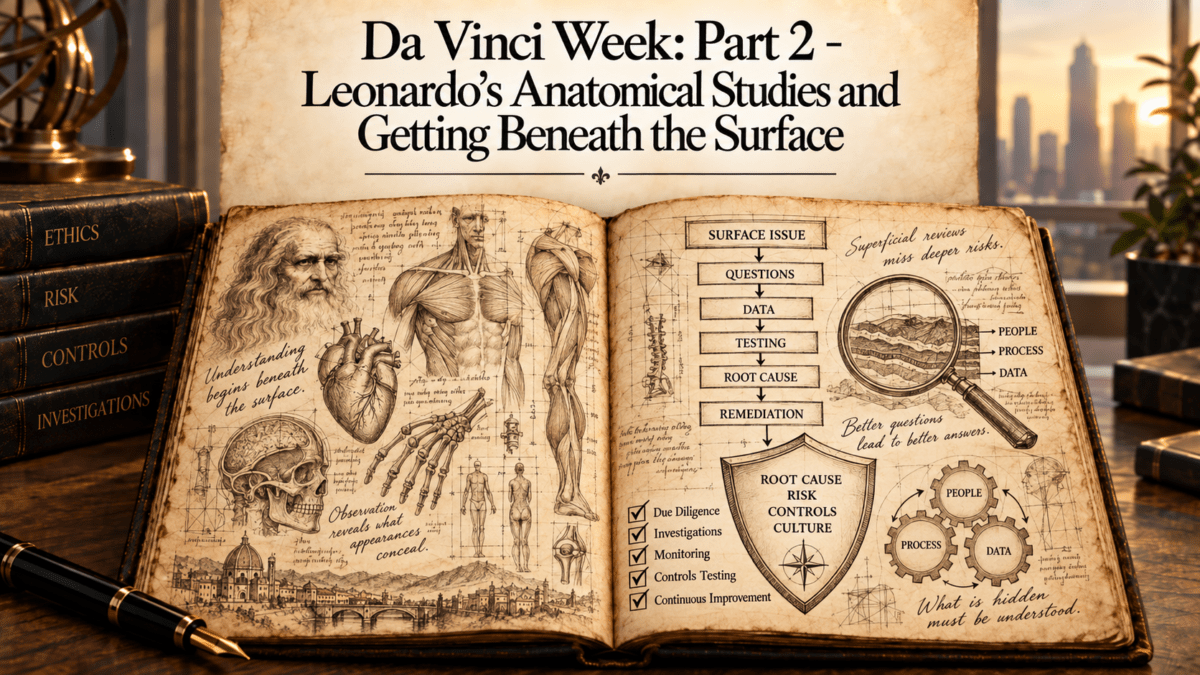
Da Vinci Week: Part 2 – Leonardo’s Anatomical Studies and Getting Beneath the Surface

In the first post in our Leonardo Compliance Framework, the Mona Lisa introduced Refine: the discipline of continuous improvement. An effective compliance program should learn from investigations, monitoring, risk assessments, employee feedback, control failures, and business changes. The program should evolve because the organization knows more today than it knew yesterday. That brings us to the second principle: investigate.

Leonardo was not satisfied with observing the human body from the outside. His anatomical studies examined muscles, bones, organs, movement, and the relationships among different parts of the body because he wanted to understand how the entire system worked. That provides a useful model for the modern Chief Compliance Officer because an effective corporate investigation should accomplish more than determine whether an employee violated a policy. It should help the organization understand why the conduct occurred, which controls failed, what incentives influenced behavior, whether management contributed to the problem, whether similar conditions exist elsewhere, and what should change as a result.

The compliance lesson from Leonardo is to look beneath the visible misconduct and understand the system that produced it.

An Investigation Is More Than a Search for Misconduct

Consider a familiar scenario. An investigation establishes that a sales employee used a consultant to make an improper payment to secure business. The company confirms the misconduct, terminates the employee and consultant, documents the findings, and closes the matter.

That process may answer the immediate legal and disciplinary questions, but it does not necessarily answer the larger compliance question. The company should also understand why it hired the consultant, how it approved the relationship, what due diligence it performed, whether it identified red flags, how it compensated the consultant, and how the resulting invoices and payments moved through the organization. Management should consider whether commercial incentives contributed to the conduct, whether supervisors encountered warning signs, and whether similar consultants are being used elsewhere.

If the company concludes only that one employee violated the anti-corruption policy, it may remove the individual while leaving intact the conditions that allowed the misconduct to occur. The investigation has then addressed the actor without addressing the vulnerability. That is why investigations should be viewed as a source of organizational intelligence.

Root Cause Should Drive Remediation

Root-cause analysis is where Leonardo’s anatomical method becomes particularly relevant. The objective is to move from the visible event to the systems underneath it. The Evaluation of Corporate Compliance Program (ECCP) states, “Finally, a hallmark of a compliance program that is working effectively in practice is the extent to which a company can conduct a thoughtful root.” It asks: What is the company’s root cause analysis of the misconduct at issue? Were any systemic issues identified? Who in the company was involved in making the analysis?

Root-cause analysis helps the company distinguish symptoms from causes, and that distinction should determine remediation. A response directed only at the visible misconduct may create the appearance of action without materially reducing the underlying risk.

This is also why significant investigations should test assumptions about the compliance program. If an intermediary engages in misconduct despite passing third-party due diligence, the company should examine whether the process missed information it reasonably could have identified. If an employee disguises improper payments, Compliance and Finance should understand how the relevant financial controls were circumvented. If retaliation occurs after an employee raises a concern, the organization should determine whether its anti-retaliation controls function in practice.

A well-designed compliance program can still experience misconduct. No reasonable system eliminates all risk. Effectiveness is measured by how the organization detects misconduct, responds, learns from failures, and strengthens the program when it identifies weaknesses.

Follow the Decision Trail

Investigators naturally follow evidence by reviewing documents, interviewing witnesses, analyzing transactions, and reconstructing events. Compliance investigations should also follow the decision trail because misconduct frequently passes through business processes designed to create accountability.

The investigation should identify who selected and approved a problematic third party, who authorized exceptions or unusual compensation, who approved payments, who received warnings, and who decided whether concerns warranted escalation. This becomes especially important when misconduct involves senior personnel, high performers, or commercially significant relationships.

The purpose is not to assign blame indiscriminately across every function connected to an incident. It is to understand where accountability actually resided and whether the people responsible for operating or supervising controls fulfilled those responsibilities.

A decision trail can reveal that misconduct was not simply the act of one individual. Other employees may have facilitated the conduct, ignored warning signs, approved questionable transactions, or failed to escalate information. Conversely, the evidence may demonstrate that established controls operated appropriately and that the individual deliberately circumvented them.

Organizational Justice Requires Consistency

Investigations also play a central role in corporate culture. Employees watch how organizations respond to allegations, particularly when cases involve senior executives or high-performing employees. They notice whether powerful people receive different treatment and whether employees who raise concerns suffer professional consequences. This makes consistency an important component of organizational justice, which the ECCP identifies as a part of every compliance program.

Consistency does not require identical outcomes. Facts, intent, responsibilities, prior conduct, cooperation, supervisory duties, and other legitimate considerations can justify different consequences. What matters is that the organization uses a credible process and applies its standards without creating privileged classes of employees.

Investigation governance is therefore important. The company should establish clear decision rights concerning whether allegations require investigation, who determines scope, who approves closure, how disciplinary decisions are made, when conflicts of interest require independent handling, and when matters involving senior executives should be escalated to the Audit Committee or board. These governance arrangements should be in place before a sensitive case arises.

Accountability should also extend beyond the individual who directly engaged in misconduct. Management behavior matters. A supervisor who ignored repeated warning signs, encouraged excessive risk-taking, approved unjustified exceptions, or created incentives that contributed to misconduct may raise separate accountability issues.

If employees see junior personnel disciplined while supervisors face no consequences for meaningful oversight failures, the company may signal that accountability flows only downward. Credible organizational justice requires a more consistent approach.

Investigation Data Is Enterprise Risk Intelligence

Individual investigations explain specific events. Aggregated investigation data can reveal enterprise-wide patterns, making it an important compliance asset. A CCO must understand which allegations recur, whether particular business units or managers appear repeatedly, where investigations are delayed, what root causes occur most often, whether similar control failures appear across jurisdictions, and whether employees who raise concerns subsequently experience unusual turnover or other adverse outcomes.

Those patterns can identify emerging risks that individual case files may not reveal. The data must be interpreted carefully. A business unit with a high number of hotline reports may have significant cultural problems, or it may have a healthy speak-up environment in which employees trust the reporting system. A location with few reports may have an excellent culture, or employees may fear retaliation.

Investigation data works best when combined with other information, including hotline trends, employee surveys, HR data, audit findings, transaction monitoring, exit interviews, and business knowledge. The objective is not simply to count cases but to use investigative information to understand the organization more effectively. This is the Leonardo approach in practice: observation combined with inquiry.

AI Changes the Investigation Function

Artificial intelligence is also changing corporate investigations. AI tools may assist with document review, chronology development, translation, pattern identification, data analysis, and summarization. Used appropriately, these capabilities may allow investigation teams to analyze larger volumes of information and identify relationships more efficiently.

They also create significant governance issues because investigations frequently involve some of the company’s most sensitive information. Before using AI, the organization should understand what data it will provide to the system, whether the material includes privileged, confidential, personal, or commercially sensitive information, where the data will be processed and retained, and what contractual and technical protections apply. Once again, the ECCP puts this onus on your compliance function.

Reliability is equally important. Investigators need a process to validate AI-assisted analysis and identify inaccurate or unsupported outputs. AI use should not obscure how a significant investigative conclusion was reached or prevent the company from explaining the evidence supporting its decision.

Human accountability should remain clear. AI can assist investigators, but it should not replace professional judgment concerning scope, credibility, findings, discipline, or remediation. The broader governance principles reflected in the NIST AI Risk Management Framework and ISO/IEC 42001 can help organizations think about risk management, human oversight, documentation, and monitoring. Still, the fundamental investigation requirements remain confidentiality, accuracy, fairness, privilege, and defensibility.

Connect Investigations to Remediation and Lessons Learned

Companies sometimes separate investigations and remediation too sharply. Legitimate reasons exist to maintain appropriate independence between fact-finding and certain management decisions, but the compliance program still needs a clear mechanism to convert investigative findings into corrective action.

For significant matters, management should understand what failed, why it failed, whether the weakness could exist elsewhere, what corrective action is required, who owns that action, and how the company will determine whether remediation worked. This turns an investigation from a historical examination into a forward-looking compliance tool. Without that connection, an organization can become highly proficient at investigating the same problem repeatedly without becoming better at preventing it.

Lessons learned should also travel beyond the specific business unit or jurisdiction involved. If an investigation in one market identifies improper distributor discounts caused partly by weak approval controls, the company should consider whether comparable controls exist elsewhere. If employees use personal messaging applications to circumvent company systems, management should assess whether the practice extends beyond the employees involved in the investigation. If an AI incident reveals that employees can deploy unapproved tools without effective technical restrictions, the organization should consider the broader governance implications.

This does not require distributing confidential investigative details throughout the company. It means converting case-specific findings into enterprise risk intelligence. Depending on the issue, the lesson may lead to changes in controls, risk assessments, monitoring, training, policies, management communications, or incentive structures. That is how Investigate feeds Refine.

What the Board Should Understand About Investigations

Boards and Audit Committees should resist evaluating the investigation function primarily through case counts. Knowing how many matters were opened and closed provides useful operational information, but it offers limited insight into program effectiveness.

Directors should understand what the company is learning from investigations. Significant themes, recurring root causes, internal control weaknesses, unusual patterns across business units, retaliation concerns, and the status and effectiveness of remediation all provide more meaningful information about compliance risk.

The board should also understand whether investigative resources match the company’s risk profile. Significant cases should not remain unresolved because the organization lacks appropriate staffing, cross-border expertise, data capabilities, employment-law support, or access to information. Matters involving senior personnel should be handled through processes designed to preserve independence and avoid conflicts.

The board does not need to manage individual investigations. Its role is to understand whether the investigation system provides reliable information about significant compliance risks and whether management responds appropriately to what that system reveals.

Getting Beneath the Surface

Leonardo’s anatomical studies give compliance professionals a useful model for investigations because the visible event may be only the first indication of a larger systemic issue. An improper payment may reveal a third-party weakness that exposes deficiencies in due diligence, technology, ownership, incentives, or management oversight.

The investigator’s task is to understand those connections without allowing every matter to become an unlimited enterprise-wide inquiry. Scope should remain proportionate to the seriousness, complexity, and potential reach of the issue. The objective is disciplined curiosity: understanding whether the evidence points to an isolated act or a broader weakness in the compliance system.

For the CCO, the practical lesson is that investigations should do more than establish whether a rule was violated. Significant matters should help the organization understand the controls, incentives, management decisions, and business conditions that contributed to the conduct. Root-cause analysis should drive remediation, investigation findings should test assumptions about program effectiveness, aggregated case data should inform enterprise risk assessment, and lessons learned should improve controls beyond the immediate matter.

That is Investigate, the second principle of the Leonardo Compliance Framework. Finding misconduct matters, but the greater compliance value comes from understanding the system that produced it and using that knowledge to reduce the likelihood of recurrence.

From Investigation to Innovation

Investigation helps the compliance professional understand how existing systems work and why they sometimes fail. Leonardo, however, was equally interested in systems that did not yet exist, which takes us to the third principle in the Leonardo Compliance Framework: Innovate.

In Blog Post Three, Leonardo’s Flying Machines and AI Governance, we will use Leonardo’s studies of flight to examine responsible innovation in 2026. Artificial intelligence and increasingly agentic technologies are moving from generating information to taking action within business processes, raising new questions about risk classification, human accountability, third-party AI, data governance, testing, monitoring, NIST AI RMF, and ISO/IEC 42001.

Leonardo’s willingness to imagine flight provides the innovation lesson. For the modern CCO, the corresponding governance task is ensuring the enterprise understands the risks, controls, and accountability needed before giving new technology meaningful authority inside the business.

Categories
Blog

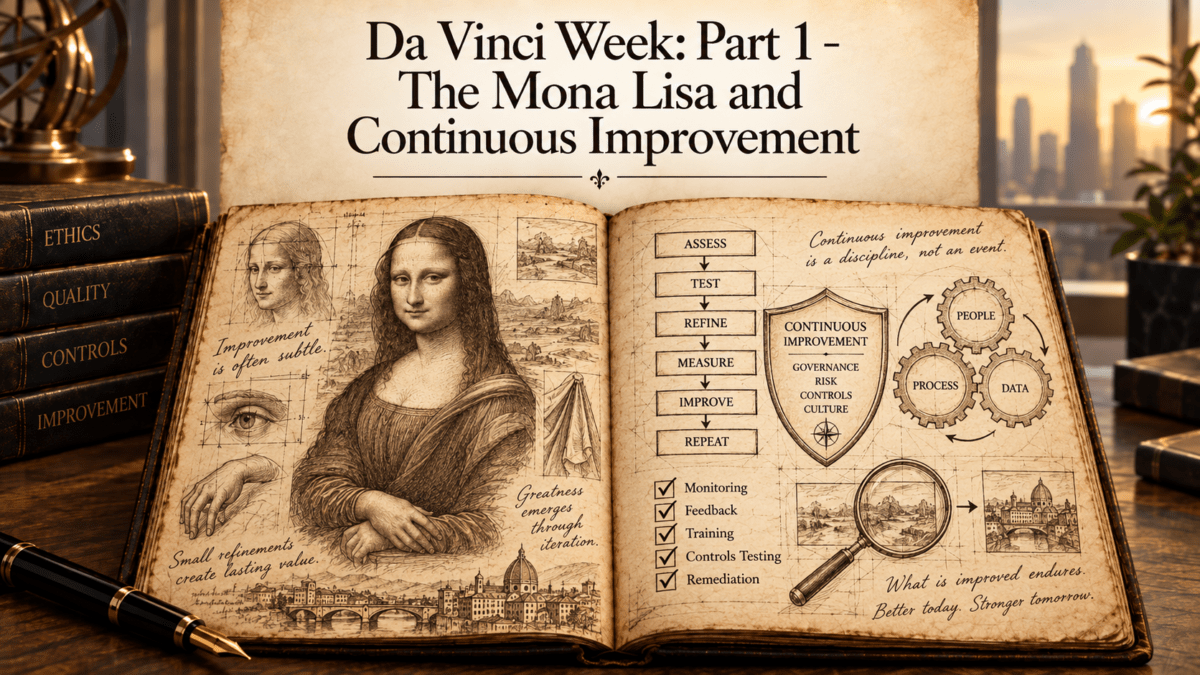
Da Vinci Week: Part 1 – The Mona Lisa and Continuous Improvement

I recently wrote a five-part blog series on compliance through Michelangelo’s lens. In our Michelangelo Compliance Framework, we used five extraordinary projects to explore five disciplines of the modern compliance function: Challenge, Execute, Defend, Build, and Govern. Michelangelo gave us a model of the compliance professional as a builder. His work showed the importance of structure, execution, resilience, accountability, and the ability to turn an ambitious vision into something enduring.

This week, I want to do the same through the lens of Leonardo da Vinci, who gives us a different model. Leonardo was an observer, investigator, experimenter, engineer, anatomist, artist, and relentless student of how things worked. Where Michelangelo offers lessons about building, Leonardo offers lessons about learning. That distinction underpins our five-part Leonardo Compliance Framework: Refine, Investigate, Innovate, Monitor, and Document. In this blog post 1, we begin with Refine and Leonardo’s most famous painting, the Mona Lisa.

The compliance lesson is continuous improvement. An effective compliance program is never truly finished because the business it supports is never truly static. Markets change. Employees change. Third parties change. Regulations change. Technology changes. Criminal methodologies change. Artificial intelligence is accelerating many of those changes simultaneously. For the Chief Compliance Officer (CCO) or compliance professional in 2026, the question is therefore not simply whether the company has a compliance program. The better question is whether the program is materially better today because of what the organization learned yesterday.

The Compliance Program Is Never Finished

One fascinating aspect of the Mona Lisa is Leonardo’s extended relationship with the work. He kept refining it as he developed his understanding of light, anatomy, optics, and human perception. That provides a useful metaphor for compliance because companies often approach compliance initiatives through the language of completion. Policies are issued, training is delivered, third-party systems are implemented, investigations are closed, remediation projects are completed, and risk assessments are presented to the board.

A policy issued three years ago may no longer address how the business operates. A successful third-party implementation may not account for changes in the company’s distribution model. A 100 percent training completion rate does not demonstrate that employees can apply the training when confronting an ethical problem. Closing a remediation item does not establish that the revised control reduced the underlying risk.

Leonardo offers a different approach. Completion should create an opportunity for observation and learning. Management should understand what worked, what did not work as expected, what changed in the business, and whether those lessons justify refinement of the program. That is continuous improvement.

Turn Compliance Failures Into Organizational Knowledge

The DOJ has made clear in the most recent iteration of the Evaluation of Corporate Compliance Programs (ECCP) that continuous improvement sits at the heart of modern expectations for compliance program effectiveness. A risk-based program should evolve as the company’s risks evolve, using risk assessments, investigations, audits, monitoring, employee feedback, transaction data, and lessons learned to inform changes. A company that identifies the same weakness year after year without changing its response has not created an effective learning system.

Leonardo’s approach to understanding the natural world was to look beneath the visible surface. Compliance professionals should apply the same discipline. Misconduct often signals a deeper weakness in the system, and root-cause analysis helps identify it and use the lesson to improve the program.

Risk Assessment Should Produce Management Action

The compliance risk assessment provides another important opportunity for refinement. Companies frequently devote substantial resources to identifying and ranking risks, producing a heat map, presenting the findings to management and the board, and repeating the process the following year.

Here the ECCP asks, “Is the risk assessment current and subject to periodic review?” Is the periodic review limited to a “snapshot” in time or based upon continuous access to operational data and information across functions? Has the periodic review led to updates in policies, procedures, and controls? Do these updates account for risks discovered through misconduct or other compliance program issues?

The principle applies to artificial intelligence. If AI adoption changes the company’s risk profile, the risk assessment should lead to governance action through measures such as an AI inventory, risk classification, approval processes, human oversight, monitoring, or technical controls.

A mature compliance program should be able to draw a line from an identified risk to a management decision. If the risk profile changes while resources, controls, monitoring, and governance remain unchanged, the risk assessment has generated information without generating action.

Use Data to Refine the Program

Leonardo was a relentless observer who recorded what he saw and used those observations to develop new ideas. Modern compliance functions possess an advantage he could scarcely have imagined: enormous quantities of organizational data.

Hotline information can reveal cultural patterns. Investigation data can identify recurring allegations and root causes. HR data may indicate retaliation. Transaction information can identify unusual payments. Third-party data can reveal concentrations of risk, while audit findings can identify recurring control weaknesses.

But these insights are not enough. Are these insights put into practice? The ECCP inquires: Does the company have a process for tracking and incorporating into its periodic risk assessment lessons learned either from the company’s own prior issues or from those of other companies operating in the same industry and/or geographical region?

Compliance analytics should not become a competition to create the most sophisticated dashboard. The objective is better decision-making. A business unit with very few hotline reports, for example, could have an excellent culture or an environment in which employees are reluctant to speak. The number alone does not tell the whole story.

Compliance should therefore combine quantitative information with qualitative evidence, including employee surveys, focus groups, exit interviews, investigations, management discussions, and audit findings. The objective is to understand what the data mean in the business context.

AI Accelerates the Need for Refinement

Artificial intelligence makes continuous improvement increasingly important because AI systems and their uses can change faster than traditional corporate governance cycles.

The ECCP asks companies to consider how emerging technologies such as AI affect their ability to comply with criminal laws, how related risks are incorporated into enterprise risk management, and how organizations mitigate unintended consequences and potential misuse. The ECCP asks some pointed questions: How does the company assess the potential impact of new technologies, such as artificial intelligence (AI), on its ability to comply with criminal laws? Is management of risks related to the use of AI and other new technologies integrated into broader enterprise risk management (ERM) strategies? What is the company’s governance approach to using new technologies such as AI in its commercial business and compliance program? The implication for the CCO is significant: AI risk cannot be treated as a once-a-year compliance exercise.

NIST’s AI Risk Management Framework and ISO/IEC 42001 provide useful approaches to this challenge because both emphasize governance and ongoing risk management. For the CCO, the broader lesson is that AI governance should operate as a management system rather than a policy-writing project. The organization needs to learn from incidents, testing, employee behavior, technological changes, and evolving business use, then adjust governance accordingly. The principle is the same as the Mona Lisa: refinement should follow learning.

Move the Board Conversation From Activity to Learning

Boards and Audit Committees can reinforce this discipline by shifting the compliance conversation. Compliance presentations frequently focus on activity metrics: employees trained, investigations closed, third parties reviewed, policies updated, and remediation items completed. These measures provide useful information about program operations, but they do not necessarily demonstrate effectiveness.

Directors should also understand what the organization learned during the reporting period, what investigations revealed about controls, what monitoring identified that management did not previously know, how the risk profile changed, and what the compliance function changed as a result.

The board should also understand whether those changes worked. This moves oversight from compliance activity to compliance effectiveness. It allows the CCO to present Compliance not simply as a collection of programs and controls but as a management system that identifies risk, learns from experience, and improves organizational decision-making.

The Mona Lisa Principle: Disciplined Refinement

Leonardo’s Mona Lisa gives the modern compliance professional a straightforward lesson about continuous improvement. An effective compliance program should develop through observation, evidence, learning, and a willingness to reconsider earlier decisions when circumstances justify change. The objective is not perpetual revision. It is disciplined refinement.

That distinction matters because continuous improvement can become counterproductive if it produces continuous disruption. Employees need stability, controls need sufficient time to operate, and management needs enough information to distinguish a meaningful trend from temporary noise. A compliance function that repeatedly changes policies, procedures, training, and controls without a clear risk-based rationale can create confusion rather than effectiveness.

Program refinement should therefore follow evidence. An investigation may reveal a systemic control weakness. Employee feedback may demonstrate that a policy is difficult to understand or apply. Monitoring may show that a control generates excessive false positives or is routinely circumvented. A regulatory development may require a different process, while an acquisition, new market, or technological change may materially alter the company’s risk profile. Artificial intelligence may introduce capabilities and risks that did not exist when the original governance structure was designed.

The CCO should have a disciplined process for converting those developments into program changes. Management should understand what triggered the proposed change, what risk it addresses, who owns implementation, and how the organization will determine whether the change produced the intended result. In this sense, continuous improvement should itself be governed.

A mature CCO should also be able to explain why today’s compliance program differs from the one the company operated two or three years ago. The answer should not simply be that policies were updated or new technology was purchased. The program should have changed because the organization learned something about its risks, controls, employees, third parties, culture, or business model and acted on that knowledge.

That is the central lesson of Refine, the first principle of the Leonardo Compliance Framework. Completion should not be confused with effectiveness. Root-cause analysis should produce program improvement, risk assessments should lead to management action, and data should help the organization understand what is happening rather than simply populate dashboards. When the evidence demonstrates that change is necessary, the organization should refine the program and then determine whether the refinement worked.

Leonardo models the compliance professional as a student of the organization. The CCO observes how the business operates, learns from failures and successes, and uses that knowledge to improve the compliance system. The measure of continuous improvement, therefore, is not how often the program changes. It is whether the program becomes more effective because the organization has learned.

From Refinement to Investigation

Continuous improvement depends upon understanding why problems occur. A company cannot meaningfully refine its compliance program if it treats each incident as an isolated act of employee misconduct. It must examine the systems, incentives, controls, management decisions, and behaviors that produced the outcome. That takes us to the second Leonardo principle: Investigate.

In Blog Post Two, we will consider Leonardo’s Anatomical Studies and will use Leonardo’s study of the human body as a framework for corporate investigations. Just as Leonardo looked beneath the surface to understand how interconnected systems functioned, modern compliance investigations should move beyond identifying misconduct to understanding its causes. We will examine how root-cause analysis connects investigations to remediation, why organizational justice matters, how investigation data can reveal systemic weaknesses, and what boards should understand when management reports that an investigation has been closed.