A new governance gap is emerging around artificial intelligence, and it is one that Chief Compliance Officers, compliance professionals, and boards need to confront now. It sits at the intersection of three areas that too many companies still treat separately: public disclosures, internal controls, and insurance coverage. That siloed approach is no longer sustainable.
As companies speak more confidently about their AI strategies, insurers are becoming more cautious about the risks those strategies create. That tension matters. It signals that the market is beginning to see something many organizations have not yet fully addressed: when a company’s statements about AI outpace its actual governance, the exposure is not merely operational or reputational. It can become a disclosure issue, a board oversight issue, and ultimately a proof-of-governance issue under the Department of Justice’s Evaluation of Corporate Compliance Programs (ECCP).
For the compliance professional, this is not simply an insurance story. It is a compliance integration story. The question is whether the company can align its statements about AI, the controls it has in place, and the protections it believes it has in place if something goes wrong.
The New Governance Gap
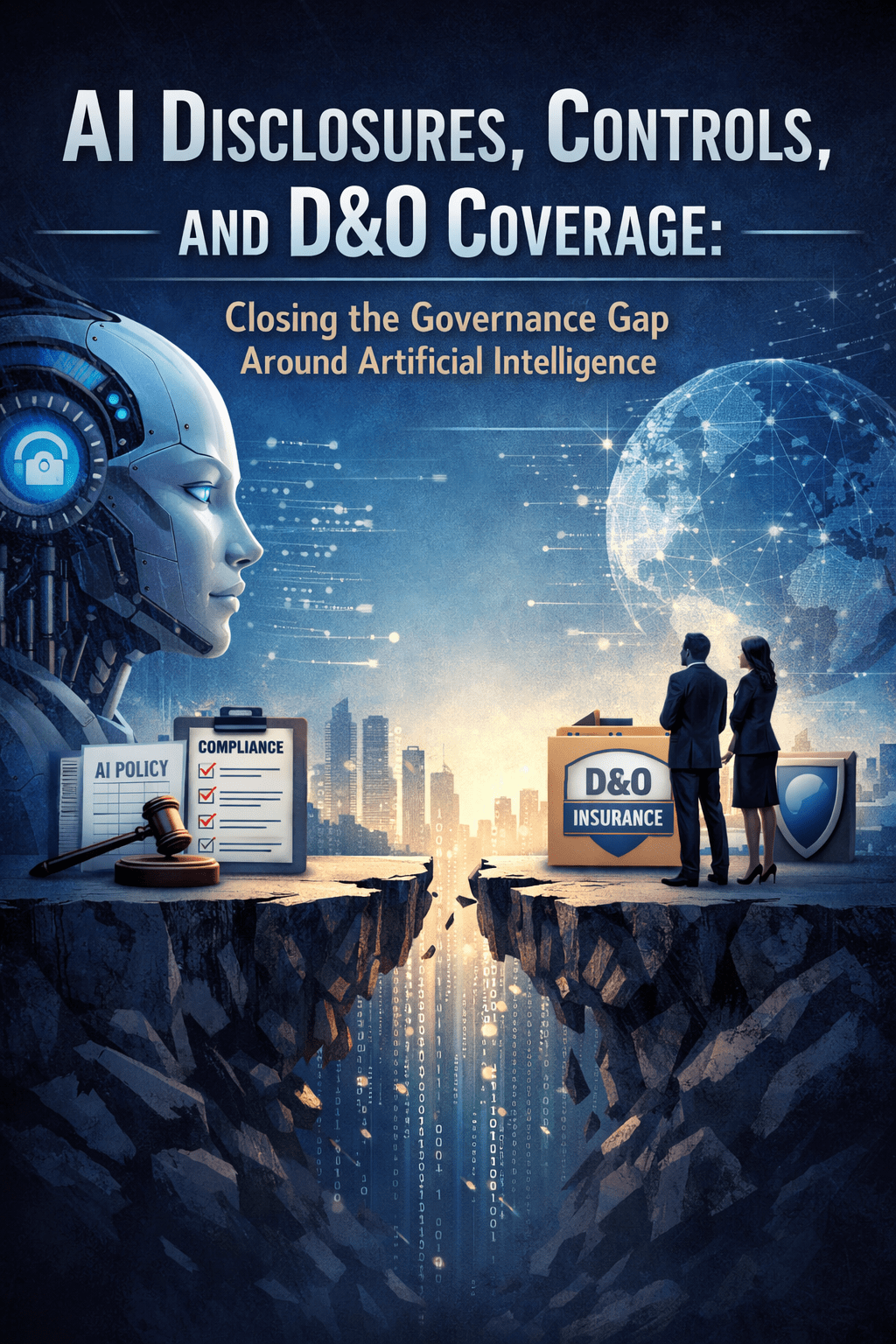
Many organizations are eager to describe AI as a source of innovation, efficiency, better decision-making, or competitive advantage. Those messages increasingly appear in earnings calls, investor decks, public filings, marketing materials, and board presentations. Yet the underlying governance structures often remain immature. That disconnect is the governance gap.
It appears when management speaks broadly about responsible AI but has not built a complete inventory of AI use cases. It appears when companies discuss oversight but cannot show testing, documentation, or monitoring. It appears that boards assume that insurance will respond to AI-related claims without understanding how new policy language may narrow coverage.
This is where D&O coverage becomes so important. It is not the center of the story, but it is a revealing signal. If insurers are revisiting policy language and introducing exclusions or limitations tied to AI-related conduct, it suggests the market sees governance risk. In other words, the insurance market is sending a message: AI-related claims are no longer hypothetical, and companies that cannot demonstrate disciplined oversight may find that risk transfer is less available than they assumed.
Why the ECCP Should Be the Primary Lens
The DOJ’s ECCP remains the most useful framework for analyzing this issue because it asks exactly the right questions.
Has the company conducted a risk assessment that accounts for emerging risks? Are policies and procedures aligned with actual business practice? Are controls working in practice? Is there proper oversight, accountability, and continuous improvement? Can the company demonstrate all of this with evidence? Those are compliance questions, but they are also the right AI governance questions.
If a company makes public statements about AI capability, oversight, or reliability, the ECCP lens requires more than aspiration. It requires substantiation. Can the company show who owns the AI risk? Can it demonstrate how models or systems are tested? Can it show escalation procedures when problems arise? Can it document how AI-related decisions are monitored, reviewed, and improved over time?
If the answer is no, then the issue is not simply that the company may have overpromised. The issue is that its compliance program may not be adequately addressing a material emerging risk. That is why CCOs should view AI as a cross-functional challenge requiring integration across legal, compliance, technology, risk, audit, investor relations, and the board.
AI Disclosure Must Be Evidence-Based
One of the most practical steps a compliance function can take is to push for an evidence-based disclosure process around AI. This means that public statements about AI should not be driven solely by enthusiasm, market pressure, or executive optimism. They should be grounded in underlying documentation. If the company says it uses AI responsibly, where is the governance framework? If it claims AI improves decision-making, what testing supports that assertion? If it says it has safeguards, where are the control descriptions, monitoring results, and escalation records?
This is not about suppressing innovation. It is about ensuring that disclosure discipline keeps pace with technological ambition. For boards, this means asking harder questions before approving or relying on public AI narratives. For compliance officers, it means helping management build the evidentiary record that turns broad statements into defensible representations.
Controls Must Catch Up to Strategy
This is where the “how-to” work begins. Compliance professionals should begin by creating a structured inventory of AI use cases across the enterprise. That inventory should identify where AI is being used, what decisions it informs, what data it relies on, who owns it, and what risks it entails.
Once that inventory exists, risk tiering should follow. Not every AI use case carries the same compliance significance. A low-risk productivity tool does not need the same oversight as a system that affects investigations, third-party due diligence, customer interactions, financial reporting, or core operational decisions.
From there, the company can design controls proportionate to risk. High-impact uses of AI should have documented governance, human review where appropriate, testing protocols, escalation triggers, and monitoring requirements. The compliance team should be able to answer a simple question: where are the controls, and how do we know they work? That is the heart of the ECCP inquiry.
Where NIST AI RMF and ISO/IEC 42001 Fit
This is also where the NIST AI Risk Management Framework and ISO/IEC 42001 become highly practical tools. NIST AI RMF helps organizations govern, map, measure, and manage AI risks. For compliance professionals, this provides a disciplined structure for identifying AI use cases, understanding impacts, assessing reliability, and managing response. It is especially useful in linking abstract AI risk to operational decision-making.
ISO/IEC 42001 brings management system discipline to AI governance. It focuses on defined roles, documented processes, control implementation, monitoring, internal review, and continual improvement. That makes it an excellent bridge between policy and execution. Together, these frameworks help operationalize the ECCP. The ECCP tells you what an effective compliance program should be able to demonstrate. NIST AI RMF helps structure the risk analysis. ISO 42001 helps embed those requirements into a repeatable governance process.
For CCOs, the practical lesson is clear: use these frameworks not as academic overlays, but as working tools to build ownership, documentation, testing, and accountability.
Insurance Is a Governance Input
Companies also need to stop treating insurance as an afterthought. D&O coverage should be considered a governance input, not merely a downstream purchase. If policy language is narrowing around AI-related claims, boards and compliance leaders need to understand what that means. What scenarios might raise disclosure-related allegations? Where is ambiguity in coverage? What assumptions has management made about protection that may no longer hold?
Compliance does not need to become an insurance specialist. But it does need to ensure that disclosure, governance, and risk transfer are aligned. If the company is making strong public claims about AI while carrying unexamined governance weaknesses and uncertain coverage, that is precisely the kind of mismatch that can trigger a crisis.
Closing the Gap Before It Becomes a Failure
The larger lesson is straightforward. AI governance is not simply about technology controls. It is about integration. It is about ensuring that what the company says, what it does, and what it can prove all line up. That is why the governance gap matters so much. It is the space where strategy outruns structure, where disclosure outruns evidence, and where confidence outruns control. For boards and compliance professionals, the task is to close that gap before it becomes a failure.
The companies that do this well will not necessarily be the ones moving the fastest. They will be the ones building documented, tested, monitored, and governed AI programs that stand up to regulatory scrutiny, investor pressure, and real-world disruption. That is not bureaucracy. That is the price of sustainable innovation.