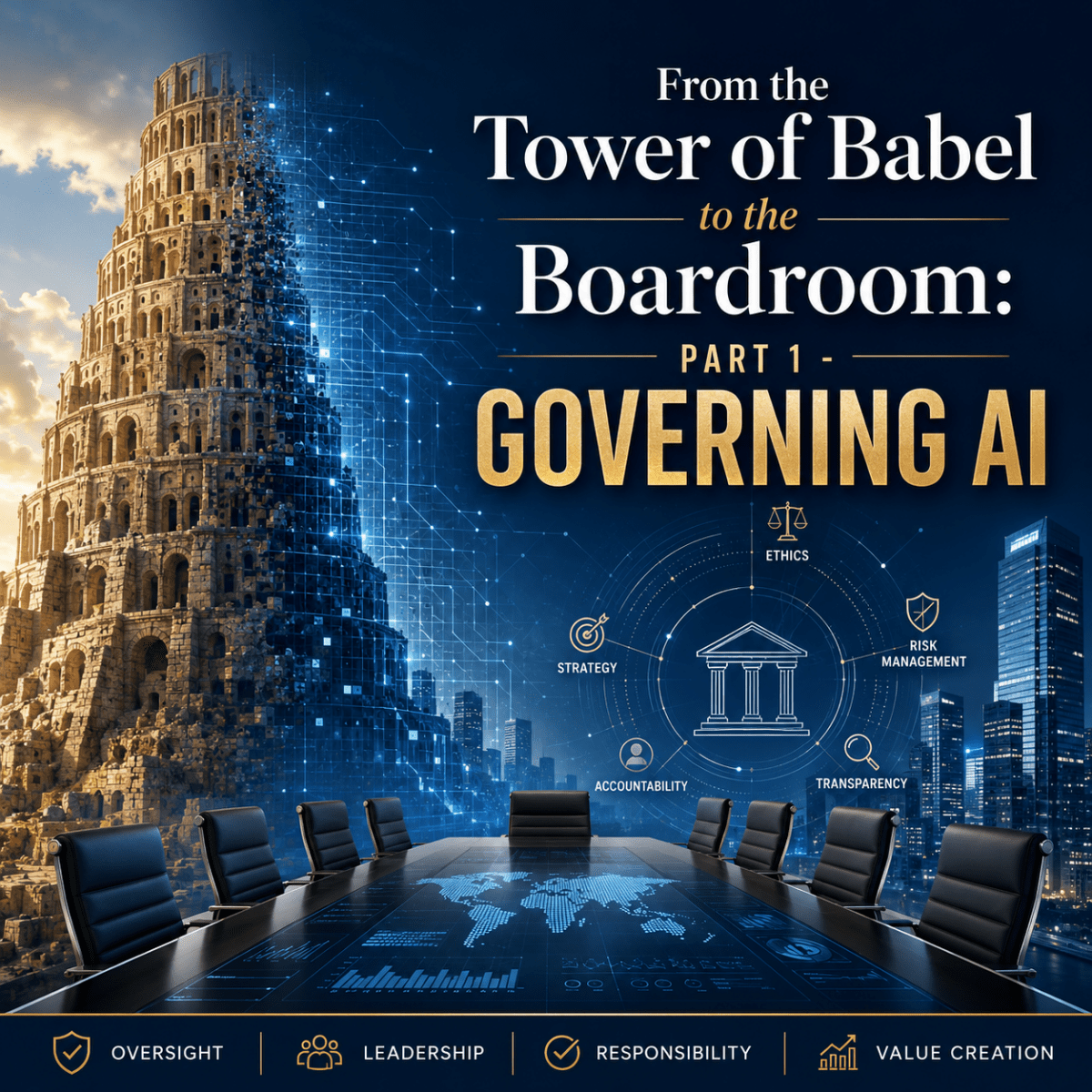
Artificial intelligence is no longer a future issue for boards, CEOs, general counsel, chief compliance officers, audit leaders, or risk professionals. It is already inside the enterprise. It is in employee workflows, vendor platforms, data analytics, customer engagement, monitoring tools, investigations support, training design, due diligence, and decision-making processes. The compliance question is no longer whether the company will use AI. The real question is whether the company will govern AI before AI becomes embedded into the business without accountability, transparency, controls, or human judgment.
That is the danger of the modern Tower of Babel. Babel was not a failure of engineering. It was a failure of purpose, humility, and governance. It was a project built on power without accountability and ambition without restraint. For modern corporations, ungoverned AI can become a similar project. It may promise efficiency, scale, speed, and competitive advantage. Yet without proper governance, it can also produce bias, opacity, data misuse, weakened accountability, employee overreliance, vendor risk, and board blind spots.
What Is Magnifica Humanitas?
Magnifica Humanitas is an Encyclical Letter issued by Pope Leo XIV on May 15, 2026, titled “On Safeguarding the Human Person in the Time of Artificial Intelligence.” (Magnifica Humanitas herein). The document places AI within the long tradition of Catholic social teaching and asks how humanity should respond to the “new things” of the digital age. Pope Leo frames AI not as a narrow technology issue but as a profound question about human dignity, work, truth, freedom, power, data, social justice, and the common good. The letter opens with two biblical images, the Tower of Babel and the rebuilding of Jerusalem under Nehemiah, to present the central choice of the AI age: will we construct systems of domination, or will we build communities of shared responsibility? (Magnifica Humanitas, paras. 1, 7-10).
The significance of Pope Leo issuing Magnifica Humanitas is that he places AI in the same broad moral and social category as prior industrial and economic disruptions. He expressly connects the document to the legacy of Pope Leo XIII and Rerum Novarum, the 1891 encyclical that responded to the labor, capital, and social disruptions of the industrial age. Pope Leo writes that digitalization, AI, and robotics are rapidly transforming the world, shaping decision-making and affecting both human dignity and the common good (Magnifica Humanitas, paras. 3-4). For this five-part series, we will use Magnifica Humanitas as the foundation for translating its core concepts into practical lessons for the modern compliance professional, the board, and the executive leadership team. This will not be a theological series. It will be a governance series. We will apply the moral force of the Encyclical Letter to compliance program design, board oversight, internal controls, data governance, third-party risk, workforce transformation, and corporate trust.
The Compliance Lesson of Babel
The Tower of Babel is a powerful compliance metaphor because it shows what happens when a project has capability but lacks discipline. Pope Leo describes Babel as an impressive feat with “a single language, a single technology, a single direction,” yet one that sacrificed human dignity for efficiency and sought power through self-sufficiency (Magnifica Humanitas, para. 7). In corporate language, Babel is the business transformation project that mistakes technical capability for good governance.
Pope Leo’s warning is direct: technology is never neutral because it takes on the characteristics of those who design, finance, regulate, and use it (Magnifica Humanitas, para. 9). That sentence should sit in every boardroom AI discussion. AI is not neutral in the compliance sense either. It reflects data, design, deployment, vendor, incentive, and governance choices. The first board question is therefore simple: What are we building?
Nehemiah as the Governance Model
If Babel is the warning, Nehemiah is the governance model. In Magnifica Humanitas, Pope Leo contrasts Babel with the rebuilding of Jerusalem. Nehemiah listens, inspects the damage, assigns responsibility, coordinates work, addresses opposition, and rebuilds section by section. The city is reborn through shared responsibility, not through the initiative of a single person (Magnifica Humanitas, para. 8).
That is the model compliance professionals should bring to AI governance. The CCO does not need to become a data scientist. The board does not need to manage model architecture. But the organization needs a disciplined governance structure that brings together compliance, legal, privacy, cybersecurity, IT, HR, internal audit, procurement, finance, and the business. AI governance cannot sit in a silo. It must be cross-functional because AI risk is cross-functional.
For compliance, that means asking practical questions. Where is AI being used? What problem is it solving? What data does it access? Who approved it? What risks were identified? What controls were designed? What human review is required? What could go wrong? How would we know? Who is accountable if the AI produces a harmful or unlawful result? Those are not anti-innovation questions. They are business discipline questions.
From Encyclical Principle to Corporate Governance Requirement
The bridge from Magnifica Humanitas to corporate governance is straightforward. Human dignity becomes a human impact assessment. The common good becomes enterprise risk governance and stakeholder impact. Subsidiarity becomes cross-functional governance, meaningful participation, and decision-making as close as possible to the affected process. Transparency becomes documentation, explainability, board reporting, and auditability. Accountability includes named owners, escalation rights, challenge mechanisms, and remediation.
Pope Leo makes this bridge explicit when he calls for responsible planning, human and social impact assessment, inclusion of the vulnerable, digital literacy, and guiding research and industry toward justice and peace (Magnifica Humanitas, para. 14). He also warns that control over platforms, infrastructure, data, and computing power can become opaque and evade oversight, producing dependency, exclusion, manipulation, and inequality (Magnifica Humanitas, para. 95). For the CCO and the board, that is the language of AI inventory, data governance, vendor management, access controls, model oversight, incident response, and internal audit testing. That is not only a moral framework. It is a corporate governance requirement.
AI Governance and the DOJ ECCP
The Department of Justice has already made AI a compliance program issue. The logic now runs together. Pope Leo provides the mandate for moral governance. The DOJ Evaluation of Corporate Compliance Programs (ECCP) supplies the compliance program test. The ECCP asks whether companies have a process for identifying and managing emerging risks, including risks related to new technologies such as AI; whether AI risk is integrated into enterprise risk management; how AI is governed in the business and in the compliance program; whether controls monitor trustworthiness and reliability; whether AI is limited to intended uses; what human decision-making baseline exists; how accountability is enforced; and how employees are trained.
That is a roadmap for the CCO. AI governance should be part of the compliance risk assessment. It should be reflected in policies and procedures. It should include training and communications. It should be monitored, audited, and improved. It should generate evidence. The company should be able to show not only that it has an AI policy but also that the policy has an operational effect. In other words, AI governance must move from aspiration to controls.
Board Oversight and Caremark
For boards, AI governance also raises Caremark oversight considerations. Directors are not expected to run the company’s AI systems. They are expected to make a good-faith effort to ensure that reasonable reporting and monitoring systems are in place for central compliance risks. In Marchand v. Barnhill (Bluebell Ice Cream), the Delaware Supreme Court emphasized that boards must make a good-faith effort to put in place a reasonable board-level system of monitoring and reporting around central compliance risks.
The board obligation is not technical mastery. It is a reporting and monitoring system that shows management has responded to the Encyclical’s accountability mandate. If Pope Leo requires that responsibility be defined, decisions be justified, systems be monitored, harms be challenged, and errors be remedied (Magnifica Humanitas, para. 105), then the board must ask whether management has built a governance system capable of producing that evidence. The board does not need technical comfort. It needs governance confidence.
Human Primacy as a Control
One of the most important lessons from Magnifica Humanitas is that AI is a tool, not a moral actor. Pope Leo explains that AI systems may imitate language, analysis, behavior, and even empathy, but they do not possess lived experience, conscience, wisdom, moral responsibility, or the capacity to understand what they produce (Magnifica Humanitas, para. 99). That matters deeply when AI affects employment, reputation, access, rights, opportunities, or treatment.
For compliance professionals, human primacy must be designed into AI governance. Human review is not a bureaucratic obstacle. It is a control. Pope Leo warns that sensitive decisions concerning employment, credit, access to services, and reputational risk are being delegated to automated systems that lack compassion, mercy, forgiveness, or the hope that people can change (Magnifica Humanitas, para. 102). The company should decide which AI outputs can be used automatically, which require review, which require escalation, and which uses should be prohibited altogether. The more consequential the decision, the stronger the human oversight must be.
5 Lessons for the CCO
- Treat AI as a human dignity and compliance risk. AI should be included in the compliance risk assessment, enterprise risk management process, and board reporting because it can affect rights, opportunities, status, freedom, privacy, and trust.
- Build an AI inventory because governance begins with visibility. The company cannot govern what it cannot see. The inventory should include business tools, vendor tools, embedded AI, compliance tools, and employee use of public AI.
- Require controls before scale because technology is never neutral. AI policies must be supported by approval processes, data controls, access controls, monitoring, testing, escalation, and remediation.
- Preserve human judgment because accountability cannot be outsourced. Human review should be required for high-risk and consequential decisions. Accountability must remain with people, not systems.
- Give the board evidence because governance requires reporting, monitoring, and remediation. Boards need dashboards, metrics, incident reporting, audit findings, risk rankings, and documentation that AI governance is working.
Conclusion: From Babel to Compliance Program Design
The lesson of Babel is not that building is wrong. The lesson is that building without humility, accountability, and purpose leads to fracture. AI is here to stay, and compliance professionals should embrace its promise. AI can improve monitoring, strengthen risk analysis, support investigations, enhance training, and identify patterns that humans might miss. But it must be governed with vigilance, responsibility, transparency, and human primacy.
Magnifica Humanitas gives us the mandate for moral governance. The ECCP gives us the compliance program questions. Caremark gives boards the oversight framework. Together, they point to the same conclusion: AI governance must be built before AI risk becomes unmanageable.
In the next post, we will move from principle to program design. We will examine why AI governance is a compliance program issue, how the CCO should help structure AI oversight, and how compliance can use AI responsibly while governing the risks AI creates.