Categories
Blog

Jessica Czeczuga on the Crucial Role of Board Oversight in Compliance Training and Communications

I recently had the opportunity to visit with folks from Diligent. We look down the road at key issues in 2024 in a podcast series sponsored by Diligent entitled Compliance professionals adapting to change: Industries, Regulations, and Beyond. I was able to chat with Nicholas Latham, Renee Murphy, Jessica Czeczuga, Yee Chow, and Alexander Cotoia. Over this series, we discussed compliance communications in regulated industries, managing conflicts of interest at the board level, the board’s role in compliance training and communications, navigating the current ESG landscape, and professional growth and mentorship in compliance. In this post, we discuss the role of the Board of Directors in compliance training and communications with Jessica Czeczuga.

Jessica, the Principal Instructional Designer at Diligent, emphasized the need for the board to underscore the importance of compliance, communication, and training and to provide messaging to employees that reinforces the significance of completing training. One of the key takeaways from the episode was the idea that the board sets the tone at the top. The board’s priorities are seen as priorities by the rest of the organization. By prioritizing compliance, communication, and training, the board can foster a culture of compliance and ensure that employees understand the importance of these initiatives.

Jessica also suggested that boards should consider providing messaging directly to the general population of their organization, highlighting the importance of completing training. This can help drive the messaging deeper into the organization and ensure that employees understand the significance of their training obligations.

We also discussed the need for boards to assess the effectiveness of training programs, particularly in multinational corporations. Computer access and language barriers should be considered when evaluating training effectiveness. By understanding employees’ challenges in different regions, the board can make informed decisions about training programs and ensure that they are effective and accessible to all employees.

Regarding board oversight of training, there are tradeoffs and challenges to consider. On one hand, the board must clearly understand the compliance program and what is required to support it. This may involve requesting additional metrics and information from the individuals responsible for training. The board can provide better oversight and support by having a deeper understanding of the program.

On the other hand, the board needs to strike a balance between oversight and micromanagement. Boards should trust the individuals responsible for training and compliance to do their jobs effectively. Micromanaging can hinder the effectiveness of training programs and create unnecessary bureaucracy.

We highlighted the importance of board oversight in corporate training and compliance. The board is crucial in driving compliance and training messaging throughout the organization. By setting the tone at the top and emphasizing the importance of compliance, communication, and training, the board can foster a culture of compliance. Additionally, the board should assess the effectiveness of training programs, considering factors such as computer access and language barriers. Balancing oversight and trust is essential for effective board oversight of training and compliance.

Ready for Purpose-Driven Compliance? Diligent equips leaders with the tools to build, monitor, and maintain an open, transparent ethics and compliance culture. For more information and to book a demo, visit Diligent.com

Join us tomorrow as we consider navigating the current ESG landscape.

Categories
31 Days to More Effective Compliance Programs

One Month to a More Effective Compliance Program Through Data Analytics – Day 8 – Data Democratization

In the world of compliance, data analysis plays a crucial role in identifying risks, making informed decisions, and ensuring legal and regulatory compliance. It enables companies to make fact-based decisions and mitigate risks effectively. By leveraging AI, organizations can identify high-risk payments and reduce investigation costs. This not only saves time and resources but also ensures that compliance teams can present risk in a timely and data-driven manner. We previously noted that it is not simply about having the data but also accessing it and then using it.

A key in this process is the implementation of data warehouses and cloud data warehousing solutions. The goal is to eliminate data silos and enable easy data access and analysis. By implementing a modern data stack, companies centralize their data, making it compliance-friendly as mandated by the DOJ (in the 2020 Evaluation of Corporate Compliance Programs) and more generally accessible to employees across the organization.

AI-driven data analysis and compliance solutions are revolutionizing the way organizations approach compliance and data utilization. By leveraging AI technology, these companies enable businesses to make fact-based decisions, identify risks, and ensure regulatory compliance. Investing in data governance and business intelligence tools is crucial for extracting value from data and driving business success. With the democratization of data access, organizations can empower employees to be data-informed and achieve greater efficiency.

 Three key takeaways:

  1. Data analysis is not simply about having the data but also accessing it and then using it.
  2. Data democratization recognizes that effective data utilization is linked to compliance and good business practices.
  3. With the democratization of data access, organizations can empower employees to be data-informed and achieve greater business efficiencies.

For more on KonaAI, click here.

Categories
Innovation in Compliance

Compliance Professionals Adapting to Change: Industries, Regulations, and Beyond: Part 2 – Renee Murphy on Managing Conflicts at the Board

Welcome to a special series sponsored by Diligent, where we look down the road at key issues in 2024 and beyond. In this series, I will visit with Nicholas Latham, Renee Murphy, Jessica Czeczuga, Yee Chow, and Alexander Cotoia. Over this series, we will consider compliant communications in regulated industries, managing conflicts of interest at the Board level, the Board’s role in compliance training and communications, navigating the current ESG landscape, and professional growth and mentorship in compliance. Part 2 considers how an organization can manage conflicts of interest with Renee Murphy on the Board of Directors.

Renee Murphy has a rich compliance, governance, and risk management background. Having served as both an internal and external auditor and currently the Chief Evangelist of Diligent, she brings a unique perspective to managing board-level conflicts of interest and implementing ESG practices. Renee believes that conflicts of interest at the board level can have serious implications and emphasizes the importance of identifying and addressing these conflicts to prevent financial misconduct. She also advocates that boards prioritize disclosing their ESG practices and carbon emissions, as stakeholders will increasingly demand this. Her expertise and insights are shaped by her diverse experiences, including her role as a lead analyst at Forrester Research and her work with Fortune 500 companies. Join Tom Fox and Renee Murphy as they delve deeper into these topics on the next episode of the Diligent Podcast.

Key Highlights:

  • Board Members Sitting on Multiple Boards
  • Conflicts of Interest at the Board Level
  • ESG Reporting for Long-Term Risk Management
  • The Role of Compliance in Board Governance

Ready for Purpose-Driven Compliance? Diligent equips leaders with the tools to build, monitor, and maintain an open, transparent ethics and compliance culture. For more information and to book a demo, visit Diligent.com

Join us tomorrow as we consider the role of the Board of Directors in compliance training, messaging, and communications.

Categories
Data Driven Compliance

Data Driven Compliance: Jim Dawson on Data Driven Compliance in Pharma

Are you struggling to keep up with the ever-changing compliance programs in your business? Look no further than the award-winning Data-Driven Compliance podcast, hosted by Tom Fox, this podcast features an in-depth conversation around the uses of data and data analytics in compliance programs. Data-Driven Compliance is back with another exciting episode. Today, I visited with James Dawson, Chief Compliance Officer at Qordata on using data-driven compliance in the pharmaceutical arena.

Jim Dawson is a seasoned professional with a robust background in sales, pharmaceutical sales, and compliance. He currently serves as the vice president of Compliance Solutions at Core Data, where he plays a crucial role in the development of compliance solutions. Dawson’s perspective on “data-driven compliance in pharmaceutical companies” is that data is a vital tool for improving compliance programs and preventing potential issues. He emphasizes the importance of data analysis to identify patterns and behaviors that may indicate potential compliance risks and believes in the power of predictive analytics to proactively implement controls. Dawson also underscores the significance of data in state price transparency reporting and auditability. He sees data as a valuable tool for monitoring, assessing, and improving compliance programs in pharmaceutical companies. Join Tom Fox and Jim Dawson on this episode of Data Driven Compliance to learn more about his insights and experiences.

Highlights Include:

  • Enhancing Compliance Programs with Data Analysis
  • Monitoring and Justifying Pharmaceutical Price Increases
  • Increased Scrutiny of Physician Payments and Compliance
  • Managing Conflicts of Interest in Pharmaceutical Companies

Resources:

Jim Dawson on LinkedIn

Qordata

 Tom Fox 

Connect with me on the following sites:

Instagram

Facebook

YouTube

Twitter

LinkedIn

Categories
Daily Compliance News

Daily Compliance News: December 12, 2023 – The WFH Winners and Losers Edition

Welcome to the Daily Compliance News. Each day, Tom Fox, the Voice of Compliance, brings you compliance-related stories to start your day. Sit back, enjoy a cup of morning coffee, and listen to the Daily Compliance News. all from the Compliance Podcast Network. Each day we consider four stories from the business world: compliance, ethics, risk management, leadership, or general interest for the compliance professional.

Stories we are following in today’s edition:

  • The Pope says to be merciful about Vatican corruption. (The Pillar)
  • Major oil producers scuttle COP28. (FT)
  • Winners and Losers in WFH. (WSJ)
  • The State Department aids in the fight against corruption. (DoS Press Release)
Categories
Blog

Renee Murphy on Risks and Consequences of Board Level Conflicts of Interest

I recently had the opportunity to visit with folks from Diligent. We look down the road at key issues in 2024 in a podcast series sponsored by Diligent entitled Compliance Professionals Adapting to Change: Industries, Regulations, and Beyond. I could chat with Nicholas Latham, Renee Murphy, Jessica Czeczuga, Yee Chow, and Alexander Cotoia. Over this series, we discussed compliance communications in regulated industries, managing conflicts of interest at the Board level, the Board’s role in compliance training and communications, navigating the current ESG landscape, and professional growth and mentorship in compliance. In this Post 2, we discuss the conflicts of interest at the Board of Directors and the Board’s role at the ESG level with Renee Murphy.

Conflicts of interest at the board level can have serious implications for companies, requiring careful management and proactive measures to ensure ethical functioning. Board-level conflicts of interest can arise when board members sit on multiple boards or engage in self-dealing. These conflicts can lead to questions of fairness and potential harm to the company. For example, a CEO whose time is divided among multiple companies may not be able to provide fair attention to each organization, creating a conflict of interest for shareholders. Additionally, self-dealing at the board level, such as funneling company funds to entities owned by board members, can harm the company’s financial health.

To mitigate these conflicts, board members should establish clear boundaries and implement board management software for transparency and accountability. This software enables effective communication and decision-making, allowing boards to address conflicts promptly and ensure ethical operations. Compliance and risk management officials play a vital role in board governance by providing the board with an understanding of legal and regulatory risks and preventing conflicts of interest. These officials enable efficient risk management and compliance processes by utilizing governance software.

The implementation of ESG practices is another crucial aspect of board governance. ESG considers environmental, social, and governance factors in business operations. Companies are advised to select a framework and start disclosing their ESG information. Failure to do so can hinder access to capital and affect long-term risk management. While ESG practices are not currently mandated by the SEC, they are increasingly demanded by banks, customers, and third parties. Therefore, companies have no choice but to disclose their ESG practices to meet stakeholder expectations.

Balancing board-level conflicts of interest and ESG practices involves tradeoffs and challenges. On one hand, addressing conflicts of interest requires strict oversight and accountability to ensure fair decision-making. On the other hand, implementing ESG practices requires companies to consider their environmental and social impact, which may involve additional costs and changes to existing operations. Finding the right balance between these factors is crucial for organizations to maintain ethical operations while meeting stakeholder expectations.

The importance of considering the impact on decision-making cannot be overstated. Conflicts of interest and the lack of ESG practices can lead to financial losses, reputational damage, and legal consequences. By proactively managing conflicts and implementing ESG practices, companies can enhance their long-term sustainability and mitigate risks. Compliance and risk management officials and board members play a pivotal role in ensuring that ethical considerations are prioritized in decision-making processes.

Managing board-level conflicts of interest and implementing ESG practices are critical aspects of board governance. Companies can enhance transparency, accountability, and ethical functioning by establishing clear boundaries, utilizing board management software, and disclosing ESG information. Balancing these factors involves tradeoffs and challenges, but the impact on decision-making and the long-term success of organizations cannot be ignored. With the guidance of compliance and risk management officials, boards can navigate these complexities and ensure ethical operations for the benefit of all stakeholders.

Ready for Purpose-Driven Compliance? Diligent equips leaders with the tools to build, monitor, and maintain an open, transparent ethics and compliance culture. For more information and to book a demo, visit Diligent.com

Join us tomorrow as we consider the role of the Board of Directors in compliance training and communications.

Categories
31 Days to More Effective Compliance Programs

One Month to a More Effective Compliance Program Through Data Analytics: Day 7 – From Cutting Edge to Table Stakes

Compliance programs play a crucial role in ensuring that companies adhere to legal and ethical standards. In today’s digital age, where data is abundant and easily accessible, the importance of data-driven compliance programs cannot be overstated. This message was driven home very forcefully in a speech in November by Nicole Argentieri, acting assistant attorney general for the Criminal Division.

Anselmo Guevara, manager at VMware, has emphasized the need for companies to have a compliance program that provides visibility into their data at their fingertips. It is no longer sufficient to simply collect data and have someone review and reconcile it. Compliance professionals must actively analyze the data for trends, anomalies, and potential compliance risks. This proactive approach allows companies to identify and address compliance issues before they escalate.

Data-driven compliance programs have moved from cutting-edge and are now seen as best practices. Soon they will simply be table stakes for companies to effectively manage compliance risks. By actively monitoring and analyzing data, companies can identify potential compliance issues, mitigate risks, and maintain their reputation and integrity. Collaboration between different departments and a formal risk assessment are key factors in establishing a robust compliance program. As technology continues to advance, the role of data analytics and AI in compliance monitoring is expected to become even more significant. Compliance professionals must stay informed, continuously learn, and adapt to the evolving landscape of data-driven compliance.

 Three key takeaways:

1. Nicole Argentieri, acting assistant attorney general for the Criminal Division, said,  “Let me be the first to tell you that we have proactively used data to generate FCPA cases, and we’ve only just gotten started.”

2. . Compliance professionals must actively analyze the data for trends, anomalies, and potential compliance risks.

3. Data-driven compliance programs have moved from cutting-edge and are now seen as best practices. Soon they will simply be table stakes for companies to effectively manage compliance risks.

Categories
Innovation in Compliance

Compliance Professionals Adapting to Change: Industries, Regulations, and Beyond: Part 1 – Nicholas Latham on Compliant Communications

Welcome to a special series sponsored by Diligent, where we look down the road at key issues in 2024 and beyond. In this series, I will visit with Nicholas Latham, Renee Murphy, Jessica Czeczuga, Yee Chow, and Alexander Cotoia. Over this series, we will consider compliant communications in regulated industries, managing conflicts of interest at the Board level, the Board’s role in compliance training and communications, navigating the current ESG landscape, and professional growth and mentorship in compliance. In this Part 1, we consider compliant communications in regulated industries with Nicholas Latham.

Nicholas Latham is an accounting professional with a strong accounting and risk management background, currently serving as a Client Partner at Diligent Corporation. His perspective on accounting and risk assessment is shaped by his extensive experience in the financial industry, particularly in the collections department of a US bank. Nicholas believes that organizations must implement and adapt frameworks such as COSO and ISO 31,000 to manage and mitigate risks effectively. He also emphasizes the need for a holistic view of risk and control across the entire organization rather than siloed departments, and he believes these frameworks can help provide a comprehensive understanding of the organization’s risk landscape. Join Tom Fox and Nicholas Latham on this episode of the Diligent Podcast as they delve deeper into Latham’s expertise in governmental accounting and risk assessment.

Key Highlights:

  • Risk and Control Expertise in Professional Background
  • Assessing and Mitigating Risk in Organizations
  • Holistic View of Organizational Operations and Risk

Ready for Purpose-Driven Compliance? Diligent equips leaders with the tools to build, monitor, and maintain an open, transparent ethics and compliance culture. For more information and to book a demo, visit Diligent.com

Join us tomorrow, where we will consider managing conflicts of interest at the Board of Directors.

Categories
Principled Podcast

Principled Podcast – S10E14: How can businesses approach AI in an ethical way?

What you’ll learn on this podcast episode

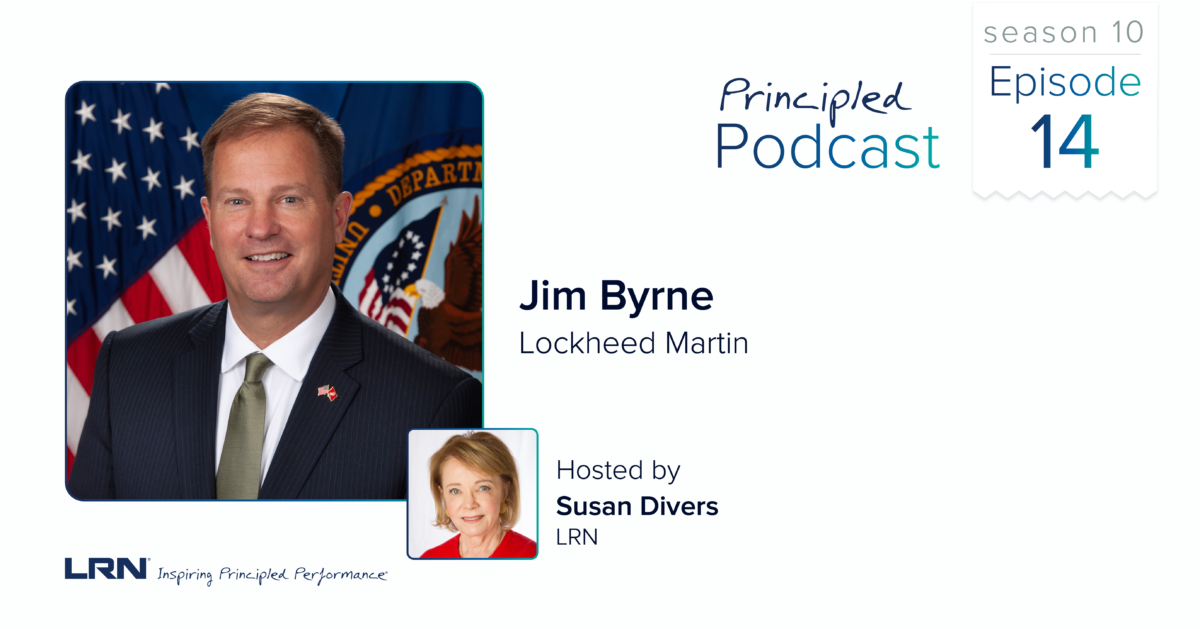
Artificial intelligence has become the topic du jour—from national news outlets to trade publications. The very term can elicit feelings of uncertainty and dissonance about how it will be applied in our daily lives. One thing is certain: AI will transform the way we do business. With such innovative technology comes the responsibility to use it wisely and ethically. In this episode of the Principled Podcast, host Susan Divers discusses how organizations can approach AI in a responsible and ethical way with Jim Byrne, the vice president for ethics and business conduct at Lockheed Martin.

Guest: Jim Byrne
Jim Byrne – Grayscale

The Honorable James M. Byrne currently serves as Vice President, Ethics and Business Conduct, for Lockheed Martin Corporation. He is responsible for the strategic direction and operational excellence of Lockheed Martin’s award-winning domestic and international ethics program and execution of the Corporation’s compliance training across the enterprise. Jim is also on the Corporate Artificial Intelligence (AI) Executive Steering Committee and Corporate Vice Presidents Contributions Committee of Lockheed Martin, established and authorized to review and approve large charitable contributions. He previously served as Lockheed Martin’s Chief Privacy Officer and Associate General Counsel leading teams supporting information security, counterintelligence, electronic discovery and records management. Jim also served for several years on the board of directors for Pacific Architects & Engineers (PAE), then a wholly-owned subsidiary of Lockheed Martin.

Jim is a Secretary of the Navy Distinguished Midshipman Graduate of the U.S. Naval Academy, where he received an engineering degree and held the top leadership position of Brigade Commander. He holds a law degree from Stetson University College of Law, where he was awarded a public service fellowship.

In his current role, Jim draws upon his experiences as a deployed Marine Corps combat arms officer, U.S. Department of Justice international narcotics prosecutor, and service at the highest levels of the federal government. He was forward-deployed as an anti-corruption advisor to senior Iraqi officials while leading a team of dedicated and experienced federal law enforcement officers investigating criminal fraud and other misuses of funds supporting the $52B U.S. reconstruction effort in Iraq. Prior to rejoining Lockheed Martin, Jim was nominated by the President and confirmed by the U.S. Senate as General Counsel and then as the 8th Deputy Secretary of Veterans Affairs—the designated chief operating officer of the second largest U.S. cabinet agency.

Jim’s past professional engagements include director and advisory board positions on several startup companies, and service on the U.S. Department of Homeland Security Data Privacy & Integrity Advisory Committee and the International Association of Privacy Professionals Board of Directors (Chairman). He currently serves as a proxy holder–outside board director for Rancher Government Solutions, a subsidiary of FWB: SUSE. Jim is active in his church and community, and prioritizes mentoring veterans. He currently volunteers on the American Association of Suicidology Board of Directors, the Navy–Marine Corps Relief Society Advisory Board, Veterans Moving Forward Board of Directors, Maternal Mental Health Leadership Alliance Board of Directors and the Give an Hour Executive Board of Directors.


Host: Susan Divers

Headshot_Susan_Divers_S7E18_Principled_Podcast

Susan Divers is a senior advisor with LRN Corporation. In that capacity, Ms. Divers brings her 30+ years’ accomplishments and experience in the ethics and compliance area to LRN partners and colleagues. This expertise includes building state-of-the-art compliance programs infused with values, designing user-friendly means of engaging and informing employees, fostering an embedded culture of compliance and substantial subject matter expertise in anti-corruption, export controls, sanctions, and other key areas of compliance.

Prior to joining LRN, Mrs. Divers served as AECOM’s Assistant General for Global Ethics & Compliance and Chief Ethics & Compliance Officer. Under her leadership, AECOM’s ethics and compliance program garnered six external awards in recognition of its effectiveness and Mrs. Divers’ thought leadership in the ethics field. In 2011, Mrs. Divers received the AECOM CEO Award of Excellence, which recognized her work in advancing the company’s ethics and compliance program.

Mrs. Divers’ background includes more than thirty years’ experience practicing law in these areas. Before joining AECOM, she worked at SAIC and Lockheed Martin in the international compliance area. Prior to that, she was a partner with the DC office of Sonnenschein, Nath & Rosenthal. She also spent four years in London and is qualified as a Solicitor to the High Court of England and Wales, practicing in the international arena with the law firms of Theodore Goddard & Co. and Herbert Smith & Co. She also served as an attorney in the Office of the Legal Advisor at the Department of State and was a member of the U.S. delegation to the UN working on the first anti-corruption multilateral treaty initiative.

Mrs. Divers is a member of the DC Bar and a graduate of Trinity College, Washington D.C. and of the National Law Center of George Washington University. In 2011, 2012, 2013 and 2014 Ethisphere Magazine listed her as one the “Attorneys Who Matter” in the ethics & compliance area. She is a member of the Advisory Boards of the Rutgers University Center for Ethical Behavior and served as a member of the Board of Directors for the Institute for Practical Training from 2005-2008.

She resides in Northern Virginia and is a frequent speaker, writer and commentator on ethics and compliance topics. Mrs. Divers’ most recent publication is “Balancing Best Practices and Reality in Compliance,” published by Compliance Week in February 2015. In her spare time, she mentors veteran and university students and enjoys outdoor activities.


 

Categories
Corruption, Crime and Compliance

Steve Naughton on Compliance and Compliance Education Program at Loyola School of Law

How can we build a culture that motivates people to do the right thing? In this episode of Corruption, Crime and Compliance, Michael Volkov and guest Steve Naughton, explore crucial questions about fostering ethical cultures within companies and practical steps compliance leaders can take to transform performance. Steve shares insights from his journey, detailing the evolution of compliance leadership roles and offering a glimpse into PepsiCo’s growth in this area during his tenure as Chief Compliance Officer. For those considering careers in compliance, he emphasizes that expertise in this field can be developed without a law degree. 

Steve Naughton currently oversees Compliance and Enterprise Risk Management programs at Loyola University Law School. He previously served as Pepsi’s Chief Compliance Officer, guiding the growth of their compliance program over 8 years. He is passionate about making sure compliance functions can work independently.

You’ll hear Michael and Steve discuss:

  • Steve began his career at major law firms before going in-house to manage litigation and M&A deals during pivotal moments at Quaker Oats and Snapple.
  • PepsiCo’s iconic GC Larry Thompson asked Steve to build a new compliance program starting with just 3 people. Over 8 years, Steve grew Pepsi’s program from 3 to over 40 employees with global reach.
  • Larry saw compliance as preventative and empowered Steve with independent reporting to the Board. Steve remarks, “[Larry] viewed [compliance] as much more preventative than reactionary … his take on compliance has always been, to the extent that we can prevent something or to the extent that as soon as we detect it, we’ll go in and check it out instead of waiting till everything was fully investigated.”
  • Pepsi has been on the World’s Most Ethical Companies list for 15 years in a row, showcasing its success in following ethical practices.
  • Pepsi has never faced serious enforcement actions, and this is attributed to turning ethical practices into a value-add for the business.
  • Not every company has the resources or leadership seen at Pepsi, making it challenging to bring others along in the compliance profession.
  • Steve emphasizes the importance of a risk-based approach in compliance and recommends developing a strategic five-year plan to address top risks progressively.
  • He encourages companies to be disciplined and follow a plan, citing the Department of Justice’s emphasis on showing work prospectively, not retroactively, to defend actions and maintain a strategic plan.
  • Michael and Steve discuss the challenges of implementing change in compliance programs, emphasizing the importance of building a team and garnering support from other functions.They recommend a realistic 3 to 5 year timeframe for implementing changes.
  • Cultures where people feel safe speaking up are foundational to compliance. This can aid in preventing and addressing ethical lapses and compliance challenges.
  • Steve cites examples from Wells Fargo, Volkswagen, General Motors, and Boeing. In these organizations, where you would expect people to be skilled and ethical, employees often didn’t speak up. This was because they thought their concerns wouldn’t be listened to, or the culture didn’t encourage open communication.
  • Compliance is not just about following rules; it’s about changing the culture in companies. We need to think differently and work towards making a culture where doing the right thing is not just accepted but encouraged. 
  • Steve runs a highly respected compliance curriculum at Loyola University which has prepared many future Chief Compliance Officers. However, compliance expertise doesn’t strictly require legal training.

KEY QUOTES

“ I think where he [Larry Thompson] was a visionary on compliance was the entire idea, two of them really. The first of which was that he viewed it as much more of an independent function. …And then the second thing is that I think he really looked at it as, ‘Okay, how do we go out and make sure that we’re taking these steps to prevent the problems that you might see otherwise?’ ” – Steve Naughton

“…the Department of Justice has said in no uncertain terms between the Monaco memo and otherwise, show your work. You can’t be doing it retroactively. Show your work prospectively. Show us what you’re thinking as you’re going along, not only to defend what you’re doing but also to have a plan that you work against.” – Steve Naughton

“You have to have a plan in place, but you also have to have as a parallel track this idea, let’s make sure that we’ve got the right culture and we’re trying to build the right culture.” – Steve Naughton

Resources:

Steve Naughton on LinkedIn | Loyola School of Law | Email

Michael Volkov on LinkedIn | Twitter

The Volkov Law Group