Categories
Innovation in Compliance

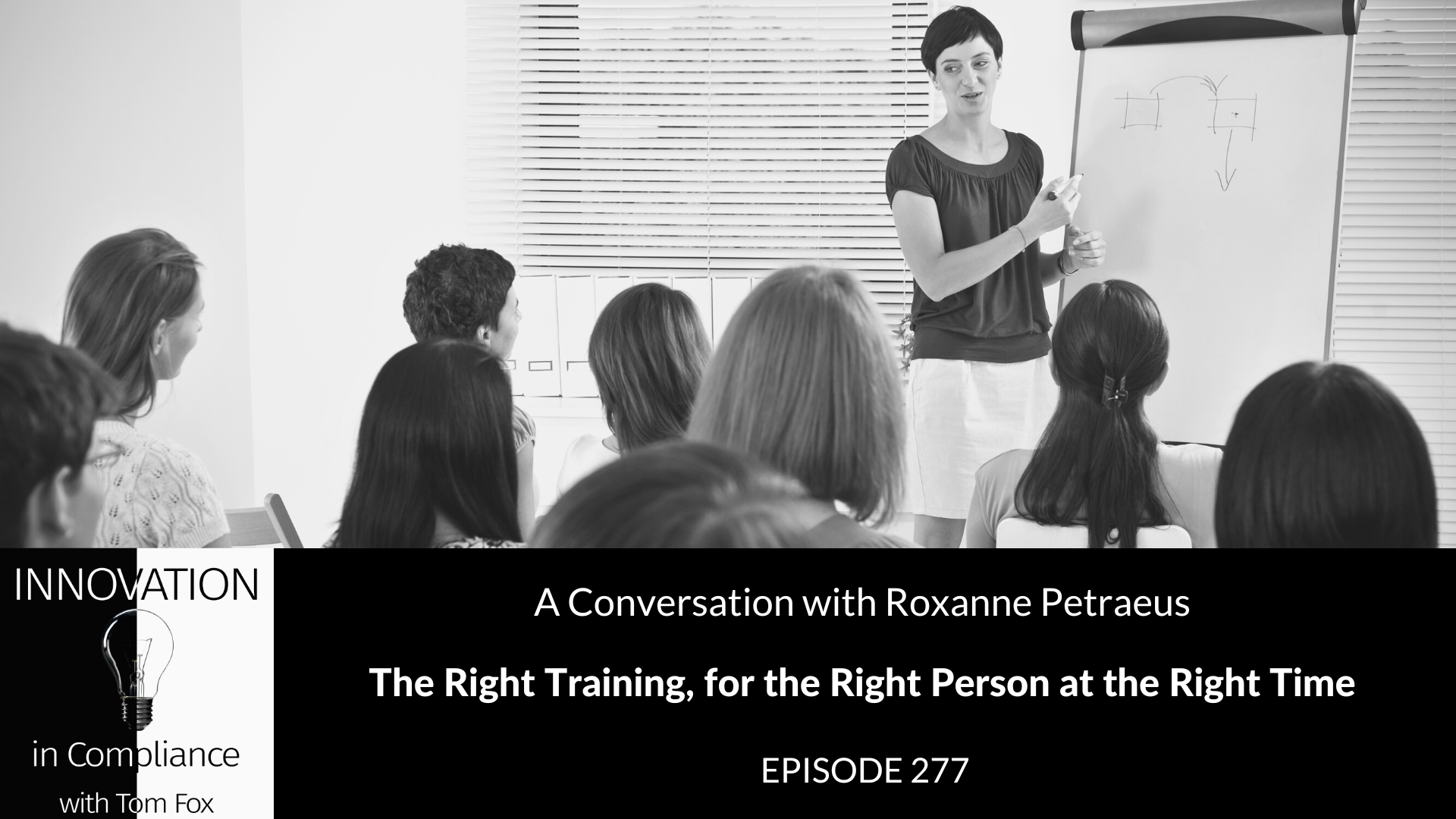
The Right Training, for the Right Person at the Right Time with Roxanne Petraeus

Tom Fox’s guest on this week’s show is Roxanne Petraeus. She is the CEO of Ethena, a compliance program for technology companies focusing on engagement and transparency. She and Tom talk about her career journey and what she and Ethena are bringing to the compliance sphere. 

Ethena

The training Ethena offers covers everything related to compliance as a broad topic. The company seeks to answer ‘Why compliance?’ and goes deep on the concept of design. For example, how would you design your compliance solutions to prevent certain issues?  What models would you look at that is similar? Roxanne tells Tom, “We just asked a fundamentally different design question: how do you iterate on the same model and make small tweaks but don’t fundamentally change the way it’s delivered or the key components of it?” 


Employee Engagement and Engaging Training 

Tom asks Roxanne how Ethena encourages employee engagement and employee training that is engaging. Employee training across any business has to be able to keep an employee’s attention. “If someone has tuned out, no matter how good your content, they’re not learning,” Roxanne remarks. A way Ethena drives engagement is by implementing feedback. Employees are able to rate training, and this feedback tells the leaders what needs to be improved. “The reason we’ve made really good training is because we’re forced to,” Roxanne says. The employee rating data is tangible evidence of what Ethena is doing right and what it’s doing wrong, so the content team can very quickly respond to that and make training better. 


Train To Improve Culture 

Training can’t simply be seen as a part of a company’s culture but also as something to improve a company’s culture. The key to achieving this is to make training a valuable part of the employee experience. Training can help a company create a holistic and healthy workplace environment and show employees that the business is serious about improving. 


Resources

Roxanne Petraeus | LinkedIn | Twitter 

Ethena

Categories
Daily Compliance News

December 6, 2022 the Glencore Pays Edition

Welcome to the Daily Compliance News. Each day, Tom Fox, the Voice of Compliance, brings you four compliance-related stories to start your day. Sit back, enjoy a cup of morning coffee and listen to the Daily Compliance News. All from the Compliance Podcast Network.

Stories we are following in today’s edition of Daily Compliance News:

  • Glencore to pay DRC $180MM.(FT)
  • Is IP litigation a fraud in the court? (Reuters)
  • AF retired generals consulting deals blocked due to COIs. (WaPo)
  • Credit Suisse says it is not responsible for ‘rogue employees.’ (Bloomberg)
Categories
Blog

ABB FCPA Resolution: Part 2 – The Corruption Partners

We continue our exploration of the latest resolution of a Foreign Corruption Practices Act (FCPA) violation involving the Swiss construction giant, ABB Ltd. The most obvious significance is from the fact that ABB is now the first three-time convicted violator of the FCPA, having prior FCPA resolutions in 2004 and 2010. The moniker of a three-time FCPA violator is certainly not one that any corporation wants to claim, yet here we are. The total fine and penalty for the violation was $315 million, with credited amounts going to South Africa, Switzerland, and Germany for ABB’s violations of those country’s anti-corruption laws. There was also a $75 million fine credited to the Securities and Exchange Commission (SEC). In addition to the SEC Order, the DOJ Press Release and Plea Agreement are also available. Conspicuously missing at this point are resolution documents from South Africa, Switzerland, and Germany.

We are exploring this FCPA enforcement action to see what lessons might be garnered from it. While we are doing so, please keep three key questions in mind: (1) How did ABB obtain such a superior resolution? (2) As a three-time FCPA violator, how did the company avoid a monitor? (3) Why was there no requirement for Chief Compliance Officer (CCO) certification? Today, we consider the corrupt partners that ABB brought into the deal with Eskom to facilitate the company’s bribery and corruption.

Capture Team and Sales Shark

In reading the resolution documents, one can only wonder at the culture of corruption which permeated ABB in the 2014-2017 timeframe. After finding out a business opportunity existed in South Africa with the national power company Eskom, ABB created a ‘Capture Team’ which was staffed largely by executives in the corporate headquarters as “The capture team did not possess confidence in personnel at ABB-South Africa to get access to the people at Eskom that would be making the decisions in regard to the C&I contract. As a result, Executive B, who had experience with obtaining business from Eskom with a previous employer, became directly involved in coordinating the efforts to win the business.” In other words, the corporate office did not believe the ABB South African operation was corrupt enough to get the job done so they stepped in to do so.

Thereafter, “at the suggestion of Executive B that a ‘sales shark’ was needed in pursuing the C&I contract, the capture team appointed Capture Team Lead, “a highly experienced sales expert” with a reputation for non-transparency about how he went about interactions with clients.” That is exactly what ABB commenced to do as thereafter Capture Team Lead, Executive B, brought in the ABB South Africa, Local Senior Manager to “set up private meetings and sent clandestine communications with Eskom officials to obtain and share confidential information regarding the Kusile C&I tender, including Eskom’s budget price and ABB’s schedule.”

 Corrupt Subcontractor 1 and Bribe Pre-Payment

This led to a business relationship with corrupt Subcontractor 1, whose sole function was to funnel bribe payments to corrupt Eskom executive(s) to facilitate ABB South Africa winning the contract. But there was a problem as the corrupt Subcontractor 1 did not meet the required business criteria to work with ABB. Indeed, “A supply chain manager at ABB-South Africa, who was not aware of the bribery scheme, raised concerns that Service Provider A was unqualified for the work for which it was being considered and that its proposed price was excessive. Given that Executive B and Capture Team Lead were part of the bribe scheme, the concerns went unaddressed by ABB management in South Africa and Switzerland.” Just to demonstrate that Subcontractor 1 was brought in to facilitate the payment of bribes, when Subcontractor 1 joined the bid team, the cost immediately went up by some $9 million. Finally, to top how unusual the arrangement with Subcontract 1 had become “ABB-South Africa signed its subcontract with Service Provider A for approximately $7.2 million which, contrary to internal company policy, was awarded without competitive bidding. The subcontract included a provision for an advanced payment of ten percent, as Eskom Official wanted an upfront payment.”

Corrupt Subcontractor 1 did their job in the corruption scheme by passing on internal and confidential information from their corrupt contact at Eskom, which ABB used to secure the contract. The Eskom official wanted an upfront, pre-payment for the corruption award of the contract to ABB. As odd as all of this was, or perhaps to demonstrate there is no honor among thieves, Subcontractor 1 decided it wanted to keep all the monies to be made as the pre-payment to the corrupt Eskom official. According to the SEC Order, “The bribe scheme nearly came undone when Service Provider A’s chair refused to share the spoils with the Eskom Official due to an apparent falling out between them. In order to save the illicit arrangement, Capture Team Lead attempted to broker a peace between the two, going so far as arranging a face-to-face meeting, but the efforts were unsuccessful.” This put the ABB bid at risk.

Corrupt Subcontractor 2 and a Waiver

The answer was simply to retain another corrupt South African business partner, who was a friend of a close friend of the corrupt Eskom official. (Reminds me of a great line from Dr. No – I like friends who have friends.) Once again, the problem was that corrupt Subcontractor 2 did not meet ABB’s internal requirements to become a business partner. This required an internal ABB waiver. ABB corporate arranged a US ABB employee from a US office, “who specialized in the SCM processes, travel to South Africa to manage the course of obtaining one. During the second week of February 2016, after spending a number of days in South Africa, the American employee was able to secure for [corrupt Subcontractor 2] a formal waiver premised on its working through two specific sub-subcontractors who were qualified for the job.” However, all of this was ruse and sham corrupt Subcontractor 2 was already on the worksite “and the message from ABB-South Africa was that Service Provider B was required to be used by Eskom, the American employee felt he had no choice but to arrange this waiver” corrupt Subcontractor 2.

In short, there is much to unpack in this matter. Join us tomorrow where we look at the bribery schemes.


Categories
Corruption, Crime and Compliance

A Deep Dive into the Oracle FCPA SEC Settlement

Oracle Corporation settled its second FCPA case in ten years. It agreed to pay the SEC $23 million to resolve allegations that its subsidiaries in Turkey, India and the United Arab Emirates maintained slush funds to bribe foreign officials. Ten years ago in 2012, Oracle paid the SEC $2 million for creating millions of dollars in off-the-books accounts at its India subsidiary. Join Michael Volkov as he takes a deep dive in the Oracle case and provides valuable lessons for managing third-party corruption risks.

  • In the SEC’s mind, Oracle is a recidivist, having its second enforcement action case in 10 years.
  • The settlement for $23 million underscored the power of the FCPA provisions, which mandate effective internal controls and accurate books and records, and can be applied to a wide range of conduct beyond foreign bribery, Michael remarks. 
  • The controls that Oracle put in place to prevent improper use of discounts and marketing reimbursements were not effective because there was a lack of compliance culture within the business.
  • The Oracle case is one that should be studied by compliance professionals, Michael believes. It reminds you to look at your own controls that surround discounting and ensure that the necessary documentation is carried out. “No matter what controls you have in place, they still have to be adhered to with a true culture of compliance underneath it as a foundation,” he adds.


Resources

SEC Oracle Case

Email Michael: mvolkov@volkovlaw.com

Categories
The ESG Report

The Role of Digital Solutions for ESG with Page Motes

Tom Fox welcomes Page Motes to this episode of the ESG Report. Page is the Head of Global Sustainability at Dell Technologies. In this conversation, Page and Tom talk about sustainability, how Dell oversees it, and where sustainability may go in the future.

The Role of Sustainability 

Tom asks Page to elaborate on what role sustainability plays at Dell. “The way we define the sustainability role and purview at our company is around all things environmental and then an aspect of social, really the human rights piece,” Page says. Human capital management, diversity, equity, and inclusion are also part of how Dell defines sustainability. 


Moving from Compliance to Sustainability and ESG 

There are skills that compliance professionals have that individuals in the field of sustainability can develop. Page specifically points to the ability to understand ambiguity, especially when dealing with the ethics side of ESG and sustainability. On the ethics side, there are more gray areas, so you have to have a set form of values and morals to help you navigate them. In sustainability, not everything is regulated, so you have to understand what works. “You’re working on a global scale. You’re having to understand all aspects of the company and the business. You have to understand the balance between what the business needs for business acceleration and growth,” Page stresses. 


Sustainability of The Future

Tom asks Page where she sees sustainability going in the corporate world. Page expresses that companies, as well as Dell, are thinking about how the solutions they offer their user and customer base can help them achieve their goals. “How can technology be used to create systems of change? How can we decarbonize our technology?” These are questions companies are thinking about intently. Currently, ESG and sustainability are more focused on structures and programs to meet regulatory requirements, but Page hopes that in the future, they will be more focused on innovation and collaboration.  


Resources

Page Motes | LinkedIn 

Dell Technologies

Categories
FCPA Compliance Report

FTX and Risk: Part 1 – Financial Institutions

Welcome to the award-winning FCPA Compliance Report, the most senior podcast in compliance. In this episode, I begin a 2-part series on the subjects of FTX and risk. I am joined by Gilbert Paiz and Andrew Gay, principals in the Texas Hill Country Advisors. In Part 1, we consider risk and risk management through the lens of US domiciled financial institutions and how their risk management protocols help to not only assess risk, but manage risk throughout the life cycle of a banking customer relationship. In Part 2, we will consider individual risk in investing and what type of background information, questions and due diligence individuals should engage in and how these questions and background investigations apply equally to larger investments made by sophisticated investors, hedge funds  and institutional investors; who should have made them before investing in FTX but they all failed to do so.

Some of the highlights include:

·      How do banks think of risk?

·      What internal processes or controls are in place to help a bank manage its risks?

·      What types of oversight do banks and financial institutions use to help manage risk?

·      Why are levels of review so critical?

·      How do banks think about customers in terms of risk?

·      Who decides how much risk to allow a customer to engage in with a banks money, whether through loans or other capital?

·      Do bank employees receive ongoing training on risk management issues?

·      What tech is in place to facilitate the management of risk?

 Resources

Texas Hill Country Advisors

Categories
Daily Compliance News

December 5, 2022 the Crazy Like a Fox Edition

Welcome to the Daily Compliance News. Each day, Tom Fox, the Voice of Compliance brings you four compliance-related stories to start your day. Sit back, enjoy a cup of morning coffee and listen to the Daily Compliance News. All, from the Compliance Podcast Network.

Stories we are following in today’s edition of Daily Compliance News:

  • SBF media strategy: Crazy or crazy like a Fox. (WSJ)
  • Bribery as contract defense: Nigeria tried to ditch $11bn award. (Reuters)
  • Hwang says prosecutorial misconduct requires dismissal. (Reuters)
  • Who cheated in chess? (NYT)
Categories
Blog

ABB FCPA Resolution: Part 1 – Introduction

Late last week, the Department of Justice (DOJ) announced a highly anticipated resolution of Foreign Corruption Practices Act (FCPA) violation involving the Swiss construction giant, ABB Ltd. The most obvious significance is from the fact that ABB is now the first three-time convicted violator of the FCPA, having prior FCPA resolutions in 2004 and 2010. The moniker of a three-time FCPA violator is certainly not one that any corporation wants to claim. The total fine and penalty for the violation was $315 million, with credited amounts going to South Africa, Switzerland and Germany for ABB’s violations of those country’s anti-corruption laws. There was also a $75 million fine credited to the Securities and Exchange Commission (SEC). Over the next several blog posts, we will explore this FCPA enforcement action, and, most particularly, three key questions: (1) How did ABB obtain such a superior resolution? (2) As a three-time FCPA violator, how did the company avoid a monitor? (3) Why was there no requirement for Chief Compliance Officer (CCO) certification?

At this point, not all of the resolution documents are publicly available. The only two documents are the DOJ Press Release and Plea Agreement. Conspicuously missing at this point are resolution documents from the SEC and those from South Africa, Switzerland and Germany. As noted, the overall FCPA fine and penalty is $315 million with credit of $75 million to the SEC and according to the Press Release, “ABB’s total criminal penalty is $315 million. The department has agreed to credit up to one-half of the criminal penalty against amounts the company pays to authorities in South Africa in related proceedings, along with other credits for amounts ABB pays to resolve investigations conducted by the SEC and authorities in Switzerland and Germany, so long as payments underlying an anticipated resolution with German authorities are made within 12 months of today’s date.”

According to Assistant Attorney General Kenneth A. Polite, Jr. of the DOJ’s Criminal Division, “This is the department’s first coordinated resolution with authorities in South Africa, where much of ABB’s criminal scheme was carried out, reflecting our commitment to relationship-building and our ever-deepening partnerships in the global fight against corruption. ABB bribed a high-ranking official at South Africa’s state-owned energy company in order to corruptly obtain confidential information and win lucrative contracts. In addition, our partners in South Africa have brought corruption charges against that official. This resolution demonstrates the Criminal Division’s thoughtful approach to appropriately balancing ABB’s extensive remediation, timely and full cooperation, and demonstrated intent to bring the misconduct to the department’s attention promptly upon discovering it, while also accounting for ABB’s historical misconduct.” The DOJ also noted, “the assistance provided by law enforcement authorities in South Africa, Switzerland, and Germany.”

Certainly, the cooperation and partnering with South Africa is a welcoming sign, given the corrupt nature of the South African government under the prior regime of President Zuma. The allegations of state capture involving Zuma, his family and the Gupta brothers rocked the country for many years. Although this enforcement action involving ABB does not appear to have been a part of the state capture allegations, it may portend a reckoning of companies who have conducted business in the corrupt state over the past decade. It may be that ABB is only the opening salvo on corruption cases from South Africa which could rival Lava Jato from Brazil.

As for the actual resolution, the Press Release noted, “ABB entered into a three-year deferred prosecution agreement (DPA) with the department in connection with the filing of a criminal information in the Eastern District of Virginia charging the company with conspiracy to violate the FCPA’s anti-bribery provisions, conspiracy to violate the FCPA’s books and records provisions, and substantive violations of the FCPA. In addition, ABB subsidiaries ABB Management Services Ltd. (Switzerland) and ABB South Africa (Pty) Ltd. (South Africa) each pleaded guilty to one count of conspiracy to violate the anti-bribery provisions of the FCPA.” Once again there is a parent receiving a DPA with subsidiaries agreeing to make criminal pleas.

The bribery schemes themselves involved a series of actions between 2014 and 2017, where ABB subsidiaries paid bribes to a South African government official at the state-owned and controlled energy company, Eskom Holdings Limited (Eskom), to obtain business advantages in connection with the award of multiple contracts. Moreover, “ABB engaged multiple subcontractors associated with the South African government official and made payments to those subcontractors that were intended as bribes. ABB worked with these subcontractors despite their poor qualifications and lack of experience. In return, ABB received improper advantages in its efforts to obtain work with Eskom, including, among other benefits, confidential and internal Eskom information. As part of the scheme, ABB conducted sham negotiations to obtain contracts at inflated prices that ABB had pre-arranged with the South African government official, all on the condition that ABB employ a particular subcontractor associated with that official. ABB also falsely recorded payments to the subcontractors as legitimate business expenses when, in fact, a portion of the payments were intended as bribes for the South African government official.”

But as bad as ABB’s conduct was during this period, perhaps even more impressive was its conduct after it uncovered the bribery and corruption. Although ABB did not self-disclose the conduct before it was made public, the company “demonstrated intent to disclose the misconduct promptly to the department.” Thereafter, the company engaged in “extraordinary cooperation with the department’s investigation” as well as extensive remediation. The DOJ specifically called out the company “carrying out a root-cause analysis of the misconduct and making significant investments in compliance personnel, compliance testing, and monitoring through the organization.” There were also statements in the DPA which made inapplicable the DOJ’s prior statements on monitors and certifications, including “ABB’s commitment to further enhance its compliance program and internal controls, including enhanced reporting provisions that require ABB, during the pendency of the DPA, to meet with the department at least quarterly and to submit yearly reports regarding the status of its remediation efforts, the results of its testing of its compliance program, and its proposals to ensure that its compliance program is reasonably designed, implemented, and enforced, so that it is effective in deterring and detecting violations of the FCPA and other applicable anti-corruption laws.”

In short, there is much to unpack in this matter. Join us tomorrow where we look at the bribery schemes.

Categories
Sunday Book Review

December 4, 2022 – The Top Books on Tech Edition

In the Sunday Book Review, I consider four books that interest the compliance professional, the business executive, or anyone curious. It could be books about business, compliance, history, leadership, current events, or anything else that might interest me. In today’s edition of the Sunday Book Review, we consider four books of the FT’s top books from 2022 on technology:

Chip War: The Fight for the World’s Most Critical Technology by Chris Miller

The Power Law: Venture Capital and the Art of Disruption by Sebastian Mallaby

Freedom to Think: The Long Struggle to Liberate Our Minds by Susie Alegre

Reality+: Virtual Worlds and the Problems of Philosophy by David J Chalmers

Resources

FT’s Best Books of 2022: Technology

Categories
Daily Compliance News

December 3, 2022 the to all, without regard to numbers, wealth, or rank Edition

Welcome to the Daily Compliance News. Each day, Tom Fox, the Voice of Compliance, brings you four compliance-related stories to start your day. Sit back, enjoy a cup of morning coffee and listen to the Daily Compliance News. All from the Compliance Podcast Network.

Stories we are following in today’s edition of Daily Compliance News:

·       FTX was risk-management-free.  (WSJ)

·       Trump, Trump judge slammed.  (NYT) 

·       Banks failing to comply with AML laws? (The Guardian)

·       Will Ramaphosa resign? (Globe&Mail)