Categories
AI Today in 5

AI Today in 5: June 26, 2026, The GenZ in the C-Suite Edition

Welcome to AI Today in 5, the newest addition to the Compliance Podcast Network. Each day, Tom Fox will bring you 5 stories about AI to start your day. Sit back, enjoy a cup of morning coffee, and listen in to AI Today In 5. All, from the Compliance Podcast Network. Each day, we consider five stories from the business world, compliance, ethics, risk management, leadership, or general interest about AI.

Top AI stories include:

  1. An AI arms race in AML. (FinTechGlobal)
  2. Easing AI-induced workforce disruptions.  (NYT)
  3. When AI puts Gen Z in the C-Suite. (WSJ)
  4. New security operating model. (Rapid7)
  5. AI is moving from automation to transformation in healthcare.  (HealthcareITNews)

For more information on the use of AI in compliance programs, Tom Fox’s new book, Upping Your Game, is available. You can purchase a copy of the book on ⁠Amazon.com⁠.

To learn about the intersection of Sherlock Holmes and the modern compliance professional, check out Tom’s latest book, The Game is Afoot-What Sherlock Holmes Teaches About Risk, Ethics and Investigations on ⁠Amazon.com⁠.

Categories
2 Gurus Talk Compliance

2 Gurus Talk Compliance: Episode 79 – The Future of Compliance Associations Edition

What happens when two top compliance commentators get together? They talk compliance, of course. Join Tom Fox and Kristy Grant-Hart in 2 Gurus Talk Compliance as they discuss the latest compliance issues in this week’s episode!

Stories This Week Include:

  • Corporate BS Goes Mainstream
  • Directors Using AI Unguided
  • Perps and Prediction Markets Fight
  • Future of Compliance Associations
  • SFO Setback in UK Corruption Trial
  • Compliance Pay Gap Reality Check
  • Companies Betting on Themselves
  • Work From Home and Boss Narcissism
  • Cigar Photo Punishment and Fairness
  • Florida Man Steals a Helicopter

Resources:

Kristy

Kristy Grant-Hart on LinkedIn

Order Kristy’s updated, 10-year new edition of How to Be a Wildly Effective Compliance Officer by clicking here.

Tom

Check out the top compliance handbook, The Compliance Handbook, 7th edition, published by LexisNexis. Visit the LexisNexis® Store at https://lexisnexis.com/fox20

To save 20% on The Compliance Handbook: A Guide to Operationalizing Your Compliance Program, please reference or enter promotion code: FOX20.

Offer expires December 31, 2026. Offer applies to new orders only, before shipping and taxes are calculated and shipped to a U.S. address. A discount will be applied to each applicable product after the code FOX20 is entered. Discount does not apply to current subscriptions, renewals, or updates. Certain exclusions and other restrictions may apply. Void where prohibited. View full terms here.

Instagram

Facebook

YouTube

Twitter

LinkedIn

Categories
Hill Country Treasures

Hill Country Treasures: Transparency, Empathy, and Due Diligence When Monetizing Inherited Coins and Jewelry

This is a podcast from MR Mint Coins & Collectibles in Kerrville, Texas, exploring the value, history, and stories behind coins, currency, gold, silver, jewelry, bullion, sports cards, memorabilia, and family collections. Whether you are a lifelong collector, a curious beginner, or someone who just inherited a box of old coins, this show helps you understand what you have, what makes it valuable, and how to make smart, confident decisions. Join host Tom Fox and MR Coin owner Mike Russ for a show that celebrates local expertise, honest conversations, and the treasures hiding in plain sight across the Hill Country.

Tom visits with Mike Russ about why transparency and empathy are critical when helping people sell inherited valuables after a loss. Russ describes common situations in which families bring in coins, gold, silver, or jewelry without knowing what they have, including a recent house call to a widow who discovered unexpected gold but was advised to keep her emotionally significant wedding rings until she was ready. He explains how to educate sellers by discussing spot prices, paying on a stated percentage basis, encouraging second opinions, and explaining coin-specific value drivers such as key dates and condition. Ross shares finding a rare three-legged Buffalo nickel and recommends grading for authentication before making an offer. He emphasizes trust, fair negotiation, local reputation, and the importance of customer reviews and provides contact details for Mr. Mint Coins in Kerrville.

Highlights:

  • Handling Inherited Valuables
  • Empathy Over Profit
  • Transparency and Spot Pricing
  • Collecting Talk and People Business
  • Three-Legged Buffalo Find

Resources

MR Mint and Coin Collectibles

Categories
Trekking Through Compliance

Trekking Through Compliance: Episode 26 – Lessons in Data Analytics from Errand of Mercy

Star Trek’s “Errand of Mercy” has long captivated viewers with its profound examination of conflict, diplomacy, and the limitations of perception. While it might not seem immediately apparent, this episode is rich in insights for the corporate compliance community, particularly in data analytics. Let’s delve into five key data analytics lessons derived from this timeless story, specifically tailored for today’s compliance professionals.

Lesson 1: Data-Driven Awareness Prevents Miscalculations

Illustrated by Captain Kirk and Mr. Spock, they initially underestimate the Organians, perceiving them as primitive due to surface-level observations. Only later do they realize that Organians possess profound power and knowledge far beyond initial assessments.

Compliance Lesson: Compliance professionals must avoid superficial analyses and surface-level assessments. Utilizing comprehensive data analytics enables organizations to understand deeper patterns, accurately predict potential risks, and make informed strategic decisions.

Lesson 2: Real-Time Analytics Facilitate Prompt Intervention

Illustrated by: During their initial stay, the Organians repeatedly attempt to deflect Federation and Klingon aggression, intervening subtly and promptly as conflicts arise.

Compliance Lesson: Effective compliance management increasingly depends on real-time data analytics to facilitate rapid intervention and corrective actions. Organizations require systems that deliver real-time or near-real-time insights into compliance violations and risks, enabling them to respond promptly and effectively.

Lesson 3: Predictive Analytics Enhance Proactive Compliance

Illustrated by: Ultimately, the Organians demonstrate foresight and predictive awareness, recognizing the likely outcomes of Federation and Klingon hostilities and intervening proactively to avoid widespread disaster.

Compliance Lesson: Predictive analytics significantly strengthens proactive compliance initiatives. Leveraging historical data, machine learning algorithms, and risk modeling allows compliance teams to anticipate potential compliance issues before they become significant problems.

Lesson 4: The Value of Integrating Diverse Data Sources

Illustrated by Kirk and Spock initially relying primarily on their direct observations and Federation reports, neglecting potentially valuable alternative perspectives and data points that might have informed a more nuanced understanding of the Organians.

Compliance Lesson: Integrating diverse data sources into compliance analytics significantly enhances the accuracy and effectiveness of decision-making. Organizations should draw on a wide array of data, including internal audit reports, third-party risk assessments, whistleblower reports, and industry-wide compliance trends, to inform their decision-making.

Lesson 5: Ethical Data Use and Transparency Build Trust

Illustrated by: In the episode’s resolution, the Organians reveal their true nature transparently, clearly communicating their intentions and reasons for their actions, which ultimately earns the trust and respect of both Federation and Klingon representatives.

Compliance Lesson: The ethical and transparent use of data is fundamental in maintaining stakeholder trust and ensuring regulatory compliance. Organizations must ensure that their data analytics practices align with privacy regulations, data ethics standards, and transparency principles.

Final ComplianceLog Reflections

“Errand of Mercy” offers a valuable allegory for contemporary compliance professionals, highlighting the importance of in-depth analysis, real-time intervention capabilities, predictive insights, diverse data integration, and ethical transparency. By embracing these data analytics lessons, compliance teams can significantly enhance their organization’s ability to proactively manage and mitigate risks. In today’s complex regulatory landscape, harnessing sophisticated analytics capabilities is not merely advantageous; it is essential. As Kirk and Spock’s ultimate realization in “Errand of Mercy” shows, understanding beyond surface appearances and leveraging deep analytical insights can make all the difference in navigating compliance challenges effectively.

Resources:

Excruciatingly Detailed Plot Summary by Eric W. Weisstein

MissionLogPodcast.com

Memory Alpha

Categories
Daily Compliance News

Daily Compliance News: June 26, 2026, The Forever Chemicals Edition

Welcome to the Daily Compliance News. Each day, Tom Fox, the Voice of Compliance, brings you compliance-related stories to start your day. Sit back, enjoy a cup of morning coffee, and listen in to the Daily Compliance News. All, from the Compliance Podcast Network. Each day, we consider four stories from the business world, compliance, ethics, risk management, leadership, or general interest for the compliance professional.

Top stories include:

  • Eric Adams, the Chief of Staff, was arrested in a corruption probe.  (CNN)
  • War, volatility, and risk. (NYT)
  • Chemours to pay $450MM to forever chemicals claims. (WSJ)
  • Apple raises computer prices by 20%. (FT)

To learn about the intersection of Sherlock Holmes and the modern compliance professional, check out Tom’s latest book, The Game is Afoot-What Sherlock Holmes Teaches About Risk, Ethics and Investigations on Amazon.com.

Categories
From the Editor's Desk

From the Editor’s Desk: Episode 39: Season 2 – June and July in Compliance Week

In this episode of ‘From the Editor’s Desk,’ Tom Fox visits with Compliance Week editor-in-chief Aaron Nicodemus to discuss highlights from Compliance Week in June, review the Inside the Mind Survey results, and take a look at what is coming down the pike in July in Compliance Week.

We review major recent coverage and Inside the Mind survey findings. Nicodemus highlights an exclusive story about a whistleblower lawsuit alleging that DocuSign moved customer data from on-site servers to Microsoft Azure in 2023 without informing major banking clients, raising contract, regulatory, and SEC disclosure concerns after 10-K reviews found no mention of it until later. They discuss a Compliance Week–coordinated retaliation survey (328 respondents), finding 70% experienced retaliation during their careers, over one-third were uncomfortable reporting it, and reported retaliation often led to no investigation or discipline, with social punishments being most common. From the “Inside the Mind of the CCO” survey, they cover limited DEI program changes despite federal pressure; widespread AI use (90%+) but one in eight lacking governance; salary results skewed by more senior CCO respondents; and law degrees correlating with higher pay but not advancement. They also note expanded EU/UK regulatory coverage and upcoming reporting on sanctions, export controls, tariffs, and third-party risk disruptions.

Resources:

Aaron Nicodemus on LinkedIn

Compliance Week

Categories
AI in Healthcare

AI in Healthcare: Five Healthcare AI Stories You Need to Know This Week – June 26, 2026

Welcome to AI in Healthcare in 5 Stories. This podcast is a Weekly Briefing of the five most important AI developments shaping healthcare, medicine, and life sciences. Each week, Tom Fox breaks down the latest stories on clinical innovation, regulation, privacy, compliance, patient safety, and operational transformation through a practical, business-focused lens. Designed for healthcare compliance professionals, executives, legal teams, clinicians, and industry leaders, the podcast moves beyond headlines to explain what each development means in the real world.

The top five stories for the week ending June 26, 2026, include:

  1. AI-Human means ‘human’ in healthcare. (New-Med)
  2. AI in healthcare perpetuates stereotypes. (PsyToday)
  3. AI can help hospitals more than insurers. (HealthcareFinanceNews)
  4. More than algorithms are needed for AI and Pharma. (PharmExec)
  5. AI is moving from automation to transformation in healthcare. (HealthcareITNews)

For more information on the use of AI in Compliance programs, Tom Fox’s new book, Upping Your Game, is available. You can purchase a copy of the book on Amazon.com.

To learn about the intersection of Sherlock Holmes and the modern compliance professional, check out Tom’s latest book, The Game is Afoot-What Sherlock Holmes Teaches About Risk, Ethics and Investigations on Amazon.com.

Categories
AI in Financial Services in 5 Stories

AI in Financial Services in 5 Stories – Week Ending June 26, 2026

Welcome to AI in Financial Services in 5 Stories. A practical weekly roundup of the five most important AI developments affecting banking, insurance, payments, asset management, and fintech. Each Friday, Tom Fox will break down the top stories that matter most through the lenses of compliance, risk management, governance, and business strategy. Designed for compliance professionals, executives, legal teams, and financial services leaders, it goes beyond headlines to explain why each development matters in a highly regulated industry. The result is a concise weekly briefing that helps listeners stay current on AI innovation while asking sharper questions about oversight, accountability, and trust.

This week’s stories include the following:

  1. AI Is Now the Threat Banks Must Plan Around. (PYMNTS)
  2. AI in fintech comes down to trust. (Forbes)
  3. AI is beginning to justify massive data center buildouts. (Yahoo!Finance)
  4. HSBC and Google announce an AI partnership. (HSBC)
  5. FCA rethinks AI oversight. (digwatch)

For more information on the use of AI in Compliance programs, Tom Fox’s new book, Upping Your Game, is available. You can purchase a copy of the book on Amazon.com.

To learn about the intersection of Sherlock Holmes and the modern compliance professional, check out Tom’s latest book, The Game is Afoot-What Sherlock Holmes Teaches About Risk, Ethics and Investigations on Amazon.com.

Categories
Blog

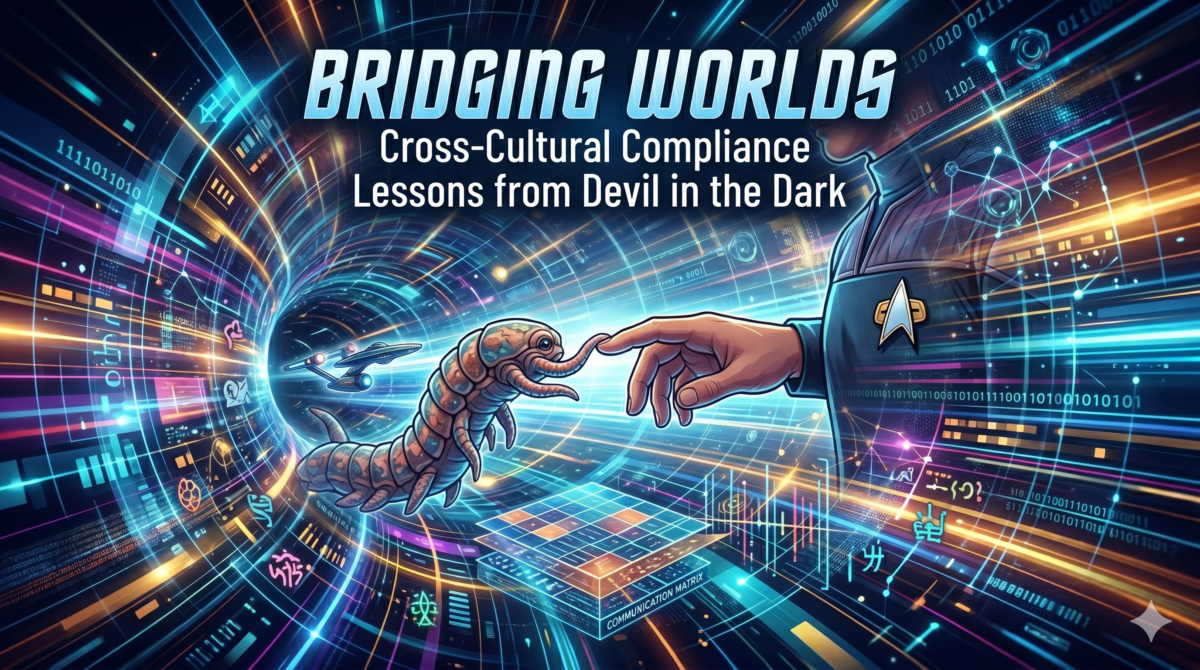
Bridging Worlds: Cross-Cultural Compliance Lessons from Devil in the Dark

Show Summary

Star Trek has always served as a powerful lens through which to view not just the potential future of humanity but the contemporary complexities we face today. The classic episode “Devil in the Dark” is a compelling exploration of misunderstandings, communication breakdowns, and reconciliation between vastly different cultures—lessons that resonate strongly with corporate compliance officers navigating today’s global marketplace.

In “Devil in the Dark,” the USS Enterprise is dispatched to investigate mysterious deaths in a mining colony. What initially seems like straightforward monster attacks turns out to be a profound misunderstanding between humans and an alien creature called the Horta. Today, we will examine five key compliance lessons that corporate professionals can learn from the iconic Star Trek episode.

Lesson 1: Recognize and Challenge Your Own Biases

Illustrated By: When the Enterprise crew arrives, the miners describe a monstrous creature attacking and killing miners, labeling it simply as a dangerous beast to be eliminated. Their preconceived notions blinded them to the possibility of understanding the creature.

Compliance Lesson: Like the miners’ initial response, corporate biases can obscure critical perspectives and valuable information. Compliance professionals must actively recognize and challenge their assumptions and biases. It’s critical to maintain impartiality, especially during investigations, risk assessments, or due diligence processes involving diverse international markets. Conducting training sessions on unconscious bias and regularly revisiting corporate procedures helps organizations maintain objectivity and fairness.

Lesson 2: Effective Communication Requires Genuine Effort and Empathy

Illustrated By: The turning point of the episode comes when Spock mind-melds with the Horta. Through genuine empathy and effort, he discovers that the Horta is not malevolent but is protecting its offspring, the silicon nodules that the miners had inadvertently been destroying.

Compliance Lesson: Effective communication across cultural boundaries requires empathy, openness, and genuine effort. Corporate compliance teams operating in multinational contexts must make sincere efforts to communicate effectively with global partners, subsidiaries, and stakeholders. Language barriers, differing business practices, and cultural nuances can lead to costly misunderstandings. Investing in cross-cultural training, employing bilingual staff, and engaging empathetically with diverse perspectives strengthens communication and helps prevent costly compliance failures.

Lesson 3: Cultural Awareness as a Risk Mitigation Strategy

Illustrated by: The miners’ failure to recognize the silicon nodules as living offspring stems from ignorance about the Horta’s culture and biology. This ignorance creates hostility and unnecessary conflict.

Compliance Lesson: Cultural ignorance significantly increases compliance risk, especially in international operations. Understanding local cultural norms, regulatory landscapes, and business ethics is vital for operating ethically and legally across jurisdictions. Companies must integrate cultural intelligence training into their compliance programs, conduct thorough risk assessments, and cultivate local relationships to enhance awareness and understanding. This proactive approach mitigates misunderstandings and ethical lapses, fostering respectful and legally compliant international operations.

Lesson 4: Embrace Diversity to Foster Innovation and Solutions

Illustrated By: The Enterprise crew’s diverse backgrounds and experiences enable them to devise innovative solutions. Spock’s unique Vulcan abilities allow communication with the Horta, transforming a volatile situation into a collaborative one.

Compliance Lesson: Diversity is not only ethically commendable but also strategically vital. Diverse compliance teams bring a range of varied experiences, perspectives, and problem-solving approaches, which are essential for effectively managing complex compliance challenges. Organizations should proactively recruit and empower diverse talent in compliance roles, ensuring a range of perspectives when assessing risks and resolving compliance-related issues. Embracing diversity fosters innovation and resilience in managing compliance across various markets.

Lesson 5: Seek Win-Win Solutions through Collaboration

Illustrated By: Ultimately, Captain Kirk brokers a cooperative agreement between the miners and the Horta, allowing peaceful coexistence and mutual benefit. The miners extracting resources and the Horta species continue unharmed.

Compliance Lesson: Effective compliance strategies often involve creative, collaborative solutions that benefit multiple stakeholders. Compliance professionals should adopt a win-win mindset, working collaboratively with regulatory authorities, local communities, employees, and third-party partners to align compliance objectives with mutual benefits. Encouraging collaborative dialogues rather than adversarial stances with stakeholders reduces friction, ensures sustainability, and promotes ethical business practices that benefit everyone involved.

Final ComplianceLog Reflections

Star Trek’s “Devil in the Dark” vividly illustrates the consequences of cross-cultural misunderstandings and the immense benefits of cultural empathy, clear communication, diversity, and collaborative problem-solving. For corporate compliance professionals, this episode serves as a powerful reminder that effective compliance programs necessitate intentional cross-cultural engagement, ongoing education, and empathy-driven interactions.

Navigating the global compliance landscape involves bridging cultural divides with sensitivity, understanding, and respect. Companies that prioritize cultural intelligence, diversity, and collaborative solutions not only minimize compliance risks—they also cultivate resilient, ethical, and respected global brands. Like the Enterprise crew, compliance professionals must boldly reach across cultural divides, ensuring business integrity thrives on mutual respect, innovation, and cooperative achievement.

Resources:

Excruciatingly Detailed Plot Summary by Eric W. Weisstein

MissionLogPodcast.com

Memory Alpha

Categories
Blog

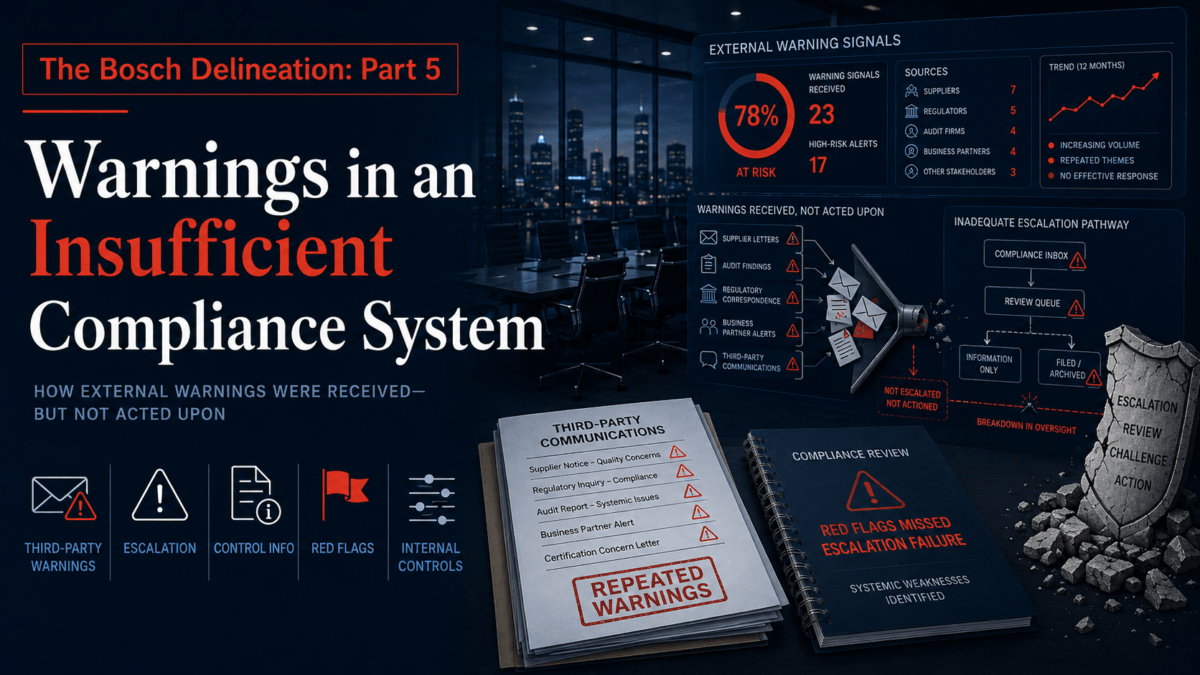
The Bosch Declineation, Part 5: Warnings in an Insufficient Compliance System

This final post in the Bosch series should not end with a victory lap about the DOJ Declination. That would be the wrong lesson. Bosch earned real credit for what it did after discovery: it disclosed, cooperated, remediated, added 66 trade compliance employees, expanded U.S. trade compliance resources, and resolved the matter with DOJ and BIS. Those are serious steps, and compliance professionals should not dismiss them.

But the Declination should not be mistaken for vindication. Bosch avoided prosecution because of what it did after the failure, not because the compliance program worked before the failure. The uncomfortable lesson is that Bosch apparently had to suffer an enforcement crisis, a $36 million BIS penalty, disgorgement, and a very public Order (and reputational hit) before it fully resourced and restructured the function. That is a very expensive way to find religion.

The core thesis of this series is that Bosch is the rare enforcement action that rewards post-discovery conduct while simultaneously exposing a pre-discovery compliance program that was under-resourced, under-expertized, and too willing to treat red flags as paperwork. Bosch did not lack all compliance infrastructure. That is what makes the case more troubling. It had processes. It had trade compliance personnel. It had internal blocks. It had external warnings. It had business personnel receiving certifications. It had opportunities to stop, ask, escalate, and reassess. Yet the wrong answer became institutional truth.

The failure was not one bad legal interpretation

Every compliance failure has a beginning. In Bosch, the initial guidance was erroneous regarding the impact of the August 2020 rule change on sales to Huawei. But that was not the whole failure. Bad advice happens. Complex regulations are difficult. People make mistakes. A mature compliance program is not measured by whether it never produces the wrong answer. It is measured by whether it can identify, challenge, correct, and contain the wrong answer before it metastasizes into operating policy. Bosch failed that test.

The BIS Order said Bosch had established export compliance processes, including U.S. export compliance processes, but its U.S. export compliance team lacked sufficient expertise and resources to address the August 2020 changes. During much of the relevant period, Bosch’s U.S. export controls team primarily consisted of two employees, only one of whom was primarily tasked with U.S. export controls advice.

That is not a rounding error. That is a resource model visibly misaligned with the risk profile of a global technology and manufacturing company with hundreds of thousands of employees, hundreds of subsidiaries, complex supply chains, and high-risk customers. Compliance professionals should say this plainly: you cannot run mission-critical regulatory risk on heroic undercapacity and then be surprised when the system breaks.

Expertise matters, and generic compliance experience is not enough

One of the sharper lessons from Bosch is that “having compliance people” is not the same thing as having the right compliance expertise. The Evaluation of Corporate Compliance Programs (ECCP) asks whether compliance personnel have the appropriate experience and qualifications for their roles, whether those qualifications have changed over time, how the company invests in further training, and who reviews the performance of the compliance function. Bosch’s facts read like an answer key in reverse.

The relevant compliance personnel misunderstood the rule, conflated separate concepts, and repeatedly relied on a flawed conclusion. That misunderstanding then became the basis for releasing orders and continuing sales. The issue was not merely a knowledge gap. It was an expertise governance failure: no second-level review, no effective challenge process, no documented reassessment trigger, and no apparent mechanism to say, “This conclusion is too consequential to rest on a thin and possibly confused analysis.”

For CCOs, the hard question is not whether your compliance team is busy. Everyone’s team is busy. The question is whether your team has the technical depth to manage the risks your business actually creates. If the answer is no, the next question is why the business is permitted to keep operating as if the answer were yes.

The company had warnings and treated them as noise

The most damning part of the Bosch story is not the original mistake. It is the persistence of the mistake after multiple warning signs. Company Four warned Bosch that equipment used in its factories included U.S.-export-controlled items and that products worked on by Company Four for Huawei might be prohibited from export. Company One asked Bosch personnel to sign a certification that should have forced reconciliation with Bosch’s prior guidance. Company Five told Bosch that products containing items manufactured by Company Five could not be provided to Huawei without authorization and even referenced the Seagate penalty. Contract manufacturer certifications repeated the same basic warning: these were not ordinary commercial forms; they were control documents.

This is where COSO Principle 15 becomes useful. Principle 15 is not only about what the company communicates outward to third parties. It also recognizes that third parties can provide information back to management about the effectiveness of internal controls and regulatory communications.

Bosch failed to treat third-party communications as control information. That is a blunt but fair reading. Supplier warnings were received. Certifications were signed. Objections were routed. But the organization lacked a system to convert that information into escalation, reconsideration, documentation, and action. That should bother every CCO. The problem was not that the information was hidden. The problem was that it was visible, yet it still did not matter enough.

Business pressure became a control weakness

The Bosch Order also shows how business pressure can quietly become a compliance override. When the U.S. trade compliance professional requested information from Bosch businesses, BST did not provide it. The response cited a “dire allocation situation” and the need to spare the team time. The order says that had BST answered the specific questions, Bosch’s U.S. trade compliance personnel likely would have identified the issue. That fact should stop compliance professionals cold.

A compliance information request tied to a major regulatory change should not be optional. It should not be negotiable because the business is under pressure. It should not depend on whether a senior business leader believes the issue was already “clarified.” The moment commercial urgency is allowed to excuse incomplete compliance fact-gathering, the control environment has already bent.

The hard question for CCOs is simple: when compliance asks for information necessary to assess legal risk, can the business say no? If the answer is yes, the company lacks an authorized compliance program, once again violating not only the tenets of a best-practice compliance program but also those of the ECCP. It has a request-and-hope function.

Remediation was real, but late

Bosch deserves credit for remediation. Adding 66 trade compliance employees is not a cosmetic move. Expanding U.S. trade compliance resources is meaningful. Updating policies and procedures to clarify U.S. export control jurisdiction and licensing requirements is exactly the kind of tangible remediation DOJ and BIS expect.

But compliance professionals should not miss the obvious: those resources came after the failure. The better compliance question is why those resources were not there before. Why did it take a public enforcement action to reveal that the compliance function was not staffed or expert for the company’s risk profile? Boards and senior executives often ask whether compliance needs more people. Bosch suggests a sharper question: what will it cost if we wait until the government answers that question for us?

Hard questions for compliance professionals

The Bosch series leaves CCOs with hard questions.

Who owns complex regulatory change from interpretation through operational implementation?

Who validates high-risk legal or compliance advice before the business relies on it?

Does high-risk advice have a lifecycle, including assumptions, facts reviewed, date issued, owner, and reassessment triggers?

Can compliance force a business unit to respond to fact-gathering requests before shipments can continue?

Are supplier letters, certifications, refusals, and regulatory objections tracked as compliance intelligence?

Are procurement, logistics, supply chain, legal, production, and contract management trained to recognize red flags in third-party communications?

Who reviews whether compliance has sufficient expertise, not just sufficient headcount?

Can the compliance function stop, hold, or escalate transactions when the facts are incomplete?

Does the internal audit test whether compliance blocks are released for sound reasons, or merely whether they were processed?

When a supplier tells the company, “You may have a compliance problem,” does the company investigate the warning or look for another supplier?

Those are not academic questions. Bosch shows what happens when the answers are weak.

The final word

Bosch is not a story about a company with no compliance program. It is more troubling than that. It is a story about a company with a compliance infrastructure that still failed when the business needed judgment, expertise, escalation, and courage.

The final lesson is systemic. Bosch’s failure was not one bad legal interpretation. It was a systemic breakdown: a wrong answer became institutional truth because no one had the expertise, authority, process, or discipline to challenge it.

That is the compliance lesson worth remembering. Not the declination. Not the headline penalty. Not even the technical export control issue. The real lesson is that compliance programs fail when they cannot recognize and act on the information already in front of them. Bosch had the warnings. It did not have a compliance system.