Categories
Blog

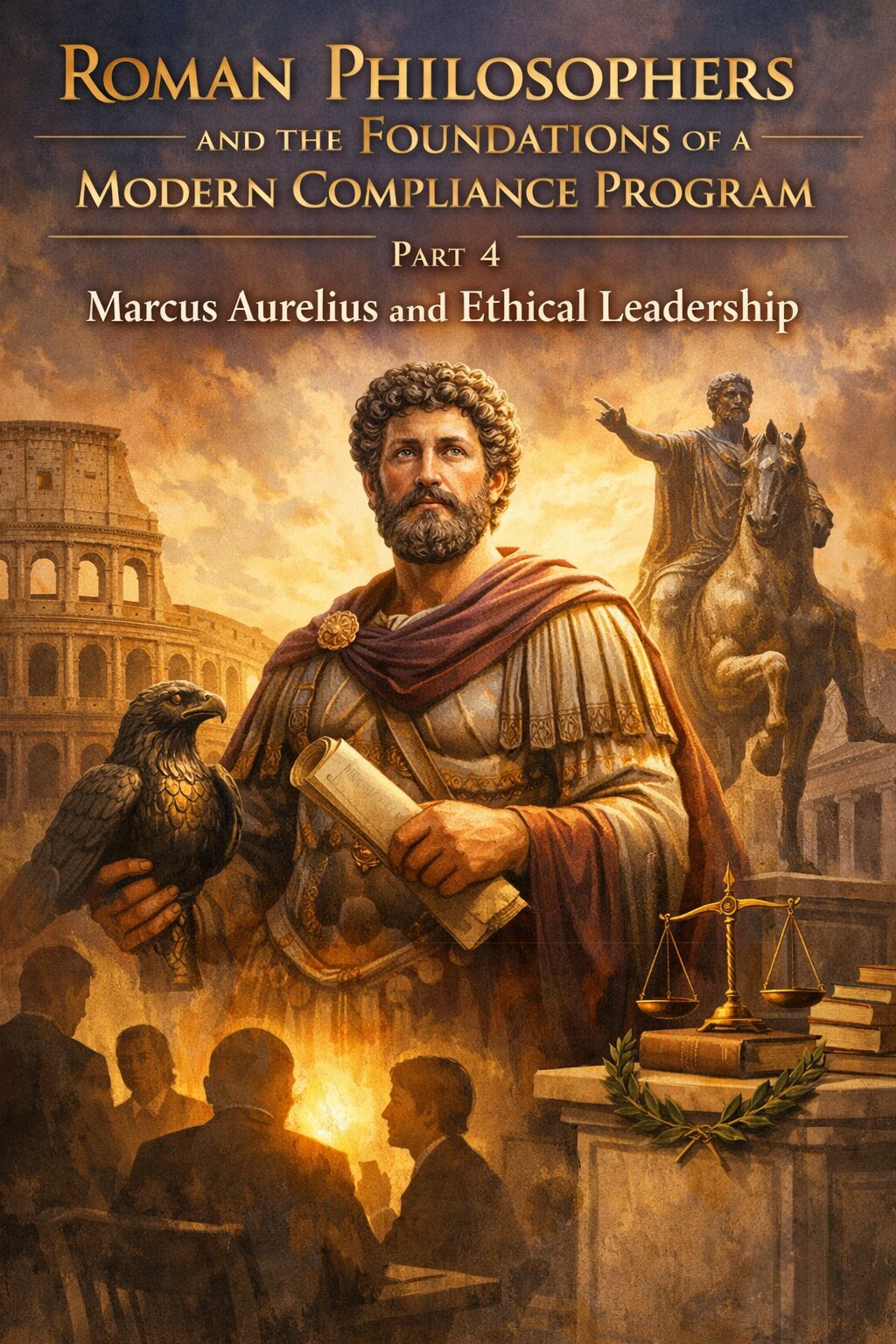
Roman Philosophers and the Foundations of a Modern Compliance Program: Part 4 – Marcus Aurelius and Ethical Leadership

I recently wrote a series on the direct link between ancient Greek Philosophers and modern corporate compliance programs and compliance professionals. It was so much fun and so well-received that I decided to follow up with a similar series on notable Roman Philosophers. This week, we will continue our exploration of the philosophical underpinnings of modern corporate compliance programs and compliance professionals by looking at five philosophers from Rome, both from the BCE and AD eras.

We have considered Cicero and the duties, law, and moral limits of business; Seneca on power, pressure, and ethical decision-making under stress; and Varro on corporate governance. Today, we consider Marcus Aurelius and ethical leadership and tone at the top. Tomorrow, we will conclude with Lucretius to explore rationality, fear, and risk perception. Today, we continue with Marcus Aurelius, Ethical Leadership, and Culture as a Compliance Control

I. Marcus Aurelius in Context: Power with Restraint

Imagine you are the single most powerful person on earth. Are you going to be an unrepentant narcissist in the manner of Donald Trump, who believes he should govern on his own twisted morality based simply on ‘gut instinct’? Or are you going to take a different approach, set out your reasoned approach to governing in a book, and then govern with the moral authority of thousands of years of philosophy?

Marcus Aurelius is often remembered as the philosopher-king, but that description understates the difficulty of his position. He ruled the Roman Empire during a period of war, plague, economic strain, and political instability. Unlike many philosophers, Marcus Aurelius did not write for an audience. His Meditations were private reflections, written to discipline his own thinking while exercising absolute power.

This matters for compliance professionals. Marcus Aurelius did not theorize about ethical leadership from a distance. He lived inside it. He understood that power magnifies temptation, insulates leaders from feedback, and creates opportunities for self-deception. His philosophy is therefore preoccupied with restraint, humility, consistency, and responsibility.

Marcus repeatedly reminded himself that leadership is not a privilege but a burden. Authority did not entitle him to indulgence; it imposed higher expectations. He believed that leaders set moral boundaries through conduct long before they issue instructions. In modern terms, Marcus Aurelius understood that culture flows downward from leadership behavior rather than upward from policy documents.

II. The Compliance Problem Marcus Aurelius Illuminates: Culture Eats Controls

One of the central lessons of modern compliance enforcement is that formal controls cannot compensate for poor culture. Organizations with detailed policies and sophisticated monitoring still fail when leadership behavior signals that results matter more than integrity. The DOJ Evaluation of Corporate Compliance Programs (ECCP) explicitly asks whether senior leaders demonstrate commitment to compliance through actions, not words. Regulators assess whether ethical behavior is encouraged, whether misconduct is addressed consistently, and whether leaders tolerate or reward problematic conduct.

Marcus Aurelius would recognize this dynamic immediately. He believed that people learn how to behave by observing those in power. When leaders act inconsistently with stated values, cynicism follows. When leaders rationalize misconduct, that rationalization spreads. Compliance programs often falter when leadership treats ethics as a communication exercise rather than a lived expectation. Codes of conduct and training sessions cannot overcome the daily signals sent by executive decisions, incentive structures, and responses to failure.

Marcus teaches that culture is not accidental. It is created continuously by leadership choices, especially under pressure.

III. Modern Corporate Application: Marcus Aurelius, DOJ Expectations, and Leadership Accountability

Applying Marcus Aurelius to modern compliance reveals several concrete expectations that closely align with DOJ guidance.

First, leadership behavior must be consistent. Marcus believed hypocrisy was corrosive to authority. The DOJ similarly evaluates whether leaders follow the same rules they impose on others. Exceptions for senior executives undermine program credibility and weaken deterrence.

Second, leadership must respond to misconduct with moral clarity. Marcus wrote that anger and denial cloud judgment. In compliance terms, this means addressing issues promptly, transparently, and proportionately. Delayed or defensive responses signal tolerance, even when discipline eventually occurs.

Third, middle management matters. Marcus understood that culture is transmitted through layers of authority. DOJ guidance emphasizes the role of middle managers as culture carriers. Compliance programs should equip managers with the tools and incentives to reinforce ethical behavior, not merely deliver targets.

Fourth, incentives must reflect values. Marcus warned against leaders who chase reputation or reward at the expense of principle. Modern compliance programs must ensure compensation structures do not reward outcomes achieved through questionable means. The DOJ has repeatedly cited incentive misalignment as a root cause of misconduct.

Finally, leadership must create psychological safety. Marcus believed leaders should listen more than they speak. In compliance terms, this translates into openness to bad news, encouragement of dissent, and protection for those who raise concerns. A culture that punishes truth-telling cannot sustain compliance.

IV. Key Takeaways for Compliance Professionals

1. The Blueprint. Compliance professionals should view Marcus Aurelius and his writings as the blueprint for culture-based compliance. You can draw a direct line from the Meditations to both your compliance program and the leadership skills a CCO needs. Compliance should evaluate leadership behavior as a primary control, not a soft factor. This means not only reviewing employees who are promoted to management, but also a deep dive into their backgrounds. Also, thorough due diligence for any senior management hires from outside your organization.

2. Higher Standards. Compliance should hold senior leaders to higher standards of consistency and accountability.

3. Institutional Justice. Compliance should focus on how leaders respond to misconduct, not just how they prevent it. This is the CCO’s charge, and it must include an institutional fairness component in your compliance program.

  1. Compliance should ensure incentives reinforce ethical behavior at every level. The DOJ has consistently discussed the role of incentives in any compliance program, as far back as the 1st edition of the FCPA Guidance in 2012.
  2. Compliance should treat culture as an operational risk area subject to oversight and testing. Culture should be assessed, monitored, and improved. Simply because it is seen as a ‘soft’ part of an organization does not mean it should be treated differently.

4. Walk the Walk. Finally, Marcus Aurelius reminds us that ethical leadership is not performative. It is visible, daily, and decisive. In organizations, culture follows leadership long before it follows policy.

V. Conclusion

Marcus Aurelius brings the compliance lifecycle to its cultural apex. He shows that leadership behavior is not merely influential but determinative, shaping whether ethical expectations are taken seriously or quietly dismissed. Yet even the strongest ethical culture is not self-sustaining. Leaders are human, memory fades, and good intentions erode without reinforcement. This is where culture must be supported by systems that observe, test, and correct.

Marcus Aurelius teaches us how leaders should behave; Lucretius challenges us to examine how organizations think. If Marcus focuses on moral example, Lucretius turns our attention to rational observation, warning against fear, superstition, and self-deception. The transition from Marcus Aurelius to Lucretius mirrors the shift from cultural leadership to continuous improvement, from ethical intent to empirical verification. In compliance terms, it is the move from assuming the program works to proving that it does, using data, monitoring, and clear-eyed analysis rather than hope or habit.

Join us tomorrow for our concluding article on Lucretius and Rationality in Monitoring and Continuous Improvement. We will consider where culture gives way to systems, data, and the discipline of seeing risk clearly rather than through fear or superstition.
Categories
FCPA Compliance Report

FCPA Compliance Report – Navigating Corporate Scandals: Insights on Governance, Compliance, and Recovery with Steve Vincze

Welcome to the award-winning FCPA Compliance Report, the longest-running podcast in compliance. In this episode, Tom welcomes Steve Vincze back to discuss the recent corporate scandal involving executives from Astronomer.

Tom and Steve take a deep dive into governance, compliance, and internal controls, drawing parallels with historical cases like Boeing’s 2003 CEO scandal. Vincze shares five critical success factors and three essential elements for establishing an effective ethics and compliance program, emphasizing the importance of transparency, strong leadership, and re-establishing trust. He also discusses how military leadership and open communication can help rebuild a company’s culture post-scandal. The episode closes with practical advice for companies facing similar challenges and how they can recover and thrive.

Key highlights:

  • The Viral Incident and Its Implications
  • Corporate Recovery Strategies
  • Five Critical Success Factors
  • Establishing Trust and Credibility
  • Military Insights on Leadership
  • Addressing Scandals and Rebranding

Resources:

Steve Vincze on LinkedIn

Trestle Compliance

Tom Fox

Instagram

Facebook

YouTube

Twitter

LinkedIn

For more information on the use of AI in Compliance programs, Tom Fox’s new book is Upping Your Game. You can purchase a copy of the book on Amazon.com

Categories
Blog

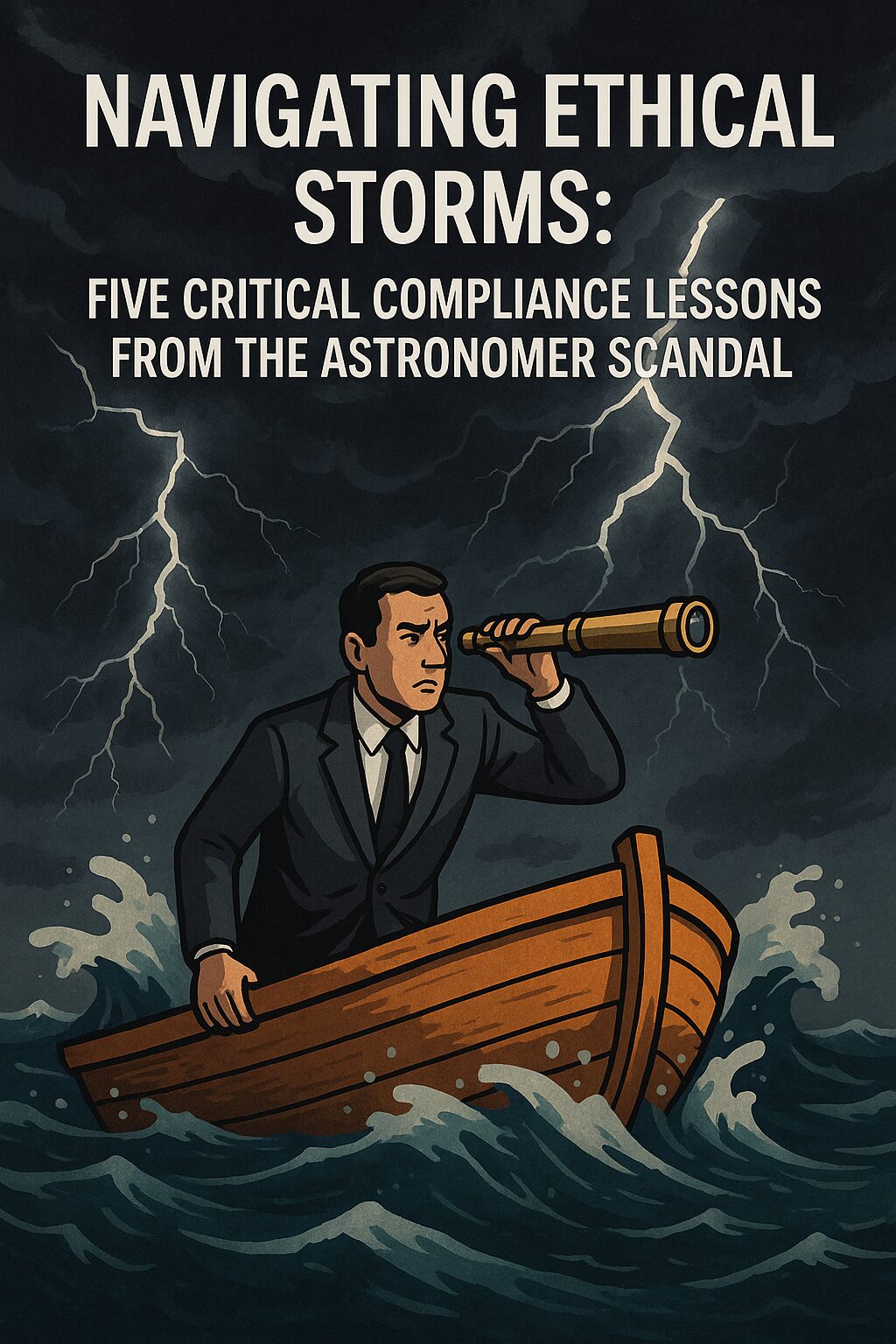
Navigating Ethical Storms: Five Critical Compliance Lessons from the Astronomer Scandal

Recently, we witnessed the Astronomer scandal unfold, making headlines not just for its salacious nature but also for the significant corporate governance and compliance questions it raised. I had the opportunity to sit down with Steve Vincze, founder of Trestle Compliance, for an episode of the FCPA Compliance Report, to consider what a company might do when such an ethics crisis hits. Vincze has extensive experience with just this issue from a similar scandal involving Boeing back in 2003.

Vincze unpacked five critical lessons compliance professionals must heed when confronted with an ethical crisis resembling Astronomer’s.

1. Own the Problem: Transparency Above All

The first, and arguably most important lesson, is the necessity of transparency. Acknowledge the issue unequivocally. Vincze stressed that a corporate crisis is fundamentally a corporate responsibility, regardless of individual faults. Resist the urge to minimize or dismiss the event as merely a lapse in personal judgment. The scandal is yours to manage, and your response will directly impact your organization’s credibility. Owning the problem conveys to stakeholders that your organization prioritizes accountability and transparency, crucial traits for long-term recovery.

2. Leadership Front and Center: Demonstrate Integrity and Commitment

The role of leadership during a crisis cannot be overstated. Vincze’s insights emphasized the need for the highest-ranking executive, especially the new leadership stepping in after a scandal, to be visibly and actively involved in both internal and external communications. Leaders must embody the change they seek, modeling integrity and reinforcing trust. Active, visible leadership sends a strong signal that ethical standards and compliance culture are fundamental and non-negotiable.

3. Establish a Robust Ethics and Compliance Framework

An ethical crisis offers a potent opportunity to recalibrate your corporate culture. As Vincze recommended, clearly define or redefine your organization’s core values through a robust ethics and compliance program. Ensure that these values permeate every policy and procedure. Such a program should go beyond mere regulatory compliance. The company must foster a genuine culture of integrity and trust. This sends a powerful message internally, bolstering employee morale, and externally, enhancing brand reputation.

4. Clarity and Precision: Communicate the Path Forward

Vincze underscored that organizations must communicate their steps to address the crisis, including the rationale behind each decision. Clarity is critical; employees, customers, and stakeholders need to understand not only what actions are being taken but also why. Ambiguity in crisis management breeds distrust and confusion. Conversely, transparent, precise communication builds confidence and illustrates genuine intent to rectify and improve organizational behavior.

5. Courage to Walk Away: Integrity Over Short-term Gains

Compliance often requires difficult choices. Vincze’s fifth lesson highlights the importance of having the courage to walk away from individuals and business relationships that are misaligned with your ethical standards. Not every stakeholder or employee will adapt to new cultural expectations or moral guidelines. It’s essential to prioritize integrity over short-term financial or relational benefits. By demonstrating a strict and uniform enforcement of your compliance policies, you solidify trust and establish a clear ethical boundary.

In addition to these lessons, Vincze shared three essential elements critical for establishing an effective ethics and compliance program post-crisis.

Personal Engagement from Leadership

The Astronomer’s leader(s) and the Chief Compliance Officer must actively participate in every aspect of the program. They should set examples through actions, not just words, exemplifying the standards they wish to instill across the organization. Leaders must engage with employees through regular communication, training sessions, and personal interactions to reinforce the importance of ethical conduct. By visibly aligning their behavior with the organization’s values, leaders inspire trust and confidence among staff. Moreover, their hands-on involvement helps address concerns quickly and effectively, ensuring employees feel heard and valued during the recovery phase.

Right People, Right Roles

Surround yourself with individuals who not only possess technical expertise but also have the interpersonal skills to effectively bridge gaps between legal compliance requirements and practical business operations. Whether building a large team or operating with limited resources, prioritize quality, integrity, and practical expertise. The right individuals should demonstrate strong ethical judgment and possess the ability to communicate compliance standards clearly and persuasively across various organizational levels. Selecting team members who can translate complex regulatory demands into actionable strategies helps facilitate a culture where compliance is not just mandated but embraced as a crucial element of business success.

Balanced Approach to Public Relations

While it is beneficial to maintain a humanizing and approachable image, Vincze advised caution regarding overly humorous or irreverent messaging during a sensitive period. Humor and creativity can indeed facilitate relatability, but they should follow the serious groundwork of rebuilding ethical credibility and trust. PR strategies must carefully balance transparency and accountability with a tone that resonates positively with internal and external stakeholders. Leveraging strategic messaging that acknowledges past issues while clearly outlining proactive measures ensures stakeholders understand your commitment to rectifying mistakes. Ultimately, maintaining an appropriate, thoughtful public image reinforces credibility and supports long-term recovery.

Drawing upon his military experience, Vincze also emphasized the importance of open, respectful dialogue between leadership and employees. Creating safe, transparent channels for communication ensures that employees feel heard and valued. This environment fosters mutual trust and aids in surfacing potential issues proactively, long before they become public crises.

Moreover, an intangible yet crucial consideration emerged from our discussion—talent acquisition and retention. As compliance professionals, we must acknowledge how ethical breaches can significantly damage our organization’s reputation among potential hires and existing employees alike. The fallout from a scandal impacts the very fabric of corporate culture, often more profoundly than immediately quantifiable losses.

Ultimately, the Astronomer scenario underscores that ethical crises, while uncomfortable and challenging, can also serve as critical turning points. They present opportunities to strengthen corporate integrity, enhance transparency, and demonstrate genuine leadership. Compliance officers must be proactive, transparent, and resolute in establishing and upholding ethical standards.

Recovery is always possible; the response is thoughtful, strategic, and aligned with the core values of integrity and transparency. Compliance professionals, armed with these five lessons, can guide their organizations through the storm toward a robust ethical culture and lasting organizational success.

Remember, the road to recovery might be challenging, but as compliance professionals, our commitment to integrity will illuminate the path forward. Let’s keep the conversation going, continue learning, and always strive to elevate the ethical standards of our corporate communities.

Categories
FCPA Compliance Report

Gordon Graham-A Whistleblower’s Story


In this episode of the FCPA Compliance Report I visit with Gordon Graham. Gordon is a successful whistleblower who told his tale in the book The Intrepid Brotherhood. In this book, Graham discusses how corruption threatened to ruin jobs and harm lives. The leadership at the top of the organization used intimidation, distrust, and secrecy to control the Chelan County Public Utility District showing that control and power can corrupt even the most ethical organization’s integrity—unless someone speaks up. Which Gordon Graham did. In this podcast, he tells his story.
Resources
website: www.intrepidbrotherhood.com
LinkedIn: linkedin.com/in/gordon-graham-57385319a
Facebook Author Page: In Search Of Aristotle | Facebook

Categories
Sunday Book Review

February 13, 2022 the Best Books for Ethical Leaders, Part II edition


Today’s episode was inspired by the Notre Dame Deloitte Center for Ethical Leadership and its Faculty Fellows who recently put together their annual list of Best Books for Ethical Leaders. In it, they share books published during the 2021 “that bridge the worlds of business and academia and provide practical insights that can help leaders live and work more ethically.” In this second of two episodes of the Sunday Book Review, I conclude my exploration of their list.
·      There is Nothing for you Here: Finding Opportunity in the Twenty-First Century by Fiona Hill, selected by Jessica McManus Warnell.
·      Chatter: The Voice in Our Head, Why It Matters, and How to Harness It by Ethan Kross, selected by Christopher Adkins.
·      Think Again: The Power of Knowing What You Don’t Know by Adam Grant, selected by John Sikorski.
·      Our Team: The Epic Story of Four Men and the World Series That Changed Baseball by Luke Epplin, selected by Brian Levey.
·      Wanting: The Power of Mimetic Desire in Everyday Life by Luke Burgis, selected by Brett Beasley.

Categories
This Week in FCPA

Episode 290 – the Super Sunday Edition


Super Sunday is here. The NFL finally gets the game in the spotlight after weeks of brutal PR. Who ya got? “Who Dey” or Hollywood? Tom and Jay are back look at some of the week’s top compliance and ethics stories this week in the Super Sunday edition.

 Stories

1.     Do compliance professionals need a union? Dick Cassin in the FCPA Blog.
2.     Jailed employees under the FCPA. Bill Jacobsen explores in the FCPA Blog.
3.     New workplace normal for policies and training. Ingrid Freeden in Risk and Compliance Matters.
4.     New SOE risk management framework.  Alexandra Gillies and Thomas Shipley in the FCPA Blog.
5.     3 questions from KPMG and Carillion tribunal. Neil Hodge in Compliance Week(sub req’d)
6.     SFO investigation protocol announced. Mengqi Sun in the WSJ Risk and Compliance Journal.
7.     Companies yet again ask EU for rules around ESG. Lawrence Heim in practicalESG.
8.     CCOs say self-reporting a hard sell. Evren Esen in CCI.
9.     What comes next for ABC and the Olympics? Andy Spalding in GAB.
10.  The Spotify imbroglio. Matt Kelly with a 2-parter in Radical Compliance, Part 1 and Part 2.

 Podcasts and More

11.  In February on The Compliance Life, I visit with Ellen Smith, a former Director of Trade Compliance who recently started her own consulting firm. In Part 1, she discussed her academic background and early professional career. InPart 2, Ellen moves in-house.
12.  Tom and Richard Lummis begin their annual review of Best Picturing winning movies on 12 O’Clock High, a podcast on business leadership. In Part 1 they review Schindler’s List for leadership and ethical lessons. Upcoming episodes will look at Gladiator, A Man for All Seasons and Platoon.
13.  CCI releases new e-book from Tom “FCPA 2021 Year in Review”. Available free from CCI.
14.  Trial of the Century-the Enron Trial. This week, Tom premiered a 5-part podcast series on the Enron Trial with Loren Steffy, who covered the trial for the Houston Chronicle. In Part 1, run up to the trial. In Part 2, the trial begins. In Part 3, the star witnesses and key testimony. In Part 4, the Verdict comes in. In Part 5, what did it all mean. It is be available on the Compliance Podcast Network, Megaphone, iTunes, Spotify and all other top podcast platforms.
15.  In a special 2-part series on the Sunday Book Review, Tom looks at the Notre Dame Deloitte Center for Ethical Leadership’s top books on ethical leadership from 2021. Part 1 and Part 2.
Tom Fox is the Voice of Compliance and can be reached at tfox@tfoxlaw.com. Jay Rosen is Mr. Monitor and can be reached at jrosen@affiliatedmonitors.com.

Categories
12 O’Clock High-a podcast on business leadership

Leadership Lessons from Schindler’s List


12 O’Clock High, a podcast on business leadership brings together stories from history, the arts and movies, research and current events to consider leadership lessons. Each year during Oscar season we look at four Best Picture-winning movies and draw leadership lessons from them. It is also a way to watch some great movies. In this episode, Richard Lummis and Tom Fox continue our annual tradition of reviewing Best Picture-winning movies by rewatching and then considering the movie Schindler’s List.  Highlights include:

  • Movie Storyline
  • How did it make you feel?
  • Leadership Lessons
  • Ethical Lessons
  • Servant Leadership
  • Final Thoughts on the Banality of Evil
  • Shoah and Schindler’s list

Resources
10 Leadership Lessons from Schindler’s List
Oskar Schindler-a Sheep in Wolf’s Clothing
Evaluating Ethics and Leadership in Schindler’s List
Ethics on Film: A Discussion of Schindler’s List

Categories
Innovation in Compliance

Ethical Leadership for Corporate Directors with Joshua Nunziato


Tom Fox welcomes Joshua Nunziato on this episode of the Innovation in Compliance Podcast. Joshua is an author, and an Instructor in the Social Responsibility and Sustainability division of the Leeds School of Business. He joins Tom to talk about corporate leaders conducting ethical leadership, its role in ESG, and why ethical leadership is a must in the future business world.


Creating Ethical Leadership
Joshua created his Ethical Leadership course for corporate leaders to equip them with the tools and insight they need to understand the changes happening around them. “We really want to help leaders who participate in our program to understand that acceleration is really the new constant,” he tells Tom. Corporate leaders need to be able to respond proactively to changes and crises. The range of stakeholders has expanded, so the traditional approach to corporate director education is no longer going to work. Directors and corporate leaders need forward-looking tools to navigate their current environment. 
 
The Relevance of Ethical Leadership in 2022
Tom asks Joshua to explain why a course on ethical leadership is needed in 2022. Joshua responds that emerging from the crisis mode of the pandemic comes with a range of challenges that board members have to face, including increasing interest rates, high inflation, and uncertainty. Board members need to be able to situate their companies against these challenges and risks, ask the right questions, and provide leadership that will drive their organizations forward. 
 
The Role of Corporate Leaders in ESG
Sustainable leadership in ESG means that the needs and wants of the broad ecosystem of company stakeholders are being met with what Joshua calls, ‘compassionate pragmatism’. “Corporate leaders are able to weigh up and evaluate the comprehensive impact that their decisions are having on the environment on local communities, on their employees, on their suppliers, on their customers, and yes on their investors,” Joshua further explains. Compassionate pragmatism is also about taking in the impact, whether positive or negative, that corporate decisions may have, as well as managing what leaders can measure, and what they cannot. Leaders have to figure out what they value, and also what values they can gather as a business community that will drive them towards enduring prosperity.
 
America in Ethical Leadership
Joshua doesn’t see America taking the lead on ESG, or other sustainability issues; however, he does see America leading relative to other economies that are trying to get their citizens into the global middle class. Innovation on various compliance and ethical issues is happening around the US, and this is because individuals are recognizing the need to respond. The impact of corporate decisions over the decades is being felt across the political spectrum. Scandals and breaches of ethics also have serious ramifications and consequences for businesses, and so it makes sense for leaders to step and lead with ethical conviction. Joshua’s role as a philosopher is to expand the moral imagination of the leaders he works with, so they can ask the right questions and consider sustainable leadership possibilities they otherwise may not have thought of. 
 
Resources
Joshua Nunziato | LinkedIn | Twitter 


Categories
Sunday Book Review

February 6, 2022 the Best Books for Ethical Leaders, Part I edition


Today’s episode was inspired by the Notre Dame Deloitte Center for Ethical Leadership and its Faculty Fellows who recently put together their annual list of Best Books for Ethical Leaders. In it, they we share ten books published during the 2021 “that bridge the worlds of business and academia and provide practical insights that can help leaders live and work more ethically.” Over the next two episodes of the Sunday Book Review, I will be exploring their list.
·      You Have More Influence Than You Think by Vanessa Bohns, selected by Brett Beasley.
·      Under a White Sky: The Nature of the Future by Elizabeth Kolbert, selected by Jessica McManus Warnell.
·      Seven Deadly Economic Sins: Obstacles to Prosperity and Happiness Every Citizen Should Know by James Otteson, selected by Brett Beasley.
·      A Catechism for Business: Tough Ethical Questions and Insights from Catholic Teaching (3rd edition) selected by John Sikorski.

Categories
12 O’Clock High-a podcast on business leadership

Episode 132-Alyson Van Hooser on Gen Z Leadership Perspectives


Richard Lummis is on assignment this week so I am pleased to host Alyson Van Hooser, who was recently in Houston. We sat down for a live recording about her recent LinkedIn post, “3 Gen Z Perspectives Leaders Need to Know”.
Highlights of this podcast include:

  1. Why are you in Houston?
  2. Why did you write the article?
  3. How is Gen Z leadership different from Boomer leadership?
  4. Why do leaders need to learn from stories from their people, not statistics about them?
  5. How does the style of Gen Z parenting different from that of Gen X (or Boomers) and why is that important to a business leader?
  6. Why do you advise Gen Z leaders not to roll up their eyes but to roll up their sleeves?
  7. Why is connecting fast so important to training and communications?
  8. Why are you so passionate about leadership?

 Resources
Alyson’s weekly leadership blog HERE.
If your business would benefit from higher-performing leaders, check out more information about the comprehensive leadership development training Alyson does training,  HERE.
If you want to reach out to Alyson directly, email alyson@vanhooser.com.
P.S. Share and tag Alyson on social — @AlysonVanHooser