
In this episode of The Ethics Experts, Nick Gallo welcomes Jim Massey.
Jim Massey is the Chief Risk, Compliance, and Sustainability Officer | Board Member | 3x Bestselling Author | Speaker & Strategic Advisor on Trust, Risk, and Innovation




Welcome to the award-winning FCPA Compliance Report, the longest-running podcast in compliance. In this episode, Tom welcomes back former Houston Chronicle business columnist Loren Steffy to discuss the business aspects of returning to Venezuela.
Loren Steffy has spent much of his career analyzing the energy industry and the challenges of oil and gas development. On Venezuela, he argues that Trump administration moves are unlikely to produce meaningful gains in oil output and are more likely to deepen market uncertainty, especially in West Texas. Steffy says Venezuela’s oil sector is effectively too risky and too unstable for major foreign investment because its infrastructure has deteriorated, its legal and political environment remains unclear, and rebuilding production would require major capital, advanced technology, and years of work. Even if some companies were willing to take a chance, he believes the combination of insecurity, weak rules, and Trump-era policy uncertainty makes a broad investment revival in Venezuela highly unlikely.
Resources:
Loren Steffy on LinkedIn
Tom Fox
The FCPA Compliance Report was recently named the world’s Best Business Ethics Podcast by FeedSpot.
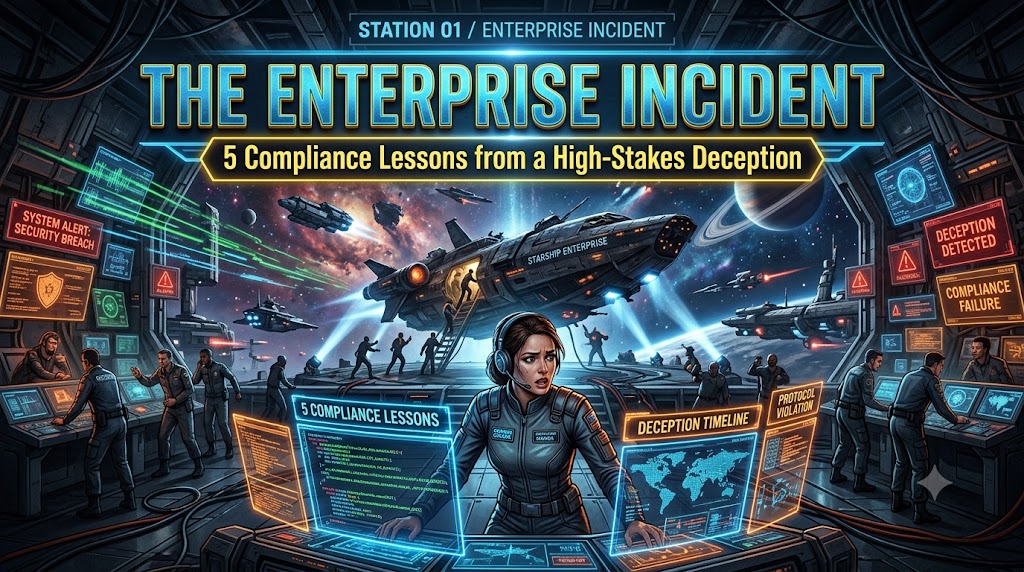
In The Enterprise Incident, Captain Kirk appears to suffer a breakdown. He orders the USS Enterprise across the Neutral Zone and into Romulan territory, where three Romulan vessels immediately surround the ship. Kirk claims that a navigational error caused the incursion. Spock refuses to support that explanation. Instead, he testifies that Kirk has become irrational and is no longer fit for command. Dr. McCoy confirms the diagnosis. Kirk then appears to die after attacking Spock. Of course, none of this is what it seems.
Kirk, Spock, and McCoy are executing a classified Federation operation to steal a Romulan cloaking device. Kirk’s breakdown is staged. Spock’s betrayal is part of the plan. The supposed Vulcan death grip is a fiction. Kirk is surgically disguised as a Romulan, returns to the enemy vessel, steals the device, and escapes with the Enterprise.
The mission succeeds. Yet operational success does not necessarily establish that the underlying decisions were ethical, properly governed, or worth the risk. That tension makes The Enterprise Incident an outstanding study in compliance leadership. It presents five lessons for compliance professionals operating in high-pressure environments.
Lesson 1: Ethical Decision-Making Requires More Than Authorization
Kirk’s mission was not an impulsive act. He was operating under Federation orders. Nevertheless, the operation required deception, an illegal border crossing, theft of sensitive technology, and conduct that could have triggered an interstellar conflict. Authorization matters, but authorization alone does not resolve the ethical question.
Corporate misconduct is often defended with some variation of “senior management approved it” or “the business required it.” Those statements do not transform improper conduct into ethical conduct. They may instead reveal weaknesses in governance, escalation, and executive accountability.
Compliance leaders must ask whether a proposed course of action is consistent with the organization’s legal obligations, stated values, risk appetite, and long-term interests. They must also consider whether the action could withstand scrutiny from regulators, shareholders, employees, and the board. Under pressure, the temptation is to focus exclusively on the desired outcome. The stronger approach is to examine both the objective and the means used to achieve it.
A successful mission can still represent a governance failure. Compliance must help the organization distinguish between what it can do, what it should do, and what it must never do.
Lesson 2: Confidentiality Must Not Eliminate Accountability
The Enterprise crew succeeds because Kirk, Spock, McCoy, and Scotty understand their roles and trust one another. Within that small group, the plan is carefully coordinated. Outside the group, almost everyone is intentionally misled. This is a classic need-to-know operation. It also demonstrates the risk created when secrecy becomes a substitute for accountability.
Organizations sometimes need to restrict information. Internal investigations, acquisition discussions, government inquiries, cybersecurity incidents, and sensitive personnel matters all require confidentiality. The mistake is assuming that confidentiality means normal controls no longer apply. Even the most sensitive matter should have an accountable owner, defined decision rights, appropriate legal oversight, protected documentation, and a process for reporting to the board when necessary. Information may be limited, but accountability should remain clear.
This lesson is particularly important in internal investigations. An investigation may require discretion, but the organization must still preserve evidence, manage conflicts, document decisions, protect against retaliation, and identify who receives the findings. The key distinction is between controlled confidentiality and organizational opacity. Controlled confidentiality protects the integrity of the process. Opacity protects decision-makers from scrutiny. Trust among a small team is valuable. It is not a replacement for governance.
Lesson 3: Sensitive Technology Demands Controls Across Its Entire Lifecycle
The Romulan cloaking device is more than a valuable piece of equipment. It is strategically significant technology capable of changing the balance of power. The Enterprise crew focuses first on acquiring the device. Scotty must then integrate an unfamiliar piece of Romulan technology into the ship’s systems while the Enterprise is under attack. There is little time for testing, security review, or compatibility analysis.
Modern organizations face similar issues with artificial intelligence, source code, proprietary algorithms, customer data, trade secrets, surveillance tools, and cybersecurity capabilities. The risk does not begin or end with acquisition. It extends across the technology’s entire lifecycle. The cloaking device also raises a broader question: Just because technology can create a strategic advantage, should the organization deploy it immediately?
That question is central to AI governance. A new AI system may promise speed, efficiency, and competitive advantage. It may also create risks related to privacy, discrimination, intellectual property, cybersecurity, and regulatory compliance. The organization needs more than an enthusiastic business sponsor. It needs governance, testing, documentation, human oversight, and clear accountability. Innovation without controls creates unmanaged exposure. Controls without an understanding of the technology create false assurance.
Lesson 4: Regulatory and Geopolitical Risk Must Be Built into Strategy
The Neutral Zone is not simply a line on a star chart. It represents a legal, diplomatic, and military boundary. Crossing it creates consequences that extend far beyond the Enterprise. International businesses operate across their own versions of the Neutral Zone. These include anti-bribery laws, sanctions, export controls, data localization requirements, competition rules, human rights expectations, and restrictions on technology transfers.
A decision that appears commercially attractive in one jurisdiction may create serious exposure in another. A third party that looks essential to market access may present corruption or sanction risks. A technology transfer may implicate national security restrictions. A routine payment may become evidence of an improper inducement. Compliance cannot be brought in after the business has crossed the border.
The compliance function should participate in market-entry decisions, transactions, major technology transfers, and relationships involving government touchpoints. This requires more than maintaining a regulatory inventory. It requires understanding how legal, political, cultural, and enforcement risks affect business strategy. The Enterprise had only one hour to respond to the Romulan demand for surrender. Corporate leaders often face similar pressure, although usually without disruptor beams. The time to establish decision protocols is before the crisis begins.
Lesson 5: Compliance Should Enable Calculated Risk, Not Eliminate It
Stealing the cloaking device was extraordinarily risky. It also offered a significant strategic benefit. Starfleet decided that the potential value justified the exposure. Every organization takes risks. The purpose of compliance is not to eliminate risk or prevent innovation. It is to help the organization understand risk, evaluate it intelligently, establish limits, and make accountable decisions.
A calculated risk is not simply a dangerous decision that happens to succeed. It is a decision supported by reliable information, appropriate expertise, documented assumptions, mitigation measures, clear ownership, and contingency planning. The Enterprise mission depended on several assumptions. The Romulans had to accept Kirk’s apparent instability. The commander had to believe Spock’s betrayal. Kirk’s disguise had to work. Scotty had to integrate the cloaking.
Compliance adds value when it helps the business take better risks. That requires early engagement, commercial understanding, credible challenge, and a willingness to say no when the proposed conduct crosses a legal or ethical boundary.
Final Thoughts
The Enterprise Incident ends with the Enterprise escaping Romulan space under the protection of the stolen cloaking device. The operation succeeds because of extraordinary coordination, technical skill, and trust. Yet the episode leaves compliance professionals with a harder question: Was the mission properly governed, or was it simply successful?
That distinction matters. Results do not validate weak processes. Senior approval does not cure unethical conduct. Confidentiality does not remove accountability. Innovation does not override controls. Strategic pressure does not suspend legal obligations. The compliance professional’s role is to help the organization navigate those tensions before it enters the Neutral Zone.
The final compliance lesson from The Enterprise Incident is straightforward: Bold leadership may take the organization into uncertain territory, but effective compliance ensures that it does not cross the line without understanding what lies on the other side.
Resources:
Excruciatingly Detailed Plot Summary by Eric W. Weisstein
In this episode of Trekking Through Compliance, we consider the episode The Enterprise Incident, aired on September 27, 1968, Star Date 5031.3.
Story Synopsis
The Enterprise Incident follows Captain James T. Kirk and his crew as they undertake a daring and covert mission within the Neutral Zone, the border region between the United Federation of Planets and the Romulan Star Empire.
The episode begins with Captain Kirk displaying erratic behavior, directing the U.S.S. Enterprise into the Neutral Zone without explanation. This action provokes an aggressive response from Romulan ships, resulting in the Enterprise being captured. The Romulan Commander, a determined and intelligent woman, boards the Enterprise and questions Kirk and Spock.
Kirk’s seemingly unstable behavior escalates, leading Spock to declare his captain unfit for command. Kirk attacks Spock but is subdued, and Spock, following Vulcan discipline, appears to kill him with a nerve pinch. This move results in Kirk’s confinement, during which the Romulan Commander attempts to persuade Spock to defect, appealing to his Vulcan logic and offering him a position in the Romulan fleet.
In reality, the entire sequence is a meticulously planned ruse. Disguised as a Romulan, Kirk infiltrates the Romulan vessel to steal a highly advanced cloaking device. Dr. McCoy’s medical skills and Spock’s loyalty are crucial in maintaining the charade. Kirk successfully retrieves the cloaking device and returns it to the Enterprise. Meanwhile, Spock stalls the Romulan Commander, revealing the truth only when necessary.
The episode culminates with the Enterprise escaping with the cloaking device. The Romulan Commander, realizing Spock’s deception, is left with a sense of betrayal and admiration for her adversaries. This mission highlights the strategic acumen and boldness of the Starfleet crew, as well as the complex interplay of loyalty and deception in espionage. “The Enterprise Incident” remains a standout episode for its suspenseful plot and the nuanced portrayal of its characters.
Commentary
The discussion focuses on key leadership lessons for compliance professionals, including ethical decision-making under pressure, maintaining transparency, managing sensitive information and technology, navigating complex regulatory environments, and balancing risk and innovation. The episode highlights how Captain Kirk and his crew’s risky mission to steal a Romulan cloaking device illustrates these principles.
Key highlights:
Resources:
Excruciatingly Detailed Plot Summary by Eric W. Weisstein
Fiona is an AI-generated voice

Welcome to the Daily Compliance News. Each day, Tom Fox, the Voice of Compliance, brings you compliance-related stories to start your day. Sit back, enjoy a cup of morning coffee, and listen in to the Daily Compliance News. All, from the Compliance Podcast Network. Each day, we consider four stories from the business world, compliance, ethics, risk management, leadership, or general interest for the compliance professional.
Top stories include:
To learn about the intersection of Sherlock Holmes and the modern compliance professional, check out Tom’s latest book, The Game is Afoot-What Sherlock Holmes Teaches About Risk, Ethics and Investigations on Amazon.com.

Welcome to AI Today in 5, the newest addition to the Compliance Podcast Network. Each day, Tom Fox will bring you 5 stories about AI to start your day. Sit back, enjoy a cup of morning coffee, and listen in to AI Today in 5. All from the Compliance Podcast Network. Each day, we consider five stories from the business world, compliance, ethics, risk management, leadership, or general interest about AI.
Top AI stories include:
For more information on the use of AI in compliance programs, Tom Fox’s new book, Upping Your Game, is available. You can purchase a copy of the book on Amazon.com.
To learn about the intersection of Sherlock Holmes and the modern compliance professional, check out Tom’s latest book, The Game is Afoot-What Sherlock Holmes Teaches About Risk, Ethics and Investigations on Amazon.com.
An effective compliance program is not a collection of disconnected policies, training modules, hotline reports, and investigation files. It is an operating system. Culture determines whether employees will use it. Risk assessment tells the organization where it must adapt. Investigations test whether the system responds credibly. Whistleblower programs reveal whether employees trust it enough to speak. Over this four-part blog post series, we will examine those connections, beginning with the discipline that makes every other element work: communication.
Compliance professionals often describe communication as one element of a program. That description is too narrow. Communication is the operating system through which employees learn expectations, seek advice, identify risk, report concerns, and judge whether management means what it says. If that system is slow, generic, inaccessible, or untrusted, even well-designed controls can fail in practice.
This matters because a compliance program does not become effective when a policy is published or training is completed. It becomes effective when an employee facing pressure knows what to do, understands where to go, and believes that asking for help will not create a career problem. Communication is therefore not simply messaging. It is a preventive control, a detection mechanism, and a source of management information.
Communication Is a Control, Not a Campaign
Many organizations still approach compliance communication as a calendar exercise. They send a Code of Conduct message, deliver annual training, publish a hotline reminder, and count distribution. Those activities may be necessary, but they do not establish whether the message reached the employee at the moment of risk.
An effective communication control has four characteristics.
These distinctions are important. A campaign pushes information out. A control creates a reliable exchange of information. That exchange gives compliance an early view of confusion, pressure, process weakness, and emerging misconduct. It also gives employees a practical path to lawful and ethical decisions.
What the DOJ Is Really Asking
The Department of Justice has moved the compliance discussion away from paper design and toward operational effectiveness. The three fundamental questions in the 2024 Evaluation of Corporate Compliance Programs (ECCP) examine the program’s design, empowerment, and whether it works in practice.
For culture, the DOJ asks, “Does the company seek input from all levels of employees?” It then asks, “What steps has the company taken in response to its measurement of the compliance culture?” Those questions place two obligations on compliance. First, the company must listen across levels, functions, and locations. Second, it must demonstrate that listening changed something. Data without response is observation, not effectiveness.
The ECCP also directs prosecutors to examine policy accessibility, training effectiveness, the availability of guidance, and whether employees know when to seek advice. Taken together, these questions make communication evidence. A company should be able to show not only what it said but also who could access it, whether employees understood it, how they used it, and what management learned from it.
Build Channels Around Employee Behavior
Employees do not experience the company through a single channel. They communicate through managers, messaging platforms, internal websites, employee groups, town halls, mobile devices, and informal workplace networks. A compliance program that relies on one formal channel will miss important signals.
The practical response is a channel portfolio. Policies should be searchable and written in language employees can use. Guidance should be available through live compliance contacts and appropriate digital tools. Reporting options should include the hotline, web intake, direct contact with compliance or human resources, and management escalation. Communications should reach operational employees who may not sit at a computer, as well as global employees who may face language or cultural barriers.
Compliance also needs to listen where employees are already speaking. That may include internal collaboration channels, employee surveys, focus groups, office visits, and patterns in questions received by the compliance team. Any monitoring must be consistent with law, privacy expectations, company policy, and records-management requirements. The goal is not surveillance. The goal is to understand the employee experience before a cultural weakness becomes a control failure.
Face-to-face contact remains especially valuable. A visit to a business unit can reveal whether employees understand a policy, whether managers create pressure, and whether the local process matches the written procedure. It also changes how employees see compliance. A familiar adviser is easier to contact than a distant function that appears only during training or an investigation.
Replace Training Completion With Decision Readiness
Completion rates answer whether an employee opened a course. They do not answer whether the employee can recognize a conflict, challenge a questionable payment, escalate an export-control concern, or pause the use of an unapproved AI tool. As Hui Chen continually reminds us, it is about results, not inputs.
Training should therefore be built around decision readiness. Scenario-based sessions allow employees to work through realistic gray areas and explain why one course of action is safer than another. Shorter, targeted modules can address risk by role. Experienced employees may be able to demonstrate proficiency through testing, while supervisors may require additional training because they receive concerns and translate policy into daily conduct.
Relevance is a control feature. Employees are more likely to retain training that reflects their workplace, business model, and actual risk. A procurement team needs different scenarios from a sales team. A manager needs to understand retaliation and escalation. An engineer needs clear boundaries around data, cybersecurity, and AI. Localization must also address more than translation. Examples, delivery methods, and escalation paths should make sense in the local operating environment. The measurement should move beyond completion. Useful indicators include questions asked after training, repeat areas of confusion, scenario performance, requests for advice, policy-page use, control exceptions, and whether similar misconduct declines over time.
Make Leadership Visible and Consistent
Tone at the top loses force when it sounds scripted or appears only once a year. Employees judge leadership commitment through repeated choices: which risks receive attention, whether high performers are disciplined, whether managers welcome questions, and whether business pressure routinely overrides control requirements.
Compliance communication is stronger when leaders explain expectations in their own voices and connect them to business responsibilities. The chief executive can frame integrity as part of strategy. Finance can address books and records. Human resources can speak to respect, retaliation, and accountability. Business leaders can explain why escalation protects customers and sustainable growth.
Middle management is equally important. Most employees experience culture through their direct supervisor. Managers should be trained to receive concerns, avoid promises they cannot keep, protect confidentiality, escalate promptly, and prevent retaliation. If employees hear an ethical message from senior leadership but experience dismissal from a supervisor, the local message will win. Consistency completes the control. The organization must apply standards across rank, geography, and commercial importance. Unequal treatment communicates more powerfully than any policy statement.
Use Data Without Losing the Human Signal
Technology can help compliance measure reach and engagement. Policy-page analytics can show whether employees use key resources. Digital guidance tools can identify common questions. Investigation and reporting data can reveal trends by issue, region, or function. Training results can show where judgment remains weak.
These data points should be treated as signals, not verdicts. High question volume may indicate confusion, but it may also show that employees trust compliance. An increase in reports may reflect more misconduct, a successful awareness campaign, or greater confidence in the reporting process. Low reporting may indicate a healthy environment, or it may be a warning that employees believe speaking up is futile.
The best analysis combines quantitative and qualitative evidence. Compliance should compare usage data with employee interviews, survey responses, investigation themes, audit findings, exit information, and observations from business partners. It should protect privacy, limit access, and avoid metrics that encourage the wrong behavior. A target that simply seeks fewer reports can suppress the very information the company needs.
Convert Listening Into Action
The strongest evidence of culture is not the survey itself. It is what the company does next. If employees cannot find a policy, redesign access. If repeated questions reveal ambiguity, rewrite the guidance. If a region reports little despite known risk, test for fear or channel barriers. If investigations identify manager misconduct, adjust training, incentives, supervision, and discipline.
This requires a closed-loop process. Gather information. Analyze it for themes and root causes. Assign ownership for action. Document the decision. Communicate appropriate changes. Then measure whether the change worked. That process turns communication into continuous improvement and creates a defensible record of program evolution.
It also connects this first installment to the rest of the series. Employee questions and reporting patterns are early risk indicators. Investigation quality tells employees whether the company acts on what it hears. Whistleblower-program credibility determines whether critical information enters the system at all. Each element depends on the others.
From Culture to a Shifting Risk Environment
Communication gives compliance something more valuable than reach. It provides intelligence. Questions about a new market, an AI application, a third party, a customer demand, or a supply-chain disruption may be the first evidence that the risk environment has changed.
Join us tomorrow for our next installment, where we will examine how compliance can convert those signals into dynamic risk assessment, clear ownership, and adaptive controls. A shifting risk environment cannot be managed by an annual exercise alone. It requires the listening discipline established here.
Bonus Questions for Compliance Professionals