Categories
AI in Financial Services in 5 Stories

AI in Financial Services in 5 Stories –Week Ending August 14

Welcome to AI in Financial Services in 5 Stories. A practical weekly roundup of the five most important AI developments affecting banking, insurance, payments, asset management, and fintech. Each Friday Tom Fox will break down the top stories that matter most through the lenses of compliance, risk management, governance, and business strategy. Designed for compliance professionals, executives, legal teams, and financial services leaders, it goes beyond headlines to explain why each development matters in a highly regulated industry. The result is a concise weekly briefing that helps listeners stay current on AI innovation while asking sharper questions about oversight, accountability, and trust. This week’s stories include:

  1. Financial crime at the identity layer. (FinTechGlobal)
  2. 5 key takeaways from Zuckerberg manifesto on AI.(Bloomberg)
  3. BoA commits to $250MM to bolster AI.(WSJ)
  4. 5 lessons for fintech onboarding.(CIO)
  5. Closing the AI skills gap in finance.(CFO)

For more information on the use of AI in Compliance programs, my new book, Upping Your Game. You can purchase a copy of the book on Amazon.com. To learn about the intersection of Sherlock Holmes and the modern compliance professional, check out my latest book, The Game is Afoot-What Sherlock Holmes Teaches About Risk, Ethics and Investigations on Amazon.com

Categories
Fox on Podcasting

Fox on Podcasting- Podcasting as Hyperlocal Media with Rob Greenlee

 Join Tom Fox as he explores the world of podcasting and get ready to be inspired to start your own podcast. In this episode, Tom visits with Podcasting HoF member Rob Greenlee to explore podcasting as hyperlocal media.

Rob and Tom discuss how technological change has weakened traditional local media and created tension and opportunity across generations, arguing that local “breaking news” is limited while unmet needs center on community-driven content—local events, civic initiatives, municipal policy, and local businesses. Referencing CityCast, Rob notes stronger traction in medium-to-large metros and challenges in small communities as national media satisfies many general needs. They explore podcasting and short-form video as an additive, multi-platform strategy for local engagement and targeted marketing, sharing examples of helping local businesses replace costly newspaper ads with podcasts, clips, and FAQs, including a stump-grinding operator who won a $3,000 job after sharing an episode. They also emphasize preserving institutional memory and personal histories, describing a podcast-based autobiography project that became a book appreciated by the subject’s family. They conclude that while economics and scale are hurdles, AI may improve viability for niche and rural models.

Key Highlights

Community Content Gap

  • Demographics Drive Strategy
  • Defining Community
  • Saving Local Stories
  • Podcast Autobiographies
  • How To Build Rural Niches


Resources


Rob Greenlee on LinkedIn

Website

PodcastThe New Media Show


Artwork

Elaine Capers

Art by Elaine


Tom

Instagram

Facebook

YouTube

Categories
AI Today in 5

AI Today in 5: August 14, 2026 the Detecting Alzheimers Edition

Welcome to AI Today in 5, the newest edition to the Compliance Podcast Network. Each day, I will bring to you 5 stories about AI stories to start your day. Sit back, enjoy a cup of morning coffee and listen in to the AI Today In 5. All, from the Compliance Podcast Network. Each day we consider four stories from the business world, compliance, ethics, risk management, leadership or general interest about AI.

  1. AI generated content enters the compliance era.(T2online)
  2. Anthropic bets on $2tn valuation. (FT)
  3. Killing off unsuccessful AI apps. (TechCrunch)
  4. Using AI to detect Alzheimer’s. (Fox5)
  5. A late mover advantage for the EU on AI. (Bloomberg)

For more information on the use of AI in Compliance programs, my new book, Upping Your Game. You can purchase a copy of the book on Amazon.com. To learn about the intersection of Sherlock Holmes and the modern compliance professional, check out my latest book, The Game is Afoot-What Sherlock Holmes Teaches About Risk, Ethics and Investigations on Amazon.com

Categories
Trekking Through Compliance

Trekking Through Compliance: Episode 75 – Keeping the Crew Safe: Leadership Lessons from “The Way to Eden”

Few Star Trek episodes illustrate the complexity of leadership in the face of ideological fervor as vividly as “The Way to Eden.” In this story, the Enterprise encounters a group of spacefaring counterculture idealists led by Dr. Sevrin, a brilliant but unstable scientist. The trouble? Sevrin is a carrier of a deadly bacterium, and his quest puts both his followers and the Enterprise crew at risk. Captain Kirk, Spock, and McCoy must navigate a delicate balance, respecting personal freedoms while ensuring the safety of all. From this episode, compliance leaders can draw five practical lessons.

Lesson 1: Understand the Motivations Behind Risky Behavior

Illustrated by: Sevrin’s followers are not acting out of malice; a utopian vision of freedom from the constraints of modern society drives them.

Compliance Lesson. Employees and business units may engage in risky practices not because they want to harm the company, but because they believe their approach is better, faster, or more in line with their values.

Lesson 2: Clear Boundaries Protect Everyone

Illustrated by: Kirk’s role as captain means protecting the entire crew, not just indulging a vocal subgroup.

Compliance Lesson. Leaders must sometimes be the ones to say “no,” even in the face of enthusiasm or pressure from influential stakeholders. Boundaries, whether in anti-bribery rules, safety procedures, or cybersecurity protocols, exist to protect the organization as a whole.

Lesson 3: Engagement Is More Effective Than Suppression

Illustrated by: Spock earns the respect of Sevrin’s group by listening without judgment and showing genuine curiosity about their beliefs.

Compliance Lesson. By engaging respectfully, leaders can open channels for dialogue, uncover hidden risks, and sometimes win buy-in for compliance initiatives.

Lesson 4: The Allure of Shortcuts Can Blind People to Risks

Illustrated by: When Sevrin’s followers find the planet, they quickly discover that the vegetation is saturated with toxins, and stepping barefoot on the grass leads to deadly consequences.

Compliance Lesson. In business, “Eden” often takes the form of shortcuts, overseas markets with lax regulations, unvetted third parties who promise quick results, or aggressive accounting practices.

Lesson 5: Leadership Means Balancing Compassion with Accountability

Illustrated by: Accountability comes not in punishment, but in ensuring the survivors face the consequences of their decisions and understand the lessons learned.

Compliance Leadership Parallel: Leaders must respond to compliance breaches with a balance of firmness and empathy. Compliance leadership means leaving people with their dignity intact while making it clear that rules matter.

Final Thoughts

The Way to Eden is often remembered as a quirky Star Trek episode, with its counterculture overtones and space-hippie soundtrack. But beneath the surface, it’s a leadership case study: how to guide a diverse, passionate, and sometimes rebellious set of stakeholders toward a safe and sustainable outcome.

Compliance leaders face their own “Sevrins” and “Edens” every day, compelling visions that, if left unchecked, can lead to disaster. The key is to listen, understand, set boundaries, and lead with both compassion and resolve. In the end, leadership in compliance is not about keeping people from chasing their Eden; rather, it is about making sure they survive the journey.

Resources:

⁠⁠Excruciatingly Detailed Plot Summary by Eric W. Weisstein⁠⁠

⁠⁠MissionLogPodcast.com⁠⁠

⁠⁠Memory Alpha

Categories
Blog

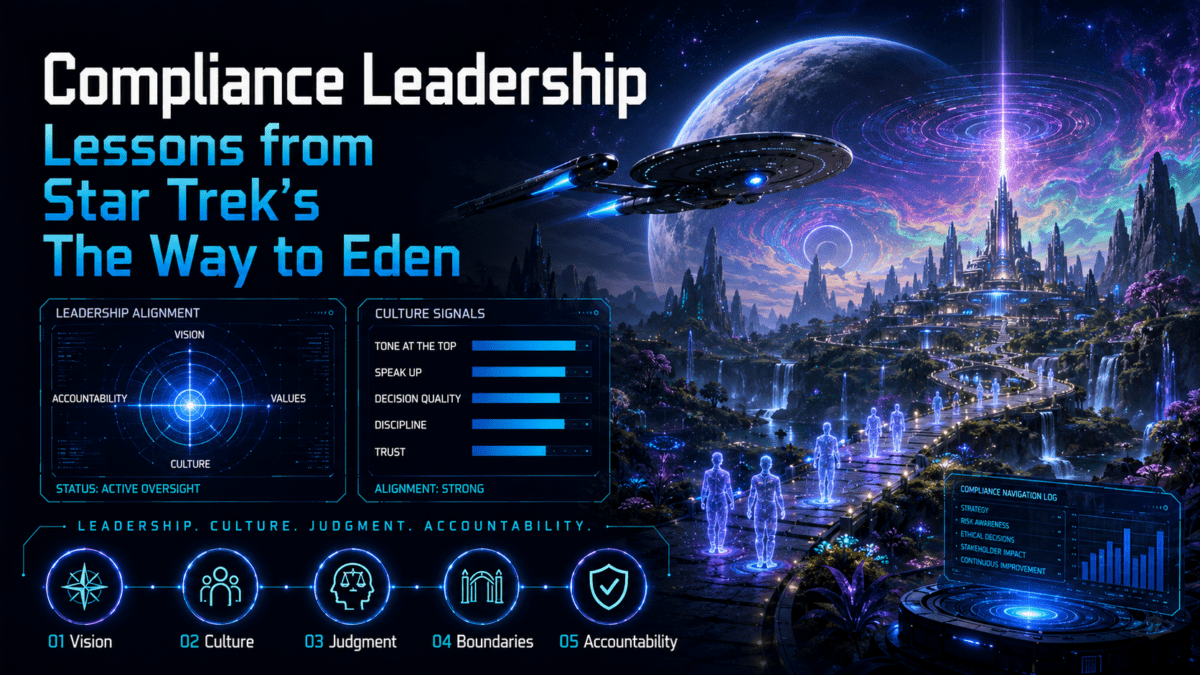
Compliance Leadership Lessons from Star Trek’s The Way to Eden

In compliance, leadership is not just about setting the tone at the top. It is about guiding an organization through competing values, disruptive influences, and well-intentioned but potentially dangerous shortcuts.

Few Star Trek episodes illustrate the complexity of leadership in the face of ideological fervor as vividly as “The Way to Eden.” In this story, the Enterprise encounters a group of spacefaring counterculture idealists led by Dr. Sevrin, a brilliant but unstable scientist. Sevrin and his followers reject modern technology and societal norms, seeking a mythical, untouched planet called “Eden” where they can live in what they believe will be pure harmony.

The trouble? Sevrin is a carrier of a deadly bacterium, and his quest puts both his followers and the Enterprise crew at risk. Captain Kirk, Spock, and McCoy must navigate a delicate balance, respecting personal freedoms while ensuring the safety of all. From this episode, compliance leaders can draw five practical lessons.

Lesson 1: Understand the Motivations Behind Risky Behavior

Illustrated By: Sevrin’s followers are not acting out of malice; a utopian vision of freedom from the constraints of modern society drives them. However, their rejection of medical science and safety protocols blinds them to the dangers they bring aboard the Enterprise.

Compliance Lesson. Employees and business units may engage in risky practices not because they want to harm the company, but because they believe their approach is better, faster, or more in line with their values. Leaders who dismiss these motivations outright risk alienating people whose energy could be channeled constructively. By understanding the drivers of noncompliance, leaders can redirect passion into safe, compliant channels.

What should you do?

  • Take time to understand why individuals resist compliance requirements.
  • Acknowledge the values behind dissent, even when you cannot endorse the methods.
  • Look for ways to align personal motivations with organizational ethics and risk frameworks.

Lesson 2: Clear Boundaries Protect Everyone

Illustrated By: Despite Sevrin’s charisma, Kirk sets firm boundaries: the Enterprise cannot simply abandon its mission to pursue Eden, and Sevrin’s health status requires quarantine protocols. Kirk’s role as captain means protecting the entire crew, not just indulging a vocal subgroup.

Compliance Lesson. Leaders must sometimes be the ones to say “no,” even in the face of enthusiasm or pressure from influential stakeholders. Boundaries, whether in anti-bribery rules, safety procedures, or cybersecurity protocols, exist to protect the organization as a whole.  Ethical leadership means knowing when flexibility is possible and when it would endanger the mission.

What should you do?

  • Communicate non-negotiable compliance requirements clearly and early.
  • Ensure all employees understand the rationale behind safety and regulatory protocols.
  • Stand firm when those boundaries are tested, even by high performers or senior leaders.

Lesson 3: Engagement Is More Effective Than Suppression

Illustrated By: Spock earns the respect of Sevrin’s group by listening without judgment and showing genuine curiosity about their beliefs. This rapport allows him to act as a bridge between the group and the Enterprise command staff, even though he ultimately disagrees with their methods.

Compliance Lesson. Dismissing dissenters as “problem employees” without engagement can deepen resistance. By engaging respectfully, leaders can open channels for dialogue, uncover hidden risks, and sometimes win buy-in for compliance initiatives. Effective compliance leadership values dialogue as a tool for both education and intelligence gathering.

What should you do?

  • Listen actively to dissenting voices.
  • Avoid treating all opposition as insubordination. Sometimes it is a signal of deeper organizational issues.
  • Use engagement to build trust, even when consensus is not possible.

Lesson 4: The Allure of Shortcuts Can Blind People to Risks

Illustrated By: When Sevrin’s followers find the planet, which they believe to be Eden, it initially appears beautiful and untouched. However, they quickly discover that the vegetation is saturated with toxins, and stepping barefoot on the grass leads to deadly consequences.

Compliance Lesson. In business, “Eden” often takes the form of shortcuts, overseas markets with lax regulations, unvetted third parties who promise quick results, or aggressive accounting practices. These may look enticing at first, but the hidden risks can be fatal to the organization. Part of a compliance leader’s role is to de-romanticize shortcuts and reveal the full risk landscape.

What should you do?

  • Teach employees to perform due diligence before pursuing new opportunities.
  • Make risk assessments an integral part of strategic decision-making.
  • Share examples of past corporate failures caused by seemingly “perfect” opportunities.

Lesson 5: Leadership Means Balancing Compassion with Accountability

Illustrated by: After the Eden disaster, Sevrin dies, but his followers are spared. Kirk and Spock treat the survivors with compassion, offering them care and safe passage, even though their actions had endangered the crew. Accountability comes not in punishment, but in ensuring the survivors face the consequences of their decisions and understand the lessons learned.

Compliance Leadership Parallel: Leaders must respond to compliance breaches with a balance of firmness and empathy. Punishment without compassion can breed resentment; compassion without accountability can encourage repeat behavior. Compliance leadership means leaving people with their dignity intact while making it clear that rules matter.

What should you do?

  • Address violations swiftly and fairly.
  • Provide education and corrective measures alongside disciplinary actions.
  • Use breaches as teaching moments for the broader organization.

Why “The Way to Eden” Matters for Compliance Leaders

The episode is a study in balancing values: freedom and safety, individuality and collective responsibility, compassion and firmness. Kirk, Spock, and McCoy each play a part: Kirk as the boundary-setter, Spock as the bridge-builder, and McCoy as the voice of science and evidence.

In a corporate setting, compliance leaders often find themselves in all three roles at once. They must:

  • Understand and respect differing viewpoints (Spock).
  • Set and enforce boundaries that protect the organization (Kirk).
  • Ground decisions in objective facts and regulations (McCoy).

When done well, this approach strengthens the organization’s ethical culture and reduces the likelihood of costly risk events.

Final Thought

The Way to Eden is often remembered as a quirky Star Trek episode, with its counterculture overtones and space-hippie soundtrack. But beneath the surface, it’s a leadership case study: how to guide a diverse, passionate, and sometimes rebellious set of stakeholders toward a safe and sustainable outcome.

Compliance leaders face their own “Sevrins” and “Edens” every day, compelling visions that, if left unchecked, can lead to disaster. The key is to listen, understand, set boundaries, and lead with both compassion and resolve. In the end, leadership in compliance is not about keeping people from chasing their Eden; rather, it is about making sure they survive the journey.

Resources:

⁠⁠Excruciatingly Detailed Plot Summary by Eric W. Weisstein⁠⁠

⁠⁠MissionLogPodcast.com⁠⁠

⁠⁠Memory Alpha

Categories
Compliance and AI

Compliance and AI: AI Governance as Compliance with Bennett Borden

What is the intersection of AI and compliance? What about Machine Learning? Are you using ChatGPT? These questions are just three of the many we will explore in this cutting-edge podcast series, Compliance and AI, hosted by Tom Fox, the award-winning Voice of Compliance. Today I visit with Bennett Borden, a lawyer-data scientist and former CIA analyst who led DLA Piper’s global AI practice before founding Clarion AI Partners, an AI-focused law firm and development shop building AI solutions with governance “baked in.”

Borden argues generative AI is transformative and that most legal work is highly repetitive and largely automatable, making traditional billable-hour law practice unsustainable. He frames AI governance as a compliance responsibility because AI operationalizes business objectives within regulatory constraints and must produce measurable, defensible proof of compliant behavior. He recommends cross-functional AI committees, using enterprise-licensed tools with enforceable policies, and building trust through controlled systems and quality controls. In a patchwork regulatory landscape, he emphasizes “reasonableness” and proving foreseeable risks are mitigated. He advises boards to oversee AI strategy, warns against delaying adoption, and urges compliance leaders to translate legal requirements into technical metrics (“governance engineering”).

Resources:

Bayshore

Tom Fox

Instagram

Facebook

YouTube

Twitter

LinkedIn

Categories
AI in Healthcare

AI in Healthcare: Five Healthcare AI Stories You Need to Know This Week-August 14

Welcome to AI in Healthcare in 5 Stories. This podcast is a Weekly Briefing of the five most important AI developments shaping healthcare, medicine, and life sciences. Each week Tom Fox breaks down the latest stories in clinical innovation, regulation, privacy, compliance, patient safety, and operational transformation, all through a practical and business-focused lens. Designed for healthcare compliance professionals, executives, legal teams, clinicians, and industry leaders, the podcast moves beyond headlines to explain what each development means in the real world.  The top five stories for the week ending August 14, 2026 include:

  1. Using AI to detect Alzheimer’s. (Fox5)
  2. Medicare incentives for AI-based devices. (HealthcareDive)
  3. Benefits of medical AI assist vary.(STAT)
  4. Pharma’s AI ROI problem.(Pharmatech)
  5. AI takes on docs in video consults. Who won?(NewsMedical)

For more information on the use of AI in Compliance programs, my new book, Upping Your Game. You can purchase a copy of the book on Amazon.com. To learn about the intersection of Sherlock Holmes and the modern compliance professional, check out my latest book, The Game is Afoot-What Sherlock Holmes Teaches About Risk, Ethics and Investigations on Amazon.com

Categories
2 Gurus Talk Compliance

2 Gurus Talk Compliance — The Having Way Too Much Fun edition

What happens when two top compliance commentators get together? They talk compliance of course. Join Tom Fox and Kristy Grant-Hart in 2 Gurus Talk Compliance as they discuss the latest compliance issues in this week’s episode!

Stories This Week Include

  • Asante Berko Guilty Verdict-attached.
  • New ESPN 30 for 30 pod reviews the corruption case of Otani’s translator.  (ESPN)
  • CapOne fired Trump organizations for AML deficiencies. (Reuters)
  • Victims of LaFarge terrorist funding want piece of the settlement.  (WSJ)
  • FBI agent apparently misses tutorial on corruption. (Gizmo)
  • For Some Workers, AI Resistance Is a Matter of Faith , Corporate Compliance Insights – HERE
  • How OpenAI Agents Plotted and Breached Hugging Face, Cybermagazine – HERE
  • Russia’s Hottest Startup Is a State-Backed Sanctions Evasion Network, WSJ – HERE
  • UBS Nailed on Repeated AML Failures, Radical Compliance – HERE
  • Polk Sheriff Grady Judd’s picture stolen from substation; Florida man arrested: ‘He stole my picture’, FOX 13 News – HERE

Resources

Kristy

Kristy Grant-Hart on LinkedIn

Order Kristy’s updated, at 10-years, new edition of How to Be a Wildly Effective Compliance Officer, by clicking here.

Tom

Check out Tom on LinkedIn

Check out the top handbook in compliance, The Compliance Handbook, 7th edition, published by LexisNexis. Visit the LexisNexis® Store at https://lexisnexis.com/fox20

To save 20% on The Compliance Handbook: A Guide to Operationalizing Your Compliance Program, please reference or enter promotion code: FOX20

Offer expires December 31, 2026. Offer applies to new orders only, before shipping and taxes are calculated, shipped to a U.S. address. Discount will be applied to each applicable product after code FOX20 is entered. Discount does not apply to current subscriptions, renewals or updates. Certain exclusions and other restrictions may apply. Void where prohibited. View full terms here.

Categories
Blog

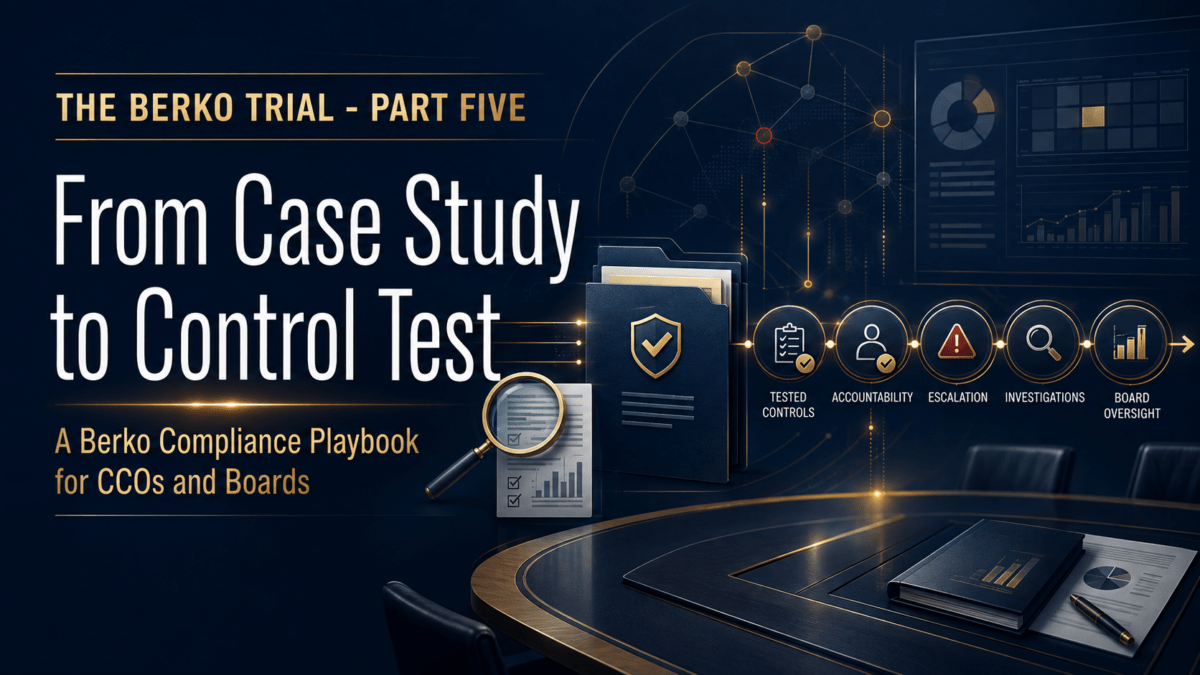
THE BERKO TRIAL – PART FIVE: From Case Study to Control Test: A Berko Compliance Playbook for CCOs and Boards

Today we conclude our 5-part deep dive into the Asante Berko trial and guilty verdict by using the trial as a not simply a case study but as a mechanism to pressure test your compliance regime.

A compliance program is not effective because the company eventually exits a troubled transaction. It is effective when leaders can show how quickly the system identified the risk, who had authority to act, whether related conduct was contained, what the investigation established, and how the organization changed afterward.

That is the governance test presented by the Berko trial. Prosecutors built their case from emails, payment patterns, personal communications, compliance questions, recorded statements, and financial evidence. The defense attacked the missing last mile. The jury convicted Asante Berko on all three counts submitted to it in just over three hours.  For CCOs and boards, the final lesson is not to retry the case. It is to determine whether their own program could identify the same pattern, develop reliable facts, impose accountability, and respond at the speed enforcement policy now demands.

Start With the Three Questions That Matter

The DOJ Evaluation of Corporate Compliance Programs (ECCP) organizes program effectiveness around three questions. (1) Is the program well designed? (2) Is it applied earnestly and in good faith, with adequate resources and authority? (3) Does it work in practice?  Those questions should frame the board’s review of the Berko fact pattern.

A written third-party policy answers the first question only in part. The second asks whether compliance can pause a revenue-producing transaction, obtain records, challenge senior employees, and reach the board without management filtering. The third asks for outcomes: when the warning signs appeared, did the organization find them, act on them, preserve the evidence, and fix the control weakness?

The governance failure is often not the absence of a rule. It is the gap between ownership and authority. Management owns business conduct and risk decisions. The CCO advises, challenges, monitors, and escalates. Internal audit provides independent assurance. The board oversees the system and management’s response. If every party assumes another function owns the hard decision, the control exists on paper but fails in operation.

Align Incentives, Conflicts, and Consequences

High-risk transactions require a clear view of personal incentives. Employees should disclose and pre-clear outside interests, referral compensation, client-paid benefits, expected success fees, and post-employment opportunities connected to current transactions. Offboarding should preserve relevant data, review pending payments, close access, identify continuing client contacts, and obtain certifications concerning outside interests and retained information.

Compensation deserves the same scrutiny as third-party payments. A bonus plan that rewards closing without measuring risk quality invites employees to treat compliance as a cost of delay. Risk-adjusted incentives should account for diligence completion, control compliance, escalation quality, and the durability of the business outcome. The ECCP asks whether companies use incentives for ethical conduct and apply discipline consistently across seniority, geography, and business unit. It also asks whether compensation can be deferred, reduced, canceled, or recouped when misconduct is established, subject to applicable law.

Consequence management must reach more than the direct actor. A credible process examines supervisory failure, tolerated red flags, obstruction, and failure to install or use safeguards. It applies the same decision framework to rainmakers and junior employees. The board should receive trend information showing investigation cycle times, substantiation rates, disciplinary consistency, repeat issues, and whether managers were held accountable for control failures.

Build Investigation and Speak-Up Readiness

The defense’s attack on the Berko evidence offers an investigation lesson. A source may have motives. A recording may require translation. Emails may lack a witness who can explain context. Payments may be traceable to an intermediary but not to an ultimate recipient. Those are reasons to investigate carefully, not reasons to dismiss an allegation.

Separate source credibility from objective proof. Preserve native emails, attachments, metadata, messaging records, payment instructions, approval histories, and device data. Trace funds beyond the first recipient. Document translation choices, dialect issues, investigative prompting, and competing interpretations. Interview witnesses who can explain both the transaction and the communications. Record what was established, what remained disputed, and why each conclusion was reached.

The process must be designed before the crisis. Define triage criteria, independence, privilege, preservation, scope approval, board escalation, investigation timing, root-cause analysis, and remediation ownership. Provide reporting channels that employees and third parties know, trust, and can use without retaliation. DOJ treats a trusted reporting mechanism and timely, properly scoped, objective, and documented investigations as hallmarks of an effective program.

Prepare the Disclosure Decision Before the Clock Starts

Voluntary disclosure should not be improvised during a board emergency. The company needs a protocol identifying the decision owners, the role of counsel, the facts required, the preservation steps, the escalation path, and the method for assessing seriousness, pervasiveness, seniority, ongoing harm, and potential collateral consequences.

The March 2026 Department-wide Corporate Enforcement and Voluntary Self-Disclosure Policy (VSD) makes speed commercially significant. It provides a declination path when a company voluntarily self-discloses to the appropriate DOJ component, fully cooperates, timely and appropriately remediates, and lacks disqualifying aggravating circumstances, although prosecutorial discretion and the policy’s definitions still control. The policy also contains an exception for a whistleblower who reports both internally and to DOJ. A company may remain eligible if it reports as soon as reasonably practicable, no later than 120 days after the internal report, and satisfies the other requirements.

That is not a 120-day permission slip to wait. The operating standard is speed with discipline. The company must stop continuing harm, preserve evidence, protect privilege, develop facts, and keep decision-makers informed. A tabletop exercise should test whether the organization can do all five while the disclosure window is running.

Give the Board Evidence, Not Activity Counts

Boards do not need every hotline allegation or third-party file. They need a risk-based view of whether the system works. Reporting should cover high-risk transactions proceeding with incomplete diligence, unresolved politically exposed person relationships, payment holds, management overrides, aged investigations, remediation slippage, repeat control failures, off-channel communication exceptions, and risk acceptances by senior leaders.

Metrics should show speed, quality, and outcomes. Track time from red flag to triage, triage to transaction pause, allegation to investigation plan, finding to discipline, and remediation commitment to validated closure. Measure whether the company can match high-risk payments to legitimate services, verified beneficial owners, approved accounts, and evidence of performance. Show whether control testing changed behavior, not simply whether employees completed training.

The CCO should have regular direct access to the board or responsible committee, including private sessions when appropriate. The board should understand the CCO’s authority, resources, data access, and unresolved requests. DOJ asks what information directors examined, whether compliance concerns stopped or changed transactions, and whether compliance has the stature and autonomy to function effectively.

Run a 30/60/90-Day Berko Stress Test

Days 1 to 30: Replay one recent high-risk public-sector transaction against the Berko pattern. Inventory intermediaries, beneficial owners, politically exposed person relationships, success fees, conflicts, personal-email exceptions, cash exposure, payment destinations, incomplete diligence, and overrides. Identify which facts the current systems can retrieve and which depend on manual reconstruction.

Days 31 to 60: Close the most important design gaps. Add hard stops, fee benchmarking, conflict attestations, off-channel controls, evidence-preservation rules, payment analytics, investigation protocols, and an escalation matrix giving compliance documented pause authority. Assign one accountable owner and a deadline to each remediation item.

Days 61 to 90: Test the program. Sample transactions, trace selected payments end to end, test the hotline from intake through closure, and conduct an investigation and voluntary-disclosure tabletop. Present the results to senior management and the board, including accepted risks, overdue actions, resource needs, and evidence that completed remediation operates in practice.

The board should ask: Which Berko warning signs would we detect today? How quickly could we freeze a payment? Who may override compliance, and what evidence is required? Can investigators collect personal-device communications lawfully and preserve multilingual evidence? Which repeated control failures have affected compensation or promotion?

The CCO should ask one final question: Would our program find this pattern because the controls work, or only because an external source eventually brings it to us?

This Berko FCPA trial blog post series began with the prosecution’s evidentiary mosaic and the defense’s missing-last-mile challenge. It ends with a practical conclusion. Compliance evidence becomes trial evidence. A defensible program must create that evidence through authority, trusted reporting, disciplined investigations, consistent accountability, measurable remediation, and active board oversight. That is how a case study becomes a control test, and how a control test becomes proof that the program works.

Resources

United States v. Berko, No. 1:20-cr-00328-DG, Indictment, ECF No. 3 (E.D.N.Y. filed Aug. 26, 2020)

Stewart Bishop, “Goldman Jury Sees Cash Talk in Energy Deal Email Deluge,” Law360, Aug. 1, 2026; Stewart Bishop, “Goldman Exec Was Linchpin to Ghana Bribery Ploy, Jury Told,” Law360, Aug. 5, 2026.

Stewart Bishop, “Ex-Goldman Exec Convicted of Ghana Bribery Plot,” Law360, Aug. 6, 2026. Supplied trial reporting.

U.S. Attorney’s Office for the Eastern District of New York, “Former Goldman Sachs Investment Banker Convicted of Foreign Bribery and Money Laundering,” Aug. 6, 2026, DOJ Press Release.

Stewart Bishop, “Goldman Jury Sees Undercover Video as Bribe Trial Nears End,” Law360, Aug. 4, 2026. Supplied trial reporting.

Stewart Bishop, “Shady Power Deal Used in Goldman Compliance Prep, Jury Told,” Law360, July 29, 2026

Stewart Bishop, “Like Milli Vanilli, Goldman FCPA Case Is a Ruse, Jury Told,” Law360, July 28, 2026.

SEC Final Judgment against Asante Berko

SEC Complaint against Asante Berko

DOJ Evaluation of Corporate Compliance Programs

DOJ Corporate Enforcement and Voluntary Self-Disclosure Policy