Categories
Innovation in Compliance

Innovation in Compliance: From Banking to AI: Tim Khamzin on Transforming Compliance

Innovation comes in many areas, and compliance professionals need not only to be ready for it but also to embrace it. Join Tom Fox, the Voice of Compliance, as he visits with top innovative minds, thinkers, and creators in the award-winning Innovation in Compliance podcast. In this episode, host Tom Fox welcomes Tim Khamzin, Founder & CEO of Vivox AI, to discuss building explainable, trusted AI agents for financial crime compliance teams.

Tim describes his background in banking operations automation, including large-scale digital transformation and the development of compliance products, and explains how large language models since 2023–2024 enable the automation of unstructured compliance work without extensive model training. He outlines key challenges in AML/KYC operations—15% of bank headcount tied to compliance, heavy manual repetitive investigations across multiple systems, and cultural resistance to adopting technology.

Tim emphasizes “explainability” through consistent, repeatable investigations with audit logs and screenshots that mirror human workflows, and “trust” through transparency, compliant vendor choices, and clear communication of limitations. Tim introduces Vivox compliance analyst, “Rachel,” a platform of collaborating agents that supports onboarding, customer due diligence, and false-positive reduction, improved via structured human feedback (thumbs up/down) to learn firm-specific standards.
He explains how Vivox stays aligned with evolving regulations by engaging with bodies such as the UK FCA and tracking frameworks such as the EU AI Act and Singapore guidance, with a focus on auditability and explainability. Tim predicts most compliance work will shift to AI agents, with humans handling complex cases and a new role of “compliance engineer” emerging to configure and evaluate agents, alongside industry consolidation and operating-system-style vendor platforms.

Key highlights:

  • From Banking Automation to Founding Vivox AI: The Opportunity in LLMs
  • What’s Broken Today: Manual Investigations, Backlogs, and Culture Gaps
  • Explainable + Trusted AI: Audit Trails, Screenshots, and Transparency
  • Regulators’ Top AI Concerns: Black Box, Bias, and 99% Accuracy
  • Inside ‘Rachel’: The AI Compliance Analyst & Human-in-the-Loop Feedback
  • The Future: Compliance Engineers, Agent “Operating Systems,” and Consolidation

Resources:

Tim Khamzin on LinkedIn

Vivox AI

Innovation in Compliance was recently honored as the Number 4 podcast in Risk Management by 1,000,000 Podcasts.

Categories
Daily Compliance News

Daily Compliance News: February 24, 2026, The $1.7bn from Binance to China Edition

Welcome to the Daily Compliance News. Each day, Tom Fox, the Voice of Compliance, brings you compliance-related stories to start your day. Sit back, enjoy a cup of morning coffee, and listen in to the Daily Compliance News. All, from the Compliance Podcast Network. Each day, we consider four stories from the business world, compliance, ethics, risk management, leadership, or general interest for the compliance professional.

Top stories include:

  • Binance sent $1.7bn in crypto to Iran. (NYT)
  • Anthropic accuses China of hacking Claude. (WSJ)
  • ECB fines Agricole. (Bloomberg)
  • Jail time for fraud in the global aviation supply chain. (FT)
Categories
The PfBCon Podcast

The PfBCon Podcast: Unlocking the Power of Podcast Networks with John Largent

In this episode of the PfBCon Podcast, John Largent, Founder and CEO of Largent Media, dives deep into the world of podcast networks.

John discusses the advantages of joining a network, how to elevate your podcast’s reach, and the importance of consistency and collaboration within networks. John also touches on potential challenges, including meeting benchmarks and maintaining quality standards. With practical examples and insights from his extensive experience, this episode is a must-listen for anyone looking to take their podcast to the next level.

Key highlights:

  • Understanding Podcast Networks
  • The Power of Joining a Network
  • Monetization and Cross-Promotional Power
  • Discovery Advantage and Real-Life Examples
  • What Networks Look for in Podcasters
  • Consistency and Engagement in Networks
  • Challenges and Considerations in Joining a Network

Resources:

Follow John Largent on:

Instagram

LinkedIn

Visit Largent Media on:

Website

Facebook

YouTube

LinkedIn

Categories
AI Today in 5

AI Today in 5: February 23, 2026, The Bold But Balanced Edition

Welcome to AI Today in 5, the newest addition to the Compliance Podcast Network. Each day, Tom Fox will bring you 5 stories about AI to start your day. Sit back, enjoy a cup of morning coffee, and listen in to the AI Today In 5. All, from the Compliance Podcast Network. Each day, we consider five stories from the business world, compliance, ethics, risk management, leadership, or general interest about AI.

Top AI stories include:

  1. How AI is transforming compliance in 2026. (FinTechGlobal)
  2. Asian banks are struggling to integrate AI into their compliance systems. (AsianBanking&Finance)
  3. A bold but balanced AI revolution. (CIO)
  4. Safely navigating chatbots and healthcare PII. (News-Medical)
  5. What is shaping AI governance? (ISEAS)

For more information on the use of AI in Compliance programs, my new book, Upping Your Game, is available. You can purchase a copy of the book on Amazon.com.

Categories
Daily Compliance News

Daily Compliance News: February 23, 2026, The Compensation from Cuba Edition

Welcome to the Daily Compliance News. Each day, Tom Fox, the Voice of Compliance, brings you compliance-related stories to start your day. Sit back, enjoy a cup of morning coffee, and listen in to the Daily Compliance News. All, from the Compliance Podcast Network. Each day, we consider four stories from the business world, compliance, ethics, risk management, leadership, or general interest for the compliance professional.

Top stories include:

  • Sweden’s FSA to investigate Swedbank for AML violations. (Reuters)
  • Trump tells Netflix to fire BOD member. (NYT)
  • Hunting the Shadow Fleet. (WSJ)
  • SCt to review if Cuba owes Exxon compensation. (Reuters)
Categories
Blog

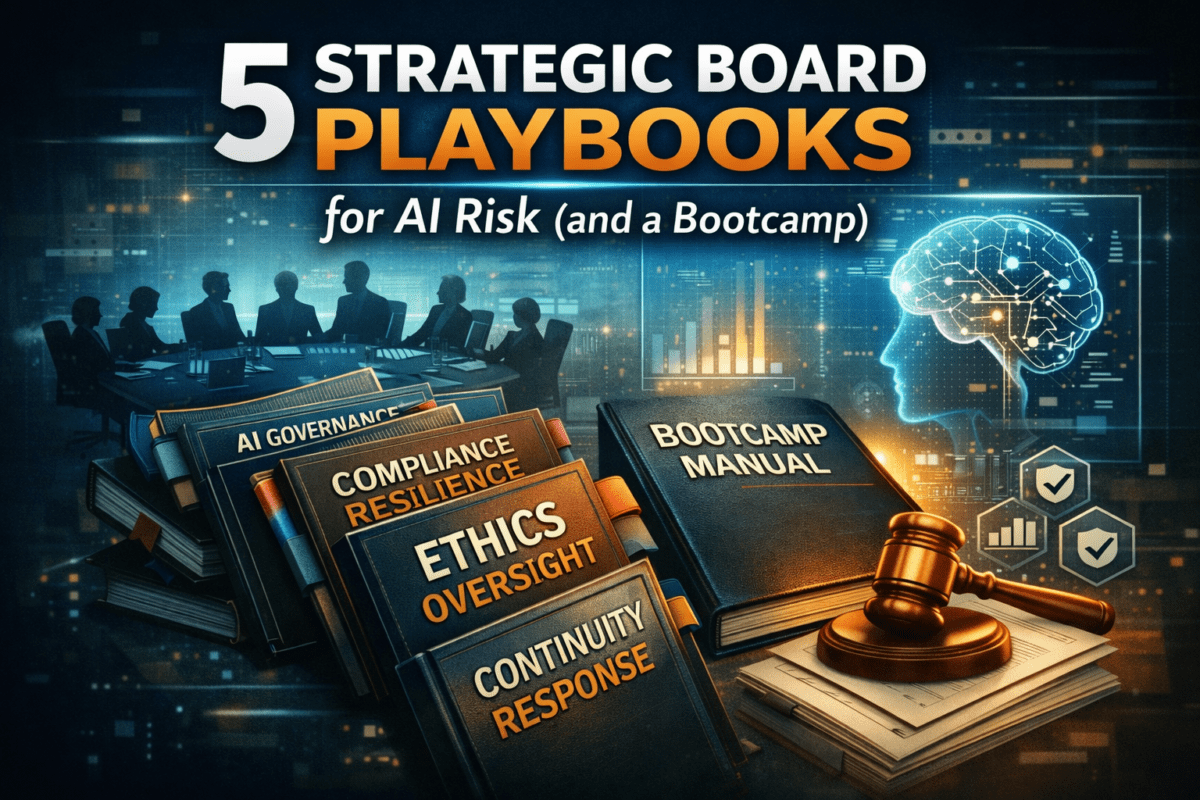
5 Strategic Board Playbooks for AI Risk (and a Bootcamp)

Artificial intelligence is no longer a future-state technology risk. It is a current-state governance issue. If AI is being deployed inside governance, risk, and compliance functions, then it is already shaping how your company detects misconduct, prioritizes investigations, manages regulatory obligations, and measures program effectiveness. That makes AI risk a board agenda item, not a management footnote.

In an innovation-forward organization, the goal is not to slow AI adoption. The goal is to professionalize it. Board of Directors and Chief Compliance Officers (CCOs) should approach AI the way they approached cybersecurity a decade ago: move it from “interesting updates” to a structured reporting cadence with measurable controls, clear accountability, and director education that raises the collective literacy of the room.

Today, we consider 5 strategic playbooks designed for a Board of Directors and a CCO operating in an industry-agnostic environment, building AI in-house, without a model registry yet, and with a cross-functional AI governance committee chaired and owned by Compliance. The program must also work across multiple regulatory regimes, including the DOJ Evaluation of Corporate Compliance Programs (ECCP), the EU AI Act, and a growing patchwork of state laws. We end with a proposal for a Board of Directors Boot Camp on their responsibilities to oversee AI in their organization.

Playbook 1: Put AI Risk on the Calendar, Not on the Wish List

If AI risk is always “important,” it becomes perpetually postponed. The first play is procedural: create a standing quarterly agenda item with a consistent structure.

Quarterly board agenda structure (20–30 minutes):

  1. What changed since last quarter? Items such as new use cases, material model changes, new regulations, and major control exceptions.
  2. AI full Risk Dashboard, with 8–10 board KPIs, trends, and thresholds.
  3. Top risks and mitigations, including three headline risks with actions, owners, and dates.
  4. Assurance and testing, which would include internal audit coverage, red-teaming results, and remediation progress.
  5. Decisions required include policy approvals, risk appetite adjustments, and resourcing.

This cadence does two things. First, it forces repeatability. Second, it creates institutional memory. Boards govern better when they can compare quarter-over-quarter progress, not when they receive one-off deep dives that cannot be benchmarked.

Playbook 2: Build the AI Governance Operating Model Around Compliance Ownership

In your design, Compliance owns AI governance and its use throughout the organization, supported by a cross-functional AI governance committee. That is a strong model, but only if it is explicit about responsibilities.

Three lines of accountability:

  • Compliance (Owner): policy, risk framework, controls, training, and board reporting.
  • AI Governance Committee (Integrator): cross-functional prioritization, approvals, escalation, and issue resolution.
  • Build Teams (Operators): documentation, testing, change control, and implementation evidence.

Boards should ask one simple question each quarter: Who is accountable for AI governance, and how do we know it is working? If the answer is “everyone,” then the real answer is “no one.” Your model makes the answer clear: Compliance owns it, and the committee operationalizes it.

Playbook 3: Create the AI Registry Before You Argue About Controls

You have no model registry yet. That is the first operational gap to close, because you cannot govern what you cannot inventory. In a GRC context, this is not a “nice to have.” Without an inventory, you cannot prove coverage, you cannot scope an audit, you cannot define reporting, and you cannot explain to regulators how you know where AI is influencing decisions.

Minimum viable AI registry fields (start simple):

  • Use case name and business owner;
  • Purpose and decision impact (advisory vs. automated);
  • Data sources and data sensitivity classification;
  • Model type and version, with change log;
  • Key risks (bias, privacy, explainability, security, reliability);
  • Controls mapped to the risk (testing, monitoring, approvals);
  • Deployment status (pilot, production, retired); and
  • Incident history and open issues.

Boards do not need the registry details. They need the coverage metric and the assurance that the registry is complete enough to support governance.

Playbook 4: Align to the ECCP, EU AI Act, and State Laws Without Creating a Paper Program

Many organizations make a predictable mistake: they respond to multiple frameworks by producing multiple binders. That creates activity, not effectiveness. A better approach is to use a single control architecture to map to multiple requirements. The board should see one integrated story:

  • DOJ ECCP lens: effectiveness, testing, continuous improvement, accountability, and resourcing;
  • EU AI Act lens: risk classification, transparency, human oversight, quality management, and post-market monitoring; and
  • State law lens: privacy, consumer protection concepts, discrimination prohibitions, and notice requirements where applicable

This mapping becomes powerful when it ties back to the board dashboard. The board is not there to read statutes. The board is there to govern outcomes.

Playbook 5: Use a Board Dashboard That Measures Coverage, Control Health, and Outcomes

You asked for a combined dashboard and narrative with 8–10 KPIs. Here is a board-level set designed for AI in governance, risk, and compliance functions, with in-house build, internal audit, and red teaming for assurance.

Board AI Governance KPIs (8–10)

1. AI Inventory Coverage Rate

Percentage of AI use cases captured in the registry versus estimated footprint.

2. Risk Classification Completion Rate

Percentage of registered use cases risk-classified (EU AI Act style tiers or internal tiers).

3. Pre-Deployment Review Pass Rate

Percentage of deployments that cleared required testing and approvals on first submission.

4. Model Change Control Compliance

Percentage of model changes executed with documented approvals, testing evidence, and rollback plans.

5. Explainability and Documentation Score

Percentage of in-scope use cases with complete documentation, rationale, and user guidance.

6. Monitoring Coverage

Percentage of production use cases with active monitoring for drift, anomalies, and performance degradation.

7. Issue Closure Velocity

Median days to close AI governance issues, by severity.

8. Internal Audit Coverage and Findings Trend

Number of audits completed, rating distribution, repeat findings, and remediation status.

9. Red Team Findings and Remediation Rate

Number of material vulnerabilities identified and percentage remediated within the target time.

10. Escalations and Incident Rate

Number of AI-related incidents or escalations (including near-misses), with severity and lessons learned.

These KPIs do not require vendor controls and align with an in-house build model. They also support both board oversight and compliance management.

AI Director Boot Camp

Your board has a medium level of literacy and needs a boot camp. I agree. Directors do not need to become engineers. They need a common vocabulary and a governance frame. The recommended boot camp design is one-half day, making it highly practical. It should include the following.

  1. AI in the company’s operating model. This means where it touches decisions, risk, and compliance outcomes.
  2. AI risk taxonomy, such as bias, privacy, security, explainability, reliability, third-party, and later.
  3. Regulatory landscape overview, including a variety of laws and regulatory approaches, including the DOJ ECCP approach to effectiveness, the EU AI Act risk framing, and several state law themes approaches.
  4. Governance model walkthrough to ensure the BOD understands the registry, risk classification, controls, monitoring, and escalation.
  5. Tabletop exercises, such as an AI incident in a GRC context with false negatives in monitoring or biased triage.
  6. Board oversight duties. Teach the BOD how they can meet their obligations, including which questions to ask quarterly, which thresholds trigger escalation, and similar insights.

The deliverable from the boot camp should be a one-page “Director AI Oversight Guide” with the KPIs, escalation triggers, and the quarterly agenda structure.

The Bottom Line for Boards and CCOs

This is the moment to treat AI risk like a board-governed discipline. The organizations that get it right will not be the ones with the longest AI policy. They will be the ones with the clearest operating model, the most reliable reporting cadence, and the strongest evidence of control effectiveness.

If Compliance owns AI governance, then Compliance must also own the proof. That proof is delivered through a registry, a quarterly board agenda item, a balanced KPI dashboard, and assurance through internal audit and red teaming. Add a director boot camp to create shared understanding, and you have the beginnings of a program that is innovation-forward and regulator-ready.

That is the strategic playbook: not fear, not hype, but governance.

Categories
Sunday Book Review

Sunday Book Review: February 22, 2026, The Top Books on Catastrophic Failure Edition

In the Sunday Book Review, Tom Fox considers books that would interest compliance professionals, business executives, or anyone curious. It could be books about business, compliance, history, leadership, current events, or anything else that might interest Tom. In this episode, we look at 4 top books on catastrophic failures and the lessons they teach.

  1. Catastrophe by Richard Posner
  2. Catastrophic Thinking by Ben Shapiro
  3. The Wisdom of Failure by Laurence G. Weinzimmer and Jim McConoughey
  4. Averting Catastrophe by Cass Sunstein
Categories
Daily Compliance News

Daily Compliance News: February 20, 2026, The Andrew Arrested Edition

Welcome to the Daily Compliance News. Each day, Tom Fox, the Voice of Compliance, brings you compliance-related stories to start your day. Sit back, enjoy a cup of morning coffee, and listen in to the Daily Compliance News. All, from the Compliance Podcast Network. Each day, we consider four stories from the business world, compliance, ethics, risk management, leadership, or general interest for the compliance professional.

Top stories include:

  • The Sony Hack and the consequences of a bad decision. (WSJ)
  • (Former Prince) Andrew’s arrest over alleged Epstein corruption. (NYT)
  • Legal rates hit $3400 per hour. (WSJ)
  • Former Corsa Coal exec, Hunter Hobson, found guilty of FCPA violation. (USAHerald)
Categories
Fox on Podcasting

Fox on Podcasting – Auditing Media Assets for Compliance with Dr. Yolanda Nollie

Join Tom Fox as he explores the world of podcasting and get ready to be inspired to start your own podcast. In this episode, Tom is joined by Dr. Yolanda Nollie, a US Navy veteran and media governance auditor, about applying audit and compliance concepts to audio, visual, and IP assets in media and creative businesses.

Dr. Nollie describes auditing both creators and investors, producing detailed data-driven reports that are transferred confidentially and encrypted, and using audits to help protect IP, support funding decisions, and prevent unfunded liabilities. She explains that audits can be light or in-depth and result in pass/fail findings without “closing down” a business. Ley outlines key concepts such as “shadow IT of media” (risk created by unmanaged asset creation and transfer), IP sovereignty and chain-of-title rigor, “copyright inoculation” at the point of creation, operational drift, decision rights mapping for fiduciary clarity and asset clearance authority, and a hybrid internal/external audit model.

Dr. Nollie addresses AI governance risks posed by employees using generative AI on personal devices, advocating embedded technical guardrails and customized “blueprinting” rather than a gatekeeper compliance model, and explains her assessment-to-report-to-remediation approach for identifying and addressing control gaps. They also cover bridging conversations between legal/compliance and creative teams to maintain speed while making outputs audit-ready, and Dr. Nollie shares her background in arts, journalism, media production, podcasting, and documentary work.


Resources:

Dr. Yolanda Nollie on LinkedIn

Clarity for Creatives Website 

Artwork

Elaine Capers

Art by Elaine

Tom

Instagram

Facebook

YouTube

Twitter

LinkedIn

Categories
AI Today in 5

AI Today in 5: February 20, 2026, The Spinx Raises Edition

Welcome to AI Today in 5, the newest addition to the Compliance Podcast Network. Each day, Tom Fox will bring you 5 stories about AI to start your day. Sit back, enjoy a cup of morning coffee, and listen in to the AI Today In 5. All, from the Compliance Podcast Network. Each day, we consider five stories from the business world, compliance, ethics, risk management, leadership, or general interest about AI.

Top AI stories include:

  1. AI compliance demands grow. (PlanAdviser)
  2. Compliance Monitoring: what works, what backfires. (UCToday)
  3. New AI governance tool. (PRNewsWire)
  4. The Spinx raises funds for new AI compliance agents. (FinTechGlobal)
  5. Boys will always be…just boys. (CNBC)

For more information on the use of AI in Compliance programs, my new book, Upping Your Game, is available. You can purchase a copy of the book on Amazon.com.